



Houston home improvement SEO is the work of getting a contractor's website and Google Business Profile to appear when homeowners in Houston and its suburbs search for a service. The core steps are a complete service-area profile, one page per service and area, a steady flow of recent reviews, visible license details, LocalBusiness schema, and call and form tracking.
Key Takeaways
- Google ranks local results mainly on relevance, distance and prominence, and says more reviews and positive ratings can help local ranking.
- 97% of consumers read reviews for local businesses, and 74% only care about reviews from the last three months (BrightLocal, 2026).
- Metro Houston added 126,720 residents between July 2024 and July 2025, the largest gain of any US metro (US Census Bureau estimates).
- National remodeling spending growth is slowing to 0.5% by mid-2027 (Harvard JCHS), so contractors will compete harder for each job.
- Service-area businesses should hide their address in Google Business Profile and can list up to 20 service areas.
Most homeowners who need a roofer, plumber, remodeler or AC technician start with a search on Google or a map app. The contractors who appear in the map results and the first organic listings get the calls; the rest compete on price or pay for every lead.
The guide below explains how local search works for home improvement businesses in Houston and its suburbs, from Katy and Sugar Land to The Woodlands and Pearland, and gives a practical plan you can run in-house or with an agency.
What Is Home Improvement SEO?
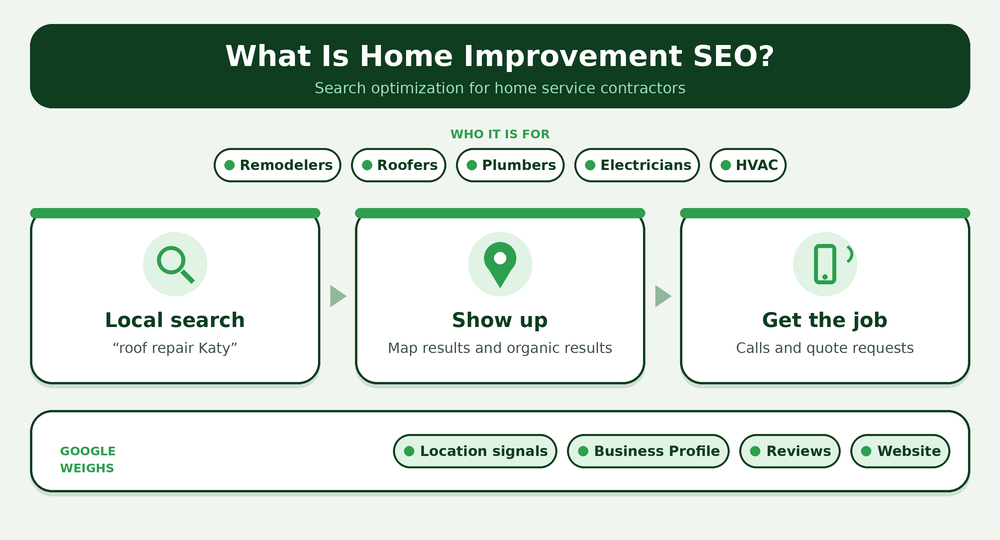 Local SEO is the part that matters most. Home service buyers want someone who serves their area, so Google weighs location signals, your Business Profile and your reviews alongside your website. Our guides to what local SEO is and local SEO vs national SEO cover the basics in more depth.
Houston Home Improvement SEO by the Numbers (2026)
The figures below show why local search visibility and reviews carry so much weight for Houston contractors in 2026. They come from BrightLocal's 2026 consumer review survey, US Census Bureau population estimates, Harvard's remodeling forecast and Google's own help pages. Use them to plan priorities, not as forecasts for your business.
|
Statistic |
What it means for contractors |
Source |
|---|---|---|
|
97% of consumers read reviews for local businesses |
Your review profile is part of your sales pitch |
|
|
74% only care about reviews written in the last three months |
A steady flow of new reviews beats a large old total |
|
|
85% are more likely to use a business after reading positive reviews; negative reviews deter 77% |
Reply to reviews and fix the issues behind complaints |
|
|
Metro Houston grew by 126,720 people from July 2024 to July 2025, the largest numeric gain of any US metro |
New households in new suburbs search for contractors they do not know yet |
|
|
US home improvement and repair spending is projected at $519 billion through mid-2027, with growth slowing to 0.5% |
A flatter market means more competition for each project |
|
|
Google Business Profile allows up to 20 service areas, within about 2 hours of driving time |
Pick the suburbs you serve; do not list the whole state |
|
|
Google ended the Google Guarantee money-back program for services booked after December 7, 2025, and moved to a single Google Verified badge |
Update any marketing copy that still promises the guarantee |
Why Local SEO Matters in the Houston Market?
Houston is a large, spread-out metro where homeowners search by suburb and neighborhood, not only by city. A contractor based in Spring may want jobs in The Woodlands and Cypress, while a Pearland remodeler targets Friendswood and Clear Lake. Local SEO lets you show up in the specific areas you serve.
-
Population growth brings new buyers. Fast-growing suburbs add homeowners every year who have no existing contractor relationships and rely on search to find one.
-
Competition is local and crowded. Search results for Houston home service terms are crowded with agencies and directory listings, so a contractor needs a sharp focus on its own services and suburbs.
-
Urgent jobs convert fast. Repairs such as a failed AC unit, a roof leak or a burst pipe are often booked from the first trusted result that answers the phone.
-
Licensing builds trust. In Texas, the TDLR licenses air conditioning contractors and electricians, and the Texas State Board of Plumbing Examiners licenses plumbers. Showing a valid license number on your site and profile answers a buyer's first question.
If you serve near-urgent demand, read our guide to near me searches and consumer behavior.
How Google Ranks Local Contractors?
Google says local results are based mainly on relevance, distance and prominence. Relevance is how well your profile matches the search, distance is how far you are from the searcher or the area named, and prominence is how well known and well reviewed your business is across the web.
|
Factor |
What Google looks at |
What a Houston contractor can do |
|---|---|---|
|
Relevance |
How well your profile and site match the search |
Pick the right primary category, list every service, and build one page per service |
|
Distance |
How close your business or service area is to the searcher |
Set accurate service areas and build pages for the suburbs you serve |
|
Prominence |
Reviews, ratings, links and mentions across the web |
Request reviews after every job, reply to all of them, and earn local links |
Google also states there is no way to request or pay for a better local ranking. See our breakdowns of local SEO ranking factors and how Google decides the local pack.
The 8-Step Houston Local SEO Plan
The plan below covers the steps that move rankings and calls for most home improvement contractors. Start with your Google Business Profile and service pages, since they affect both map and organic results, then build reviews, trust signals and tracking. Review progress monthly and adjust by service line and area.
Step 1: Set up Google Business Profile as a service-area business
-
If you work at customers' homes and do not serve customers at your address, hide the address, as Google's guidelines require for service-area businesses.
-
Add up to 20 service areas by city or ZIP code, such as Katy, Sugar Land and Cypress, within about 2 hours of driving time.
-
Use your real business name only; Google does not permit extra keywords or locations in the name, and a virtual office is not eligible.
-
Choose the most accurate primary category, add every service, and upload real project photos.
Step 2: Build one page per service and per key area
-
Create a page for each main service, such as roof replacement, bathroom remodeling or AC repair.
-
Add area pages only for suburbs you serve, with local project examples, not copied text with a new city name.
-
Link each area page to the related service pages and to your contact page.
Step 3: Research keywords by trade and neighborhood
-
Map searches that combine a service, a place and an intent, such as "roof repair Pearland" or "kitchen remodeling cost Houston."
-
Use your call logs and form submissions to find the words customers actually use.
-
See how to find keywords for local SEO for a step-by-step method.
Step 4: Build a review system, not a review push
-
Ask every customer for a review when the job is done, with a direct link to your Google profile.
-
Reply to every review, positive or negative, within a few days.
-
Aim for a steady flow; most consumers only weigh reviews from the last three months.
-
Read our guide to online reviews and local SEO.
Step 5: Keep your business details consistent and show trust signals
-
Use the same business name, phone number and service areas on your site, profile and directory listings.
-
Show license numbers for licensed trades, plus insurance and warranty details you actually offer.
-
Earn links from local suppliers, trade associations and community sponsorships.
Step 6: Add LocalBusiness schema
-
Mark up your business with the most specific schema.org type. HomeAndConstructionBusiness includes Electrician, GeneralContractor, HVACBusiness, HousePainter, Locksmith, MovingCompany, Plumber and RoofingContractor.
-
Include name, address (if public), phone, URL and opening hours, matching your profile exactly.
Step 7: Publish content that answers buyer questions
-
Answer the questions homeowners ask before hiring: cost factors, timelines, permits, materials and maintenance.
-
Write clear, direct answers with a short summary at the top, which also helps your content appear in AI search answers.
-
Show completed Houston-area projects with photos and a short description of the work.
Step 8: Track calls, forms and bookings
-
Set up call tracking and form tracking so you know which pages and areas produce jobs.
-
Use UTM tags on your Google Business Profile website link to separate profile traffic from organic search.
-
Compare local SEO reporting tools to pick one that fits your budget.
For a broader walkthrough, see how to do local SEO and Google Business Profile optimization.

Local Services Ads vs Local SEO
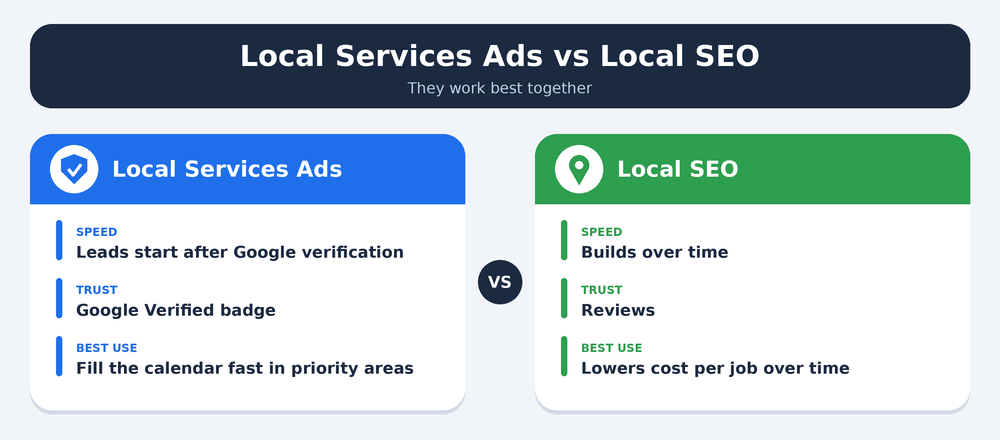
Local Services Ads and local SEO work best together. Local Services Ads cover many home service categories and charge only for leads related to your services, while local SEO builds rankings you do not pay for per click. Ads bring leads quickly; SEO lowers your cost per job over time.
|
Factor |
Local Services Ads |
Local SEO |
|---|---|---|
|
How you pay |
Per lead related to your services |
Time and content investment; no cost per click |
|
Speed |
Leads can start once you pass Google's verification |
Builds over months |
|
Eligible categories |
Listed home services such as roofers, plumbers, HVAC, electricians, general contractors and kitchen and bathroom remodeling |
Any service you offer |
|
Trust badge |
Google Verified badge after screening |
Reviews, licenses and project proof on your profile and site |
|
Best use |
Fill the calendar fast in priority areas |
Lower long-term cost per job across all services |
Centric performance marketing team can run paid search and Local Services Ads alongside SEO, and our PPC competitor analysis guide shows how to size up local rivals.
Turning Local Searches Into Booked Jobs
Ranking only pays off when visitors call or request a quote. Contractor websites lose leads when the phone number is hard to find, the quote form is long, or trust signals are missing. A few changes to your service pages can lift the share of visitors who become booked jobs, without buying more traffic.
-
Make calling easy. Put a click-to-call number at the top of every page on mobile.
-
Shorten the quote form. Ask only for name, phone, ZIP code and the service needed.
-
Place proof near the button. Show recent reviews, license numbers and project photos beside each call to action.
-
Say what happens next. Tell visitors when you will call back and how quotes work.
-
Load fast on phones. Compress images and remove heavy scripts; see mobile-first landing page design.
Our landing page CRO audit guide covers the full review, and Centric landing page design services build pages made to convert.
Proof: local SEO for a business where customers book within minutes
For Big Tex Storage, a self-storage operator whose customers convert soon after searching "storage near me," Centric combined local authority signals (including the Google Business Profile), FAQ-driven content with schema markup and a shorter path from search to booking. Over the six-month campaign, total conversions (calls and online bookings) rose by over 125%, online reservations by over 200%, and Google impressions by over 140%. Read the Big Tex Storage SEO case study.
Get More Customers From Local Search
How to Measure Local SEO Results?
Measure local SEO by the jobs it produces, not only by rankings. Track calls, quote requests and bookings by service and area, along with profile actions and review growth. Review the numbers monthly so you can shift effort toward the services and suburbs that bring the most profitable work.
|
Metric |
Where to find it |
Why it matters |
|---|---|---|
|
Calls and quote requests |
Call tracking and GA4 key events |
The closest measure of new jobs |
|
Profile calls, direction requests and website clicks |
Google Business Profile performance |
Shows map visibility turning into action |
|
Map and organic rankings by area |
Local rank tracking tool |
Shows which suburbs need more work |
|
New reviews per month and average rating |
Google Business Profile |
Tracks prominence and recency |
|
Organic clicks to service pages |
Google Search Console |
Shows which services are gaining demand |
|
Cost per booked job by channel |
CRM or job management software |
Compares SEO with ads and referrals |
Common Mistakes
Most local SEO problems for contractors come from shortcuts: keyword-stuffed business names, fake addresses, thin city pages, bursts of reviews followed by silence, and no tracking. Each one can cost rankings or even a suspended profile. The table lists each mistake, why it hurts and what to do instead.
|
Mistake |
Why it hurts |
What to do instead |
|---|---|---|
|
Adding keywords or cities to the business name |
Google may suspend the profile |
Use your real business name only |
|
Listing a virtual office or mailbox address |
Not eligible for a Business Profile |
Set up as a service-area business |
|
Copy-paste city pages |
Thin pages that rarely rank or convert |
Build area pages with real local projects |
|
Asking for reviews once a year |
Old reviews carry little weight with buyers |
Request reviews after every job |
|
Hiding license details |
Buyers cannot confirm you are qualified |
Show license numbers on site and profile |
|
Still promoting the Google Guarantee |
The money-back program has ended |
Update copy to the Google Verified badge |
|
No call or form tracking |
No way to see which pages bring jobs |
Track calls, forms and bookings |
Houston Contractor Local SEO Checklist
Use this checklist to audit your current setup or plan a new one. It covers your Google Business Profile, website pages, reviews, trust signals, schema and tracking, which together decide whether Houston homeowners find you, trust you and call you. Work through it once, then review it every quarter.
-
Google Business Profile verified, with the address hidden if you serve customers at their homes.
-
Correct primary category and every service listed.
-
Up to 20 accurate service areas set.
-
One page per main service on your website.
-
Area pages only for suburbs you serve, with local project proof.
-
Review request sent after every job, and every review answered.
-
Business name, phone and service areas consistent everywhere.
-
License numbers shown for licensed trades.
-
LocalBusiness schema using the most specific type.
-
Click-to-call and a short quote form on every service page.
-
Call, form and booking tracking running.
-
Marketing copy updated for the Google Verified badge.
Frequently Asked Questions
What is home improvement SEO?
Home improvement SEO is search engine optimization for remodelers, roofers, plumbers, electricians, HVAC companies and other home service contractors. It helps your Google Business Profile and website appear when homeowners search for your services in your area, and turns those searches into calls and quote requests.
How long does local SEO take for a Houston contractor?
No one can promise a timeline, because results depend on your competition, your starting point and how many services and suburbs you target. Profile fixes are quick to make, while service pages, reviews and local links build over months. Track calls, quote requests and bookings monthly to see real progress.
Should a contractor show an address on Google Business Profile?
Only if customers visit you there. Google's guidelines say service-area businesses should hide their address, and a virtual office or mailbox is not eligible for a profile. Set service areas instead, using up to 20 cities or ZIP codes within about 2 hours of driving time.
How many reviews does a home improvement company need?
No fixed number guarantees rankings, but Google says more reviews and positive ratings can help local ranking. BrightLocal's 2026 survey found 74% of consumers only care about reviews from the last three months, so a steady flow after every job matters more than a one-time push.
Are Local Services Ads better than SEO for contractors?
Neither replaces the other. Local Services Ads charge per lead and can bring calls quickly once you pass Google's verification. Local SEO takes longer but builds rankings you do not pay for per click. Many contractors run ads in priority areas while SEO lowers their long-term cost per job.
Does the Google Guarantee still exist?
Google discontinued the money-back guarantee tied to the Google Guarantee badge for services booked after December 7, 2025, and is moving advertisers to a single Google Verified badge. Contractors should remove guarantee promises from their websites and ads and describe the Google Verified badge instead.
Which schema type should a Houston contractor use?
Use the most specific schema.org type for your trade. HomeAndConstructionBusiness covers Electrician, GeneralContractor, HVACBusiness, HousePainter, Locksmith, MovingCompany, Plumber and RoofingContractor. Include your name, phone, URL and opening hours, and keep every detail identical to your Google Business Profile so search engines see one consistent business.
Final Thoughts
Houston's growth keeps adding homeowners who need contractors, but a slower remodeling market means every job is contested. The contractors who win set up an accurate service-area profile, build real service and area pages, earn recent reviews, show their licenses, and track which pages bring booked jobs. Start with the checklist and review it every quarter. Centric provides local SEO services, including Google Business Profile optimization, service and location page development, and review and citation management, alongside technical SEO and reporting. With an office in Houston, its team works within the local market this guide covers.