



The most practical uses of AI in oil and gas today are predictive maintenance, production and pipeline anomaly detection, forecasting, safety monitoring with computer vision, document assistants for engineers, and cleaning up material and vendor data. Each one depends on data the company already has (sensor history, maintenance records, documents and master data) being connected and trustworthy first.
The interest is not in doubt. In Bain's 2026 survey of 859 energy and natural resources executives, 68% expected AI to have a substantial or transformative effect on business performance over the next five to ten years, yet fewer than 20% said their companies were scaling AI with measurable impact. Nearly half named the same obstacle: outcomes that are unclear or not tied to business value, with talent shortages and data availability and governance close behind.
The potential prize is large. McKinsey estimates that AI could unlock about $65 billion a year in upstream oil and gas in the near term with today's technology, with a credible path to $230 billion, and that the top ten use cases drive nearly half of that value.
So the useful question isn't whether AI matters. It's which use case to start with, what data it needs, and how to prove its return before the next one gets funded. This guide works through ten use cases across the value chain with exactly those answers.
AI Across the Oil and Gas Value Chain
AI is not limited to one part of an oil and gas business. Upstream, it predicts failures in artificial lift and compressors, flags production anomalies, and helps engineers search well files faster. Midstream and downstream, it spots pipeline and compressor anomalies, forecasts throughput and fuel demand, and keeps refinery and terminal equipment running.
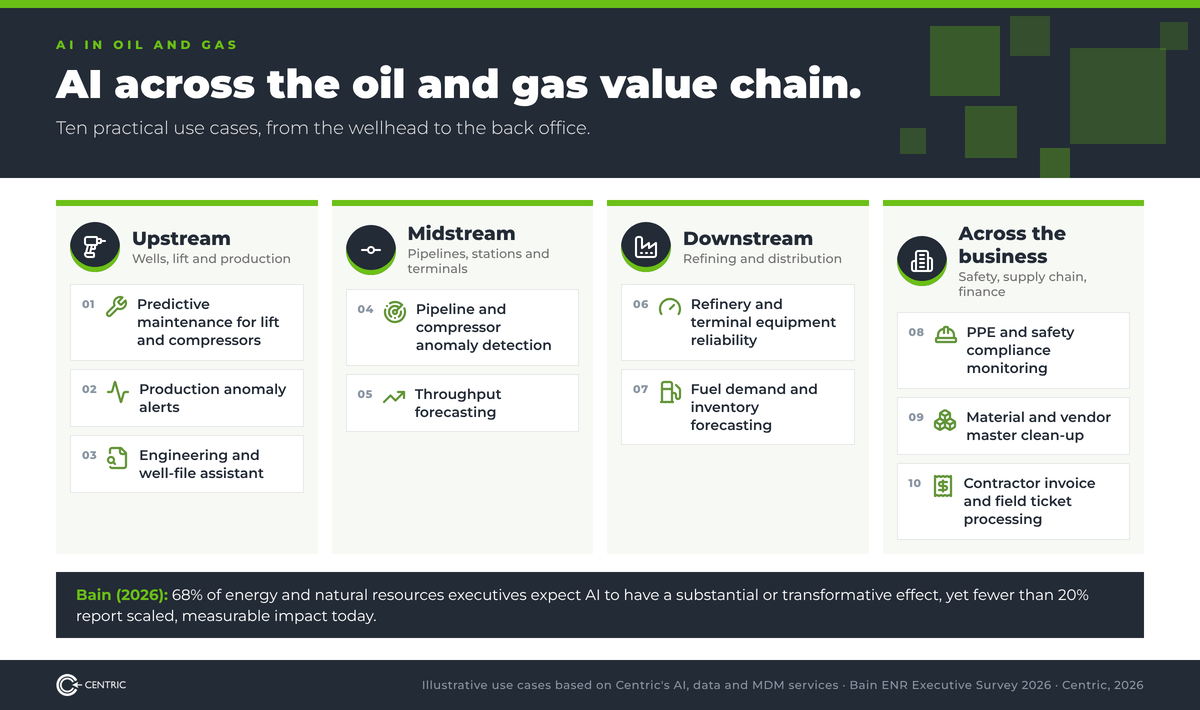
Across the business, it monitors PPE and safety compliance, cleans up material and vendor master data, and speeds up contractor invoice and field ticket processing.
Upstream: Wells, Lift and Production
Upstream is where McKinsey's value estimate focuses, and where much of the useful data already exists: sensor history from wells and equipment, production records, and decades of well files.
1. Predictive Maintenance for Artificial Lift and Compressors
- What the AI does: learns the patterns that come before a failure (rising vibration, temperature drift, changes in motor load) and warns crews days or weeks ahead, so a pump or compressor is serviced before it stops.
- Data it needs: high-frequency sensor data from SCADA and historians, plus work orders and failure history from the maintenance system.
- The usual data gap: failures are recorded inconsistently, so the model can't tell which patterns led to which outcome; tag names differ between sites.
- How to measure return: unplanned downtime hours, deferred production, and emergency callouts per asset, against the year before.
- Illustrative example: an operator starts with the electric submersible pumps on its most productive field, where each failure means days of deferred production, and expands to compressors once the alerts prove reliable.
- How Centric helps: our predictive and decision AI team builds custom models that optimize maintenance schedules and flag anomalies before they disrupt operations, and our MDM practice fixes the asset records the model depends on.
This is also where the industry reports results. In an IBM Institute for Business Value survey, oil and gas executives reported a 27% improvement in production uptime, for example through AI-based predictive maintenance, and a 26% improvement in asset utilization. These are survey responses, not audited results, but they show where executives see value first.
2. Production Anomaly Alerts
- What the AI does: compares each well's behavior with what's expected and ranks the wells drifting furthest, so engineers review the right ten wells instead of all of them.
- Data it needs: production volumes, well tests and pressures.
- The usual data gap: gaps and allocation errors in production data that hide real changes.
- How to measure return: engineer hours per review cycle; deferred production found earlier.
- Illustrative example: a production team replaces a weekly spreadsheet review with a ranked list each morning, and spends the saved time on the wells that need intervention.
- How Centric helps: our predictive AI team builds the models, and our Microsoft Fabric and BI and reporting teams bring the production data together and put the alerts in front of engineers.
3. Engineering and Well-File Assistant
- What the AI does: answers questions over well files, completion reports, procedures and lessons learned, citing the source document for every answer.
- Data it needs: documents in SharePoint and file shares, with their permissions.
- The usual data gap: scanned PDFs, duplicate versions and unclear access rights.
- How to measure return: time to find an answer; repeat questions to senior engineers.
- Illustrative example: a newly hired engineer asks how a well was completed and which issues came up, and gets the answer with links to the reports, instead of waiting for a colleague.
- How Centric helps: our generative AI and knowledge systems team builds assistants grounded in your approved documents, and our SharePoint document management consultants clean up and permission the content first.
Have Years of Sensor And Maintenance Data And No Clear First Model?
Centric data scientists build predictive models for maintenance, anomalies and forecasting on the data you already have, as an ISO/IEC 27001:2022 certified team.
Talk To A Data Scientist!Midstream: Pipelines, Stations and Terminals
Midstream assets run continuously over long distances, so the value of AI here is earlier warning and better planning.
4. Pipeline and Compressor Station Anomaly Detection
- What the AI does: watches pressure, flow, temperature and vibration together and flags unusual behavior earlier than fixed alarm limits, which only trigger once a single value crosses a line.
- Data it needs: SCADA telemetry and maintenance history.
- The usual data gap: operational (OT) networks are deliberately kept apart from business (IT) networks for security, so data access and latency have to be designed, not assumed.
- How to measure return: issues caught before an alarm; false-alarm rate; time from alert to action.
- Illustrative example: a pipeline operator runs the model alongside existing alarms for three months, compares what each caught, then decides where the model earns a place in the control room workflow.
- How Centric helps: our predictive AI team builds the detection models, and Centric's AI deployment work runs models at the edge for field and industrial sites, where decisions can't wait for a round trip to the cloud.
5. Throughput Forecasting
- What the AI does: forecasts volumes by line, station or terminal for the weeks ahead, so scheduling and maintenance windows are planned around real demand.
- Data it needs: historical throughput and schedules.
- The usual data gap: short or inconsistent history after system changes.
- How to measure return: forecast error compared with today's method.
- Illustrative example: a terminal team compares a model's forecast with its current spreadsheet forecast for a quarter before switching.
- How Centric helps: our predictive and decision AI team builds forecasting models for demand, operations and resource planning.
Downstream: Refining and Distribution
Downstream combines heavy equipment with tight margins and logistics, so reliability and forecasting lead.
6. Refinery and Terminal Equipment Reliability
- What the AI does: combines sensor trends with inspection findings to rank which equipment needs attention first.
- Data it needs: historian data, plus inspection records and photos.
- The usual data gap: inspection findings stored as free text or images that no system reads.
- How to measure return: unplanned downtime; inspection hours; repeat failures.
- Illustrative example: a terminal uses computer vision to read inspection photos for corrosion and damage, then feeds the findings into the same priority list as the sensor alerts.
- How Centric helps: our predictive AI team builds the reliability models, and our computer vision and video analytics team handles visual inspection from images and video.
7. Fuel Distribution Demand and Inventory Forecasting
- What the AI does: forecasts demand by site so inventory and delivery schedules match it.
- Data it needs: sales and inventory history; delivery schedules.
- The usual data gap: site data held in separate systems.
- How to measure return: stockouts; inventory days; last-minute delivery changes.
- Illustrative example: a distributor forecasts demand for its busiest sites first, and extends to the rest once the forecast beats the current method.
- How Centric helps: our predictive AI and BI and reporting teams build the forecasts and put them in the dashboards planners already use.
Across the Business: Safety, Supply Chain and Finance
Several useful use cases sit outside operations, in work every oil and gas company does: keeping people safe, buying materials and paying contractors.
8. PPE and Safety Compliance Monitoring
- What the AI does: detects missing hard hats, vests or harnesses and people in restricted zones on existing cameras, and alerts supervisors in real time.
- Data it needs: camera feeds and the site's safety rules.
- The usual data gap: camera coverage, lighting, and privacy and consent policies that must be settled before any monitoring starts.
- How to measure return: violations detected and corrected; time from detection to response.
- Illustrative example: a fabrication yard starts with two high-risk zones, agrees with HSE and workers how alerts are used, then extends coverage.
- How Centric helps: our computer vision and video analytics team covers PPE compliance monitoring and edge-based deployments built for industrial and regulated environments.

9. Material and Vendor Master Clean-Up
- What the AI does: suggests duplicate materials and vendors and standardizes descriptions, for data stewards to approve.
- Data it needs: ERP material and vendor masters.
- The usual data gap: the same part or supplier entered several times across business units, with different descriptions.
- How to measure return: duplicates removed; spend visible by category; fewer purchase orders blocked by bad master data.
- Illustrative example: a procurement team cleans its top spend categories first, so the next sourcing event works from one list of parts and suppliers.
- How Centric helps: our MDM practice manages vendor, material and asset data for energy companies; see MDM for oil and gas.
10. Contractor Invoice and Field Ticket Processing
- What the AI does: extracts the data from contractor invoices and field tickets, matches it to purchase orders and service entries, posts the clean ones and routes exceptions with the reason.
- Data it needs: the documents, purchase orders and the vendor master.
- The usual data gap: handwritten or scanned field tickets, and vendor records that don't match.
- How to measure return: straight-through rate; cycle time from receipt to approval; exceptions by reason.
- Illustrative example: an operator starts with its highest-volume service contractors, where tickets follow a consistent format, before taking on the rest.
- How Centric helps: our intelligent automation and AI workflows team builds document processing with approvals and audit trails.
The Data Foundations Every Use Case Shares
Plan for the data work first: in each use case above, the data gap is the first thing to close, by getting the right data out of the field, connected and trusted.
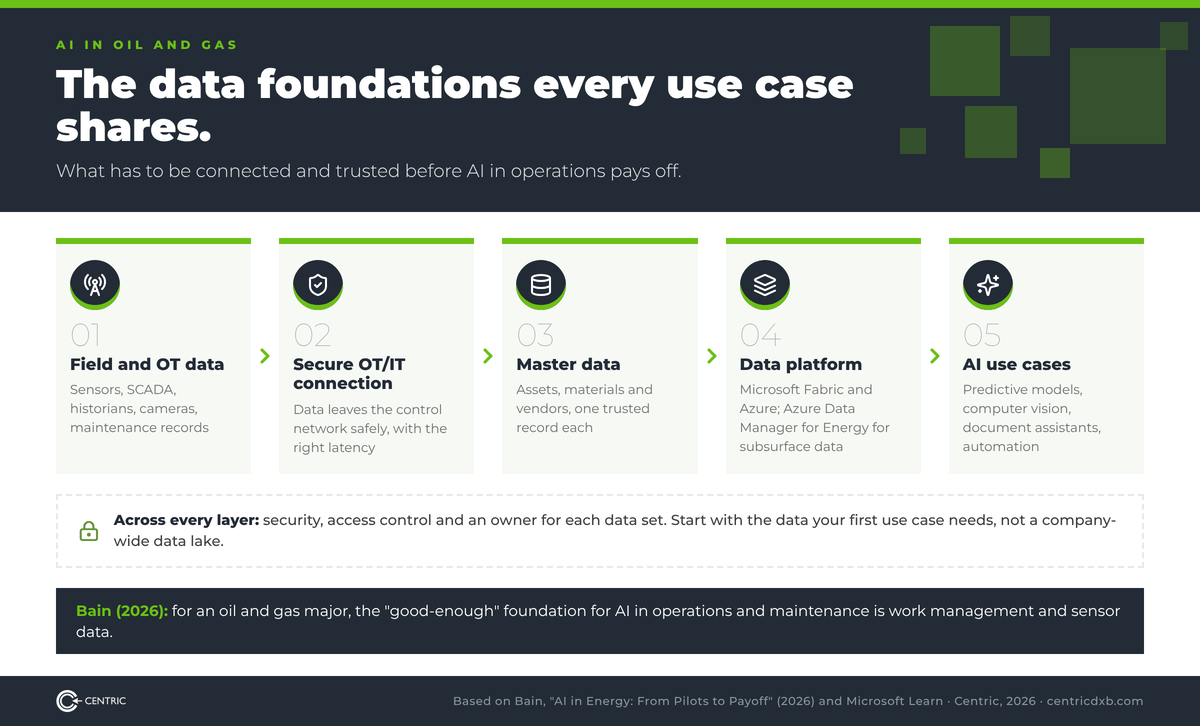
Bain makes the same point: for an oil and gas major, the foundation that matters first for AI in operations and maintenance is work management and sensor data, not a company-wide data program.
- Field and OT data. Sensors, SCADA systems, historians, cameras and maintenance records hold most of what operational AI needs. Start by listing which of them your first use case depends on.
- A secure OT/IT connection. Control networks are separated from business networks for good reason. Design how data leaves them (what, how often, through which controls) with your OT security team before any model is built. BRG's 2026 AI in Energy report lists cybersecurity risk, data availability and a lack of skilled talent among the challenges energy companies face.
- Master data. Assets, materials and vendors need one trusted record each; otherwise every model inherits the duplicates. Centric's view on this is in MDM for oil and gas.
- A data platform. Microsoft Fabric and Azure bring operational and business data together for analytics and AI; for subsurface and wells data, Azure Data Manager for Energy is Microsoft's fully managed platform built on the OSDU standard.
- AI use cases. Only then do predictive models, computer vision, document assistants and automation have something reliable to work with.
Across all five: security, access control and a named owner for each data set. For a fuller checklist of what "ready" means for each kind of AI, see our guide to AI-ready data [Editor: link once that article is published].
How to Estimate ROI Before You Build
Don't fund an AI use case on a vendor's percentage. Estimate the return in your own units first, then let your finance team put a value on each unit.
- Pick one measure the use case moves, such as unplanned downtime days, failures, inspection hours or invoice cycle time.
- Record the baseline for the last 12 months.
- Estimate the change the use case could make, and be conservative.
- Ask finance for the value of one unit, such as a day of deferred production or an hour of engineering time.
- Subtract the effort: data work, building, running and the people who act on the output.
- Agree the evidence the pilot must produce before the next stage is funded.
Worked example (illustrative): a field has 40 electric submersible pumps and recorded 12 unplanned failures last year, each costing about three days of deferred production: 36 days in total. If a model gives a week's warning for half of those failures and crews act on it, about six failures become planned interventions, and roughly 18 days of deferred production are avoided. Finance multiplies 18 by the value of a production day for that field; the team sets that against the effort above. The pilot's job is to show whether the warnings actually arrive, and whether crews trust them enough to act.
Choosing Your First Use Case
Score each candidate from 1 to 5 on five questions, and start with the highest total:
- Business value: does a senior leader ask about it every week, and can the result be counted in hours, events or volumes?
- Data readiness: does the data exist, connected and trusted?
- OT access: can the data leave the control network safely, with acceptable latency?
- Low safety risk: is a wrong recommendation caught by a person before anything changes on site?
- An owner: is an operations owner named, with time to act on the results?
A use case that scores high on value but low on data readiness isn't a bad idea; it's a second use case, after the data work the first one starts.
How Centric Approaches AI in Energy
Centric is headquartered in Houston and works with energy companies across Texas, the US and worldwide. Our AI work follows the same steps as this guide:
- Rank the use cases. An engagement can start with a 2 to 5 day discovery workshop with your business and technology stakeholders, where we rank use cases by business value and risk and agree which one to build first.
- Approve one stage at a time. The output is a phased roadmap, so leadership sees the business case before each investment.
- Fix the data the first use case needs. Our MDM, data engineering and Microsoft Fabric teams connect and clean the data, starting narrow.
- Build and run, not just advise. We connect AI to your ERP and other systems with access controls and audit, and deploy at the edge where field sites need real-time decisions.
- Choose models on merit. We work with OpenAI, Anthropic, Google and Microsoft models, and hold ISO/IEC 27001 certification.
Not Sure Where to Start With AI?
Centric helps you identify and prioritize AI use cases based on business value, feasibility and risk through a focused 2–5 day discovery workshop. We turn the findings into a phased roadmap that gives leadership a clear path forward, one stage at a time.
Book Your AI Strategy Session!Frequently Asked Questions
What are the main uses of AI in oil and gas?
Predictive maintenance for lift equipment and compressors; production and pipeline anomaly detection; throughput and demand forecasting; refinery and terminal reliability; safety monitoring with computer vision; document assistants for engineers; and back-office work such as material and vendor master data and contractor invoice processing.
How does AI improve safety on site?
Computer vision on existing cameras can detect missing PPE or people in restricted zones and alert supervisors in real time, and predictive maintenance reduces the emergency repairs that put crews at risk. Agree privacy and consent rules with HSE and workers before monitoring starts.
What data do we need before starting AI?
The data the first use case depends on, not everything. For predictive maintenance that's sensor history and consistent failure records; for document assistants, current and correctly permissioned documents; for procurement, clean material and vendor masters. Plan how operational data leaves the control network securely.
How do we measure the ROI of AI in oil and gas?
Pick one measure the use case moves (downtime days, failures, inspection hours, invoice cycle time), record a 12-month baseline, estimate a conservative change, and ask finance for the value of one unit. Subtract the effort to build and run it, and agree what the pilot must prove before the next stage is funded.
Where should a mid-sized operator start?
With one use case that scores well on value, data readiness, OT access, safety risk and ownership, for example predictive maintenance on the equipment whose failures cost the most production. Fix the data that one use case needs, prove the result, then reuse that data for the next.
Final Thoughts
Treat AI in oil and gas as a series of focused bets rather than a single program: one use case, the data it needs, a measure everyone agrees on, and an owner who acts on the results. Each success leaves behind cleaner data and a team that knows how to run the next one.