



Plenty of B2B websites grow organic traffic every quarter while the sales team still sees almost none of it as pipeline. SEO for lead generation closes that gap. You target the searches made by people who have a problem you solve, and every ranking page gives them a clear next step that is tracked into your CRM. Traffic is only the means, not the goal.
This guide covers:
- What counts as a lead and why search works as a lead channel
- A 7-step framework with a keyword-to-intent map
- How to measure leads instead of sessions
- What AI Overviews change
- SEO vs PPC, and how to choose an approach and a partner
- What it costs and what to expect when you start
What Is SEO Lead Generation?
SEO lead generation means ranking pages for searches made by people with a problem your business solves, then turning those visits into contacts you can follow up. Those contacts include demo, quote or audit requests, calls and form fills. Traffic is the visit. The lead is the visitor who raises a hand.
On a B2B site, count these as leads:
- Demo requests
- Consultation or quote requests
- Audit requests
- Phone calls
- Content downloads that include a qualifying field, such as company size or role
Newsletter signups are a weaker signal. Track them, but report them separately so they don't inflate your lead numbers.
Two terms matter from here on. A marketing-qualified lead (MQL) fits your customer profile and has shown interest. A sales-qualified lead (SQL) has been reviewed by sales and accepted as a real opportunity. Judge SEO on SQLs and pipeline, not raw form fills, because a form fill from a student or a competitor looks identical in a dashboard.
Search is one inbound channel among several, and it helps to see how lead generation works across channels. Organic lead generation has one advantage over paid campaigns: a ranking page keeps working after you stop publishing.
Improve Your Online Visibility!
Does SEO Generate Leads, or Just Traffic?
Yes, if you target searches with buying intent and give each page a way to convert. Search reaches people who are already looking for a solution, so organic leads are usually warmer than cold outreach. Expect months, not weeks, before leads arrive steadily, and returns that build as pages gain rankings.
The reason is simple. The searcher typed their problem into Google, so you are answering a question they asked rather than interrupting them. That is also why SEO matters for B2B buyers, who usually research on their own before they speak to a vendor.
Lead generation SEO fails for three predictable reasons:
- The keywords are awareness-only
- The pages carry no offer
- Nobody tracks which page produced which lead
Once pages rank, they keep producing leads without a per-click cost, which is why the returns compound. There is one honest limit. If nobody searches for what you sell yet, SEO cannot create that demand quickly.
From Search to Lead: How the SEO Funnel Works
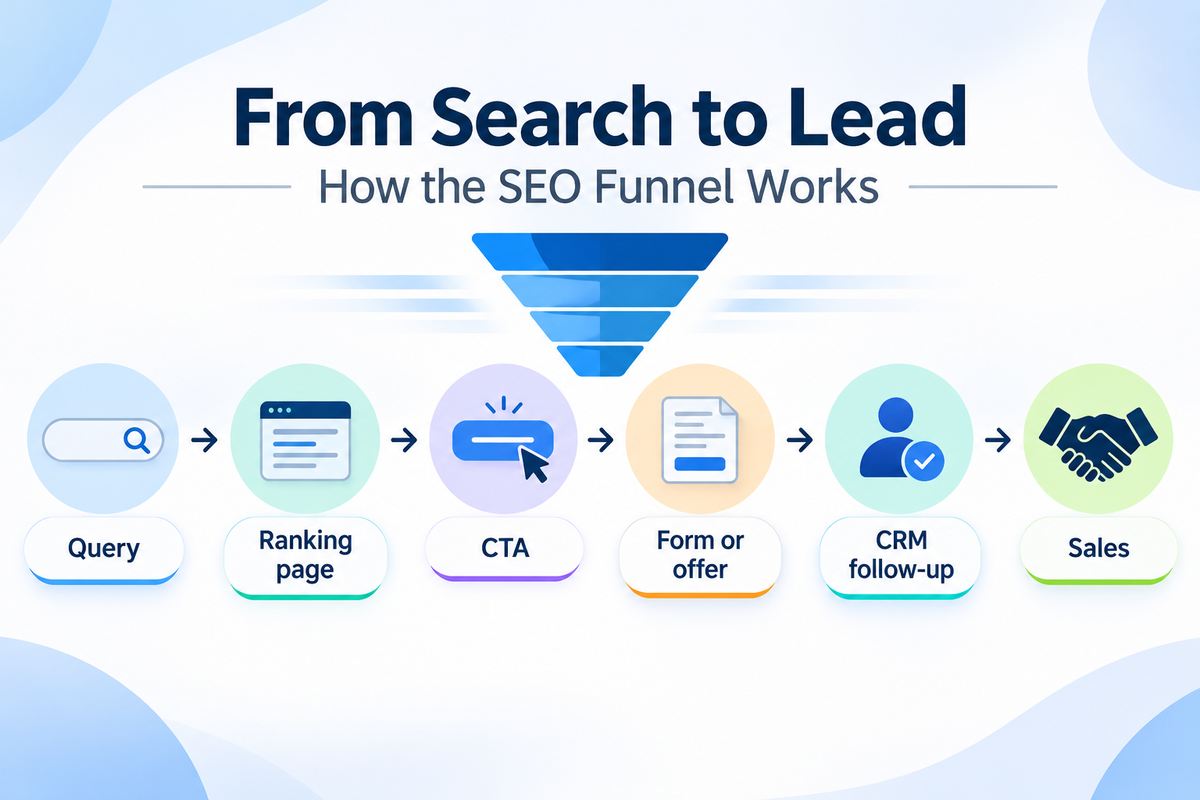
A search becomes a lead through six steps. Each one can leak.
- Query: what the buyer types, and the intent behind it.
- Ranking page: the page type that matches that intent.
- CTA: an offer that fits the reader's stage. "Contact us" should not appear on every page.
- Form or offer: a short form, audit, consultation, calculator or downloadable asset.
- CRM follow-up: the lead is captured with its organic source and landing page, then routed and answered quickly.
- Sales: MQL → SQL → opportunity → closed deal, with the outcome reported back to SEO.
Most leaks in an SEO funnel happen at steps 3 to 5, not at ranking. That is why the seven steps below give conversion and tracking the same weight as rankings.
How to Use SEO for Lead Generation: 7 Steps
These seven steps are the order we'd run them for a B2B site that already has some traffic. If your site is brand new, steps 1 to 4 come first, and step 5 runs alongside them for months.
1. Choose Keywords by Lead Intent, Not Volume
The first decision in how to generate leads with SEO is which searches to chase. Group keywords by what the searcher is ready to do: learn, compare, or buy and hire. Lead quality usually rises as search volume falls.
Bring the sales team in early. The questions prospects ask on calls are keywords, and they are often missing from keyword tools.
The table below maps each keyword type to the right page and offer. It uses one example business throughout: a B2B managed IT services firm.
|
Keyword type |
Example query |
What the searcher wants |
Page type |
Best CTA |
Lead quality |
|
Awareness |
"what is managed IT" |
To understand the topic |
Explainer blog post |
Related guide, newsletter |
Low |
|
Problem |
"how to reduce IT downtime" |
To fix a pain |
How-to guide |
Checklist or assessment offer |
Low-medium |
|
Comparison |
"managed IT vs in-house IT" |
To choose an approach |
Comparison post |
Cost calculator, consultation |
Medium-high |
|
Shortlist |
"best managed IT for law firms" |
To pick vendors |
Industry or use-case page |
Case study + consultation |
High |
|
Bottom of funnel |
"managed IT services pricing", "managed IT services Dallas" |
To buy or hire |
Service, pricing or location page |
Quote, call, audit |
Highest |
These ratings are directional and come from practice. Once tracking is live (step 6), confirm them with your own CRM data.
2. Build the Page Type the Searcher Expects
Search the query and look at what Google already ranks: guides, comparison posts or service pages. Build that format. Bottom-of-funnel terms need service, pricing or industry pages.
A common mistake is trying to rank a blog post for "X pricing" when the whole first page is service pages. Google has already told you what searchers want for that query.
3. Give Every Page a Conversion Path
- Give each page one primary CTA, matched to its stage in the table.
- Keep forms short. Ask only what sales needs to qualify the lead.
- On BOFU pages, put the offer above the fold. On guides, place it mid-article and again at the end.
- Use a thank-you page that says what happens next and how quickly.
An audit offer is a good example of a low-friction BOFU offer. It gives the buyer something useful before asking for a sales call.
4. Fix the Technical Basics That Block Rankings and Forms
Check four things:
- Important pages are crawlable and indexable
- Mobile pages load fast and stay stable while loading
- Forms work on mobile and fire their tracking event
- No key page is blocked or orphaned with no internal links pointing to it
A broken form on mobile costs you leads even if every page ranks well.
5. Earn Authority in Your Niche
Build topical depth: a cluster of pages around each service, with internal links from guides to the money pages. Earn links and mentions from industry publications, partners and associations, and use white-hat methods only.
One correction is worth making. Domain authority and domain rating are third-party metrics from SEO tools. They are not scores Google uses.
6. Track Leads Back to the Page That Produced Them
Mark form submissions and calls as GA4 key events. Pass the organic source and landing page into hidden CRM fields so each lead record shows where it came from. The next section covers measurement in more detail.
7. Improve What Already Ranks
Run a monthly loop:
- Pages with impressions but no leads get CTA and offer fixes.
- Pages ranking at positions 5 to 15 get content upgrades and stronger internal links.
- Pages that attract the wrong visitors get pruned or merged.
This loop also sets the order of work when budget is tight, which the prioritisation section below covers.
Measure Leads, Not Sessions
Sessions mislead. They rise with awareness traffic that never converts, and they say nothing about lead quality. A report built on sessions can show steady growth while pipeline from search stays flat. Report the SEO metrics worth reporting instead:
- GA4 key events: GA4's name for conversions. Set one up for each form and call type.
- Organic conversion rate: organic leads ÷ organic sessions on pages that carry an offer. Measure your SEO conversion rate per page group, not sitewide. Compare it against your own baseline rather than an industry average.
- Organic MQL → SQL rate: the share of organic leads that sales accepts.
- Pipeline and revenue influenced by organic: taken from the CRM, not from analytics.
Store original source, landing page and first conversion on every contact record. Many B2B organic leads convert on a second or third visit, so last-click reports undercount SEO. With that data in place, you can start setting SEO goals tied to pipeline rather than to rankings.
How AI Overviews Change Organic Lead Capture
The foundations have not changed. According to Google's documentation on AI features in Search, AI Overviews and AI Mode rely on the same SEO foundations: crawlable, indexable content, with no special AI markup or new machine-readable files required. The same page confirms that traffic from AI features is included in overall Search Console reporting. You can't isolate it there, so watch lead trends per page group instead.
To get cited, write answers that are easy to quote: a direct 40 to 60 word answer under each question heading, clear definitions and original specifics. The 40 to 60 word length is our working habit, not a Google rule. Google's May 2025 guidance on succeeding in AI search points to unique, satisfying content as what matters.
For CTAs, the practical shift is this. Simple informational questions often get resolved on the results page. The clicks that remain tend to come from people who want more depth or are evaluating options. Make the next step visible early, and put your strongest offers on comparison and BOFU pages, where AI answers resolve less.
The verdict: SEO is evolving, not dead. Pages that only answer simple definitions lose value, while pages that help a buyer decide gain it.
Common Mistakes That Keep SEO From Producing Leads
The biggest mistake is chasing traffic volume instead of buyer intent and treating forms and tracking as an afterthought. Five more follow close behind:
- A generic "Contact us" CTA on every page. Fix: match the offer to the reader's stage.
- No CRM source tagging. Without it, you can't defend the budget or tell good pages from bad ones. Fix: add source and landing-page fields.
- Reporting rankings and sessions only. Fix: report SQLs and pipeline.
- Publishing new posts while near-page-one pages sit untouched. Fix: work on positions 5 to 15 first.
- Choosing keywords without sales input. Fix: ask the team that hears objections every day. They know the real queries.
Once the keywords reflect buyer intent, the next questions are which channel to use, which SEO approach fits, and who should do the work.
SEO vs PPC for Lead Generation: Which Should Come First?
SEO and paid search solve different problems. The real question is timing and budget, not which one wins.
|
Factor |
SEO |
PPC |
|
Time to first leads |
Months |
Days once campaigns are live |
|
Cost behaviour over time |
Upfront investment; cost per lead tends to fall as pages rank |
Pay per click; cost per lead rises with competition |
|
Lead intent |
High on BOFU and comparison terms; mixed on awareness terms |
High when bidding on BOFU terms |
|
Scalability |
Grows with content and authority |
Grows with budget |
|
Control |
Limited: rankings and AI features change |
High: targeting, copy, budget, schedule |
|
When spend stops |
Rankings and leads continue for a while, then decay without upkeep |
Leads stop almost immediately |
In the SEO vs PPC decision, SEO is the compounding base and PPC bridges the gap. If you have no organic presence and need pipeline this quarter, run PPC on bottom-of-funnel terms and build SEO alongside it. PPC search-term reports also show which queries actually convert, which makes them good input for choosing SEO keywords. If you want the longer version, there is a deeper SEO and PPC comparison.
The decision also depends on how you think about inbound vs outbound lead generation. SEO is inbound: it catches buyers who are already searching. Outbound reaches accounts that are not searching yet. Most B2B teams with long sales cycles need both, and SEO lowers the cost of outbound by giving reps pages worth sending. Here is how inbound and outbound work together.
SEO is a poor first channel for a brand-new product category with no search demand. In that case, outbound, events or paid social have to create the demand first, as covered in a multi-channel B2B lead generation playbook. Content marketing and SEO are not rivals either: content is the asset, and SEO gives it structure and distribution. Neither produces leads without a conversion path.

Which SEO Approach Fits Your Business?
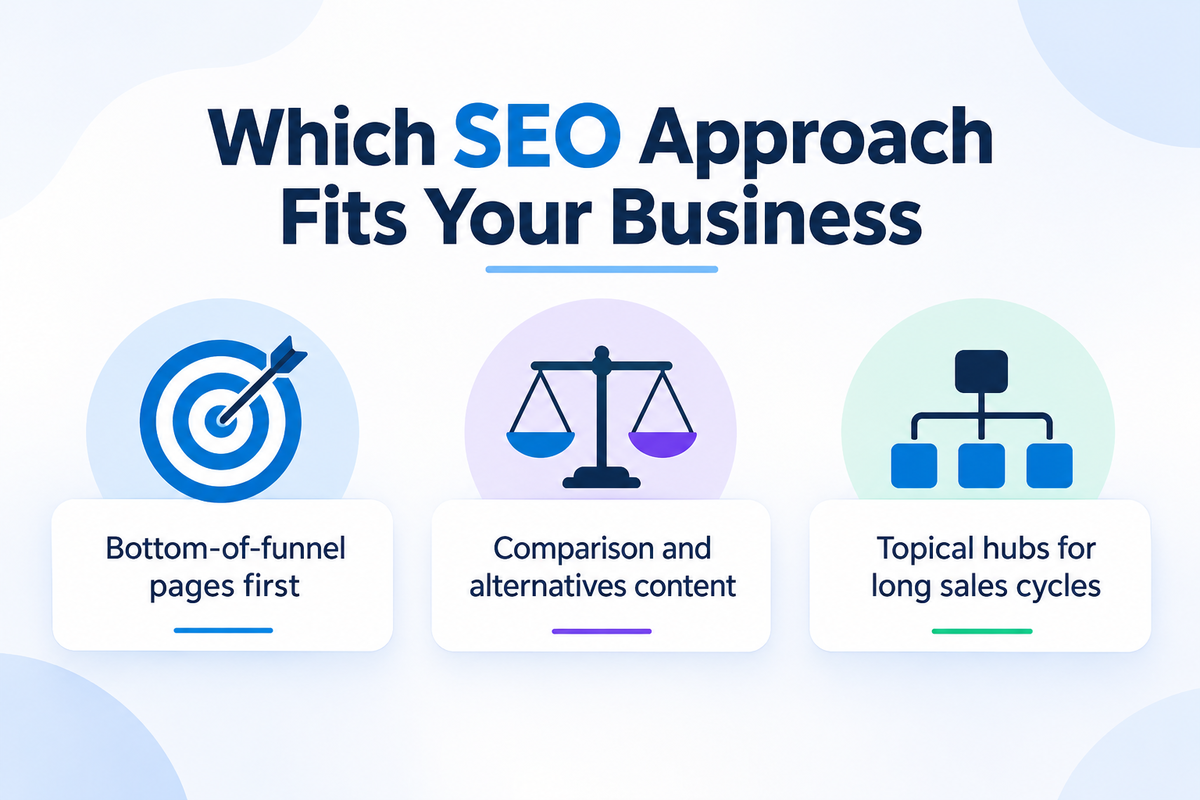
There is no single B2B SEO strategy. The right starting point depends on your sales cycle, deal size and how your buyers research.
1. Bottom-of-funnel pages first (service, industry, pricing and location pages)
- Best for: short sales cycles, lower annual contract value (ACV), service businesses, and categories where buyers know what they need.
- Trade-off: lower search volume and often stiffer competition.
2. Comparison and alternatives content ("X vs Y", "alternatives to X", "best X for [industry]")
- Best for: crowded software or service categories where buyers build vendor shortlists.
- Trade-off: it must be accurate and fair, or it damages trust.
3. Topical hubs for long sales cycles (a pillar page plus clusters around each problem, with assets for each buying-committee role)
- Best for: enterprise deals, high ACV and multiple stakeholders.
- Trade-off: it is the slowest to show leads and needs patient measurement of influenced pipeline.
For SEO for B2B companies, the split usually looks like this: service firms win faster with industry and location service pages, and software firms win with comparison and use-case pages. The execution details are covered in running a B2B SEO campaign end to end.
How to Prioritise Pages and Keywords
With a limited budget, score every page and keyword on five criteria:
- Buyer intent: use the keyword-to-intent table above.
- Existing rankings: start with positions 5 to 15, because they are closest to page one.
- Conversion path: check whether one exists or can be added.
- Keyword difficulty vs your site's authority: both are third-party estimates, not Google scores.
- Sales feedback: ask which topics bring in good deals.
Most B2B SEO best practices skip the last criterion, and it is often the most useful.
Fix and convert the pages you already have before publishing new ones.
Make Your Business More Visible!
Should You Do SEO In-House or Hire an Agency?
An agency brings speed and breadth across technical SEO, content, links and analytics. An in-house team brings product context and control. In-house is the better choice if you already have:
- A content writer
- Someone who can ship technical fixes
- An owner for conversion tracking
A hybrid model is common: your team owns the subject matter, and the agency owns execution and measurement.
If you're working out how to choose an SEO agency, look for one that:
- Reports leads, SQLs and pipeline, not just traffic
- Shows case studies with lead or revenue results
- Explains how it qualifies leads
- Uses white-hat methods only
- Leaves you owning your GA4 and Search Console accounts
- Sets realistic timelines
- Offers references you can call
For a full interview checklist, see the questions to ask an SEO company.
Whichever route you take, start by auditing the pages you already have. An audit shows where the fastest leads are.
How Much Does SEO for Lead Generation Cost?
SEO for lead generation is usually priced as a monthly retainer or a scoped project. So how much does SEO cost? That depends on how competitive your keywords are, your site's size and technical health, how much content and link building is needed, and whether conversion tracking has to be built. Ask for a scoped quote after an audit.
These are the main drivers behind SEO pricing:
- Keyword competition: crowded categories need more content and authority to rank.
- Site size and technical debt: large or neglected sites need more fix work up front.
- Content volume: the number of new and upgraded pages per month.
- Link building and digital PR: earning genuine industry mentions takes time.
- Tracking and CRM integration: setting up key events and source fields from scratch adds work.
- Retainer vs project: the engagement model changes how the work is scoped.
A project suits a one-off audit or a sprint of fixes. A retainer suits ongoing content, authority building and the monthly improvement loop from step 7.
To judge value, don't compare cost against monthly traffic. Compare it against the pipeline value of organic SQLs over 12 months, measured with the CRM tracking described above.
What to Expect When You Start
Before you hire an SEO agency or book a first consultation, know what a sound engagement includes and what tends to slow results down.
How Long Until SEO Produces Leads
Months, not weeks, and no one can honestly promise a date. These factors slow results:
- A new or low-authority domain
- Heavy competition
- Technical debt
- Slow content approvals, especially in regulated industries
- A busy development queue
- No tracking in place at the start
Two things speed results up: existing pages already ranking at positions 5 to 15, and existing BOFU pages that only need a better offer.
What a Lead-Focused Engagement Includes
A sound engagement usually follows this sequence:
- An audit
- A keyword and lead-intent map
- Page and conversion fixes
- A content plan
- Tracking and CRM setup
- Monthly reporting on leads and pipeline
Bring these to a first SEO consultation:
- Access to GA4 and Search Console
- CRM lead data broken down by source
- Your best-fit customer profile
- The questions your sales team hears most
If you want a team that reports on pipeline rather than traffic, you can book a consultation through Centric's SEO lead generation services.
Red Flags
- Promises of a fixed ranking or a set number of leads.
- No access to your own analytics or Search Console.
- Reports that stop at traffic and rankings.
- Vague or "secret" link building.
FAQs
How do you use SEO for lead generation?
Choose keywords by buyer intent, build the page type each search expects, put a stage-matched offer on every page, and track leads into your CRM. Then improve the pages that rank but don't convert. The 7 steps above cover each part.
Is SEO dead or evolving in 2026?
It is evolving. Google says AI Overviews rely on the same SEO foundations as regular results, and pages that help buyers compare and decide still earn the clicks that turn into leads.
What is the biggest mistake in lead generation?
Chasing traffic volume instead of buyer intent, then adding forms and tracking as an afterthought.
What is the 80/20 rule in SEO?
It is a working rule of thumb: a small share of your pages and keywords produces most of your results. For lead generation, find the pages already driving leads or ranking near page one, and put most of your effort there.
How much do SEO services for lead generation cost?
The cost depends on keyword competition, site size, content volume and tracking work, and most providers quote after an audit. The cost section above explains what drives the price.
Key Takeaways: SEO for Lead Generation
Leads come from intent, not volume. Every ranking page needs an offer matched to the reader's stage, and success is measured in SQLs and pipeline, not sessions. AI search rewards content that is easy to cite and helps buyers decide. Improving the pages that already rank usually pays off faster than publishing more.
SEO for lead generation is a system: intent, pages, conversion paths and tracking working together. If you want to know where your site stands on each of those today, Centric can assess it and show which pages are closest to producing leads.