What is automotive technology? It is a dynamic field focused on the study, design, development, and maintenance of vehicles like cars, trucks, buses, and other motorized transportation systems.
It plays a vital role in shaping the way people travel and how goods are transported across the world.
This field combines multiple branches of engineering, including mechanical, electrical, and software engineering, to create innovative solutions that improve vehicle performance, efficiency, and safety.
Modern automotive technology goes beyond just building vehicles. It integrates advanced electronics, safety systems, and cutting-edge technologies like artificial intelligence (AI), machine learning, and the Internet of Things (IoT).
These innovations are used to develop features such as autonomous driving, driver-assistance systems, and smart connectivity.
Additionally, with the growing need for sustainability, alternative energy solutions like electric vehicles (EVs) and hybrid vehicles are at the forefront of automotive advancements, reducing environmental impact and dependency on fossil fuels.
By merging traditional engineering with modern digital technologies, automotive technology ensures that vehicles are not only reliable and efficient but also safe and eco-friendly.
This field continues to evolve rapidly, driving the future of transportation toward smarter, greener, and more sustainable solutions for individuals and industries alike.
What is Automotive Technology?
Automotive technology is the study and application of designing, developing, and maintaining vehicles, including cars, trucks, buses, and other motorized transportation systems.
It brings together mechanical, electrical, and software engineering to create vehicles that are efficient, reliable, and safe.
This field covers every aspect of the automotive world, from the initial design and manufacturing process to diagnostics, repair, and ongoing innovation.
Modern automotive technology also involves integrating advanced systems such as artificial intelligence (AI), sensors, and connectivity features to enhance driving experiences.
It includes the development of alternative energy vehicles like electric and hybrid cars, which are crucial for reducing environmental impact and dependence on fossil fuels.
By combining traditional engineering with cutting-edge digital technologies, automotive technology plays a vital role in improving performance, ensuring safety, and driving sustainability in the global transportation industry.
History and Evolution of Automotive Technology
The history of automotive technology spans over a century, marked by groundbreaking innovations that have transformed transportation.
The journey began in the late 19th century when Karl Benz introduced the first gasoline-powered automobile in 1886, revolutionizing personal mobility.
In the early 1900s, Henry Ford pioneered mass production with the Model T, making cars affordable and accessible to the general public.
As technology advanced, vehicles evolved with the introduction of automatic transmissions in the 1940s, power steering in the 1950s, and electronic fuel injection systems in the 1980s.
The 1990s and early 2000s saw the rise of computer-controlled systems, airbags, anti-lock braking systems (ABS), and hybrid vehicles, like the Toyota Prius, which combined fuel efficiency with eco-friendliness.
The most significant shift in recent decades has been the move from internal combustion engines (ICE) to electric vehicles (EVs). Driven by environmental concerns and the need to reduce carbon emissions, automakers are now focusing on fully electric and hybrid models. Companies like Tesla, Nissan, and traditional brands such as Ford and Volkswagen are leading this transformation.
Today, the automotive industry is entering an era of smart, connected, and autonomous vehicles, reshaping transportation with sustainable energy and advanced digital technologies.
Importance of Automotive Technology in the Modern Society
Automotive technology plays an important role in shaping how people and goods move across the world. It drives the transportation sector, making travel faster, safer, and more efficient.
From personal vehicles to commercial fleets, advanced automotive systems ensure reliable mobility, connecting cities, industries, and communities.
Economically, the automotive industry is one of the largest global sectors, providing millions of jobs in manufacturing, engineering, sales, and maintenance.
It fuels innovation and growth, contributing significantly to national and global economies through production, exports, and technological advancements.
From a sustainability perspective, automotive technology is vital in addressing climate change. The shift toward electric and hybrid vehicles, along with advancements in fuel efficiency and emission control, helps reduce pollution and reliance on fossil fuels.
By promoting greener, smarter, and more connected transportation systems, automotive technology is leading the way toward a sustainable future while improving the quality of life worldwide.
3 Key Components of Automotive Technology
Automotive technology is built on several core systems that work together to ensure a vehicle’s performance, safety, and efficiency.
These components form the foundation of modern vehicles, combining traditional engineering with advanced digital technology.
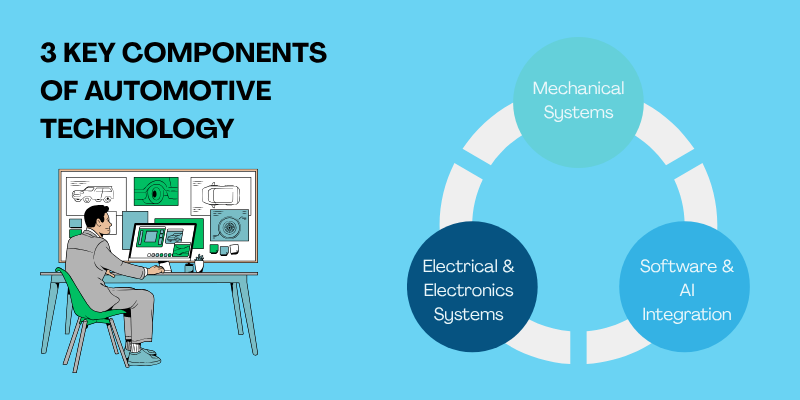
Here are the three main areas that make up the automotive tech ecosystem:
1. Mechanical Systems
Mechanical systems are the backbone of any vehicle, responsible for core functions such as power generation and distribution, suspension, and braking.
The engine is the heart of the vehicle, converting fuel or electrical energy into mechanical power to drive the car. In hybrid and electric vehicles (EVs), electric motors are used for propulsion, with batteries providing the stored energy.
The transmission system plays a crucial role by managing the delivery of power from the engine or motor to the wheels, enabling the vehicle to change speeds efficiently.
Suspension systems ensure a smooth ride by absorbing shocks from the road, while braking systems, including advanced technologies like ABS (Anti-lock Braking System), ensure safety by preventing wheel lock-up during sudden stops.
These mechanical components work in tandem to deliver performance, fuel efficiency, and safety.
2. Electrical and Electronics Systems
Modern vehicles are equipped with sophisticated electrical and electronic systems that handle a wide range of functions.
Vehicle sensors constantly monitor the performance of various systems, detecting potential issues and improving reliability. Infotainment systems provide entertainment, connectivity, and seamless interaction with mobile devices, while navigation systems offer real-time driving assistance, enhancing the driving experience.
On the safety front, these systems power critical features such as lane departure warnings, collision detection, and automatic parking. They make driving safer and more intuitive, reducing human error and enhancing vehicle performance.
Additionally, in hybrid and electric vehicles, the electrical system is crucial for charging, energy distribution, and powering the motors.
3. Software and AI Integration
With the rise of digital technology, software and artificial intelligence (AI) have become integral to modern vehicles. AI enables autonomous driving by using data from sensors and cameras to make real-time decisions, allowing cars to drive themselves in certain conditions.
Additionally, AI helps with predictive maintenance, analyzing vehicle data to forecast potential failures and alert the driver in advance. Advanced Driver Assistance Systems (ADAS), powered by software and AI, include features like emergency braking, adaptive cruise control, and lane-keeping assist, all designed to reduce accidents.
These intelligent systems transform vehicles into smart machines, improving safety, efficiency, and convenience. Furthermore, vehicle-to-vehicle (V2V) and vehicle-to-infrastructure (V2I) communication systems are becoming essential for future automotive technologies.
These systems allow vehicles to communicate with each other and the surrounding infrastructure, enhancing safety, optimizing traffic flow, and enabling smart cities.
8 Types of Automotive Technology
Automotive innovations are paving the way for smarter, safer, and more sustainable vehicles.
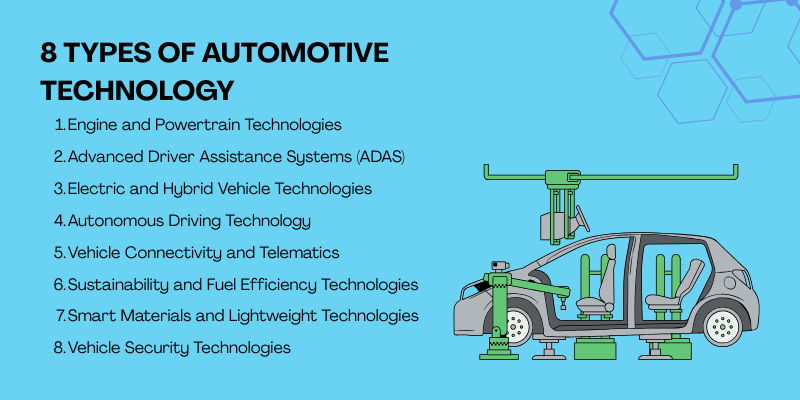
Here are the most significant advancements in automotive tech today:

1. Engine and Powertrain Technologies
Engine and powertrain technologies include internal combustion engines (ICE), hybrids, and electric powertrains.
While ICE vehicles burn fuel to power the vehicle, hybrids combine an engine with an electric motor for better fuel efficiency, and EVs rely solely on electric motors powered by batteries.
Transmission systems distribute power to the wheels, and dual-clutch or CVT transmissions improve shifting speed and efficiency.
2. Advanced Driver Assistance Systems (ADAS)
ADAS technologies enhance driving safety by using sensors and cameras. Features like lane departure warnings, adaptive cruise control, and automatic emergency braking assist drivers by detecting potential hazards and taking corrective actions, thus reducing the risk of accidents and improving driving comfort.
3. Electric and Hybrid Vehicle Technologies
Electric and hybrid vehicles combine traditional fuel systems with electric motors and batteries. EVs are powered entirely by electricity, while hybrids use both an engine and electric motor to optimize fuel efficiency.
Battery management systems ensure safe and efficient operation of batteries, extending vehicle range and lifespan.
4. Autonomous Driving Technology
Autonomous driving uses sensors like LiDAR, radar, and cameras along with AI to allow vehicles to drive themselves.
These systems detect obstacles, recognize traffic signs, and make real-time decisions, paving the way for self-driving cars that reduce human error and improve safety.
5. Vehicle Connectivity and Telematics
Telematics technology allows vehicles to communicate with each other and infrastructure. Vehicle-to-Vehicle (V2V) and Vehicle-to-Infrastructure (V2I) communication improve safety and traffic flow.
Infotainment systems and remote diagnostics provide convenience and real-time vehicle performance insights.
6. Sustainability and Fuel Efficiency Technologies
Technologies aimed at improving fuel efficiency and reducing environmental impact include start-stop systems, which shut off the engine when idle, regenerative braking to recharge batteries, and the use of lightweight materials like aluminum and carbon fiber to reduce vehicle weight and enhance fuel economy.
7. Smart Materials and Lightweight Technologies
Lightweight materials such as aluminum and carbon fiber reduce vehicle weight, improving fuel efficiency and performance. Self-healing materials are also being developed to repair minor scratches, improving vehicle longevity and reducing maintenance costs.
8. Vehicle Security Technologies
Keyless entry systems and biometric security (like fingerprint or facial recognition) protect vehicles from unauthorized access. Remote locking and tracking features also allow owners to secure their vehicles and track them in case of theft.
As the automotive industry continues to innovate, these safety technologies are becoming more advanced, contributing to the overall safety of roadways.
3 Key Career Roles in Automotive Technology
The automotive technology industry offers a variety of job roles that play crucial parts in the development, maintenance, and innovation of modern vehicles.
Key job roles include automotive engineers, technicians, and software developers, each contributing uniquely to the industry's evolution.
1. Automotive Engineers
Automotive engineers are responsible for the design, development, and testing of vehicles and their components. They may specialize in areas such as mechanical, electrical, systems, or safety engineering.
Engineers work on creating vehicle systems, improving performance, and ensuring compliance with environmental and safety standards.
They are involved in everything from engine design to aerodynamics and suspension systems, as well as integrating new technologies like electric powertrains and autonomous driving features.
2. Technicians
Automotive technicians perform essential diagnostic and repair work on vehicles, ensuring their proper functioning.
Technicians may specialize in traditional internal combustion engines, electric vehicle (EV) systems, or hybrid technology.
With the rise of advanced vehicle technology, technicians must stay up-to-date with evolving systems such as ADAS (Advanced Driver Assistance Systems) and autonomous vehicle technologies. Their role is critical in maintaining vehicle performance, safety, and reliability.
3. Software Developers
Software developers in the automotive industry focus on creating and optimizing the digital systems that control modern vehicles.
This includes developing vehicle infotainment systems, navigation software, and autonomous driving algorithms. Software developers also work on embedded systems that manage engine performance, safety features, and real-time data processing.
As vehicles become more connected and autonomous, the demand for skilled professionals in software development is growing rapidly, making them an essential part of automotive innovation and digital transformation within the industry.
Future of Automotive Technology
The next decade in automotive technology is poised for significant transformation. As electric vehicles (EVs) become more mainstream, the automotive industry will continue to shift toward sustainable transportation solutions.
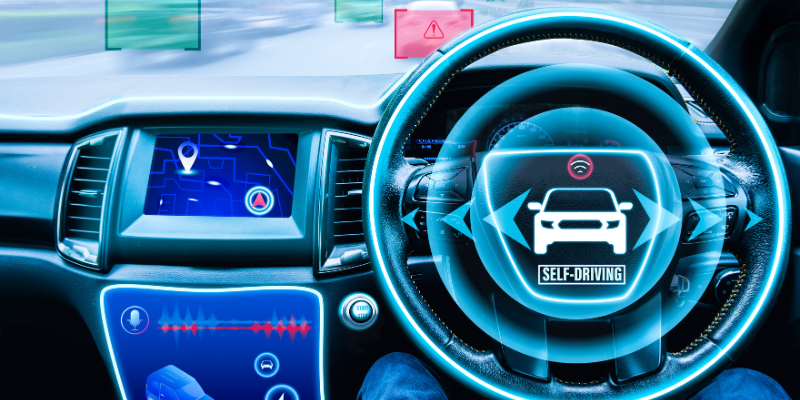
Companies like Centric, a leading automotive marketing agency, are helping brands communicate this shift effectively, bridging innovation with consumer engagement.
We can expect advancements in autonomous driving technology, vehicle-to-vehicle (V2V) communication, and smart infrastructure that will make driving safer and more efficient.
AI and machine learning will further enhance vehicle performance and safety features, enabling cars to learn from their environment and improve over time.
The comparison of AI vs Machine Learning highlights how both technologies contribute uniquely—AI focuses on decision-making and automation, while machine learning enables vehicles to adapt through data-driven learning.
Sustainability and Green Energy will be at the forefront of this transformation. The push for reducing carbon emissions will drive the development of more energy-efficient vehicles and greener technologies.
We can anticipate widespread adoption of electric and hydrogen fuel cell vehicles, which will not only reduce dependency on fossil fuels but also decrease environmental pollution.
Additionally, renewable energy sources will play a key role in powering EVs, further advancing green energy initiatives.
The automotive industry is expected to integrate solar power, battery recycling, and sustainable manufacturing practices to create a more eco-friendly ecosystem.
Conclusion
What is automotive technology, and why is it so important? Automotive technology is a driving force behind the transformation of transportation, playing a crucial role in improving vehicle performance, safety, and sustainability. With the integration of electric vehicles, autonomous driving systems, and smart technologies, automotive technology is paving the way for a more efficient, eco-friendly, and safer future. As the industry continues to evolve, it holds the potential to reshape the way we travel, reducing environmental impact and enhancing the driving experience. The innovations we see today are only the beginning, and the future of automotive technology promises even more groundbreaking advancements that will make transportation smarter, greener, and more connected than ever before.