



To choose a web design agency, define your goals and must-haves first, shortlist three to five agencies with relevant work, send the same brief or RFP to each, and score them on strategy, design, technical quality, accessibility, process, support and contract terms. Check references, confirm you will own the code, content and domain, then sign.
Key Takeaways
-
Compare agencies on the same brief and a weighted scorecard, not on portfolio looks or price alone.
-
Make accessibility a requirement: WebAIM found detected WCAG 2 failures on 95.9% of the top one million home pages in 2026.
-
Write performance targets into the contract: Google's Core Web Vitals call for LCP within 2.5 seconds, INP of 200 ms or less and CLS of 0.1 or less.
-
Get ownership in writing; under US copyright law, most commissioned website work is not automatically "work made for hire."
-
Plan redesign SEO up front: Google says a site move with new URLs can take a few weeks or more to settle
Find your answer fast
-
Starting the search? Go to How to choose a web design agency in 7 steps.
-
Comparing proposals? Use the web design agency scorecard.
-
Writing an RFP? Go to What to include in a web design RFP.
-
Ready to add Centric to your shortlist?
In this guide
-
What makes a good web design agency?
-
Web design benchmarks by the numbers (2026)
-
How to choose a web design agency in 7 steps
-
Web design agency scorecard
-
What to include in a web design RFP
-
Questions to ask a web design agency
-
Pricing models and what a proposal should include
-
Contracts, ownership and post-launch support
-
Red flags to avoid
-
Agency selection checklist
-
Frequently asked questions
Your corporate website is often the first place buyers, partners and candidates judge your business, and most sites still miss basic quality bars. HTTP Archive's 2024 Web Almanac found only 43% of mobile websites had good Core Web Vitals, and WebAIM's 2026 study found an average of 56.1 accessibility errors per home page. The agency you choose decides which side of those numbers you land on.
The guide below gives you a repeatable selection process: what to look for, a scorecard to compare agencies, an RFP outline, the questions that expose weak answers, how to read pricing and contracts, and the red flags that should end a conversation. It is written for marketing, digital and IT leaders choosing an agency for a corporate or B2B website.
What Makes a Good Web Design Agency?
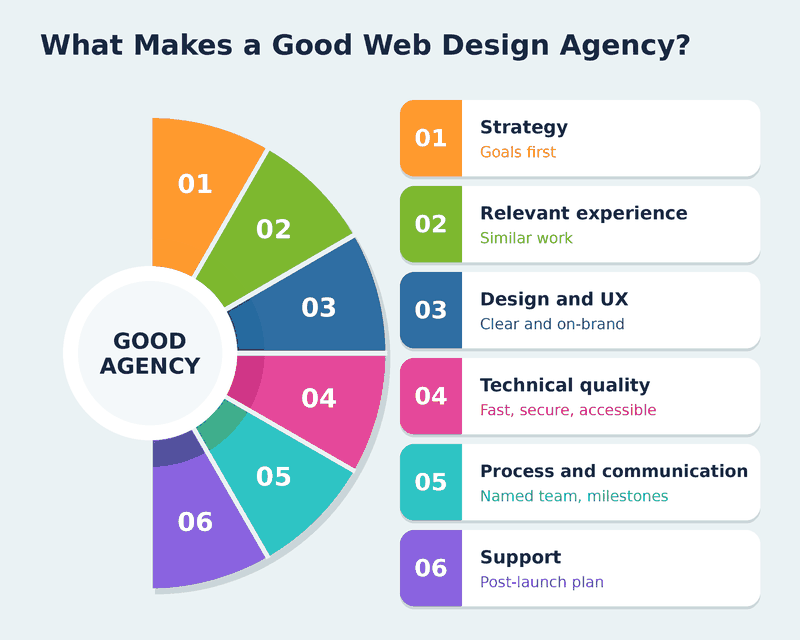
|
Quality |
What good looks like |
How to check |
|---|---|---|
|
Strategy |
Starts with goals, audiences and conversion paths before visuals |
Ask how discovery works and what it produces |
|
Relevant experience |
Work for similar companies, buyers or complexity |
Ask for two case studies close to your project |
|
Design and UX |
Clear navigation, readable content, consistent brand |
Click through live sites, not just mockups |
|
Technical quality |
Fast, secure, accessible, built on a CMS that fits your team |
Test live client sites in PageSpeed Insights |
|
Process and communication |
Named team, defined milestones, regular reviews |
Ask who works on your account day to day |
|
Support |
Clear post-launch plan with response times |
Ask for the support terms in writing |
Design and development are different disciplines, and corporate sites need both; see web design vs web development for how they fit together, and what B2B website design involves if your site serves business buyers. For brand or visual design projects rather than a full website, see how to choose a design agency.
Web Design Benchmarks by the Numbers (2026)
Use published benchmarks to set requirements and to test agency claims. The figures below come from WebAIM, HTTP Archive, Google, W3C, the US Department of Justice and the US Copyright Office, and each one maps to a question you should put to every agency on your shortlist.
|
Benchmark |
What it means for your selection |
Source |
|---|---|---|
|
95.9% of the top one million home pages had detected WCAG 2 failures (February 2026) |
Make accessibility a scored requirement |
|
|
Average of 56.1 accessibility errors per home page, up from 51 in 2025 |
Ask how the agency tests accessibility before launch |
|
|
43% of mobile websites and 54% of desktop websites had good Core Web Vitals in 2024 |
Test the agency's live client sites |
|
|
Good thresholds: LCP 2.5 s, INP 200 ms, CLS 0.1, at the 75th percentile of page loads |
Write these targets into the scope |
|
|
"Core Web Vitals are used by our ranking systems" |
Performance affects search, not just experience |
|
|
WCAG 2.2 became a W3C Recommendation on 12 December 2024 |
Ask which WCAG version and level the agency builds to |
|
|
DOJ position: ADA requirements apply to goods and services of public accommodations, "including those offered on the web" |
Accessibility is a legal risk, not only a design choice |
|
|
A site move with URL changes can take "a few weeks or more" for medium-sized sites |
Require a redirect and SEO migration plan |
Our guides to Core Web Vitals and SEO and how to make a website ADA compliant explain both standards in more detail.
How to Choose a Web Design Agency in 7 Steps?
The most reliable way to choose a web design agency is a structured process: set goals and requirements, build a shortlist, send one brief, review proposals against a scorecard, check references and live work, negotiate the contract, and plan launch support. Each step below lists what to do and what to collect.
Step 1: Define goals, scope and must-haves
-
Write down the business goals (for example, qualified leads, recruiting, investor relations) and the metrics you will track.
-
List must-haves: CMS, integrations such as CRM or ERP, languages, accessibility level, hosting and security requirements.
Step 2: Build a shortlist of three to five agencies
-
Look for agencies with work in your industry or at your level of complexity, and with in-house design and development.
-
Use industry fit as one input, as explained in choosing a digital agency with your industry experience.
Step 3: Send the same brief or RFP to each
-
One brief makes proposals comparable; see how to brief a design agency.
-
Give a budget range and timeline so proposals match reality.
Step 4: Score proposals and pitches
-
Use the weighted scorecard below, scored by at least two people separately.
-
Ask each agency to walk through one past project from discovery to results.
Step 5: Check references and live work
-
Speak to two recent clients and ask about deadlines, budget changes and support after launch.
-
Run two or three live client sites through PageSpeed Insights and an accessibility checker.
Step 6: Negotiate the contract
-
Confirm scope, milestones, change-request process, acceptance criteria, ownership and support terms.
-
Have your legal team review IP and liability clauses.
Step 7: Plan launch and post-launch support
-
Agree on a redirect map, analytics setup, training and a support plan before development starts.
-
Set review dates at 30, 60 and 90 days after launch.
For an engineering-focused view of the same decision, read our 9-step process for choosing a B2B web development partner.
Web Design Agency Scorecard
A weighted scorecard turns opinions into a defensible decision. Score each agency from 1 to 5 on each criterion, multiply by the weight, and add the results. Adjust the example weights to your priorities, but agree on them before you read any proposals, so the team scores against the same standard.
|
Criterion |
Example weight |
What a 5 looks like |
|---|---|---|
|
Understanding of goals and buyers |
20% |
Proposal reflects your goals, audiences and conversion paths, not a template |
|
Relevant work and results |
15% |
Case studies close to your project with stated outcomes |
|
Design and UX quality |
15% |
Live sites are clear, consistent and easy to use |
|
Technical quality and CMS fit |
15% |
Performance and security plans; CMS your team can run |
|
Accessibility and SEO |
10% |
Named WCAG level, testing method and redirect plan |
|
Process, team and communication |
10% |
Named team, milestones, review cadence |
|
Post-launch support |
5% |
Written support terms and response times |
|
Price and contract terms |
10% |
Clear scope, change process and full ownership for you |
What to Include in a Web Design RFP?
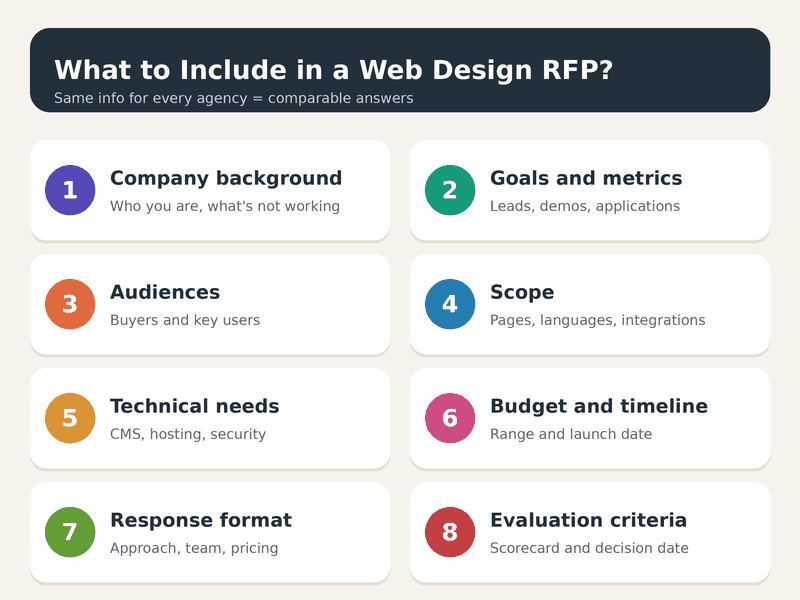
A web design RFP gives every agency the same information and asks for comparable answers. Keep it short enough that good agencies will respond, but specific about goals, scope, technical requirements and how you will decide. The outline below covers what most corporate website projects need.
-
Company and project background: Who you are, why the site is changing and what is not working today.
-
Goals and success metrics: For example, leads, demo requests or job applications.
-
Audiences: Primary buyers and other users such as investors or candidates.
-
Scope: Page count or templates, content migration, languages, integrations.
-
Technical requirements: CMS preference, hosting, security, accessibility level and performance targets.
-
Budget range and timeline: Including any fixed launch date.
-
Response format: Approach, team, relevant work, timeline, pricing breakdown, assumptions.
-
Evaluation criteria and process: Your scorecard weights and decision date.
If you have not chosen a platform, our guides to CMS in web design and the best headless CMS options help you set the technical requirements.

Questions to Ask a Web Design Agency
The right questions separate agencies that follow a real process from those that sell a look. Ask every agency the same questions and compare the answers side by side. The table shows what a strong answer includes and the warning signs to note, so each conversation feeds directly into your scorecard.
|
Question |
Strong answer includes |
Warning sign |
|---|---|---|
|
What happens in discovery? |
Stakeholder interviews, analytics review, goals and sitemap |
Jumps straight to visual design |
|
Who will work on our project? |
Named roles and the day-to-day contact |
"Our team" with no names |
|
Can you show work similar to ours? |
Live sites and outcomes |
Mockups only |
|
Which WCAG level do you build to, and how do you test? |
A named level (for example, WCAG 2.2 AA), automated and manual testing |
"Our sites are accessible" with no method |
|
What performance targets do you commit to? |
Core Web Vitals thresholds and how they are measured |
No targets |
|
How do you protect our SEO during a redesign? |
URL mapping, 301 redirects, post-launch monitoring |
Not considered |
|
How are change requests priced? |
Written change process approved before work |
Unclear or verbal |
|
Who owns the code, design files, content and domain? |
You do, in writing |
Agency keeps rights or the domain |
|
What does support look like after launch? |
Written terms, response times, update plan |
"Contact us if anything breaks" |
For a longer list, see our 17 questions to ask a design agency before hiring.
Proof: Centric corporate web work
For TotalEnergies' Middle East website, Centric handled UI/UX design, copywriting and end-to-end development on Oracle WebCenter Sites (FatWire), delivering a bilingual English and Arabic site within a 12-week schedule while following Total's global brand guidelines. Read the TotalEnergies case study.
Pricing Models and What a Proposal Should Include
|
Pricing model |
Best for |
Watch out for |
|---|---|---|
|
Fixed price |
Clear scope and fixed launch date |
Change requests priced separately; vague assumptions |
|
Time and materials |
Evolving scope or complex integrations |
Weak budget control without regular reporting |
|
Phased (discovery first, then build) |
Large or uncertain projects |
Make sure discovery outputs are yours to keep |
|
Retainer |
Ongoing updates, optimization and support |
Unused hours and unclear priorities |
Every proposal should list deliverables, page templates, content migration, integrations, accessibility and performance targets, testing, training, launch support, timeline, team, assumptions and exclusions. A low quote that leaves out migration, testing or redirects often costs more later. If budget is the deciding factor, our comparison of in-house designers vs a design agency covers the trade-offs.
Contracts, Ownership and Post-Launch Support
The contract decides what you own and what happens after launch. Get ownership of code, design files, content, domain and accounts in writing, define acceptance criteria and change requests, and attach the support terms. Under US copyright law, commissioned work is usually not "work made for hire" unless strict conditions are met, so use an explicit assignment.
-
Ownership. The US Copyright Office explains that a commissioned work is a work made for hire only if it falls into one of nine specific categories and the parties sign a written agreement; if it fails any requirement, "it is not a work made for hire" (Circular 30). Ask your counsel to include a written assignment of rights to you.
-
Accounts and domain. Register the domain, hosting, analytics and CMS admin accounts in your company's name.
-
Acceptance criteria. Include accessibility level, Core Web Vitals targets and browser and device coverage.
-
SEO migration. Require a URL map and 301 redirects; Google recommends "server side permanent redirects from the old URLs to the new URLs."
-
Support. Define response times, security updates, backups and who handles content changes.
The points above are general information, not legal advice. Our guides to the website redesign SEO checklist, website maintenance and why to ask your agency about ISO 27001 cover the operational side.
Red Flags to Avoid
Some warning signs should end a conversation or at least trigger hard questions. Watch for agencies that skip discovery, cannot name your team, guarantee rankings, keep ownership of your domain or code, have no accessibility or performance method, or price far below the other proposals without explaining what is left out.
|
Red flag |
Why it matters |
What to ask |
|---|---|---|
|
Guaranteed first-page rankings |
No agency controls Google's rankings |
"What exactly do you deliver for SEO?" |
|
Agency registers your domain |
You may lose control of your site |
"Will all accounts be in our name?" |
|
No named team |
Work may be passed to unknown subcontractors |
"Who works on our project each week?" |
|
No accessibility method |
Legal and usability risk |
"Which WCAG level and how do you test?" |
|
Quote far below others |
Missing scope or rework later |
"What is excluded from this price?" |
|
Mockups but no live sites |
Unproven delivery |
"Can we see live sites and speak to clients?" |
Agency Selection Checklist
Use this checklist from the first shortlist to the signed contract. It keeps the selection consistent across stakeholders, makes sure every agency answers the same questions, and confirms that ownership, accessibility, performance, SEO migration and support are settled in writing before any design or development work begins.
-
Goals, metrics and must-haves written down.
-
Budget range and timeline agreed internally.
-
Shortlist of three to five agencies with relevant work.
-
Same brief or RFP sent to every agency.
-
Scorecard weights agreed before reading proposals.
-
Live client sites tested for performance and accessibility.
-
Two references called per finalist.
-
Named team and day-to-day contact confirmed.
-
Ownership of code, files, content, domain and accounts in writing.
-
Accessibility level and Core Web Vitals targets in the acceptance criteria.
-
Redirect and SEO migration plan agreed.
-
Support terms and response times attached to the contract.
Frequently Asked Questions
How do I choose the right web design agency?
Define your goals and must-haves, shortlist three to five agencies with relevant work, and send each the same brief. Score proposals on strategy, design, technical quality, accessibility, process, support and contract terms. Then test their live sites, call references and confirm in writing that you own the finished site.
What questions should I ask a web design agency?
Ask how discovery works, who will work on your project, which WCAG level they build to, what performance targets they commit to, how they protect SEO during a redesign, how change requests are priced, who owns the code and domain, and what support looks like after launch.
Should I hire a freelancer or a web design agency?
A freelancer can suit a small, simple site with a tight budget. A corporate website with integrations, multiple stakeholders, accessibility requirements and ongoing support usually needs an agency, because it brings strategy, design, development, testing and support under one accountable team with backup if someone leaves.
What should a web design proposal include?
A proposal should list goals, deliverables, page templates, content migration, integrations, accessibility and performance targets, testing, training, launch support, timeline, named team, pricing model, assumptions and exclusions. If two proposals differ widely in price, compare these items line by line to see what each one leaves out.
How long does it take to build a corporate website?
Timelines depend on scope, integrations, content readiness and approvals. As one example, Centric delivered TotalEnergies' bilingual Middle East website on Oracle WebCenter Sites within a 12-week schedule. Ask each agency for a milestone plan and what they need from your team to keep to it.
Who should own my website after launch?
Your company should own the code, design files, content, domain and all accounts. Under US copyright law, most commissioned website work is not automatically a work made for hire, so the contract should include a written assignment of rights to you. Have your legal team review the clause.
Why does accessibility matter when choosing a web design agency?
WebAIM found detected WCAG 2 failures on 95.9% of the top one million home pages in 2026, and the US Department of Justice says ADA requirements apply to services businesses offer on the web. Choose an agency that names a WCAG level and explains how it tests.
Final Thoughts
Choosing a web design agency is a procurement decision, not a beauty contest. Define goals first, compare agencies on one brief and a weighted scorecard, test their live work, and settle ownership, accessibility, performance, SEO migration and support in the contract. The agency that answers those points clearly is usually the one that delivers. Centric provides web design and development services for B2B and corporate websites, including UI/UX design, copywriting, CMS development and ongoing support. Its work for TotalEnergies’ Middle East website, a bilingual English and Arabic build delivered in 12 weeks, reflects the kind of scope, brand and timeline requirements covered in this guide.