Have you ever wondered what is machine learning and why everyone is talking about it?
Machine learning (ML) is a branch of artificial intelligence that allows computers to learn from data, identify patterns, and improve their performance without being directly programmed for every task.
Instead of following fixed instructions, systems adapt based on experience. Understanding machine learning is important because it powers many of the tools we use every day.
From personalized recommendations on streaming platforms to fraud detection in banking and predictive analytics in healthcare, ML is transforming industries.
In this blog, we’ll break down what machine learning is, how it works, its main types, practical applications, and why it plays such a vital role in modern AI and data-driven decision-making.
What is Machine Learning?
Machine learning (ML) is a branch of artificial intelligence (AI) that enables machines to learn from data, identify patterns, and make decisions without explicit programming. It involves using algorithms and statistical models to analyze and interpret complex data.
The acronym ML stands for "Machine Learning." It refers to the process by which systems automatically learn and improve from experience without being explicitly programmed. Essentially, ML is about teaching machines to identify patterns in data and make predictions based on those patterns.
Machine learning is a subset of artificial intelligence. While AI refers to the broader concept of machines simulating human intelligence, machine learning specifically focuses on the algorithms that allow machines to learn from data and improve over time. So, while machine learning is a type of AI model, not all AI systems involve machine learning.
What is the Importance of Machine Learning?
Machine learning is transforming industries by enabling smarter decision-making, automating complex tasks, and unlocking new possibilities.
- Pattern Recognition: Machine learning algorithms identify trends and patterns in large datasets. For example, eCommerce platforms use ML to analyze shopping behavior, improve recommendations, and uncover new product opportunities.
- Automation: ML and AI services automate repetitive and time-consuming tasks. From robotic process automation to fraud detection and computer vision in manufacturing, machine learning increases efficiency and reduces human workload.
- Continuous Improvement: Machine learning models improve over time as they process new data and receive real-world feedback, becoming faster, smarter, and more accurate in their predictions.
5 Key Components of a Machine Learning System
A machine learning system is composed of several key components that work together to process data and make decisions:
-
Data Input: Raw data is collected and preprocessed to prepare it for the algorithm.
-
Algorithm: The ML algorithm is applied to the data to identify patterns or make predictions.
-
Model Training: The system is trained using historical data to learn the relationships between inputs and outputs.
-
Testing and Validation: The model is tested on new, unseen data to evaluate its accuracy and adjust its parameters if necessary.
-
Deployment: Once trained and validated, the machine learning model is deployed to make real-time predictions or automate processes.
3 Types of Machine Learning
Machine learning is generally divided into three main types, each designed to solve different kinds of problems based on how data is used.

Here are the 3 types of machine learning.
1. Supervised Learning
Supervised learning uses labeled data, meaning the input data comes with correct answers. The model learns by comparing its predictions to the actual outcomes and improving over time.
Common examples include spam detection, image classification, and sales forecasting.
2. Unsupervised Learning
Unsupervised learning works with unlabeled data. The system identifies hidden patterns, relationships, or groupings within the dataset without predefined outputs.
It is commonly used for customer segmentation, anomaly detection, and recommendation systems.
3. Reinforcement Learning
Reinforcement learning is based on trial and error. The model learns by interacting with an environment and receiving rewards or penalties based on its actions.
It is widely used in robotics, gaming AI, autonomous vehicles, and real-time decision systems.

What is Machine Learning Used For?
Machine learning is used to analyze data, recognize patterns, and make intelligent decisions with minimal human intervention. It powers many technologies we use daily and plays a major role in modern business operations.
Here are some common uses of machine learning:
- Recommendation Systems: Platforms like Netflix, Amazon, and Spotify use machine learning to suggest movies, products, or music based on user behavior and preferences.
- Fraud Detection: Banks and financial institutions use ML models to detect unusual transactions and prevent fraud in real time.
- Predictive Analytics: Businesses use machine learning to forecast sales, customer demand, and market trends based on historical data.
- Healthcare Diagnosis: ML helps analyze medical images, detect diseases early, and support doctors in making accurate diagnoses.
- Customer Service Automation: Chatbots and virtual assistants use machine learning to understand queries and provide instant responses.
- Image and Speech Recognition: Machine learning enables facial recognition, voice assistants, and automated transcription systems.
- Autonomous Systems: Self-driving cars, robotics, and smart devices rely on ML to make decisions based on real-time data.
Machine Learning in Real Life
Machine learning is increasingly integrated into our daily lives, helping to enhance convenience and efficiency across various applications:
-
Voice Assistants: AI-powered voice assistants like Siri, Alexa, and Google Assistant use ML algorithms to understand spoken commands, improve responses, and offer personalized experiences.
-
Recommendation Systems: Platforms like Netflix, Amazon, and YouTube use ML to suggest content based on your past behavior, improving the user experience by offering relevant recommendations.
- Fraud Detection: In banking and finance, machine learning models are used to detect unusual patterns in transactions, helping to prevent fraud by flagging suspicious activities in real time.
5 Machine Learning Technologies
Several key technologies power machine learning, enabling its wide range of applications.
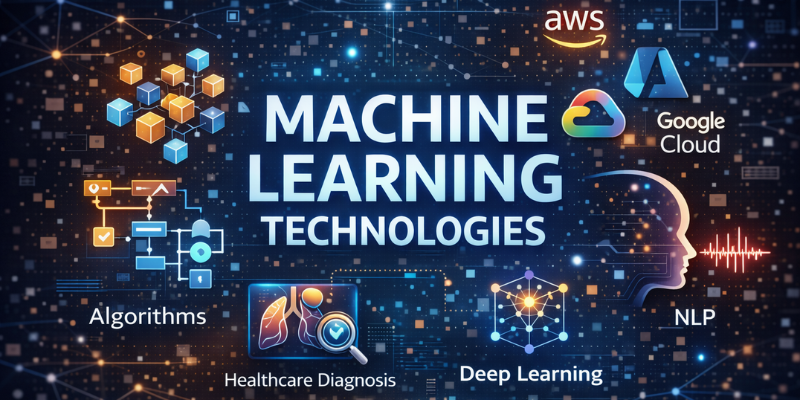
Here are some of the core technologies behind machine learning.
-
Algorithms: These are the core components that help process data and enable learning from it. Popular algorithms include decision trees, neural networks, and support vector machines (SVM).
-
Big Data: ML thrives on large datasets that help algorithms identify patterns and make accurate predictions. Big data technologies such as Hadoop and Spark are often used to handle vast amounts of information.
-
Cloud Computing: Cloud platforms like AWS, Google Cloud, and Microsoft Azure cloud services provide scalable computing resources that are essential for training large ML models and deploying them in real-time applications.
-
Deep Learning: A subset of ML that uses neural networks with many layers (known as deep neural networks) to model complex patterns. Technologies like TensorFlow and PyTorch are widely used for machine learning and deep learning applications.
-
Natural Language Processing (NLP): NLP enables machines to understand, interpret, and generate human language. Technologies such as transformers and recurrent neural networks (RNNs) are key in improving NLP applications like chatbots and translation services.
Frequently Asked Questions
What is ML?
ML stands for Machine Learning, a branch of artificial intelligence (AI) that enables computers to learn from data without being explicitly programmed. In ML, algorithms identify patterns in data, make predictions, and continuously improve their performance over time as they are exposed to more data. It is used in various fields like healthcare, finance, marketing, and more.
Is Machine Learning Artificial Intelligence?
Yes, Machine Learning is a subset of Artificial Intelligence (AI). While AI refers to any technique or system that enables machines to simulate human intelligence, machine learning specifically focuses on the ability of systems to learn from data, improve over time, and make decisions or predictions. Machine learning provides the foundation for many AI applications, such as natural language processing, image recognition, and autonomous systems.
What Does ML Mean in Text?
In the context of text and online discussions, ML is most commonly used as an abbreviation for Machine Learning. It is frequently mentioned in relation to AI, data analysis, and predictive analytics. However, ML can also stand for other terms in specific fields:
-
Maximum Likelihood: A statistical method used to estimate the parameters of a statistical model.
-
Meta Language: A type of language used for describing other languages in computer science.
-
Multi-Layer: Used in discussions of neural networks, where "ML" refers to multi-layered networks (deep learning).
Is Machine Learning a Coding Language?
No, machine learning is not a coding language. Instead, it is a field of study and a methodology within AI. However, machine learning requires programming languages like Python, R, and Java to implement algorithms and work with data. These languages provide libraries (e.g., TensorFlow, PyTorch, Scikit-learn) that facilitate machine learning tasks.
Final Thoughts
Now that you understand what is machine learning, it’s clear that ML is more than just a trending technology. Machine learning is a branch of artificial intelligence that enables systems to learn from data, recognize patterns, and make predictions without being explicitly programmed.
Today, machine learning plays a critical role in industries such as healthcare, finance, marketing, and logistics, where it improves decision-making, increases efficiency, and automates complex processes. From fraud detection and personalized recommendations to predictive analytics and smart assistants, ML is already reshaping how businesses operate.
Looking ahead, the future of machine learning is even more promising. As computing power expands and data becomes more accessible, ML will continue to drive breakthroughs in autonomous vehicles, natural language processing, robotics, and climate solutions.
Given this, its growing impact will unlock smarter systems, deeper insights, and more intelligent automation across every sector, empowering forward-thinking innovators like Centric to build more advanced and data-driven solutions.