When it comes to how to structure a page for AEO (Answer Engine Optimization), understanding the intricacies of content layout is key to improving visibility and engagement in the era of AI-driven search engines.
Traditional SEO techniques are evolving, and now, optimizing content for advanced technologies like ChatGPT and other large language models (LLMs) has become essential for businesses aiming to stay ahead.
Centric specializes in helping clients optimize their content strategy to align with these changing dynamics. It ensures that your website is built with the latest AEO principles, driving higher-quality traffic and better user interaction.
In this guide, we'll show you how to optimize your content for AI-driven search engines like ChatGPT, ensuring better visibility and engagement. Read on to discover key strategies and best practices to boost your AEO success with Centric’s expert insights!
What is AEO (Answer Engine Optimization)?
Answer Engine Optimization (AEO) refers to the process of structuring content to ensure it is easily understood and extracted by advanced AI-powered systems, such as Large Language Models (LLMs).
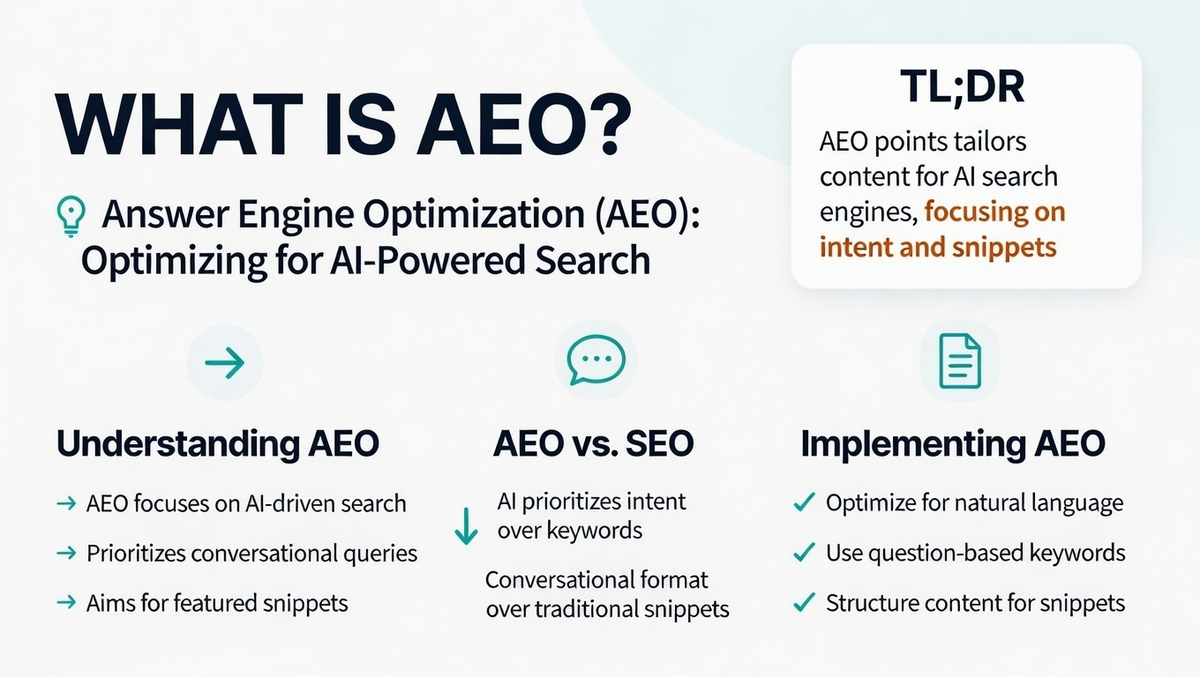
Unlike traditional search engines that focus primarily on keyword matching and backlinks, AEO services aims to optimize content for systems that provide direct, contextual answers to user queries.
How AEO Differs from Traditional SEO?
While traditional SEO focuses on ranking content based on keywords, backlinks, and technical optimization, AEO prioritizes the ability of AI systems to extract relevant and clear answers from content. SEO aims to increase page visibility in search engine results, but AEO ensures that the content is structured in a way that LLMs like ChatGPT can quickly understand and cite, leading to better user experiences and higher engagement.
Why AEO Matters for Businesses Today?
With the rise of AI-powered search engines, AEO has become critical for businesses that want to stay visible in an AI-driven world. Optimizing your AEO page structure ensures that your content is not only discoverable by traditional search engines but also extractable by AI models, resulting in better rankings and visibility across modern platforms.
As more users turn to chat-based engines for answers, businesses that master AEO will have a significant edge over their competitors.
How AEO Works?
AEO is fundamentally different from traditional SEO because it focuses on how AI engines, particularly LLMs, process and extract information. Unlike search engines that rely on crawling and indexing, AEO optimization techniques focus on making content more easily digestible for AI systems.
LLMs process structured data, clear headings, and relevant, concise answers in real-time, enabling them to deliver accurate responses to user queries.
One key difference between search engines is how they prioritize content. While search engines rank pages based on keywords and backlinks, answer engines evaluate content based on its ability to directly answer specific questions. This is why a well-organized AEO page structure is essential.
It helps AI engines pinpoint and extract the most relevant information quickly, ensuring that your content gets featured in the AI’s response.
Clear page structure improves the chances of your content being extracted and cited by LLMs. Well-defined headings, concise paragraphs, and semantic markup ensure that answer engines can easily identify your content’s relevance, boosting your AEO for better rankings.
Maximize Your Reach with AEO Services
How Answer Engines Process Content?
As the way we search for information online continues to evolve, understanding how answer engines process and rank content has become crucial for businesses aiming to stay ahead. In the past, search engines like Google relied heavily on keyword matching and backlinks to rank pages.
However, with the rise of AI-driven search engines and Large Language Models (LLMs), content optimization now demands a more contextual and structured approach. This shift has made AEO content optimization essential for achieving better visibility and rankings across modern platforms.
The Evolution from SEO to AEO
The way search engines process and rank content has drastically shifted with the advent of AI-powered engines. As a result, marketers must now focus on AEO content optimization to ensure their pages are properly structured to meet the needs of these advanced algorithms.
How Traditional Search Engines Rank Content?
Traditional search engines primarily rank content based on keyword relevance, backlinks, and technical SEO factors like page speed and mobile-friendliness. These algorithms would "crawl" pages, analyze the text for keywords, and determine their relevance to a user’s search query.
The Shift from Keyword Matching to Contextual Analysis
The move towards AEO content optimization signifies a shift from simple keyword matching to understanding the context of content. Modern search engines powered by AI analyze the meaning behind words, not just their frequency. This evolution allows LLMs to deliver more accurate, direct answers to users’ queries, prioritizing relevant content in real-time.
Why Page Structure Now Plays a Central Role in Ranking?
With this shift, effective AEO strategies now require an optimized AEO page structure. Answer engines prioritize content that is clearly structured and easy for AI systems to extract. Without a clear layout—complete with well-defined headings, concise answers, and structured data—your content may be overlooked, even if it ranks well under traditional SEO.
Understanding How AEO Algorithms Work
AEO algorithms are designed to assess the structure and relevance of content based on how AI model processes and extract information. Understanding how these algorithms function is essential for ensuring your content ranks well in AI-driven search environments.
How LLMs (like ChatGPT) Process and Extract Content?
LLMs like ChatGPT and other answer engines process content by extracting relevant, high-quality information that directly addresses user queries. These models rely on contextual understanding, looking at the relationships between words and sentences to produce accurate, coherent responses.
What AEO Algorithms Prioritize in Well-Structured Content?
AEO algorithms prioritize content that is easily digestible for AI systems. Well-structured content with clear headings (H1, H2, H3), concise answers, and logical organization ensures that answer engines can efficiently extract and deliver the most relevant information. The content must be factual, clear, and to the point, making it easier for AI models to process.
The Importance of Metadata, Schema Markup, and Headings
Metadata, schema markup, and properly formatted headings (H1, H2, and H3) play a crucial role in how LLMs extract content. Effective AEO strategies include marking up content with structured data like FAQ schema, Article schema, and HowTo schema. This helps answer engines better understand the content’s context, enabling them to present it in response to user queries.
2 Key Elements to Structure Your Page for AEO
When optimizing content for AEO (Answer Engine Optimization), structuring your page correctly is essential to make it easily understood by both human readers and advanced AI systems.
By focusing on clear headings, concise information, and effective use of subheadings, you can enhance your content’s chances of being featured in answer engines. Let’s dive into the key elements that will make your page optimized for AEO success.
1. Creating a Strong Headline (H1) for AEO
Your H1 headline is the first thing both human readers and answer engines will encounter on your page, making it one of the most critical elements for AEO. The H1 needs to be structured clearly to ensure that LLMs can extract relevant information right away, while also appealing to the user's intent.
Your headline serves as the primary guide for both humans and AI, informing both of the content's subject matter in a clear and straightforward way. A headline that’s too vague or stuffed with superlatives won't resonate with LLMs and could impact your AEO optimization efforts.
Best Practices for Writing AEO-friendly H1s
When creating your AEO-friendly H1, keep these best practices for AEO in mind:
-
Be specific and clear: Avoid generic terms and ensure your headline answers the user's query directly.
-
Use natural language: LLMs prefer content that mirrors how people ask questions, so make your headline conversational.
-
Front-load keywords: Place your main keyword towards the beginning of the H1 for better extraction by AI engines.
-
Keep it concise: Aim for 60-70 characters so it's easy for both users and engines to digest.
Examples of Effective AEO Headlines
-
"How to Structure a Page for AEO: A Complete Guide"
-
"What Is AEO and How to Optimize Content for Better Rankings"
-
"AEO Page Structure: Best Practices for Answer Engines"
2. Optimizing Subheadings (H2/H3) for Answer Engines
Subheadings (H2, H3) act as critical building blocks in your content structure, ensuring that answer engines can easily extract relevant information. When properly optimized, subheadings can help AEO algorithms identify and rank content more efficiently.

The Power of Question-based Headings
Question-based H2/H3s align well with user search queries and AEO for better rankings. Answer engines prioritize content that directly addresses user questions. By structuring your subheadings as questions, you signal to the answer engines that your content provides relevant, targeted answers.
Structuring H2 and H3 to Match Common User Queries
To maximize AEO optimization, ensure your H2 and H3 headings match the queries users are likely to ask. For example, instead of a generic heading like “Page Structure for AEO,” opt for more specific headings like, “How Do I Structure My Content for AEO?” This makes your content easier to extract and align with user intent.
How to Create Content that Is Easily Extracted by LLMs?
To ensure your subheadings and content are easily extracted by LLMs, follow these tips:
-
Be concise and clear in each heading.
-
Use simple, direct language that LLMs can easily process.
-
Structure your paragraphs under each heading to immediately answer the question posed by the heading.
By applying these principles, you can craft effective AEO strategies that ensure your content stands out in the AI-driven world of modern search engines.
6 Step Guide for Structuring a Page for AEO
Structuring a page for AEO (Answer Engine Optimization) involves several key steps that ensure your content is optimized for AI-driven search engines.
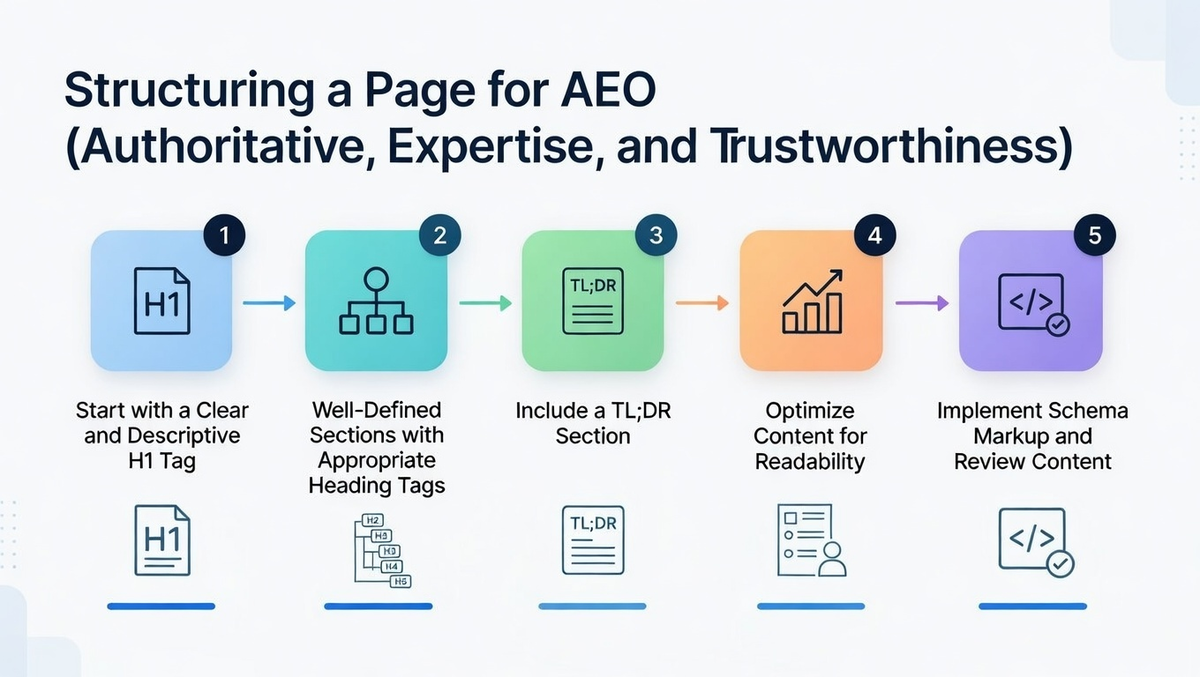
By following these steps, you can make your content easily discoverable, extractable, and relevant for users interacting with LLMs (Large Language Models) like Gemini and ChatGPT.
1. Start with a Clear, Descriptive H1
Your H1 should directly communicate the topic and incorporate your primary keyword. Make it specific and natural to match how users ask questions in AI-driven search engines.
2. Break Content into Well-Defined Sections
Use H2 and H3 headings to create a logical flow. Organize your content into clear sections that address specific aspects of the topic. This helps LLMs process the information efficiently and improve AEO optimization.
3. Include a TL;DR (Too Long; Didn't Read) Section
Place a concise summary at the beginning of your page, offering key takeaways in bullet points or a short paragraph. This section allows answer engines to quickly extract critical information.
4. Optimize Content for Readability
Use short paragraphs and varied sentence lengths to make your content more digestible. Avoid keyword stuffing and aim for natural language to improve both user experience and AI extraction.
5. Add Schema Markup
Implement schema types like FAQPage schema, Article schema, and HowTo schema to help LLMs understand the content’s structure and improve its chances of appearing in rich results or answer boxes.
6. Review and Refine Your Content
Regularly audit and refine your content to ensure it stays relevant and up-to-date. Incorporate new insights, answer emerging questions, and update schema markup for AEO for better rankings.
2 Tools and Techniques for AEO Optimization
Optimizing for AEO (Answer Engine Optimization) requires not only the right structure but also the right tools. In this section, we’ll explore the essential tools that help marketers optimize content for AI-driven search engines, from CMS platforms to schema markup techniques, enhancing both content visibility and ranking potential.
1. Content Management Systems for AEO
CMS platforms play a crucial role in AEO optimization by offering tools that enhance AEO page layout and simplify content organization. These platforms allow for easy integration of AEO page design guide strategies, such as managing structured data, headings, and metadata.
2. Essential Schema Markup for AEO
Schema markup is vital for improving content’s visibility in AEO. Adding FAQPage schema, Article schema, and HowTo schema to your content helps LLMs (Large Language Models) understand the structure of your page, making it easier for them to extract relevant information. SEO Tools like Google’s Rich Results Test allow you to validate schema, ensuring it's correctly implemented.
By utilizing schema markup, you improve the chances of your content appearing in rich results or as a featured snippet, boosting your content's AEO optimization and visibility across AI-driven search engines.
2 Common Mistakes to Avoid When Structuring for AEO
While optimizing for AEO is crucial, certain mistakes can hinder your efforts. From keyword stuffing to poor navigation, these issues can negatively affect how answer engines process your content. In this section, we’ll highlight common mistakes to avoid to ensure your content is optimized correctly and effectively.
1. Keyword Stuffing and Over-Optimization
Keyword stuffing can harm your AEO efforts by making your content sound unnatural and difficult for LLMs to process. While it’s important to target specific keywords, overuse can lead to poor readability, ultimately reducing the chances of your content being properly extracted.
To maintain a natural flow, use keywords sparingly and in context, ensuring they enhance readability. Best practices for AEO suggest incorporating keywords naturally into your content while focusing on providing value, clarity, and relevance, rather than cramming in as many as possible.
2. Poor Navigation and Unclear Content Structure
Confusing content layout can significantly impact answer engines' ability to extract relevant information. LLMs rely on clear, logical page structures to identify key insights. A well-defined content hierarchy is vital for better extraction, ensuring that answer engines can find and deliver the right information quickly.
Organizing your content with intuitive H2s and H3s guides both readers and AI systems through the page seamlessly. Tips for AEO page layout include using bullet points, numbered lists, and simple transitions to help maintain flow and improve AEO optimization.
FAQs
What is the difference between SEO and AEO?
SEO focuses on optimizing content for traditional search engines by targeting keywords and backlinks, whereas AEO (Answer Engine Optimization) is about structuring content for AI-powered engines like ChatGPT, which extract information directly to answer user queries. AEO places more emphasis on content structure, clarity, and schema markup.
How do I structure my content for AEO?
To optimize for AEO, focus on clear, logical page layouts with well-organized headings (H1, H2, H3), concise paragraphs, and a TL;DR section at the beginning. Use question-based headings, avoid keyword stuffing, and implement schema markup like FAQPage or Article schema to help answer engines process and extract your content.
Why is metadata important for AEO?
Metadata, such as schema markup, helps answer engines understand the structure of your content. By using structured data like FAQPage schema or HowTo schema, you signal to LLMs which parts of your content are most relevant, improving visibility and increasing the chances of being featured in rich results or answer boxes.
Can poor content structure affect my AEO rankings?
Yes, poor content structure can severely impact AEO rankings. Answer engines rely on clear, organized content to extract relevant information. If your page lacks a logical flow or has confusing navigation, LLMs may miss critical insights or skip over your content, leading to lower visibility and engagement.
Conclusion
When considering how to structure a page for AEO, it’s essential to focus on clarity and organization to ensure your content is easily understood by AI-driven systems. By utilizing clear headings, concise sections, and strategic schema markup, you increase the likelihood of your content being extracted and ranked by LLMs like ChatGPT.
Avoiding common mistakes such as keyword stuffing and poor page structure is critical for ensuring your content remains accessible to both users and search engines. A well-organized layout, combined with proper AEO optimization techniques, will improve your rankings and enhance user experience.
Centric helps businesses optimize their content for AEO, ensuring it not only meets search engine standards but is also primed for AI extraction, improving visibility and engagement across digital platforms.