In today’s rapidly evolving digital landscape, the question "What is AEO in marketing?" has become increasingly crucial for businesses looking to stay competitive. Answer Engine Optimization (AEO) is the practice of optimizing content to be featured as a direct answer in AI-powered search results, such as Google’s AI overviews, voice assistants, and AI chatbots like ChatGPT.
Unlike traditional search engines that provide links, AEO ensures your content is highlighted as the best direct answer, making it more accessible and valuable to users. As AI continues to play a bigger role in how people find information, AEO is becoming an essential part of any marketing strategy.
Centric is committed to staying at the forefront of digital marketing trends, ensuring its clients adapt to the latest innovations in AI and search technologies.
In this guide, you will explore the significance of AEO, how it differs from traditional SEO, and why it is becoming essential in the modern AI-driven landscape. We will also discuss actionable strategies for optimizing content to increase visibility and engagement through answer engine results.
What is AEO?
Answer Engine Optimization (AEO) is the process of tailoring content so that it directly answers specific questions and appears in answer boxes, featured snippets, or other AI-generated responses.
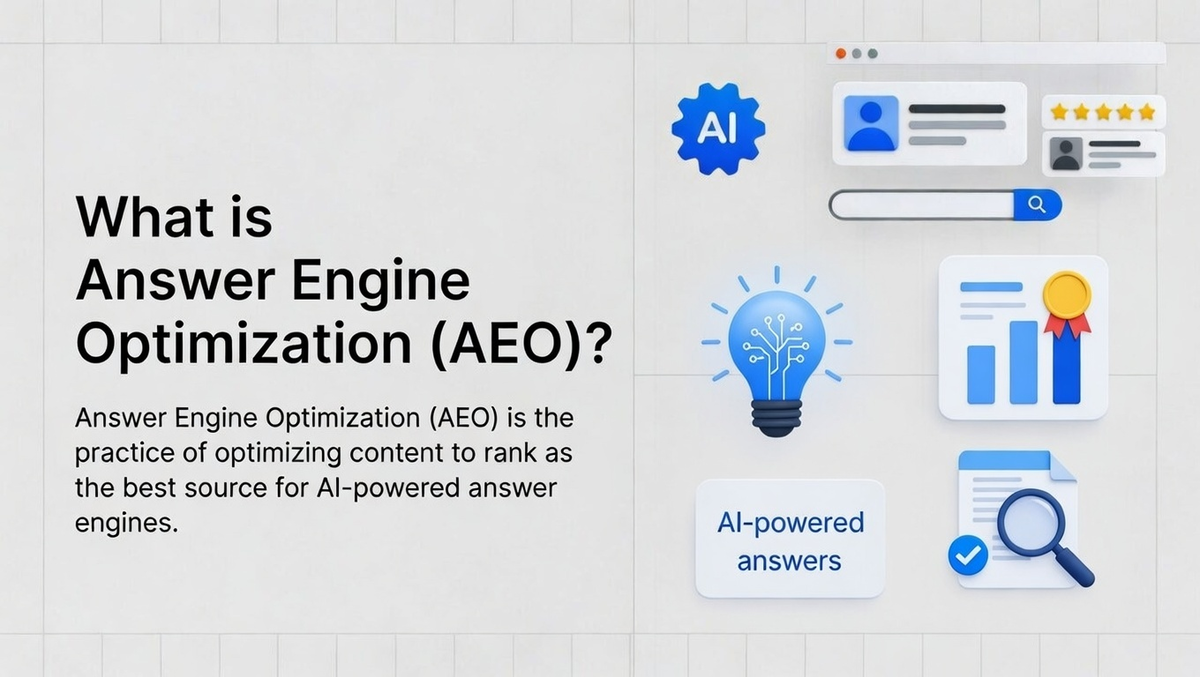
AEO focuses on providing content that is easily understood and accessible by AI search engines, which extract concise, context-rich information to deliver immediate answers to users' questions.
Unlike traditional SEO, which relies on ranking for clicks, AEO techniques for content marketing aim to optimize content for being directly cited as an authoritative response by AI-powered systems.
How AEO Differs from Traditional SEO?
While traditional SEO aims at improving a website’s ranking by optimizing for specific keywords and driving clicks, AEO focuses on the content’s ability to answer user queries directly. Traditional SEO worked to get content ranked at the top of search engine results pages (SERPs), but with the advent of AI, the goal has shifted.
Now, Answer Engine Optimization strategies aim to make your content the definitive, concise answer provided directly in the search results, even if the user doesn’t click through to your website. The key difference is that AEO doesn’t just focus on rankings, but on how well content is positioned to be cited and used by AI engines.
Start Improving Your Search Performance with AEO Service
The Importance of AEO in Today’s Marketing Landscape
As AI continues to revolutionize how people search for and consume information, Answer Engine Optimization for voice search and AI-driven platforms has become essential for brands to remain visible. Traditional SEO methods, while still valuable, are no longer enough to guarantee visibility in today’s rapidly changing search environment.
AEO is critical in ensuring that your brand is featured directly in the search results, providing immediate answers to user queries. In this section, we’ll explore why AEO is a key component of any modern marketing strategy and how it can help businesses maintain their digital presence.
Why AEO is Critical for Brands Today
AEO is vital for brands to stay visible amidst the rise of AI-powered search engines like Google’s AI overview and platforms like ChatGPT. Unlike traditional SEO, which focuses on driving clicks, AEO emphasizes becoming the answer users seek directly in search results.
By optimizing content for AI-generated answers, brands ensure they are part of the conversation, increasing their chances of being cited by search engines. How to implement AEO in marketing includes strategies like creating direct answers to common questions, using structured data, and ensuring your content is contextually relevant.
This shift not only impacts visibility but also directly influences content strategy, traffic, and conversions as more users turn to AI to quickly fulfill their needs.
The Rise of Zero-Click Searches and How AEO Can Help
The trend of zero-click searches is becoming more pronounced, with over half of all Google searches now ending without users clicking through to a website. This shift in search behavior means that businesses must adapt to be visible even when users don’t visit their sites.
AEO plays a crucial role in this change by positioning content to appear as the direct answer in AI-generated responses, such as featured snippets or voice assistants. Consumers increasingly expect to receive answers directly from search engines, and AEO ensures that your content remains visible in this new format.
This move from click-based traffic to answer-based visibility calls for AEO and search engine optimization to evolve alongside changing user expectations.
AI Chatbots and Virtual Assistants: A Game Changer for Businesses
AI chatbots and virtual assistants like ChatGPT, Siri, and Alexa are transforming how consumers interact with search engines. These platforms provide immediate answers to questions, removing the need for users to click through multiple links.
As a result, businesses must adapt their content strategies to ensure their information is available for these AI-powered responses. Answer Engine Optimization for voice search is one key way to stay ahead.
By structuring content to answer voice-based queries in a natural, conversational tone, businesses can ensure they are included in voice assistant results. AEO helps businesses adjust to this shift by optimizing content for quick, accurate responses, ensuring that their brand remains relevant in an AI-dominated search landscape.
How Does AEO Work? Key Components
To fully leverage Answer Engine Optimization (AEO), businesses need to understand the key components that make it effective. AEO is about more than just traditional SEO tactics; it involves adapting content for AI-powered search engines that deliver direct answers to users' queries.
From AEO in digital marketing to optimizing for voice search and AI chatbots, the core elements of AEO are designed to ensure content is easily understood and utilized by advanced search algorithms. In this section, we will explore the essential components of AEO, including structured data, content strategy, and the role of natural language processing.
Structured Data and Schema Markup for AEO
One of the most important components of AEO is structured data. Structured data, such as Schema.org markup, helps search engines and AI understand the context of content more effectively.
By adding structured data to your content, you provide a roadmap that search engines use to extract and present your content in answer boxes, featured snippets, or voice assistant responses.
Schema markup can help identify key information such as FAQs, how-to steps, and product details, making it easier for AI engines to deliver the most relevant and accurate answers. This process significantly increases the likelihood that your content will be cited as the top answer, improving visibility and driving engagement without requiring clicks.
Content Strategy for AEO: Focusing on User Intent
For AEO to work effectively, content must be aligned with user intent. Unlike traditional SEO, which often focuses on ranking for keywords, AEO is about addressing the user's needs directly and succinctly. To optimize your content for AEO, start by researching the questions your target audience is asking.
Organize content around these queries, ensuring that your answers are clear, concise, and placed prominently within the content. Use AEO in digital marketing strategies like question-based headings and bullet points to make your answers easily scannable.
Structuring content in a way that directly addresses specific questions increases the chances that your content will be selected as the top response in answer boxes or featured snippets, ultimately improving your brand’s visibility.
The Role of Natural Language Processing (NLP) in AEO
Natural Language Processing (NLP) is a vital element of AEO, as it allows AI and search engines to understand the meaning behind user queries rather than just matching keywords. By leveraging NLP, search engines can interpret the context of a question and identify the most relevant answers.
To optimize content for NLP algorithms, businesses need to ensure their content is written in a natural, conversational tone that aligns with how users phrase their queries.
Additionally, using clear, precise language and avoiding unnecessary jargon is key to making your content understandable for both humans and AI. This approach ensures that your content can be effectively processed by AI engines, increasing its chances of being featured in response to user queries.
4 Benefits of AEO in Marketing
Answer Engine Optimization (AEO) offers several benefits that can significantly impact a business’s online presence and engagement. As AI-driven search engines continue to dominate the digital landscape, optimizing content for AEO is not just a trend but a necessity.
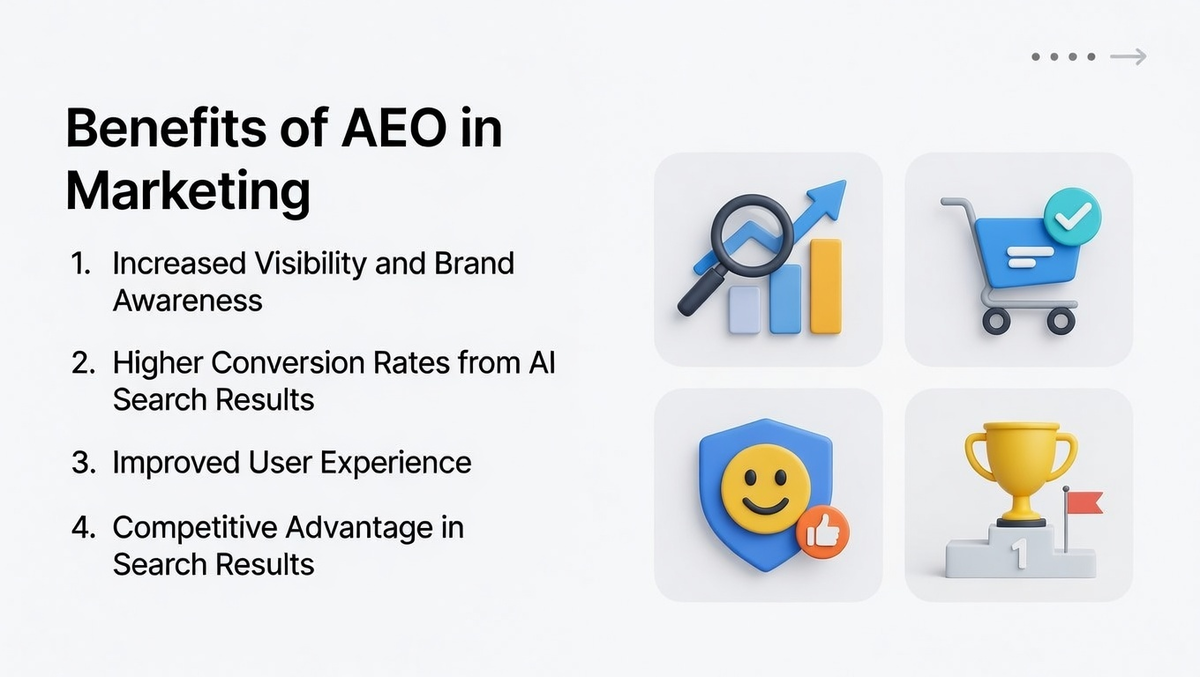
This section will explore the key benefits of implementing AEO in your marketing strategy and how it can enhance visibility, drive traffic, and improve conversions.
1. Increased Visibility and Brand Awareness
By optimizing your content for AEO, you increase the chances of being featured in AI-generated responses like answer boxes and featured snippets. How AEO boosts online visibility is through this strategic placement, significantly enhancing your brand's visibility without requiring users to click through to your website.
As search engines evolve, AEO helps you stay relevant by positioning your content as the definitive answer, ultimately increasing brand awareness and credibility.
2. Higher Conversion Rates from AI Search Results
While AEO may lead to fewer direct clicks, it often results in higher-quality traffic that is more likely to convert. AI-powered search platforms, such as voice assistants and chatbots, provide answers to users' specific needs, which means that the traffic driven to your site is more intent-driven.
This increased user intent can lead to higher conversion rates as users are already engaged with the information you're providing and are more likely to trust your brand.
3. Improved User Experience
AEO focuses on delivering precise, concise answers to user queries, which directly enhances the user experience. By answering questions in a straightforward manner, businesses can help users find the information they need faster, increasing satisfaction and reducing bounce rates.
This positive experience not only helps with rankings but also builds trust and encourages repeat visits.

4. Competitive Advantage in Search Results
Implementing AEO can give your business a competitive edge in search results. As more brands compete for visibility in an increasingly AI-driven search environment, those who optimize for AEO are more likely to stand out.
By becoming the go-to source for answers to specific queries, you position your brand as an authority in your field, giving you an advantage over competitors who are still focused on traditional SEO tactics.
3 Best Practices for AEO in Marketing
To fully harness the potential of AEO, businesses must follow proven AEO best practices that ensure their content is optimized for AI-driven search engines and is presented as the definitive answer to user queries. Adopting the right strategies can enhance your content’s visibility, improve user engagement, and increase conversions.
This section will cover actionable tips and key strategies for optimizing content, building authority, and measuring AEO success in today’s digital marketing landscape.
1. Optimizing Content for Direct Answers
Creating content that answers questions directly and concisely is key to AEO success. Start by identifying the most common questions your audience asks and ensure that your content addresses those questions up front. Use question-based headings to help search engines and readers easily navigate your content.
After each question, provide a clear, concise answer, ideally within 40-60 words, making it easy for AI systems to extract this information and present it as a featured snippet or in answer boxes.
Additionally, break your content into digestible sections with bullet points to improve readability and scannability. By focusing on providing direct answers, you increase your chances of being featured in AI-generated responses, ensuring that your content is visible even if users don’t click through to your site.
2. The Importance of Authority and Trustworthiness in AEO
In the world of AEO, E-E-A-T (Expertise, Authoritativeness, and Trustworthiness) is essential. AI search engines prioritize content from trusted sources that demonstrate expertise and authority on a given topic. For businesses, this means creating high-quality content that is well-researched, accurate, and backed by credible sources.
Establishing your brand as an authority in your industry not only helps you build trust with your audience but also increases the likelihood that your content will be featured in AI-driven results. Search engines like Google value authoritative content, so ensure that your content is comprehensive, well-cited, and consistently updated.
AEO best practices include referencing authoritative sources like research studies, government websites, and expert opinions to reinforce your content’s credibility.
3. Monitoring and Measuring AEO Success
Tracking the performance of your AEO efforts is critical to understanding what works and what needs improvement. Use tools like Google Search Console and Google Analytics, and AI platforms to monitor how your content is appearing in answer boxes, featured snippets, and voice search results.
Pay attention to metrics like impressions, click-through rates (CTR), and voice search visibility to assess your success. Tools like SEMrush and Ahrefs can also help you track your presence in answer results.
Additionally, regularly monitor featured snippets and voice search results to see if your content is being cited as a top answer. Adjust your content strategy based on these insights to ensure that your AEO efforts are continuously improving and delivering results.
3 Common Mistakes to Avoid in AEO
As businesses adapt to the evolving world of AEO, it’s essential to avoid common pitfalls that can hinder your efforts and impact your visibility in AI-driven search results. Focusing too heavily on outdated SEO tactics, neglecting regular content updates, or failing to use structured data properly can all limit the effectiveness of AEO.
In this section, we will highlight the most frequent mistakes and provide guidance on how to avoid them to ensure your content is optimized for AI-driven platforms.
1. Focusing Too Much on Keywords
AEO doesn’t rely as heavily on traditional keyword usage as SEO does. While keywords are still important for general search visibility, Answer Engine Optimization focuses more on providing clear, concise answers that directly address user intent.
Overusing keywords can lead to keyword stuffing, which not only affects content quality but also signals to AI search engines that the content lacks substance.
This can hurt your rankings and visibility. Instead of focusing on keywords, prioritize creating high-quality, informative content that directly answers user queries and provides value, ensuring that AI algorithms can easily extract the necessary information.
2. Ignoring the Need for Regular Content Updates
One of the biggest mistakes in AEO is neglecting to keep content fresh and up-to-date. AI-driven search engines favor content that is both authoritative and current. Regularly updating older content is essential to maintaining its relevance and ensuring it remains visible in answer engine results.
By refreshing content with the latest information, statistics, and insights, businesses can ensure their content stays competitive. Additionally, updating older posts can help improve their performance in AI search results, making it more likely for the content to appear in answer boxes, featured snippets, or voice search responses.
3. Not Leveraging Structured Data Properly
Structured data plays a crucial role in AEO by helping search engines and AI-powered tools understand the context of your content. A common mistake businesses make is either not using structured data at all or implementing it incorrectly. Without the right schema markup, search engines may struggle to interpret and display your content in answer boxes or featured snippets.
To improve AEO, businesses must properly implement Schema.org markup to define content types like FAQs, how-tos, and product information. Ensuring that your content is formatted correctly with structured data not only improves AI visibility but also enhances the likelihood of being selected as the top answer.
The Future of AEO in Marketing
The future of Answer Engine Optimization (AEO) lies in its ability to adapt to rapidly evolving AI technology and shifting user behaviors. As AI and machine learning continue to transform how information is accessed and consumed, businesses must stay ahead of the curve to maintain visibility in this new search environment.
In this section, we’ll explore the future developments in AI that will shape AEO strategies and offer advice on how businesses can stay competitive by integrating AEO into their long-term marketing strategies.
The Increasing Role of AI and Machine Learning in Search
The role of AI and machine learning in search will continue to grow, influencing how content is optimized for answer engines. As AI-driven search engines evolve, they will become more adept at understanding user intent, context, and the nuances of human language.
This will result in even more personalized search experiences, where AI chatbots and virtual assistants provide tailored answers based on individual user behavior and preferences. As machine learning algorithms become more sophisticated, they will be able to predict the information users are most likely to seek, making it even more important for businesses to optimize their content for these advanced systems.
Future developments in AI will drive even more automation in content retrieval, requiring marketers to focus on providing the most accurate and contextually relevant answers possible.
How Brands Can Stay Ahead of the Curve with AEO?
To stay ahead of the curve in the evolving AI landscape, brands must embrace AEO best practices and continuously adapt their content strategies. This includes creating content that is not only optimized for AI but also structured in a way that makes it easy for AI systems to extract and deliver.
Businesses should also invest in technologies that allow them to track and analyze AI search results, ensuring that their content is being cited and featured in AI-generated answers. Furthermore, integrating AEO into a long-term content strategy is crucial for sustained success.
By focusing on creating authoritative, high-quality content that directly addresses user queries, brands can ensure that they remain visible as AI-driven search engines continue to dominate the digital space. Embracing AEO in digital marketing now will position businesses for success in the future of AI-powered search.
FAQs
What is AEO in marketing?
Answer Engine Optimization (AEO) is the practice of optimizing content so that it is directly cited in AI-driven search results, such as featured snippets, voice assistants, and AI chatbots. AEO focuses on providing clear, concise answers that AI systems can easily extract and present.
How does AEO differ from traditional SEO?
While traditional SEO focuses on ranking for keywords and driving clicks, AEO optimizes content to be featured as direct answers in search results. AEO enhances content visibility without requiring clicks, providing AI-generated answers to specific user queries, improving user experience and engagement.
Why is AEO important for digital marketing?
AEO is crucial for digital marketing because it ensures your content appears in AI-driven responses, increasing visibility without the need for clicks. As AI and voice search dominate, optimizing for AEO helps businesses stay competitive, ensuring their content is directly accessible to users.
How can brands implement AEO strategies?
Brands can implement AEO by creating content that directly answers user questions, using structured data and schema markup for AI to easily extract information, and focusing on clear, concise responses. Regularly updating content and monitoring AI search results will further optimize AEO efforts.
Conclusion
What is AEO in Marketing? Answer Engine Optimization (AEO) is revolutionizing how businesses approach digital marketing. As AI-powered search engines become the norm, optimizing content to be directly cited as an answer is more crucial than ever.
AEO helps brands increase visibility, drive traffic, and engage users by ensuring their content is featured in AI-driven responses like answer boxes and voice search results.
Centric helps businesses stay ahead by implementing innovative digital marketing solutions, including AEO strategies. By embracing AEO, companies can enhance their online presence and ensure their content remains relevant in an AI-dominated search environment.
Now is the time to integrate AEO best practices into your content strategy. Start optimizing today to stay competitive and position your brand as the go-to source for answers in this new digital era.