



"AI agent" now describes almost anything with automation in it, from a rule that fires an alert to a team of autonomous agents running a customer workflow. That makes buying decisions hard, because two products sold under the same label can carry very different costs and risks.
The types of AI agents are usually grouped into seven: simple reflex, model-based reflex, goal-based, utility-based, learning, hierarchical and multi-agent systems. They differ in how they decide, whether they remember, whether they learn and how much they can do without a person. The type you pick sets the cost, how predictable the agent is and how much oversight it needs.
The classic types of agents in AI come from academic computer science. The last two describe how modern systems organise several agents. This guide covers each type with a business example, a comparison table with risk levels, how agents differ from chatbots, assistants and RPA, how to choose, and what a first project involves.
What Is an AI Agent (and What It Isn't)?
An AI agent is software that perceives its environment (data, events or user input), decides what to do and takes actions toward a goal. It often acts through tools such as APIs, databases or business applications. Four terms describe every agent in this guide:
Perception: the inputs the agent reads.
Decision logic: the rules, plan or scoring function it uses to choose an action.
Actions: what it is allowed to change, such as a ticket, a record or a message.
Memory (state): what it keeps between steps.
The AI agent vs LLM distinction comes down to action. A large language model (LLM) predicts and generates text, but it does nothing on its own. It becomes part of an agent when it is wrapped with a goal, tools, memory and permission to act. Many modern agents use an LLM as their reasoning engine, but the model alone is not the agent.
A dashboard, a single prompt or a script that runs the same steps every time without making a decision isn't an agent either. If you're weighing one agent against a wider system, Centric's guide explains how one agent differs from agentic AI.
Improve Your Business with AI!
What Are the 7 Types of AI Agents?
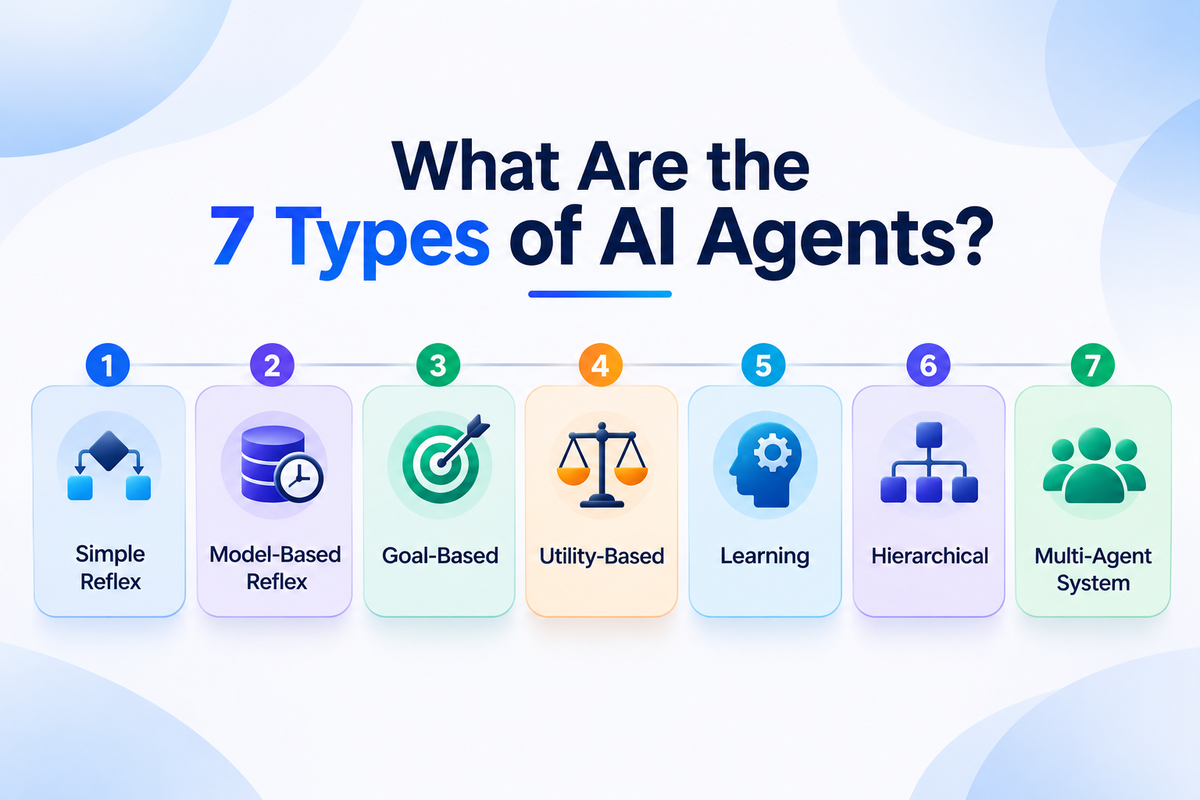
The seven main types of AI agents are simple reflex, model-based reflex, goal-based, utility-based, learning, hierarchical and multi-agent systems. They differ in how they decide: fixed rules, rules plus memory, planning toward a goal, scoring trade-offs, improving from feedback, delegating to sub-agents, or coordinating several specialist agents.
The first five come from the classic agent taxonomy in Russell and Norvig's textbook Artificial Intelligence: A Modern Approach. Hierarchical and multi-agent systems are architecture patterns that organise several agents. Taxonomies differ by source, which is why lists of the different types of AI agents range from five entries to many more. In practice, most LLM-based agents built today combine several behaviours, such as a goal-based planner with memory.
From simplest to most autonomous:
1. Simple reflex: if X, then do Y
2. Model-based reflex: rules plus remembered state
3. Goal-based: plans steps to a goal
4. Utility-based: scores options, picks the best
5. Learning: improves from feedback
6. Hierarchical: a manager delegates sub-tasks
7. Multi-agent system: specialists coordinate the work
How Each Agent Type Works, with Business Examples?
The seven types run from simplest to most autonomous. Here are the types of AI agents with examples, each explained the same way: how it decides, a business example, memory or learning, and its main limit. Platforms such as Microsoft Copilot Studio let teams build agents that mix several of these behaviours.
Simple Reflex Agents
How it decides: condition-action rules ("if X, then do Y") applied only to the current input.
Business example: an IT monitoring agent opens a priority ticket and pages the on-call engineer when a server's CPU stays above a set threshold for five minutes.
Memory or learning: none. It reacts to what it sees right now and never improves on its own.
Main limit: it can't handle situations its rules don't cover. It also doesn't know it has fired the same alert twenty times, which is how alert storms start. When conditions change, someone has to rewrite the rules.
Model-Based Reflex Agents
How it decides: it still follows rules, but it keeps an internal model (state) of things it can't see directly.
Business example: an inventory agent tracks stock on hand plus open purchase orders and in-transit stock. It flags a reorder when projected stock will fall below safety stock, not only when today's count is low.
Memory or learning: it remembers state but doesn't learn.
Main limit: the model is only as good as the data feeding it. A stale ERP sync produces wrong reorders that look perfectly confident.
Goal-Based Agents
How it decides: given a goal, it searches for or plans a sequence of actions that reaches it.
Business example: a field-service scheduling agent builds the day's technician routes so that every urgent job is covered by a technician with the right certification.
Memory or learning: it uses state to plan but doesn't learn by default.
Main limit: any plan that reaches the goal counts as success, so it won't prefer the cheaper of two valid plans unless you tell it to. Planning also slows down as the number of options grows.
Utility-Based Agents
How it decides: it scores possible outcomes with a utility function, a formula that weighs competing factors, and picks the option with the best overall score.
Business example: a freight agent chooses a carrier for each shipment by weighing cost, delivery time and on-time reliability.
Memory or learning: it uses state. Learning is optional.
Main limit: setting the weights is a business decision, not a technical one. A badly weighted function makes the same wrong trade-off consistently and at scale.
Learning Agents
How it decides: it improves its behaviour from feedback. A performance element acts, a critic judges the results, a learning element adjusts, and a problem generator tries new options.
Business example: a B2B ecommerce recommendation agent reorders its "frequently bought together" suggestions based on what buyers actually add to cart. Recommendation engines are among the most familiar examples of AI agents in commerce.
Memory or learning: both.
Main limit: it needs enough feedback data, and it can drift or learn bias from skewed data. Because its behaviour changes over time, it needs ongoing monitoring.
Hierarchical Agents
How it decides: a manager (supervisor) agent breaks a goal into sub-tasks, delegates them to lower-level agents and combines their outputs.
Business example: asked to "prepare the quarterly business review pack", a manager agent sends sub-tasks to a data-pull agent (CRM and finance figures), a chart agent and a drafting agent for the narrative. A person approves the final pack.
Memory or learning: shared context is passed down the hierarchy. Learning depends on the sub-agents.
Main limit: a wrong breakdown at the top cascades down, and each layer adds cost and latency.
Multi-Agent Systems
How it decides: several specialist agents, each with its own tools and permissions, work on one shared workflow. Orchestration is how the work gets routed: either a coordinator assigns it or the agents pass it peer to peer. A hand-off is the moment one agent passes its result and context to the next. Unlike a hierarchy, the agents may be peers rather than a top-down chain.
Business example: customer onboarding. An intake agent reads the submitted documents, and a verification agent checks them against CRM data and policy rules. A provisioning agent then creates the accounts, and exceptions go to a person.
Memory or learning: the workflow carries shared context, and each agent keeps its own state. Learning depends on the agents involved.
When it beats a single agent: a multi-agent system splits the work when steps need different tools or data access, or when separation of duties matters (the agent that checks shouldn't be the one that approves). It also helps when one agent's instructions would grow too long to stay reliable.
Main limit: every hand-off is another place for errors, problems are harder to trace, and model costs add up across agents.
As autonomy grows, two controls matter more. The first is human approval on any action that touches money, customers or records. The second is an audit log of what each agent saw, decided and did. To see how these controls fit into the build, read about how agentic workflows are designed.
Knowing the types is half the job. The harder question is which one fits your task, data and risk.
Enhance Your Business with AI!
Agent Types Compared: Business Job and Risk Level
The table maps each type to the job it does best and to how much damage a wrong decision could do.
|
Type |
Decision logic |
Memory / state |
Learns over time |
Best business job |
Risk level (reason) |
|
Simple reflex |
Fixed if-then rules |
No |
No |
Threshold alerts, simple routing |
Low: predictable and easy to audit |
|
Model-based reflex |
Rules plus internal state |
Yes |
No |
Inventory and status tracking |
Low: rules stay auditable; main risk is stale data |
|
Goal-based |
Plans steps to a goal |
Yes |
No (by default) |
Scheduling, routing |
Medium: can execute a multi-step plan before anyone checks it |
|
Utility-based |
Scores trade-offs |
Yes |
Optional |
Carrier, vendor or offer selection |
Medium: a mis-weighted score repeats the same wrong choice |
|
Learning |
Improves from feedback |
Yes |
Yes |
Recommendations, classification |
High: behaviour changes over time and can drift |
|
Hierarchical |
Manager delegates to sub-agents |
Shared context |
Depends |
Multi-part reports and documents |
Medium: top-level errors cascade, but sub-agents can be scoped |
|
Multi-agent system |
Specialist agents coordinate |
Shared plus per agent |
Depends |
Cross-system workflows (onboarding, case handling) |
High: many hand-offs, harder to trace |
The risk levels are a practical rule of thumb from Centric's editorial assessment, not a measured score. Any type becomes higher risk once it can act on money, customers or records without approval.
Use the table to shortlist one or two types, then test them against the checklist below.

AI Agents vs Agentic AI, Chatbots, Assistants and RPA
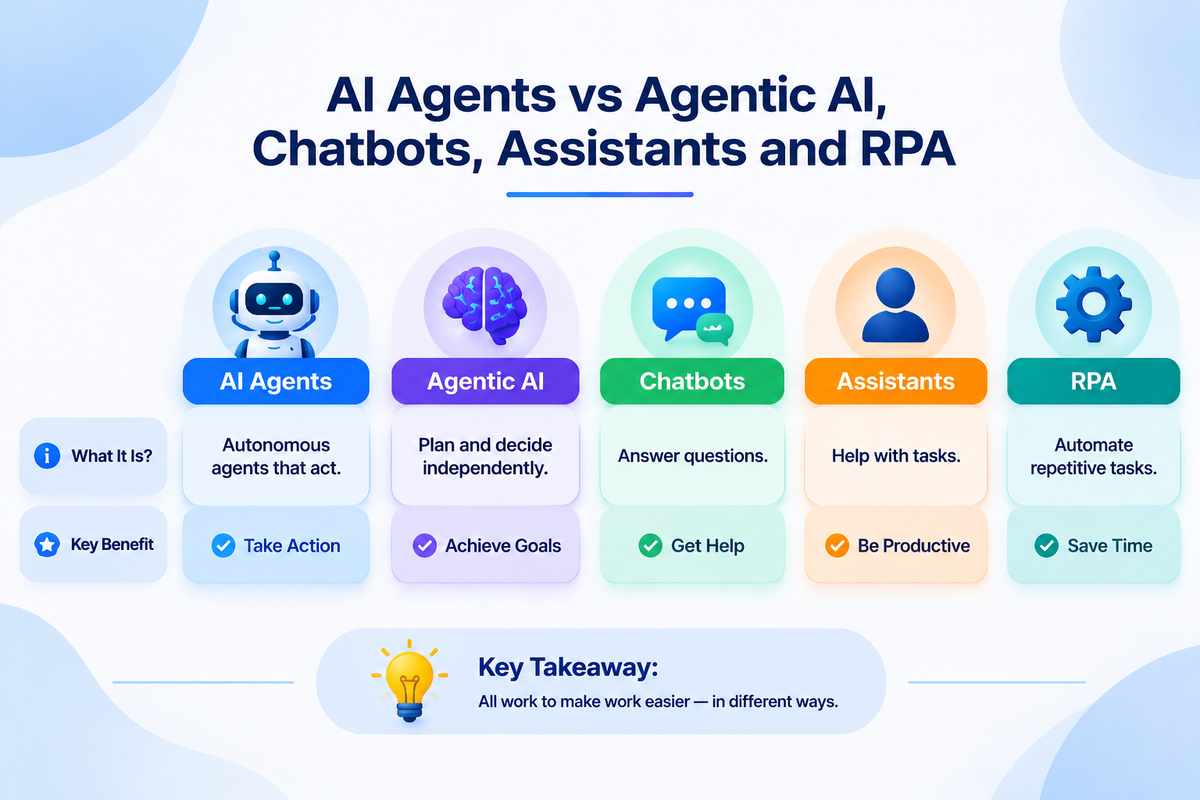
Vendor marketing often uses these terms interchangeably, but they describe different levels of autonomy. Knowing the difference stops you paying agent prices for a chatbot.
AI Agent vs Chatbot vs AI Assistant
A chatbot answers within a conversation, often from scripts or rules. An AI assistant is an LLM-powered helper that responds to a person's request and usually waits for that person to act or approve, like a copilot drafting an email. An AI agent pursues a goal and takes actions in business systems on its own, within the permissions it has been given.
The deciding factor in AI agent vs chatbot comparisons is action: a chatbot talks, an agent does. In AI agent vs AI assistant terms, the difference is who acts. The assistant suggests and the person decides, while the agent acts within set limits. Chatbots and assistants are both forms of conversational AI, which handles the dialogue layer.
A simple chatbot is often the right answer. If questions are predictable, answers are fixed (opening hours, order status) and there's no action to take, an agent adds cost without adding value. Centric's comparison covers when a rule-based chatbot is enough in more detail.
AI Agents vs Agentic AI
The AI agents vs agentic AI question is about scale. An AI agent is a component. Agentic AI is the wider approach or system in which one or more agents plan, act and coordinate with limited supervision. A single agent can exist without an agentic system, while an agentic system usually contains several agents, as covered above.
AI Agents vs RPA
Robotic process automation (RPA) uses software bots that repeat fixed clicks and keystrokes in applications. For AI agents vs RPA, the rule is simple. RPA is the better choice when rules are fixed and screens are stable. An agent fits when inputs vary, such as free-text emails or documents in different formats. Many companies combine the two: the agent interprets the input, and RPA executes the fixed steps.
How to Choose an AI Agent Type?
Pick the simplest type that does the job. Each step up the ladder adds cost, unpredictability and oversight work. Use this checklist when you choose an AI agent for a specific process:
Task complexity: choose a reflex agent if fixed rules cover the task, goal-based if it needs several steps, and utility-based if it involves trade-offs.
Data availability and quality: choose a learning agent only if you have enough clean feedback data, and a model-based agent only if your real-time data is reliable.
Cost of a wrong decision: choose a simpler type with human approval if a mistake would be expensive.
Need for human approval: decide up front which actions need a person to sign off, before you pick the type.
Integration with existing systems: choose a type your CRM, ERP or Microsoft 365 setup can support, because agents are only as useful as the systems they can reach.
Audit trail: choose a design that logs inputs, decisions and actions if the work is regulated or customer-facing.
Build effort versus value: estimate the hours saved or errors avoided before you build, and drop the use case if the numbers don't hold.
These checks matter. Gartner predicts that over 40% of agentic AI projects will be canceled by the end of 2027, citing rising costs, unclear business value or inadequate risk controls. Items 3, 6 and 7 address exactly those reasons.
Sometimes the right answer is no agent at all. If the process is stable and rule-based, plain workflow automation or RPA is cheaper and easier to audit. If the underlying data is unreliable, fix the data first.
To match these criteria to real processes, browse AI agent use cases by department.
If your shortlist points to building in-house, follow a step-by-step guide to building one.
If your answers point to a type that acts on money, customers or records, plan the approvals and logging before the build.
Which Type to Start With, and What a First Project Involves?
For most businesses, the first agent should be small, low-risk and measurable. Here is where to start, what drives the cost and what a first project looks like.
Where Most Businesses Should Start?
Start with a simple reflex or model-based agent on repetitive, low-risk work such as alerts, status tracking or ticket triage. Move to goal-based or utility-based agents once your data and approval steps are in place. Treat learning agents and multi-agent systems as later steps.
Whatever the type, keep human approval on anything that touches money, customers or records, the line where the comparison table's risk levels jump. If several use cases compete for the first slot, a short AI agent consulting session focused on ranking use cases by value and risk keeps the first build small.
What Drives the Cost?
AI agent development cost depends on the type and the scope, so any honest estimate starts with these drivers:
Integrations: each connection to CRM, ERP or Microsoft 365 adds build and testing work.
Data readiness: clean, accessible data is cheaper than data that needs fixing first.
Number of agents and tools: a single reflex agent costs far less than a multi-agent system.
Human-in-the-loop and logging: approval steps and audit trails take design and build time.
Ongoing run costs: model usage, monitoring and maintenance continue after launch.
If you build on Microsoft's platform, Copilot Studio licensing is a separate line item.
What a First Project Looks Like?
A sensible first project follows five steps:
Scope one use case and define how you'll measure success.
Test the agent on approved data.
Add human approvals and audit logging.
Deploy to a limited group of users.
Monitor results and adjust.
If you have a use case in mind, Centric's AI agent development services start with a scoping call to match the right agent type to your data, systems and risk.
FAQs About AI Agent Types
Is ChatGPT an AI Agent or an LLM?
ChatGPT is a chat application built on large language models, so at its core it's an LLM-powered assistant. When it's given tools and permission to complete multi-step tasks, it behaves like an agent, and OpenAI has added agent-style features to ChatGPT that do this.
Who Are the "Big 4" AI Agents?
There's no official list, and the phrase is used in different ways. Some people mean the four basic types in Russell and Norvig (simple reflex, model-based, goal-based and utility-based). Business news sometimes uses "Big 4" for the accounting firms Deloitte, PwC, EY and KPMG, while some blogs use it for major AI vendors.
What Are the Top AI Agents?
There's no neutral ranking. The best agent depends on the job: customer service agents for support queues, coding agents for developers, and workflow agents built in platforms like Copilot Studio for internal processes.
How Much Does It Cost to Build an AI Agent?
It depends on scope: the agent type, the number of integrations, data readiness, approval and logging requirements, and ongoing model costs. A simple rule-based agent costs far less than a multi-agent system connected to several core systems.
Can You Build an AI Agent for Free?
You can prototype one with free tiers or no-code builders. Production use adds the cost of integration, security, monitoring and model usage.
Conclusion: Choosing Among the Types of AI Agents
The types of AI agents range from rule-following reflex agents to coordinated multi-agent systems. Each step up adds capability, but it also adds cost and the need for oversight. Most real agents mix several behaviours, so the type is a guide to how an agent decides rather than a strict label.
Start with the simplest type that does the job, keep people approving high-stakes actions, and log what your agents see, decide and do. When you're ready to match a specific use case to the right type, Centric's AI team is a practical place to turn next.