



Almost every enterprise software vendor now calls its product an "agent," so it is hard to see what agentic AI actually does inside a company. The agentic AI examples in this guide answer that with named deployments, not marketing categories.
In simple terms, agentic AI is software that is given a goal, plans the steps, uses tools such as your CRM, ERP or ticketing system to carry them out, checks the result, and either continues or hands the decision to a person. A chatbot answers; an agent acts.
In an August 2025 release, Gartner forecast that 40% of enterprise apps would feature task-specific AI agents by 2026, up from less than 5% in 2025.
Every example below names a real organization, links a public source, shows where a human approves or takes over, and lists its main risk. After the examples come a test for what is genuinely agentic, how agents differ from chatbots, RPA and generative AI, a five-question agent-washing test, how to pick a first use case, and what a pilot costs.
The 12 Examples at a Glance
These examples of agentic AI come from public announcements and reports; the table shows where each one keeps a human in the loop.
All examples are third-party deployments. Outcomes appear only where a public source reports them, and none of them are Centric client results.
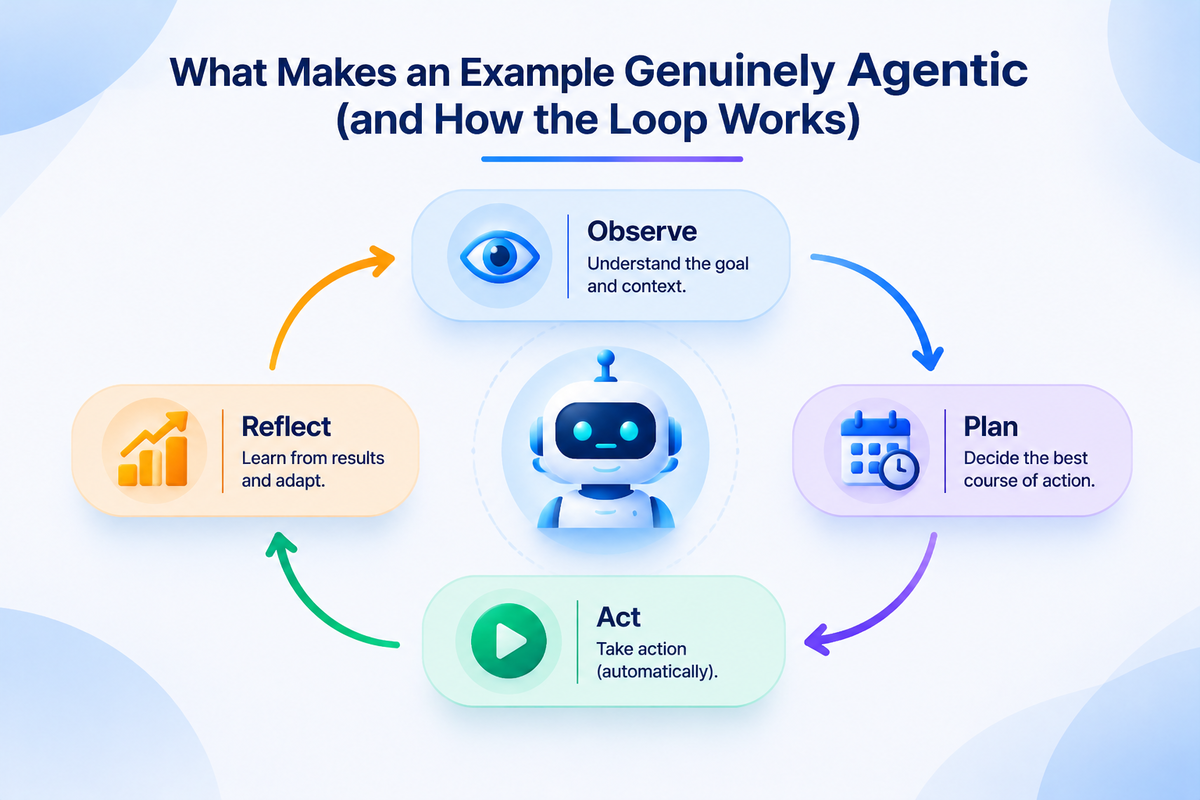
What Makes an Example Genuinely Agentic (and How the Loop Works)
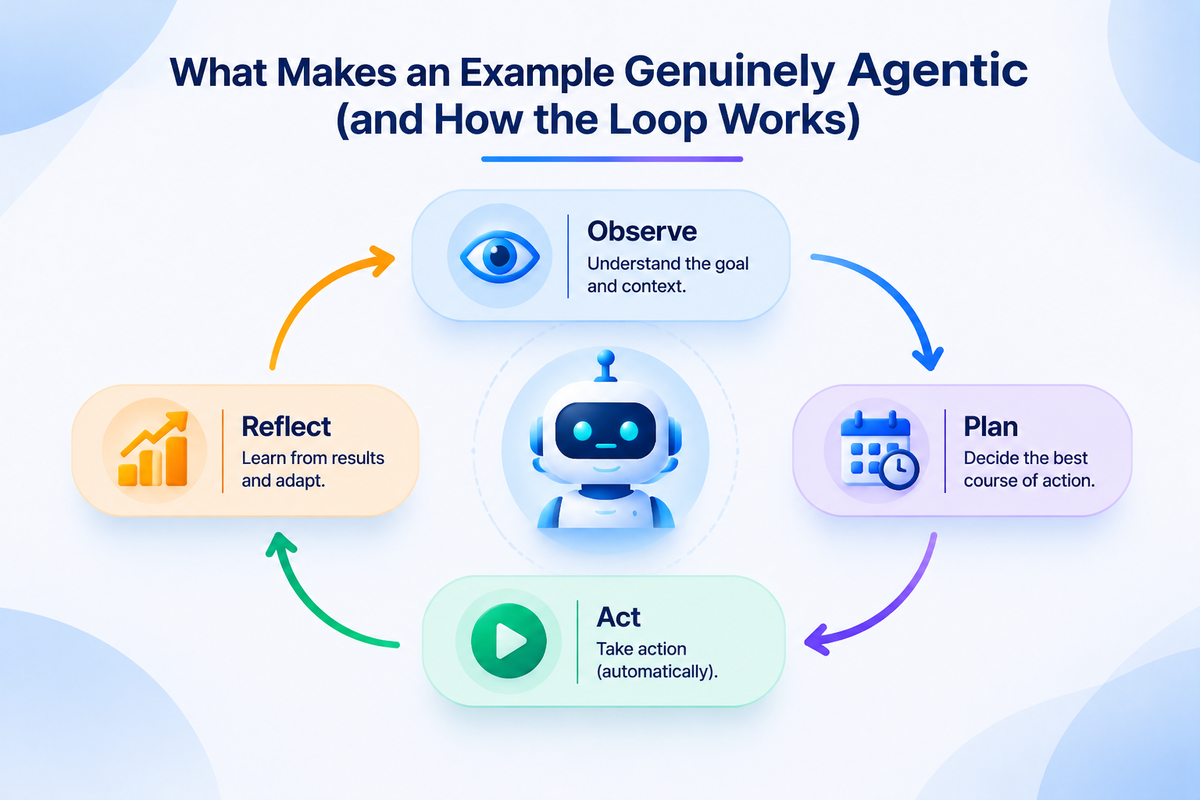
A system counts as agentic in this guide only if it shows these five traits:
Goal: it pursues an outcome ("resolve this refund"), not a single prompt. A chatbot: one reply per prompt.
Tools: it reads from and writes to other systems through APIs. A chatbot: text only.
Autonomy: it chooses the next step itself, within limits you set. A chatbot: waits for you.
Memory and state: it keeps context across steps and sessions. A chatbot: often starts fresh.
Guardrails: permissions, spending or action limits, logging and escalation to a human. Without them, no agent is trustworthy.
For the finer distinction between a single agent and a wider agentic system, see how AI agents differ from agentic AI.
How does agentic AI work? The agent takes a goal, plans a step and makes a tool call, meaning the model asks software to perform an action such as looking up an order. It checks the result, then plans the next step or, if the step failed or exceeds its permissions, escalates to a person. Each stage is broken down in agentic workflows step by step.
Customer Service and IT Operations
Customer service and IT are where most agentic AI use cases start, because the work is high-volume, rule-bound and easy to measure. The three examples below resolve requests across systems instead of just answering questions.
Agentic AI in customer service builds on the chat and voice channels many firms already run. If you are earlier in that journey, start with conversational AI in customer service.
Finance, Banking and Insurance
Agentic AI in banking and insurance moves slower than in other sectors because every automated decision needs an accountable owner. These three examples show how firms keep a human signature on the decisions regulators care about.
The institution, not the model, stays accountable for credit, fraud and claims decisions, which is why deployments in finance pair every agent with audit logs and a named approver. For the regulatory side, see the explainability rules US regulators expect.
Improve Your Business with AI!
Healthcare: Administrative Agents, Not Clinical Ones
Agentic AI in healthcare is real today mainly in administrative work such as scheduling, prior authorization and revenue-cycle tasks, not in diagnosis or treatment. The two examples below keep clinicians and staff in charge of every decision that affects care.
Any patient-facing or clinical use of an agent needs clinical governance and a HIPAA review before it goes live, so involve qualified compliance and clinical professionals early. Nothing in this section is medical advice.
Manufacturing, Supply Chain and Retail
Agentic AI in manufacturing and supply chain builds on forecasting models, such as the predictive AI already used by US companies. The prediction says what will happen, and the agent decides what to do about it within set limits. Both examples below act on that forecast, but a planner signs off on costly changes.
Software, Marketing and Data Work
Knowledge work is where agents are easiest to try, because the tools are already digital and the output can be reviewed before it ships. The last two examples follow that pattern, and they also show where agents tend to break.
Where Even Good Agents Fail
Three failure patterns recur:
Hallucinated actions: the agent calls the wrong tool or invents a parameter, such as an order number that doesn't exist.
Permission creep and prompt injection: the agent's service account gains more rights than any employee would have, and malicious text in an email or web page can redirect it.
Unclear accountability: nobody owns the agent's decisions, so errors sit unresolved.
Which raises the practical question: how do you tell a real agent from a chatbot or an automation script with a new label?
Agent, Chatbot, RPA or Generative AI? How to Tell Them Apart
The plain answer to agentic AI vs generative AI: generative AI produces content when asked. Traditional automation such as RPA follows a fixed script. An AI agent pursues a goal across several steps and systems, decides the next step itself, and escalates when it hits its limits.
|
|
Who decides the next step |
What it can act on |
How it handles exceptions |
Typical human role |
Typical failure |
Example from this list |
|
Rules-based automation / RPA (including classic ML, or "traditional AI") |
The script or model designer |
Fixed screens, fields and APIs |
Stops or raises an error |
Builds and maintains the rules |
Breaks when a screen or format changes |
No example in this list |
|
Chatbot or copilot |
The user, prompt by prompt |
Mostly text; some read-only lookups |
Hands back to the user |
Asks, reviews and acts |
Confident wrong answer |
— |
|
Generative AI assistant |
The user |
Documents, images, code drafts |
None built in |
Edits and approves output |
Plausible but inaccurate content |
— |
|
Agentic AI |
The agent, within set limits |
Several systems, read and write |
Retries, reroutes or escalates |
Sets goals, approves risky steps |
Wrong action taken at scale |
— |
A copilot sits in the middle: it suggests and drafts, but a person still clicks the button. If that sounds closer to what you need, read about what an AI copilot does.
The table also settles agentic AI vs traditional AI: a classic model scores or classifies, while an agent uses that score to choose its next step. With agentic AI vs RPA or a chatbot, the deciding question is who picks the next step and how exceptions are handled.
Most real deployments combine these categories; an agent often calls RPA bots and a generative model as tools. The right choice depends on how much the task varies from one case to the next.
How to Spot Agent-Washing: A Five-Question Test
Agent washing means rebranding existing assistants, RPA tools or chatbots as "agents" without real agentic capability. In its June 2025 release on agentic AI project cancellations, Gartner estimated that only about 130 of the thousands of vendors claiming agentic AI are real, and forecast that over 40% of agentic AI projects will be canceled by the end of 2027.
Ask every vendor these five pass/fail questions:
1. Goal: Can it take an outcome and plan its own steps? Fail: it needs a prompt for every step.
2. Tools: How many of my systems can it act in, reading and writing? Fail: it only reads, or only chats.
3. Autonomy and exceptions: What happens when a step fails? Fail: it stops silently, or there is no defined escalation.
4. Memory: Does it keep state across a case that runs for several days? Fail: every session starts blank.
5. Guardrails: Where are the audit logs, and which step requires human approval? Fail: there are no logs, or approval can't be configured.
Ask for a live run in your own test environment, not a slide deck or a scripted demo. Watch for these red flags of agent washing:
A chat window shown in place of a live demo.
"Workflow automation" renamed as an agent.
No stated limits or failure modes.

How to Choose a First Use Case for an AI Agent
The best first pilots share six traits:
High volume with clear rules.
Data and systems accessible through APIs.
Reversible errors.
A human can approve the risky step.
Success measurable in 60–90 days.
A low-risk internal process, not customer-facing work.
Each trait shapes the build effort, as explained in what building an AI agent involves. Not every problem needs an agent: if the task never varies, RPA or a simple workflow is cheaper and easier to audit.
Tooling falls into three broad categories: agent platforms, developer frameworks, and agents built into suites you already use. These are compared in AI agent options for businesses.
If more than one process looks promising, structured use-case discovery helps narrow the shortlist before any build starts. Once you have a candidate use case, the next questions are cost and who runs the pilot.
What a First Agentic AI Pilot Costs and How to Start
Agentic AI pricing depends less on the model than on how many systems the agent must touch and how much control you need around it. Here is what published estimates say, what drives the number and how a scoped pilot runs.
What Published Estimates Say and What Drives the Cost
Published estimates of AI agent development cost vary widely, mostly because of scope. A single agent with one integration is a very different project from a multi-agent system wired into legacy platforms under compliance controls. Treat any figure you see as a scoping input, not a quote.
Five drivers decide most of the cost:
Integrations: usually the largest. Each connected system needs secure access, error handling and testing.
Data readiness: without clean, well-permissioned data, the agent acts on bad inputs.
Model and token usage: scales with volume and the number of reasoning steps per case.
Security, compliance and audit work: logging, approval flows, access reviews and, in regulated sectors, model-risk documentation.
Ongoing run costs: monitoring, evaluation, prompt and policy updates, and support. These continue after launch.
Cost overruns are a real risk. The Gartner cancellation forecast in the agent-washing section names escalating costs, unclear business value and inadequate risk controls as the main reasons projects stall.
Build, Buy or Partner
Buy when a packaged agent already covers the process in software you own.
Build when the agent touches your own systems and data and you have an engineering team to maintain it.
Partner when you need the integrations and governance but lack the in-house capacity.
What a Scoped Pilot Looks Like
A sound agentic AI implementation starts small: one process, one team, one clear success measure, and a human approval step on anything risky. That keeps cost visible and the go/no-go decision simple. The harder work comes in moving an AI pilot into production: hardening security, scaling integrations and assigning long-term ownership.
Centric has worked on digital projects since 2011, has delivered more than 2,000 projects and holds ISO 27001 certification, with offices in Houston and Mountain View. If you want an outside view on scope before committing budget, a short consulting call is a reasonable first step.
Ready to scope a pilot without overspending?
Agentic AI FAQs
Short answers to the questions leaders ask most often when they first look at agents.
Is ChatGPT agentic?
Standard ChatGPT chat is not agentic: it answers each prompt and waits for the next. ChatGPT agent, OpenAI's agent mode, can browse, use tools and complete multi-step tasks, and it asks the user to confirm before consequential actions such as purchases. That mode fits the definition; everyday chat does not.
What is the most popular agentic AI?
No reliable, independent usage ranking exists, so be wary of any list that claims one. Most leaders first meet agents inside software they already pay for, such as their CRM, service desk, office suite or coding tools. That is often the lowest-friction place to test the approach.
What are the top agentic AI frameworks?
Frameworks fall into three groups: orchestration frameworks, vendor SDKs and low-code agent builders. Well-known options include LangGraph, CrewAI, Microsoft Agent Framework, the OpenAI Agents SDK and Google's Agent Development Kit (ADK). This is not a ranked or tested list; the right fit depends on your stack and team skills.
What exactly is agentic AI?
Think of a trusted junior employee with a defined goal, access to specific systems and a manager who signs off on anything risky. Agentic AI is software built to work the same way: inside limits you set, logging each action so someone can check what it did and why.
Key Takeaways: Agentic AI Examples Worth Learning From
The agentic AI examples worth studying share four traits: a defined goal, access to real tools, limited autonomy and a clear point where a human approves. The strongest early wins come from high-volume, reversible processes, not from high-stakes customer or clinical decisions. Agent-washing is common, so test every claim against a live run in your own environment before you buy.
When you are ready to rank your candidate use cases or scope a first pilot, Centric's AI team is a practical place to turn next. It can help you apply these tests to your own processes and systems.