If you’re focusing solely on Google for your SEO efforts, you might be overlooking a valuable traffic source: Bing. In this guide, we’ll dive into how SEO works in Bing, helping you unlock the potential of this often-overlooked search engine.
While Google remains the dominant player, Bing has been quietly gaining ground, with a significant user base, particularly in specific demographics and regions. As more users turn to Bing-powered platforms like Yahoo, Microsoft Edge, and even ChatGPT, optimizing for Bing is becoming a strategic necessity.
Centric specializes in helping businesses expand their digital presence across all major search engines, including Bing.
In this guide, you’ll learn how to effectively optimize your website for Bing, improve your rankings, and drive more traffic. From understanding Bing’s unique ranking factors to actionable optimization tips, we’ll cover everything you need to know to boost your visibility and capture valuable traffic. Let's get started!
What is Bing SEO?
Bing SEO refers to the process of optimizing your website to perform better on the Bing search engine. Similar to other search engines, Bing uses its unique set of Bing ranking factors to determine how pages are ranked on its search engine results pages (SERPs).
By aligning your website with these factors, you increase your chances of ranking higher, driving more organic traffic from Bing. While Google often steals the spotlight, Bing remains an important player in the search engine landscape, with millions of searches every day.
The key difference between Bing SEO and Google SEO lies in their algorithms and ranking priorities. While both search engines consider factors like content relevance, backlinks, and user engagement, Bing search engine optimization places more emphasis on exact-match keywords, domain age, and backlink quality.
On the other hand, Google’s algorithm is more dynamic, relying heavily on user intent, AI-driven content relevance, and engagement metrics.
Why Bing SEO Matters for Your Business?
Bing SEO strategies offer significant potential for driving traffic, especially among specific markets. Bing commands a solid share of the desktop search engine market, which can be crucial for businesses targeting professional users who access search engines through workstations.
In addition, Bing's integration with Windows and Microsoft Edge increases its visibility in markets where these products dominate.
By optimizing for Bing, businesses can also tap into specific demographics that show higher conversion rates, such as older and more affluent users. This makes Bing SEO a key strategy to ensure your content is seen by valuable audiences, giving you an edge over competitors who might overlook Bing as a search engine platform.
4 Key Ranking Factors in Bing’s Algorithm
To successfully optimize for Bing search engine traffic, understanding the core ranking factors of the Bing search algorithm is essential. These factors determine how your website ranks on Bing’s search engine results pages (SERPs).
While Bing’s ranking system shares some similarities with Google’s, it has its unique set of priorities. By aligning your website with these ranking factors, you improve the chances of appearing higher in Bing’s search results, ultimately driving more organic search on Bing.
Exact-Match Keywords
One of the most significant ranking factors for Bing search engine optimization is the use of exact-match keywords. Unlike Google, which interprets semantically related terms, Bing tends to favor web pages that use the exact keywords a user is searching for.
When your target keyword appears in the title, headings, URL, and throughout the content, Bing’s indexing techniques can quickly understand the topic of the page, improving its relevance to search queries. This focus on exact keywords makes it easier for businesses to rank for niche or specific terms compared to Google, where competition can be stiffer.
Backlink Quality
Backlinks play a crucial role in Bing search engine traffic. The Bing search algorithm places significant weight on the authority and quality of backlinks rather than just the quantity. A few high-quality backlinks from trusted, authoritative websites in your niche can boost your rankings more effectively than dozens of low-quality links.
These backlinks signal to Bing that your website is trustworthy and relevant, making it a valuable resource for users searching on its platform. Focusing on building meaningful relationships and acquiring backlinks from reputable sources is key to improving your organic search on Bing.
User Experience & Engagement
User engagement metrics are critical to Bing’s ranking algorithm. Bing tracks how users interact with your content, including factors such as dwell time, bounce rates, and page visits. Websites that keep users engaged and encourage them to stay on the page longer are favored.
High levels of user engagement signal to Bing’s indexing techniques that your content is valuable, relevant, and meets the user's needs. To improve rankings, focus on providing high-quality content, ensuring that it is easy to navigate, and minimizing distractions that could lead to a high bounce rate.
Mobile-Friendliness and Site Speed
With more users accessing the internet via mobile devices, Bing search engine optimization increasingly prioritizes mobile-friendliness and page load speed. Bing’s search algorithm rewards websites that offer a seamless mobile experience and load quickly, regardless of the device used.
Slow-loading pages or those that are not mobile-optimized can result in a poor user experience, negatively affecting your rankings. To capture more organic search on Bing, ensure that your site is responsive and optimized for mobile, with fast load times and minimal elements that could slow it down.
Step-by-Step Guide to Optimize Your Website for Bing SEO
Optimizing your website for Bing search engine traffic requires a methodical approach to align your content and structure with Bing web search optimization strategies. Unlike Google, Bing has specific ranking factors that focus on clarity, user engagement, and exact-match keywords.
In this step-by-step guide, we’ll walk you through the process to improve your rankings on Bing and drive more targeted traffic. Whether you’re just starting or need to refine your approach, these actionable steps will help you achieve measurable results.
Step 1: Register and Use Bing Webmaster Tools
The first step to optimizing your website for Bing is to register and use Bing Webmaster Tools. This free tool allows you to submit your site’s sitemap, monitor its performance, and track Bing’s indexing techniques.
By submitting your sitemap, Bing can crawl your pages more efficiently and help you identify issues such as broken links, crawl errors, or missing meta tags. Regularly using Bing Webmaster Tools ensures that you are always up-to-date with Bing’s algorithm changes and allows you to fine-tune your website to improve your rankings on Bing.
Step 2: Focus on Exact-Match Keywords
To improve your visibility in Bing search results, focusing on exact-match keywords is crucial. Unlike Google SEO, which places more emphasis on semantic search and related keywords, SEO for Bing vs Google requires more precise targeting.
Ensure that your exact target keyword appears in key places like your page title, meta description, and URL. Additionally, integrate it naturally into your content, headings, and image alt text. By doing this, you improve your content’s relevancy and increase the likelihood of how to improve rankings on Bing.
Step 3: Enhance User Experience
User experience is a vital component of Bing web search optimization. Bing favors websites that provide a positive experience for users by reducing bounce rates and encouraging engagement.
To enhance the user experience, ensure your website’s navigation is intuitive, and your content is easy to read. Use clear headings, concise paragraphs, and a visually appealing layout to keep users on your site longer. The more time users spend on your website, the better your chances of ranking higher in Bing search results.
Step 4: Build High-Quality Backlinks
Backlinks remain one of the most powerful ranking factors in Bing SEO. Unlike Bing vs Google SEO, where Google prioritizes the quantity of backlinks, Bing tends to focus more on the quality of backlinks.
Acquire backlinks from authoritative and relevant websites in your niche. These high-quality backlinks signal to Bing that your site is trustworthy and credible. To build these links, consider guest posting, collaborating with industry influencers, or creating valuable content that naturally attracts backlinks.
Step 5: Leverage Social Media Signals
Social signals, such as shares, likes, and engagement, play a role in Bing search engine optimization. Bing takes these signals into account when determining the authority and relevance of your content.
To leverage social media marketing campaigns for Bing, regularly post your content on popular platforms like Facebook, X, and LinkedIn. Encourage engagement by crafting posts that resonate with your audience. The more social traction your content gains, the more likely it is to rank well on Bing.
Step 6: Implement Structured Data
Implementing structured data (schema markup) is an essential step in Bing SEO. Schema markup helps Bing’s search engine traffic understand and categorize your content more accurately. By adding structured data to your website, you make it easier for Bing to display rich snippets, knowledge panels, and other enhanced search features.
This leads to higher click-through rates and increased visibility in Bing search results. Use SEO tools like Schema.org to mark up your content with the appropriate schema tags.
Step 7: Monitor and Adjust Your Bing SEO Strategy
SEO is an ongoing process, and tracking your performance is essential for continued success. Using Bing Webmaster Tools, regularly monitor your website’s performance, including keyword rankings, backlinks, and user engagement metrics. Review your data to see what’s working and identify areas that need improvement.
As Bing’s algorithm evolves, make adjustments to your strategy to ensure your website remains optimized and competitive. How to improve rankings on Bing is a continuous effort that requires staying proactive and adaptive.

How to Track Your Bing SEO Performance?
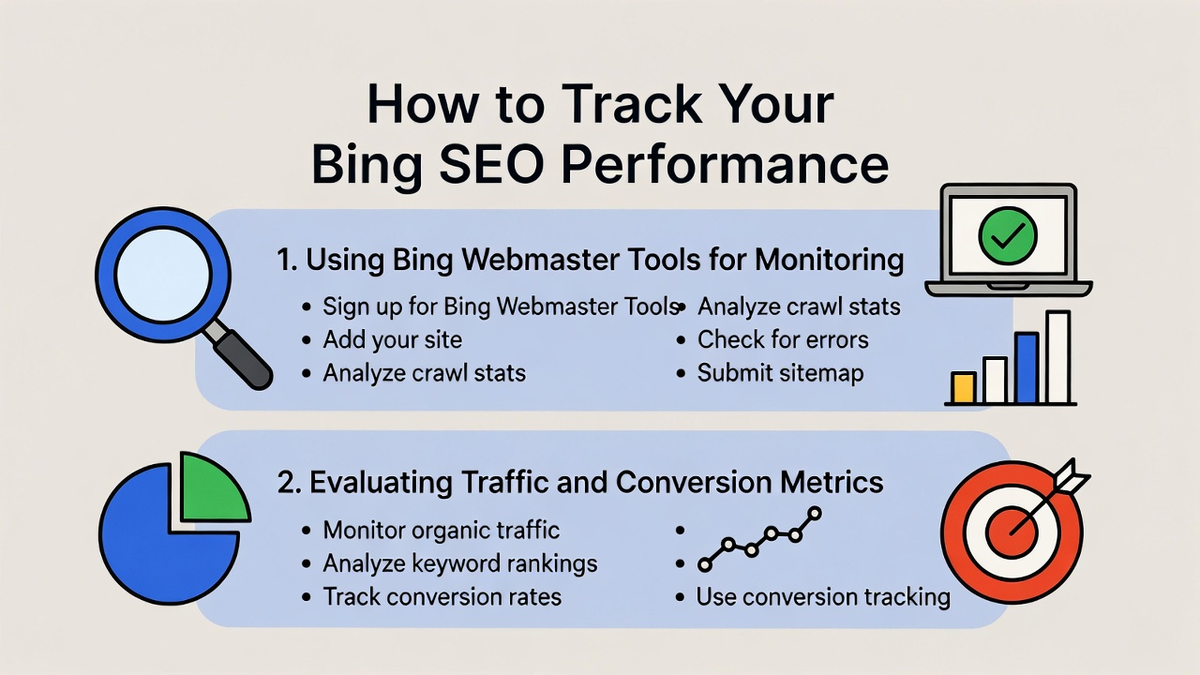
Tracking your Bing SEO performance is essential for understanding how well your optimization efforts are paying off. By monitoring your Bing search engine ranking and analyzing key metrics, you can refine your strategy and ensure continuous improvement.
Effective tracking helps you identify which areas need more attention, ensuring that your website stays visible in Bing search results and continues to drive organic search on Bing. Here’s how you can track your Bing SEO performance effectively using the right tools and data points.
Using Bing Webmaster Tools for Monitoring
Bing Webmaster Tools is an essential platform for tracking your website's SEO performance. By using Bing indexing techniques, this tool helps you identify how your content is being crawled and indexed by Bing. It provides valuable insights into keyword performance, which pages are performing best, and any issues preventing your site from being indexed correctly.
Additionally, it tracks backlinks and shows which external sites are linking to your pages. By keeping an eye on these factors, you can make informed decisions to adjust your Bing search engine traffic strategy and improve your Bing search engine ranking.
Evaluating Traffic and Conversion Metrics
To understand how organic search on Bing is impacting your business, you need to analyze traffic sources and conversions coming from Bing. Look at metrics like the number of visitors, the duration of their visits, and which pages they are landing on from Bing search results. This will help you gauge how effective your Bing SEO efforts are.
You can also track conversion rates, such as sign-ups or product purchases, to understand the quality of traffic you're getting from Bing. Using tools like Bing Webmaster Tools and Google Analytics, you can evaluate this data and make adjustments to your strategy to boost conversions and improve your overall Bing search engine ranking.
Advanced Bing SEO Strategies for Long-Term Success
To achieve sustained success with Bing SEO strategies, it’s essential to focus on advanced techniques that not only improve your rankings but also maintain them over time. Long-term Bing SEO tips revolve around factors like content freshness, local optimization, and continuous monitoring of key performance indicators.
By incorporating these strategies into your SEO efforts, you can ensure that your website remains relevant, visible, and competitive in Bing search results for the foreseeable future.
The Importance of Content Freshness
One of the most effective Bing SEO tips for improving rankings over time is regularly updating your content. Bing’s search engine algorithm rewards fresh, relevant content because it indicates that your site is active and keeping up with the latest trends.
Regularly updating blog posts, articles, or even adding new pages ensures that your site remains relevant and visible to Bing’s search crawlers. By focusing on content freshness, you signal to Bing search engine traffic that your site is offering current and valuable information, which can significantly improve your Bing SEO strategies and boost your rankings in the long run.
Building a Strong Local SEO Presence with Bing Places
For businesses targeting local customers, optimizing for local searches on Bing is essential. Bing Places for Business is a powerful tool for improving your local SEO presence. By claiming and optimizing your Bing Places profile, you can ensure your business appears in local search results and on the Bing map.
Having an up-to-date profile with accurate information such as your business hours, address, phone number, and photos will not only help your business stand out but also improve its Bing search engine ranking for location-based queries. This is one of the most effective Bing SEO strategies for businesses that rely on local customers.
Bing SEO vs Google SEO: Key Differences and Similarities
When it comes to Bing SEO strategies versus Google SEO, understanding the differences and similarities is crucial for optimizing your content effectively. Both search engines aim to deliver the best possible results to their users, but they each have unique algorithms and ranking priorities.
By knowing these distinctions, you can tailor your SEO approach to match the specific preferences of each search engine and improve your visibility across both platforms. Here, we’ll explore the key differences in ranking factors, user behavior, and more, allowing you to leverage each search engine’s strengths to your advantage.
Ranking Factors: Comparing Bing’s Algorithm to Google’s
While Google SEO and Bing SEO share some common ground, their ranking factors are not identical. Google tends to emphasize search intent, content relevance, and user engagement, while Bing’s algorithm gives more weight to exact-match keywords, domain authority, and social signals.
For example, Bing search engine optimization tends to prioritize backlinks from authoritative domains and exact keywords in titles and descriptions. On the other hand, Google uses AI-driven content analysis, taking into account factors like semantic search and user behavior signals.
Understanding these key differences allows you to fine-tune your content to meet the specific needs of each search engine. By implementing both Bing SEO strategies and Google SEO techniques, you can achieve broader visibility and capture traffic from both platforms.
Search Intent and User Behavior in Bing
While Google has made significant strides in understanding search intent through AI and machine learning, Bing SEO strategies are more focused on matching exact keywords with user queries. Bing search engine traffic is influenced by different user behavior patterns compared to Google, which means understanding these patterns is key to optimizing content effectively.
Bing users often engage with more specific, exact-match queries, and the platform’s algorithm rewards clear and concise content that directly addresses those needs. When optimizing for Bing, ensure that your content clearly targets these exact terms, with an emphasis on keywords that are highly relevant to what Bing users are searching for.
This means creating content that’s aligned with Bing search engine ranking factors while considering user behavior and intent.
Why You Shouldn’t Ignore Bing SEO?
While Google remains the dominant player in the search engine market, Bing SEO offers distinct advantages that shouldn’t be overlooked. With less competition and a unique user base, optimizing for Bing can provide businesses with valuable opportunities to increase visibility and drive targeted traffic.
In this section, we’ll explore why Bing should be an integral part of your SEO strategy, from faster rankings to reaching a high-value audience that Google may not fully capture.
Lower Competition and Faster Rankings
One of the key advantages of Bing SEO is the relatively lower competition compared to Google. Many businesses focus their SEO efforts solely on Google, which results in highly competitive search results. On the other hand, Bing search engine optimization benefits from fewer businesses optimizing specifically for its platform.
This means there are more opportunities to rank highly with less effort, especially in niche industries where Google may have saturated results. By optimizing for Bing search engine ranking, businesses can achieve faster rankings and higher visibility, making it a great option for those looking to gain an edge over competitors.
Reaching a Different, High-Value Audience
Bing serves a unique audience that differs significantly from Google’s. Research has shown that Bing users tend to be older, more affluent, and more engaged than the average internet user. This makes Bing a powerful tool for targeting high-value audiences with higher conversion potential.
For businesses in industries like finance, health, or real estate, Bing search engine traffic can deliver users who are ready to make purchasing decisions. By targeting this demographic with tailored Bing SEO strategies, you can effectively capture more qualified leads and improve your conversion rates. This is why SEO for Bing is a key part of reaching a more specific and profitable customer base.
FAQs
What are the key differences between Bing SEO and Google SEO?
Bing SEO emphasizes exact-match keywords, domain authority, and social signals, while Google SEO focuses on search intent, content relevance, and user engagement. Understanding these differences is crucial to tailor your strategy for each platform and improve Bing search engine ranking effectively.
How can I improve my rankings on Bing?
To improve your Bing SEO, focus on exact-match keywords, high-quality backlinks, and providing a great user experience. Regularly update your content, optimize for mobile, and use Bing Webmaster Tools to track your site’s performance and identify areas for improvement in Bing search engine traffic.
Why should I optimize my website for Bing SEO?
Optimizing for Bing SEO helps capture traffic from a unique user base, especially in desktop searches. Bing search engine optimization offers less competition and quicker rankings, providing opportunities for businesses to rank higher and reach valuable customers with higher conversion potential.
Does Bing prioritize mobile-friendliness in SEO?
Yes, Bing search engine optimization requires mobile-friendliness and fast load times for better rankings. While Bing is more desktop-oriented, mobile responsiveness is still crucial for improving user experience, reducing bounce rates, and ensuring your site ranks well in Bing search engine traffic.
Conclusion
Understanding how SEO works in Bing is crucial for businesses looking to expand their digital footprint beyond Google. With its unique ranking factors, less competition, and valuable audience, optimizing for Bing can significantly boost your visibility and drive targeted traffic.
By incorporating Bing SEO strategies into your broader digital marketing plan, you tap into a market segment that is often overlooked, resulting in faster rankings and higher conversions.
Centric specializes in optimizing businesses’ digital presence across multiple search engines, including Bing. Our expertise in Bing SEO helps clients leverage this powerful platform, ensuring they reach new customers and gain a competitive edge. With our tailored strategies, your business can thrive in both Google and Bing search results, maximizing overall online visibility and success.