



AI-ready data is data that's fit for a specific AI use case: representative of the situations the AI will face, accessible, governed and secure, described with good metadata, delivered by reliable pipelines, and monitored over time. It isn't the same as "clean" data, and it's never finished. Readiness is judged one use case at a time.
When an AI project stalls, the model is often not the problem. Gartner's research points at the data instead: scattered, overshared, out of date, or simply not the data the use case needs. A Copilot pilot surfaces a file nobody meant to share. A forecast looks great until a season it never saw. An agent answers confidently from a customer record that exists three times.
This guide explains what AI-ready data actually means, how readiness changes with the kind of AI you're building, how to score where you stand, and how to prepare data for your first use case without starting a company-wide cleanup program you'll never finish. It follows the approach behind Centric data and AI services: start from one use case ranked by business value, build on your data inside your security controls, and prove progress on one domain before scaling.
There's No Such Thing as AI-Ready Data in General
The most useful idea in this whole topic is also the simplest: data is only AI-ready for a particular use case. Gartner puts it this way in its research on AI-ready data: the data has to be representative of the use case, including the patterns, errors, outliers and unexpected cases the AI needs in order to be trained or to run. Gartner also stresses that AI-ready data is an ongoing practice, not a one-off project.
That's a different standard from the one most organizations use for reporting. Data that's perfectly fine for a monthly dashboard can be useless, or risky, for AI:
|
Analytics-ready data |
AI-ready data |
|
|
Purpose |
Answer known questions in reports and dashboards |
Train or ground AI for a specific use case |
|
Completeness |
Accurate totals and trends |
Covers the full range of situations the AI will meet |
|
Errors and outliers |
Usually cleaned out |
Often needed, and documented, so the AI learns or handles them |
|
Unstructured content |
Rarely in scope |
Often central (documents, emails, tickets, pages) |
|
Access |
Report-level security |
Item-level permissions that AI tools respect, so oversharing becomes visible |
|
Metadata |
Field names and report definitions |
Rich, active metadata: meaning, ownership, sensitivity, lineage, freshness |
|
Lifecycle |
Refreshed on a schedule |
Monitored continuously for quality, drift and change |
The gap shows up in research. In a Gartner survey of 1,203 data management leaders, 63% said their organization either doesn't have, or isn't sure it has, the right data management practices for AI, and Gartner predicts that through 2026 organizations will abandon 60% of AI projects unsupported by AI-ready data.
That's why Centric data governance work for AI starts with a review of the quality, coverage, permissions and lineage of the data a specific use case needs, rather than a general data cleanup.
What "Ready" Means for Four Kinds of AI?
Because readiness depends on the use case, the practical question isn't "is our data ready?" but "ready for what?". This guide groups business AI into four families, because each one stresses your data differently.
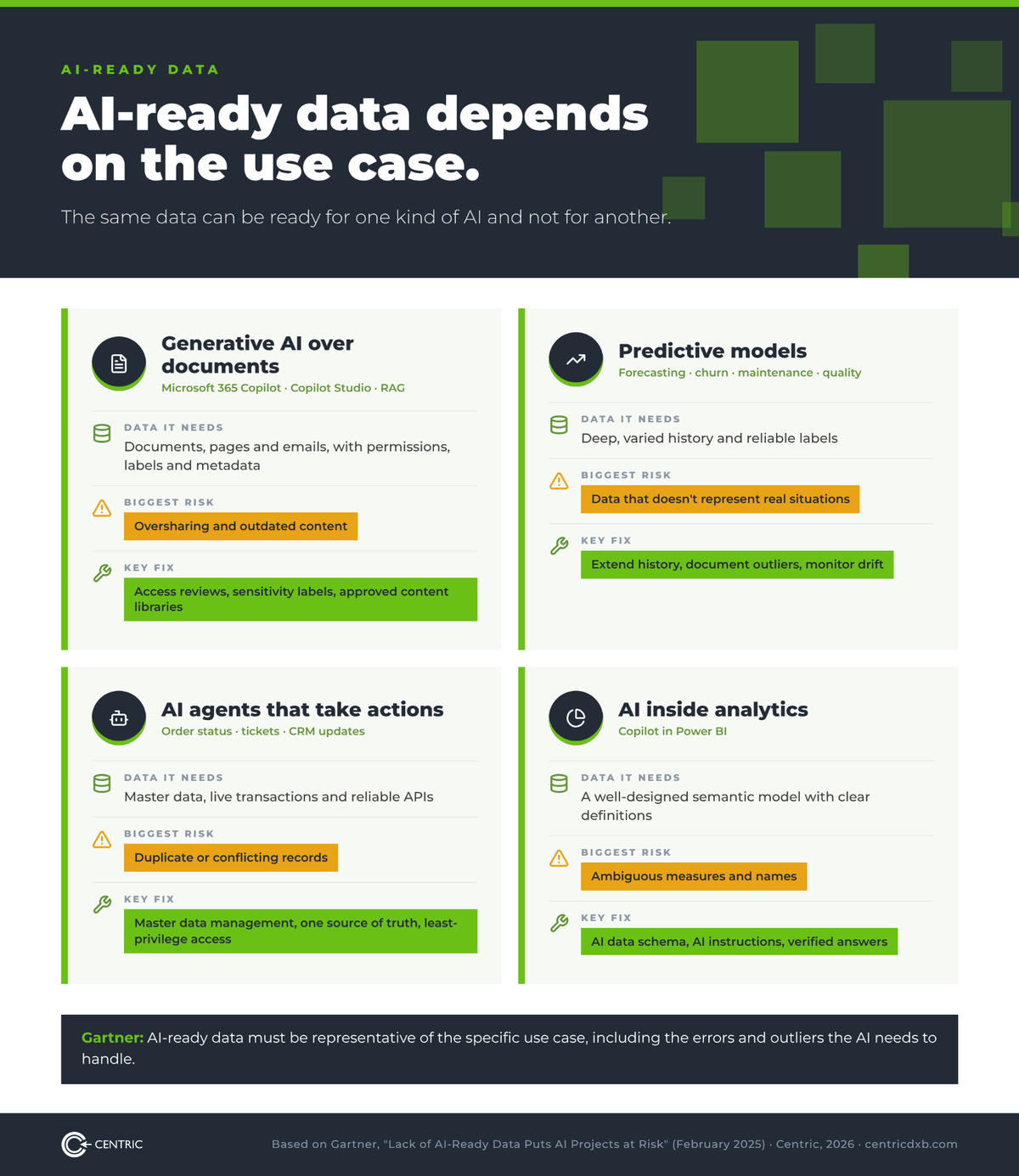
1. Generative AI Over Your Documents
Examples: Microsoft 365 Copilot, Copilot Studio agents grounded in SharePoint, chat assistants built with retrieval-augmented generation (RAG).
The data it needs: documents, pages, emails and records, mostly unstructured, plus the permissions, labels and metadata around them.
Readiness tests:
- Do the right people, and only the right people, have access to each site and library?
- Is outdated, duplicate or draft content excluded or clearly marked?
- Are sensitive documents labeled, so policies can follow them?
- Is content described well enough to be found: titles, content types, metadata?
Where it usually breaks: permissions. Microsoft 365 Copilot answers using data the user already has permission to access, and Microsoft notes that overshared and outdated content can lead to inaccurate results. Copilot doesn't create oversharing; it makes existing oversharing easy to find.
Microsoft tools that help: SharePoint Advanced Management (data access governance reports to find overshared sites, site access reviews for owners, and Restricted Content Discovery to keep a site out of Copilot and organization-wide search without changing permissions); Microsoft Purview (Data Security Posture Management for AI, sensitivity labels and DLP). For your own RAG applications, Azure AI Search provides hybrid search and built-in chunking and vectorization, so the quality and structure of the source content carry straight into answers. Good SharePoint content types and metadata pay off here.
How Centric helps: our Copilot readiness assessment reviews data readiness, security posture and organizational readiness before rollout. Our data governance team applies sensitivity labels and access rules that stop Microsoft 365 Copilot and other AI tools from exposing data people shouldn't see, and our SharePoint document management work sets up the metadata, content types and role-based permissions that make content findable and safe. When you build your own assistants, our Copilot Studio and generative AI teams ground them in approved sources, inside your security controls.
Example scenario: A mid-sized industrial distributor pilots Copilot with its sales team. On day two, a rep asks for "last year's compensation guidelines" and gets a summary of an HR salary spreadsheet stored on a site shared with everyone in the company. Nothing was hacked; the file had been overshared for years. The fix wasn't a Copilot setting. It was a data access governance report, site access reviews for the twenty most broadly shared sites, Restricted Content Discovery on HR sites while owners cleaned up, and sensitivity labels on salary data.
2. Predictive Models
Examples: demand forecasting, churn prediction, predictive maintenance, quality defect prediction.
The data it needs: structured history with enough depth and variety, and, for supervised models, reliable labels (what actually happened).
Readiness tests:
- Does the history cover the situations the model will face: seasons, promotions, disruptions, new products?
- Are errors and outliers documented, so they're kept or excluded on purpose?
- Are labels trustworthy and consistently defined?
- Is any information in the training data that wouldn't be known at prediction time (leakage)?
- Will someone notice when real-world patterns drift away from the training data?
Where it usually breaks: representativeness. Data that's "clean" by reporting standards can still miss the situations that matter most to the prediction.
Microsoft tools that help: a consolidated data platform such as Microsoft Fabric and OneLake to bring history together, with data quality checks and monitoring built into the pipelines. See how Microsoft Fabric compares with Power BI.
How Centric helps: we implement OneLake as the single governed data layer in Microsoft Fabric and design lakehouse architectures with Bronze, Silver and Gold layers that deliver curated data to Power BI and machine learning models. Our data engineering team builds the pipelines, and our MLOps practice monitors models for drift after launch.
Example scenario: A manufacturer builds a demand forecast on the two most recent years of order data, cleaned for reporting. The model performs well in testing, then badly in the first spring. The training window included a three-week plant shutdown, which the model read as a demand drop, and too little history to learn the spring buying pattern. Extending the history, flagging the shutdown as a known event and adding promotion data fixed what no amount of model tuning could.
Not Sure Where Your Data Stands For AI?
Centric data governance team assesses ownership, access, quality and metadata across the data your AI will use, including governance for AI.
Get an Assessment!3. AI Agents That Take Actions
Examples: an order-status agent for customers, an agent that creates service tickets, an assistant that updates CRM records or triggers approvals.
The data it needs: accurate master data (customers, products, suppliers), live transactional data, and reliable APIs to read and write it.
Readiness tests:
- Is there one trusted record for each customer, product and supplier the agent touches?
- Do the systems it reads from agree with each other, and is it clear which one wins when they don't?
- Does the agent's identity have only the permissions it needs?
- Is every action logged, so you can see what the agent did and why?
Where it usually breaks: master data. An answer from a duplicate or stale record is wrong in front of a customer, and an action taken on it is worse. Agents raise the stakes because they act, not just answer.
What helps: master data management to create one trusted record (what master data management is), well-documented and secured APIs (B2B API integration trends), least-privilege access and audit logging. For the architecture side, see agentic AI architecture.
How Centric helps: our MDM practice builds golden records with automated quality rules, match and merge, and exception workflows that stop bad data at ingestion, then publishes them to ERP, CRM, commerce and analytics systems through APIs. Our enterprise AI integration work connects agents to platforms such as SAP, Dynamics 365, Salesforce and ServiceNow, with human approval and audit trails, and we name a business owner for accuracy before an agent goes live.
Example scenario: A distributor launches an order-status agent on its customer portal. Within a week, a customer gets two different delivery dates for the same order. The customer exists three times, once in the ERP and twice in the CRM, and the agent picked up different records on different questions. A short master data project (matching, merging and naming one system as the source of truth for customer identity) did more for the agent than any prompt change.
4. AI Inside Analytics
Examples: Copilot in Power BI, natural-language questions on dashboards, AI-generated report summaries.
The data it needs: a well-designed semantic model: clear tables, relationships, measures and business definitions.
Readiness tests:
- Does the semantic model follow good modeling practice, such as a star schema?
- Are measures named and described so that "revenue", "margin" and "active customer" mean one thing?
- Have you limited what AI sees to the fields that matter, and recorded the business rules it should follow?
- Do the most common questions have verified answers?
Where it usually breaks: ambiguous definitions. If two measures could both be "revenue", AI will sometimes pick the wrong one.
Microsoft tools that help: Power BI's Prep data for AI features (some in preview), which save three things on the semantic model: an AI data schema (which tables and columns Copilot sees), AI instructions (business context and rules) and verified answers (approved responses to common questions). Models can then be marked as approved for Copilot. Microsoft notes that without this preparation, Copilot can give less helpful and inaccurate results.
How Centric helps: our business intelligence and reporting team builds the semantic models and role-based reports leaders rely on, and our Fabric work delivers the curated Gold-layer data underneath. A Power BI Assessment is a practical first step before turning on Copilot in Power BI.
Example scenario: A finance team turns on Copilot in Power BI. The first question from the CFO, "What was revenue last quarter?", returns gross revenue, while every finance report uses net. The model had three revenue measures with similar names and no descriptions. Hiding two from the AI data schema, adding an AI instruction that "revenue" means net revenue, and creating verified answers for the ten most common questions made the answers match the reports.

The AI-Ready Data Scorecard
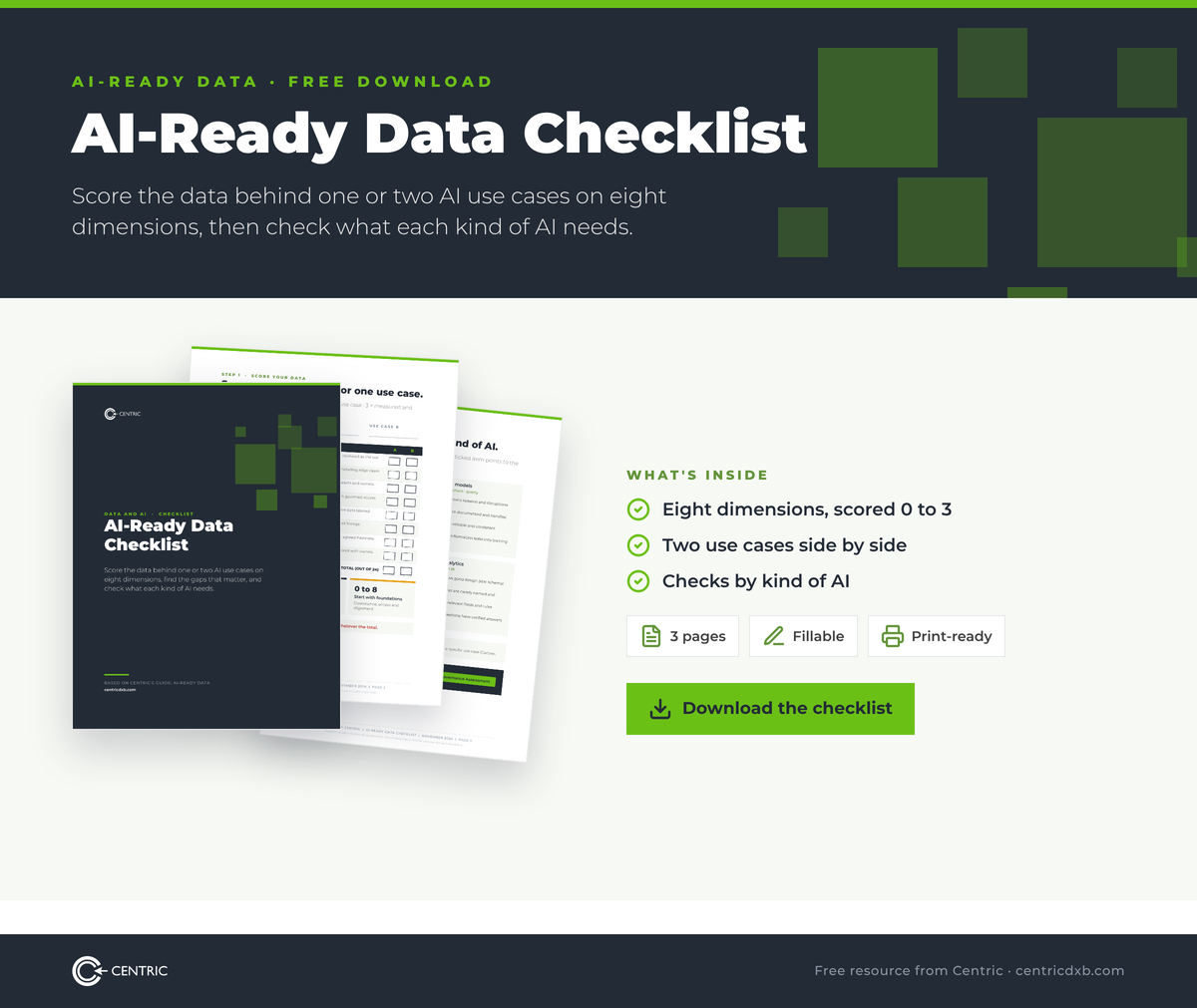
Score the data behind one specific use case, not your whole estate. For each dimension, pick the level that honestly describes it today. It extends the four areas Centric reviews for AI use cases (quality, coverage, permissions and lineage) to eight dimensions you can score yourself.
|
Dimension |
0: Not in place |
1: Partly |
2: In place for this use case |
3: Measured and maintained |
|
Use-case alignment |
No defined use case or data requirements |
Use case named; data needs vague |
Data requirements written for the use case |
Requirements reviewed as the use case evolves |
|
Coverage and representativeness |
Unknown whether data covers real situations |
Gaps known but not addressed |
Data covers the key situations, including edge cases |
Coverage checked against new situations over time |
|
Quality |
No quality rules |
Rules exist for some fields |
Rules enforced on the data this use case depends on |
Quality tracked with alerts and owners |
|
Access and integration |
Data scattered; manual exports |
Some sources connected |
All required sources available through governed access |
Integration monitored; changes managed |
|
Governance and security |
Permissions unknown; oversharing likely |
Sensitive data partly identified |
Permissions reviewed; sensitive data labeled and protected |
Access reviews and AI-specific policies run routinely |
|
Metadata and lineage |
Little documentation |
Some definitions and owners recorded |
Meaning, owner, sensitivity and lineage documented |
Metadata active: used to automate checks and decisions |
|
Pipelines and freshness |
One-off extracts |
Scheduled loads, fragile |
Reliable pipelines with agreed freshness |
Pipelines tested and observed end to end |
|
Monitoring |
None |
Ad hoc checks |
Monitoring of quality and usage for this use case |
Drift and incidents trigger defined actions |
Reading your score (out of 24): 0 to 8 means start with governance, access and use-case alignment before building; 9 to 16 means pilot carefully and fix the lowest-scoring dimensions first; 17 to 24 means you're ready to scale, so focus on monitoring. Any dimension at 0 for governance and security is a stop sign, whatever the total.
How to Prepare Data for Your First AI Use Case?
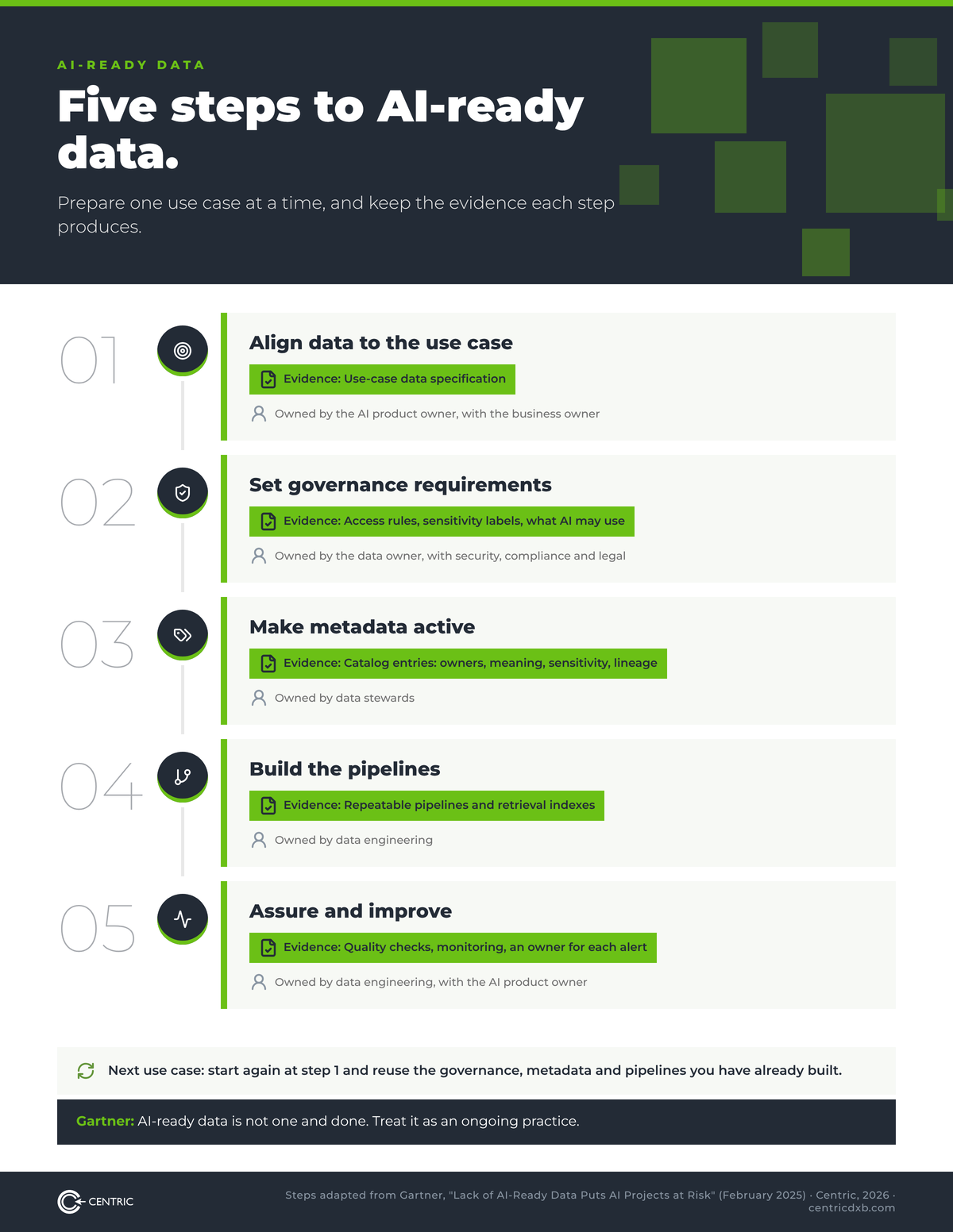
The fastest route to AI-ready data is narrow: pick one use case, make its data ready, prove it, then reuse what you built. Gartner's research sets out five steps; here's what each should produce, so you can tell when it's done.
|
Step |
Key questions |
Evidence it should produce |
Typically owned by |
|
1. Align data to the use case |
What decision or task will AI support? Which data does it need, internal and external? |
A one-page data specification for the use case: sources, fields or content, coverage needed, freshness |
AI product owner with the business owner |
|
2. Set governance requirements |
Which data is sensitive or regulated? Who may see it, and through which AI tools? What's off limits? |
Documented access rules, sensitivity labels, and decisions on what AI may and may not use |
Data owner with security, compliance and legal |
|
3. Make metadata active |
Is it clear what each field or document means, who owns it, and how fresh it is? |
Catalog entries for the in-scope data, with owners, definitions, sensitivity and lineage, used to automate checks |
Data stewards |
|
4. Build the pipelines |
How does data reach the model or retrieval index, and how often? |
Repeatable pipelines (including chunking and indexing for generative AI) with agreed freshness |
Data engineering |
|
5. Assure and improve |
How will you know when quality or relevance drops? |
Quality checks, usage monitoring and an owner for each alert |
Data engineering with the AI product owner |
Then loop back: each new use case starts at step 1 and reuses the governance, metadata and pipelines you've already built. That reuse is how readiness grows without a big-bang cleanup.
How Centric runs these steps: our AI readiness assessment evaluates data maturity, technology infrastructure, governance and security posture, and produces a gap analysis and a prioritized remediation plan before any build begins. Our data governance team then measures maturity, picks priority domains, and sets owners, policies, quality rules and the platform for the first domains, so you see progress on one domain before committing to an enterprise program.
Who Owns AI-Ready Data?
AI-ready data fails quietly when everyone assumes someone else owns it. A simple split of responsibilities avoids that:
|
Role |
Accountable for |
|
Business data owner |
What the data means, who should see it, and whether it's fit for the decision |
|
Data steward |
Definitions, quality rules and metadata for their domain |
|
AI product owner |
The use case: its data requirements, success measures and risks |
|
Data engineering |
Pipelines, integration, freshness and monitoring |
|
Security and compliance |
Access controls, labels, policies and reviews |
|
Legal |
Use of personal, contractual and licensed data in AI |
In Centric AI projects, we name a business owner for accuracy before any use case goes live and set up monitoring, so that owner sees problems before users do.
If you're also assessing wider organizational readiness (skills, governance, technology), see our guide to an AI readiness assessment.
Want A Clear Picture Of Your Data Before You Invest In AI?
Centric data team assesses your sources, quality, governance and platform, and shows where to start.
Data Maturity Assessment!Worked Example: Preparing Data for a Proposal Assistant
The goal. A B2B engineering services firm wants a Copilot Studio agent that helps its bid team answer RFP questions: company capabilities, past project descriptions, certifications and standard responses. The content lives in SharePoint, spread across a marketing site, a bids library and dozens of project sites.
Scoring the data first. The team scores the use case before building anything:
|
Dimension |
Score |
What they found |
|
Use-case alignment |
2 |
Clear goal; questions the agent must answer were listed |
|
Coverage and representativeness |
1 |
Past answers covered common questions; newer services were missing |
|
Quality |
1 |
Three versions of the capabilities statement, two of them outdated |
|
Access and integration |
2 |
All content in SharePoint, reachable through Microsoft 365 |
|
Governance and security |
0 |
The bids library also held pricing workbooks and signed contracts, shared with the whole sales department |
|
Metadata and lineage |
1 |
No content types; file names were the only description |
|
Pipelines and freshness |
1 |
No process for retiring old answers |
|
Monitoring |
0 |
No plan to review what the agent answered |
The total was 8 out of 24, with a zero on governance. That's a stop sign, not a reason to cancel.
What they fixed. They moved pricing and contracts out of the bids library and labeled them as confidential. They created an approved content library with a simple content type (topic, service line, owner, review date, approved yes or no) and pointed the agent only at that library. Marketing consolidated the capabilities statement into one approved version. The bid manager became the business owner, with a quarterly review of answers. They then added monitoring: a weekly sample of agent answers checked by the bid team, and a feedback button for corrections.
What "ready" looked like. The rescored total was 18, with no zeros. The agent answered only from approved, current content; sensitive files were out of reach; and every answer could be traced to a document with an owner and a review date. The same library, content type and review process were then reused for a second agent supporting the customer service team.
Where Centric fits: this is the kind of project where our Copilot Studio team works alongside our SharePoint consultants: governance and permissions first, an approved content library with metadata, then the agent, with guardrails, an accountable owner and monitoring.
How Centric Approaches AI-Ready Data?
These principles come straight from how Centric data and AI teams work:
-
Start from use cases ranked by business value. Our AI strategy and use-case discovery work scores each use case on feasibility, business value, data availability and implementation complexity, so the first data investment supports the use case most likely to pay back.
- Govern before you scale. Sensitivity labels, access rules and approval steps for AI use come first, with policies aligned to frameworks such as the NIST AI Risk Management Framework, ISO/IEC 42001 and the EU AI Act.
- Build on your data, inside your security controls. Generative AI is grounded in your approved sources and runs within your security perimeter, citing where answers come from.
- Fix master data at the source. Quality rules, matching and exception workflows stop bad data at ingestion, so it doesn't spread to every system and model downstream.
- Give AI one governed data layer. A single source of truth, such as OneLake in Microsoft Fabric, replaces copies scattered across systems that AI would otherwise read inconsistently.
- Name an owner and monitor. Every use case gets a business owner for accuracy, with quality and drift monitoring that alerts when something changes.
- Prove one domain before an enterprise program. Progress on one domain or use case comes before a company-wide commitment.
Ready To Move From Pilot To Production?
Centric AI team assesses data, governance, skills and technology for your priority use cases and builds a plan to get them production-ready, as an ISO/IEC 27001:2022 certified team.
AI Readiness Assessment!Frequently Asked Questions
What is AI-ready data?
AI-ready data is data that's fit for a specific AI use case: representative of the situations the AI will face, accessible through governed access, labeled and secured, documented with metadata, delivered by reliable pipelines and monitored over time.
How do I know if my data is AI-ready?
Score it against a specific use case. The scorecard in this guide rates eight dimensions from 0 to 3. A total of 17 or more with no zeros, especially on governance and security, is a reasonable sign the data is ready to scale for that use case.
Is AI-ready data the same as good data quality?
No. Quality is one part. AI-ready data also needs to represent the right situations (sometimes including errors and outliers), carry the right permissions and labels, be described with metadata and stay monitored. Data can be accurate and still not be AI-ready.
Do we need a data lakehouse before we start?
Not necessarily. For generative AI over documents, much of the work is permissions, content quality and metadata in the systems you already use. Predictive models and analytics often benefit from a consolidated platform such as Microsoft Fabric, but start from the use case and build the platform it needs.
Who should own AI-ready data?
Business data owners own meaning and access; data stewards own definitions and quality; an AI product owner owns each use case's requirements; data engineering owns pipelines and monitoring; security, compliance and legal own policies. Name them before you build.
Is making data AI-ready a one-time project?
No. Gartner describes it as an ongoing practice. Content changes, systems change and use cases expand, so readiness needs monitoring, reviews and owners, not just an initial cleanup.
How does Centric help make data AI-ready?
Centric combines data governance for AI (labels, access rules, quality and lineage), master data management, Microsoft Fabric data platforms, and AI readiness assessments, and then builds the AI itself, from Copilot Studio agents to integrated enterprise AI. Work starts with one prioritized use case and a review of the quality, coverage, permissions and lineage of the data it needs.
Final Thoughts
There's no finish line called "AI-ready data", only data that's ready for a particular job. Pick the use case that matters most, score its data honestly, fix the zeros first (usually permissions and ownership), and build pipelines and monitoring you can reuse for the next one. That's the approach behind Centric data and AI services, and it's how AI moves from impressive demos to answers people trust.