In the digital age, businesses need a robust strategy to ensure their content stands out in a crowded marketplace. How to Make Content Rank for B2B is a critical question for companies looking to improve their online presence and attract the right clients. In this guide, you'll learn the essential steps to craft SEO-driven content that not only appeals to your target audience but also ranks higher on search engines.
Centric helps businesses implement effective content strategies that boost SEO and drive traffic, ensuring content reaches its intended audience. We’ll dive into keyword research, content creation, on-page optimization, and off-page strategies that will take your B2B content to the next level.
Whether you're just starting or looking to refine your current approach, this guide will provide actionable insights that align with the best practices for B2B SEO. Learn how to optimize your content, build backlinks, and measure your success with key metrics to stay ahead in the competitive B2B space.
What is B2B SEO?
B2B SEO (Business-to-Business Search Engine Optimization) refers to the practice of optimizing a business's online content to improve visibility in search engines and attract other businesses as customers. Unlike B2C (Business-to-Consumer) SEO, which targets individual consumers, B2B SEO techniques focus on reaching decision-makers, such as executives and procurement officers, within other companies.
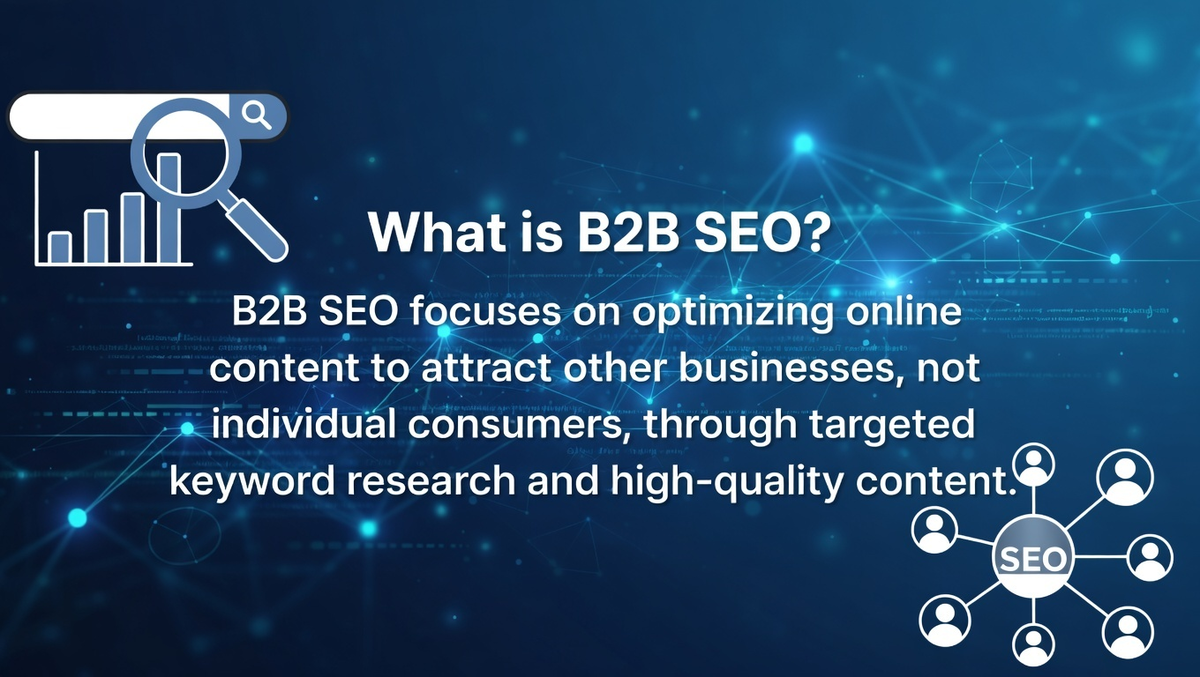
B2B SEO strategies tend to be more focused on lead generation and building long-term relationships rather than immediate consumer sales.
B2B SEO plays a critical role in B2B content marketing strategies by ensuring that content is discoverable by the right audience at the right time. For instance, a company may focus on content optimization for B2B, ensuring that their blog posts, case studies, and whitepapers rank for industry-specific keywords that appeal to other businesses.
Effective B2B SEO services is essential for generating high-quality leads and driving long-term sales in the business-to-business market.
Importance of SEO for B2B Businesses
For B2B companies, SEO is a cornerstone of their digital marketing strategy. SEO for B2B websites helps businesses increase their online visibility and attract a targeted audience. By optimizing their website and content, B2B businesses ensure they appear in search engine results when potential clients are looking for relevant products or services.
Without proper SEO, businesses risk losing out on valuable leads and brand recognition.
A solid SEO strategy for B2B companies offers numerous benefits. First, it allows companies to build authority and trust within their industry by ranking for high-value keywords. This not only helps with content optimization for B2B but also positions the company as an expert in their field.
Furthermore, B2B SEO helps businesses reduce customer acquisition costs by attracting highly qualified leads through organic search, ultimately contributing to long-term growth and profitability.
Rank Higher on Google with SEO Services
Researching Keywords for B2B Content
Keyword research is a vital step in developing an effective B2B content strategy. It allows businesses to identify the most relevant search terms that their target audience is using to find products, services, or solutions. Understanding these keywords helps businesses create content that drives traffic, increases visibility, and attracts high-quality leads.
In this section, we’ll explore the best practices for B2B keyword research strategies and provide actionable insights on how to find keywords that will boost your content’s SEO performance.
Identifying the Right Keywords for B2B
Conducting keyword research for B2B requires a more strategic approach than B2C because the target audience is typically more specific and niche. To start, it’s important to focus on the SEO ranking factors for B2B, such as search volume, keyword competition, and relevance to your business offerings.
Using best seo tools like Google Keyword Planner, SEMrush, or Ahrefs can help uncover high-value, industry-specific keywords.
By narrowing down the keyword list based on the needs and pain points of your ideal customer, you can create content that aligns with their search behavior and improves your chances of ranking higher.
Long-Tail Keywords in B2B SEO
Long-tail keywords are essential in B2B SEO campaign because they are more specific and reflect the precise needs of your audience. These keywords, which are longer phrases containing multiple words, typically have lower competition but higher intent, making them ideal for targeting decision-makers within companies.
Incorporating long-tail keywords into your content strategy can help you attract highly qualified leads who are further along in the buying cycle and ready to make a purchase decision. When using B2B keyword research strategies, focus on identifying these long-tail terms to increase your content’s visibility and drive better results.
Using Buyer Personas to Guide Keyword Strategy
A thorough understanding of your target audience is key to identifying the right keywords. By developing buyer personas—detailed profiles of your ideal customers—you can gain insights into their motivations, challenges, and search behavior.
This knowledge helps you select keywords that resonate with your audience’s needs, ensuring your content aligns with their search intent. When developing SEO-friendly content for B2B, always refer to your buyer personas to choose keywords that not only match their search terms but also address their pain points, ultimately driving higher engagement and conversions.
Crafting High-Quality B2B Content
Creating high-quality content for B2B is essential for building trust, improving engagement, and driving leads. Quality content not only increases SEO rankings but also helps establish authority within your industry.
To rank well and deliver value to your audience, the content you produce should be informative, actionable, and optimized for both search engines and user intent. In this section, we'll discuss the key elements that make content high-quality, as well as the best content types and strategies for B2B SEO.
What Makes Content High-Quality for B2B?
High-quality B2B content is clear, relevant, and deep. It provides in-depth knowledge that addresses the specific needs of your audience. When creating content, ensure it’s easy to read and offers valuable insights.
A successful B2B content creation for SEO strategy includes integrating data, case studies, and industry insights that support the content’s claims and demonstrate your expertise.
Data-backed content not only boosts your credibility but also enhances its ability to rank well in search engines. By following B2B content ranking tips, businesses can craft content that both educates and engages, ensuring their position as thought leaders in their industry.
Content Types that Work Best for B2B SEO
For B2B content to be truly effective, it needs to address the unique interests of decision-makers. Blog posts, white papers, case studies, and eBooks are excellent types of content that engage B2B audiences, providing them with the information they need to make informed decisions.
These formats are highly shareable and downloadable, making them more likely to generate leads. Additionally, integrating multimedia like videos, infographics, and interactive content can improve user engagement and boost SEO performance.
When optimized properly, these formats can enhance B2B lead generation through content by attracting and nurturing potential clients through various stages of the buyer’s journey.
Creating Content that Solves Problems
When developing content for B2B, the primary goal should be solving the specific pain points of your audience. This means going beyond just promoting products or services and instead focusing on how your solution helps businesses overcome challenges.
Educational and solution-oriented content plays a vital role in B2B content creation for SEO by ensuring that the content resonates with your audience’s needs. By offering actionable insights and addressing real business issues, your content can guide potential customers toward making purchasing decisions.
This type of content not only helps businesses rank better in search engines but also supports lead generation and builds long-term relationships with clients.
Transform Your Content into Leads with Content Marketing Services
On-Page Optimization for B2B Content
On-page optimization is a crucial aspect of SEO for B2B websites. It ensures that your content is not only valuable to your target audience but also structured in a way that search engines can easily crawl and rank it. By optimizing various on-page elements like keywords, meta tags, and internal linking, businesses can significantly improve their rankings and visibility.
Let’s explore the key elements of on-page SEO for B2B and how to make your content SEO-friendly.
Optimizing Content for Target Keywords
To rank higher in search results, it’s essential to integrate your target keywords naturally into the content. Use keywords in the introduction, body text, and conclusion to maintain a natural flow. Incorporating keywords into headings and subheadings enhances on-page SEO for B2B by helping search engines understand the structure and relevance of your content.
Avoid keyword stuffing and focus on creating content that is both informative and optimized for search engines.
Importance of Meta Tags for B2B Content
Meta titles and descriptions are critical for improving click-through rates and attracting the right audience. Craft compelling meta titles that include your target keyword and a call to action. The meta description should summarize the content’s value in a concise and engaging manner.
Optimizing these elements for on-page SEO for B2B increases your content’s visibility in search results and encourages users to click through to your website.

Internal Linking Strategy
Internal linking is an important on-page SEO for B2B as it helps search engines discover additional content on your site and improves the overall user experience. A solid internal linking structure guides visitors through relevant content, keeps them engaged, and reduces bounce rates.
By linking related articles, case studies, and service pages, you ensure that your audience stays on your site longer, while also strengthening the SEO value of your entire site.
Off-Page SEO for B2B Content
Off-page SEO for B2B is just as important as on-page optimization for improving your website’s visibility and search engine rankings. It focuses on the activities outside your website that influence your rankings, such as acquiring backlinks, leveraging social media, and building relationships with influencers.
These strategies help establish your brand's authority and drive organic traffic to your content. Let’s explore the essential components of off-page SEO for B2B and how they contribute to business growth.
Building Backlinks for B2B SEO
Backlinks are one of the most important factors for improving domain authority and search engine rankings. High-quality backlinks from reputable websites signal to search engines that your content is trustworthy and valuable.
For B2B businesses, building backlinks should focus on authoritative industry websites, guest posts, and partnerships. Effective strategies include creating shareable content, such as case studies and whitepapers, and engaging in guest blogging to acquire backlinks that strengthen your site’s credibility and improve its search ranking.
Leveraging Social Media for SEO
Social media plays a vital role in amplifying your content’s reach and driving traffic to your website. Platforms like LinkedIn, Twitter, and industry-specific forums can significantly enhance off-page SEO for B2B by allowing businesses to share content with a wider audience.
Engaging with followers and participating in discussions can also generate social signals that indicate relevance and authority to search engines. By sharing valuable insights, articles, and case studies, you can position your business as an industry leader while boosting your SEO efforts.
Influencer Marketing and B2B SEO
Collaborating with industry influencers is a powerful way to boost content authority and extend your content’s reach. Influencers can share your content with their audience, driving more traffic to your site and helping you build high-quality backlinks. Off-page SEO for B2B can benefit significantly from these partnerships as influencers often have large, engaged followings within your industry.
These collaborations not only help with link-building but also increase brand awareness, trust, and credibility, ultimately contributing to higher search engine rankings.
Measuring and Analyzing B2B Content Performance
Measuring and analyzing the performance of your B2B content is crucial for understanding its impact and making data-driven decisions. By tracking the right metrics and testing different content variations, businesses can optimize their SEO strategies and improve their content's effectiveness.
In this section, we’ll explore the key metrics to track and the best practices for A/B testing, helping you refine your approach and improve content ranking for B2B.
Key SEO Metrics to Track for B2B Content
To successfully improve content ranking for B2B, it’s essential to monitor metrics like organic traffic, bounce rate, and conversions. Organic traffic shows how many visitors come from search engines, indicating your SEO efforts’ effectiveness.
Bounce rate helps gauge user engagement, and conversions track how many visitors take desired actions, such as filling out forms or downloading resources. Tools like Google Analytics and SEMrush are vital for tracking these metrics and gaining insights into areas of improvement.
A/B Testing for B2B Content
A/B testing is a powerful way to optimize your B2B content for better SEO performance. By comparing two versions of a piece of content (e.g., headlines, calls-to-action), you can identify which performs better in terms of engagement and conversion. This method allows you to refine content and ensure it resonates with your audience.
Key areas for A/B testing include experimenting with different headlines and adjusting calls-to-action, ultimately leading to improved B2B content ranking tips and better results.
The Role of Technical SEO in B2B Content Ranking
Technical SEO is a crucial aspect of improving your B2B content’s visibility and rankings. It ensures that search engines can crawl and index your website efficiently, leading to better organic search results. By addressing technical aspects like website speed, mobile optimization, and schema markup, businesses can enhance their content’s SEO performance and user experience.
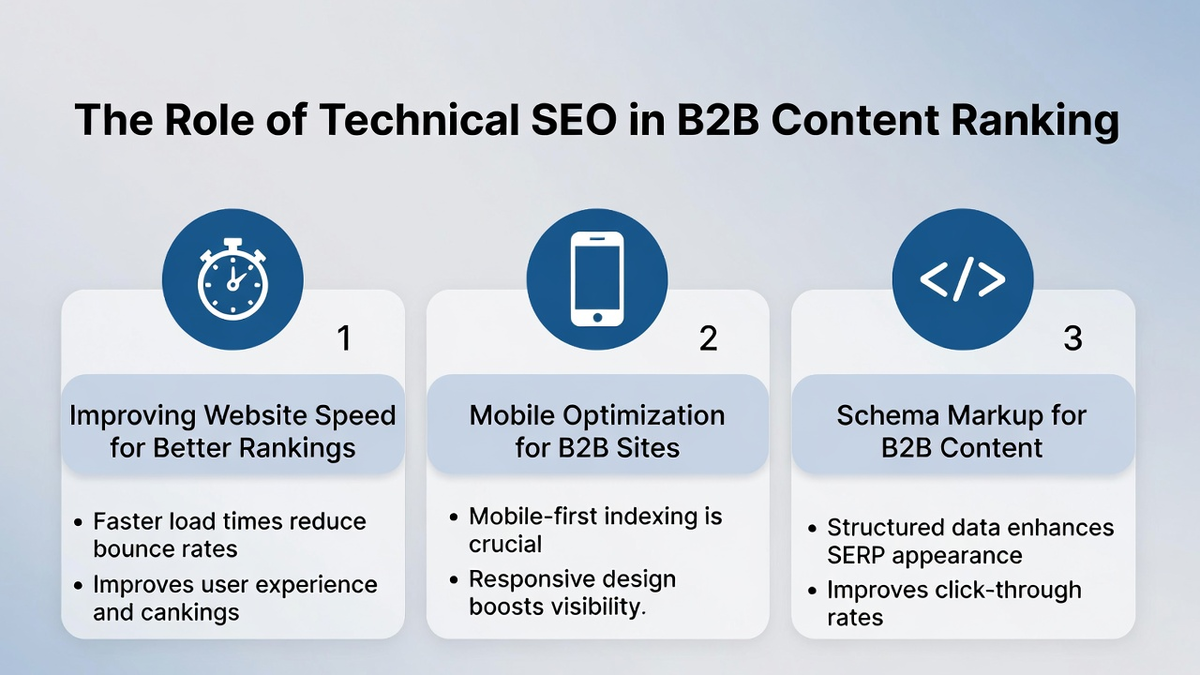
In this section, we’ll delve into the technical SEO elements that can boost B2B SEO best practices and improve your content's ranking.
Improving Website Speed for Better Rankings
Website speed directly impacts both user experience and SEO rankings. A fast-loading website ensures that users can access content quickly, reducing bounce rates and improving engagement. For building SEO-friendly content for B2B, optimizing image sizes, leveraging browser caching, and minimizing HTTP requests are key practices.
Additionally, best seo tools like Google PageSpeed Insights and GTmetrix can help identify areas for improvement. Faster websites are more likely to rank higher, contributing to overall success in B2B content distribution for SEO.
Mobile Optimization for B2B Sites
Mobile optimization is essential for B2B SEO best practices as more users access websites via mobile devices. With mobile-first indexing, Google prioritizes the mobile version of your site for ranking purposes, making responsive design a necessity.
Ensuring that your website is mobile-friendly not only improves user experience but also boosts your rankings. A mobile-optimized site allows B2B companies to reach decision-makers on-the-go, enhancing accessibility and increasing the chances of content engagement.
Schema Markup for B2B Content
Schema markup is a type of structured data that helps search engines understand the context of your content. By adding schema to your B2B content, you make it easier for search engines to categorize and display your content in rich snippets, which can increase visibility in search results.
For example, adding schema for articles, reviews, or events can enhance your content’s presence and drive more qualified traffic. Building SEO-friendly content for B2B involves using schema markup to improve rankings and boost the discoverability of your business content.
FAQs
What are the key elements of a successful B2B SEO strategy?
A successful B2B SEO strategy includes keyword research, on-page optimization, high-quality content, backlink building, and mobile optimization. Incorporating B2B SEO best practices ensures content ranks well, engages the target audience, and generates valuable leads, boosting overall visibility and sales.
How can I improve my B2B content ranking on search engines?
Improving B2B content ranking for SEO involves optimizing your website for speed, ensuring mobile responsiveness, and implementing schema markup. Regularly updating content, using targeted keywords, and building high-quality backlinks are also essential for driving better rankings and increasing organic traffic.
What role does technical SEO play in B2B content marketing?
Technical SEO helps search engines crawl and index your site efficiently, improving content visibility. Key aspects include optimizing website speed, ensuring mobile optimization, and implementing schema markup. Proper technical SEO ensures building SEO-friendly content for B2B, ultimately boosting rankings and improving user experience.
How can social media impact B2B SEO performance?
Social media can amplify your content's reach and drive traffic to your website, indirectly improving SEO rankings. By sharing valuable content on platforms like LinkedIn, businesses can increase engagement, enhance brand awareness, and improve B2B content distribution for SEO, boosting organic search visibility.
Conclusion
Learning How to Make Content Rank for B2B is crucial for any business looking to increase its online visibility and attract the right audience. By focusing on the right B2B SEO strategies—such as in-depth keyword research, content optimization, and building quality backlinks businesses can significantly improve their content's performance in search rankings.
Additionally, technical aspects like website speed, mobile optimization, and schema markup play a vital role in boosting SEO efforts. Centric’s expertise in B2B content strategies ensures businesses can apply these tactics effectively to elevate their online presence.
By mastering these B2B SEO best practices, you can enhance your content’s ability to engage prospects, drive traffic, and generate valuable leads, leading to long-term success in the B2B market.
Ready to improve your B2B content and SEO? Contact Centric today to get started on optimizing your content for better rankings and business growth!