ERP systems are the transactional backbone of every enterprise. They process orders, manage inventory, run financial close, and coordinate supply chains. But they are not designed to be the single source of truth for master data. When organizations try to use ERP as their master data authority, they discover that the same customer has three different records in SAP and Salesforce, that product codes in Oracle do not match the e-commerce platform, and that vendor master data in Dynamics 365 was never properly deduplicated after the last acquisition.
Master Data Management bridges this gap. An MDM layer sits above your ERP systems, establishing golden records that are published downstream to SAP, Oracle, Dynamics 365, and every other system that needs trusted master data.
Why ERP Migrations Fail Without MDM?
The SAP S/4HANA migration wave is the largest ERP transformation in a generation. Gartner reports that 83% of data migration projects fail or exceed their budget and schedule. The primary reason is not technology. It is data quality.
Organizations migrating from legacy SAP ECC to S/4HANA, from Oracle E-Business Suite to Oracle Cloud, or from Dynamics AX to Dynamics 365 are forced to confront decades of accumulated data debt: duplicate vendor records, inconsistent customer hierarchies, conflicting material codes, and business partner data that was never properly governed.
MDM deployed before or alongside your ERP migration dramatically reduces this risk. By establishing golden records and governance processes before the migration cutover, you ensure that the data entering your new ERP is clean, consistent, and governed from day one.
Integration Architecture: How MDM Connects to ERP?
MDM-to-ERP integration follows one of three patterns, depending on your architecture and data flow requirements.
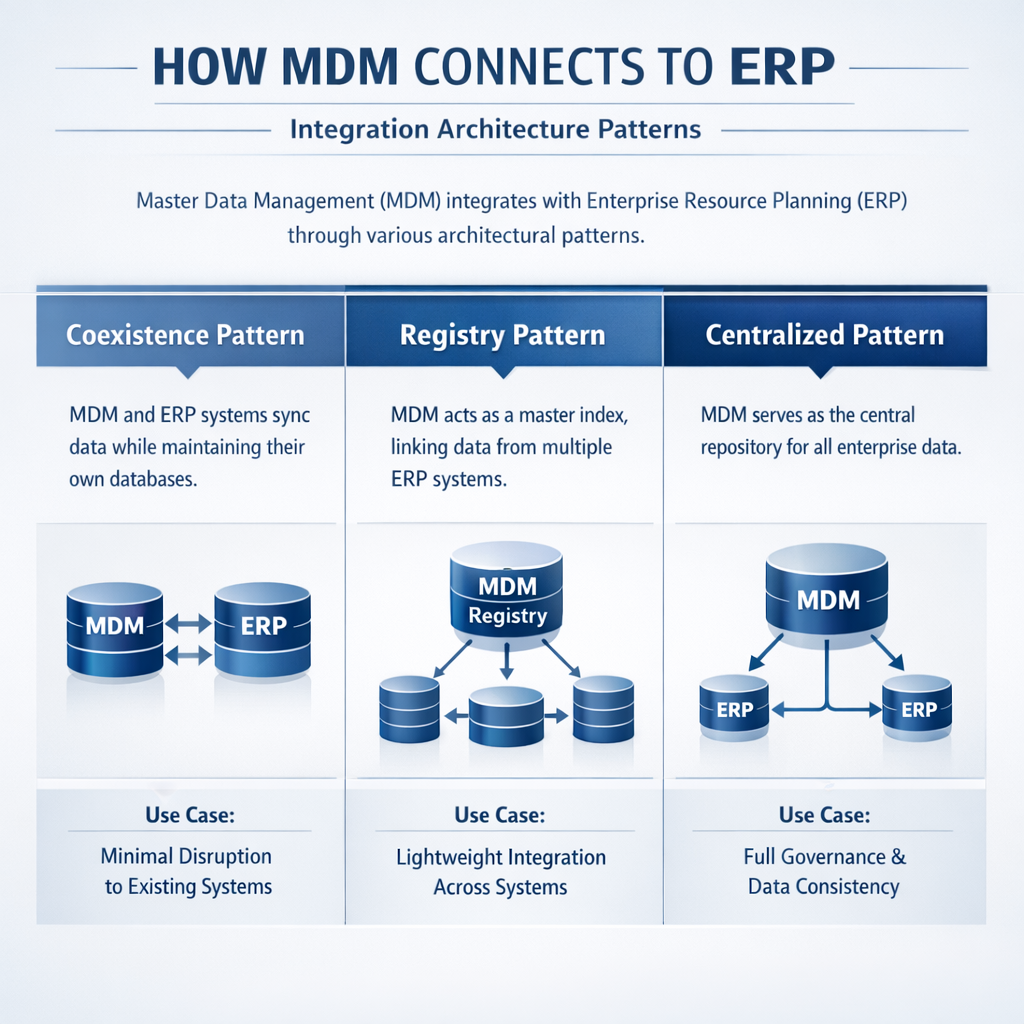
Coexistence Pattern
The MDM hub and ERP systems both maintain master data, with synchronization processes keeping them aligned. This is the most common pattern for organizations that cannot immediately centralize all master data creation in the MDM hub. Data flows bidirectionally, with the MDM hub applying quality rules, deduplication, and survivorship logic.
Registry Pattern
The MDM hub maintains a registry of where master data lives across systems, providing a unified view without physically moving data. This works for organizations that need visibility and governance but have complex legacy integration constraints.

Centralized Pattern
All master data creation and modification happens in the MDM hub, which publishes golden records to ERP and other consuming systems. This delivers the highest data quality but requires the most organizational change, as business users must adopt new data entry workflows.
SAP S/4HANA MDM Integration
SAP offers its own Master Data Governance (MDG) module, but many organizations find that a platform-agnostic MDM solution provides greater flexibility, especially when their landscape includes non-SAP systems. Integration with S/4HANA typically uses SAP Integration Suite (formerly CPI) or direct APIs to synchronize business partner, material, and financial master data.
Key considerations for SAP integration include business partner data model changes in S/4HANA (the BP model replaces separate customer and vendor masters), material master simplification opportunities, and the timing of MDM deployment relative to the S/4HANA cutover.
Oracle Cloud MDM Integration
Oracle offers Customer Data Management (CDM) within its Fusion Cloud suite, but organizations with multi-vendor landscapes need an independent MDM implementation layer. Integration with Oracle Cloud typically leverages Oracle Integration Cloud (OIC) and REST APIs. Product, supplier, and customer domains require careful mapping between Oracle's data model and your canonical MDM schema.
Microsoft Dynamics 365 MDM Integration
Dynamics 365 environments benefit significantly from external MDM because the Dynamics data model can become fragmented across modules (Finance, Supply Chain, Sales, Customer Insights). Integration uses Dataverse APIs and Power Platform connectors, making MDM-to-Dynamics synchronization straightforward for organizations already invested in the Microsoft ecosystem.
Pimcore, as an open-source MDM platform with strong API capabilities, integrates particularly well with Dynamics 365 environments, offering a cost-effective alternative to proprietary MDM solutions for Microsoft-centric enterprises.
Implementation Roadmap: MDM Before, During, or After ERP Migration
The optimal timing depends on your migration timeline and data quality baseline. For organizations with significant data debt, deploying MDM 3-6 months before ERP migration is ideal. Companies such as Centric specialize in helping organizations manage their data challenges early on. For organizations mid-migration, a parallel MDM workstream can still capture value. Post-migration MDM deployment is the least efficient approach but still delivers governance benefits