Every enterprise runs on data. Customer records in the CRM, product specifications in the ERP, vendor details in procurement systems, material codes in manufacturing. When this data is accurate, consistent, and governed, operations run smoothly. When it is not, meetings multiply, launches slip, audits bite, and AI projects fail before they start.
Master Data Management (MDM) fixes the foundation. It is the discipline of creating and maintaining a single, authoritative version of your most critical business data, your golden records, across every system that touches it. This guide walks you through every phase of an MDM implementation: from building the business case to deploying your first domain and scaling across the enterprise.
What Master Data Management Actually Solves?
MDM addresses a specific, measurable set of business problems. Organizations pursue MDM when they recognize that the same customer appears differently in five systems, that product data conflicts between ERP and e-commerce create fulfillment errors, that vendor duplicates cause duplicate payments, or that material master inconsistencies delay production.
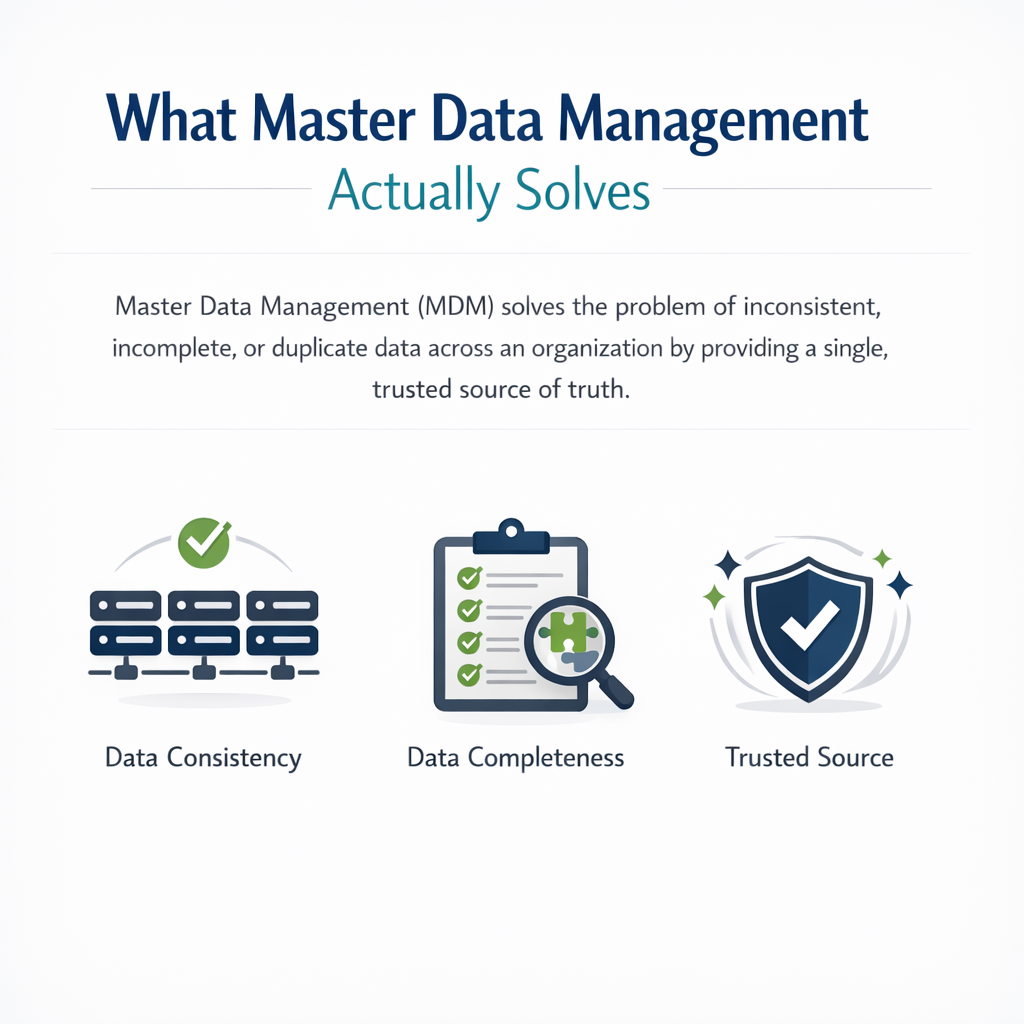
The cost of these problems is substantial. Industry research consistently shows that poor data quality costs organizations between 15% and 25% of revenue. For a $500M enterprise, that represents $75M to $125M in hidden drag from rework, compliance failures, missed cross-sell opportunities, and delayed decision-making.
MDM services solves this by establishing golden records: single, trusted, version-controlled master records for each critical business entity. These golden records are then published to every downstream system, ERP, CRM, commerce platforms, analytics, and AI, ensuring that every team operates from the same truth.
The Six Phases of MDM Implementation
Here, we will discuss the six phases of Master Data Management (MDM) implementation focusing on the key steps that ensure effective data management. From initial planning to ongoing maintenance, these steps are essential for establishing a robust and sustainable MDM framework.
Phase 1: MDM Strategy and Business Case (Weeks 1-3)
Every successful MDM initiative begins with quantifying the cost of bad data. Map your current-state systems, identify where master data lives, document the duplicates and conflicts, and attach dollar values to the business impact. This becomes your board-ready value case.
During this phase, you also prioritize domains. Most organizations start with product, customer, or vendor data, choosing the domain that offers the highest business impact relative to implementation complexity. Define your success metrics upfront: duplicate reduction rate, time-to-market improvement, audit pass rate, or data quality score.
Phase 2: Data Governance and Operating Model (Weeks 2-5)
Governance is where MDM projects succeed or fail. Before touching technology, define who owns the data, who stewards it, and how decisions get made. Build your RACI matrix, establish a data governance council, create steward playbooks, and define your operating cadence (monthly data quality reviews, quarterly audits, annual standards refresh).
The operating model must answer practical questions: Who approves a new product master record? What happens when customer data conflicts between Salesforce and SAP? How does a vendor record get created, validated, and published? Without clear answers, technology implementation becomes an expensive exercise in recreating chaos in a new system.
Phase 3: Data Modeling and Domain Architecture (Weeks 4-8)
Design the canonical data model that your MDM hub will enforce. This includes entity definitions, attribute schemas, hierarchy designs, identifier strategies, and survivorship rules (how the system resolves conflicts when two source systems disagree about the same record).
Critical decisions at this stage include your ID strategy (durable keys and crosswalks to legacy codes), hierarchy design (multi-level account, product, and location rollups), taxonomy alignment with industry standards like GS1, and versioning approach for slowly changing dimensions.

Phase 4: Technology Selection and Configuration (Weeks 6-12)
Choose your MDM platform based on your domain requirements, integration landscape, budget, and team capabilities. The market ranges from enterprise platforms like Informatica and Stibo Systems (starting at $500K+) to open-source alternatives like Pimcore that deliver enterprise functionality at a fraction of the cost.
Platform configuration includes setting up domain models, match-and-merge rules, data quality validations, workflow configurations for human approvals, and user interface customization for stewards. Integration architecture, how golden records flow to and from source systems, is typically the most complex technical workstream.
Phase 5: Data Migration and Quality (Weeks 10-16)
Load your existing data into the MDM hub, apply quality rules, execute match-and-merge processes, and resolve exceptions. This phase typically reveals the true scale of your data quality challenges: duplicate rates of 15-40% are common in organizations that have never implemented MDM.
Automated data quality rules catch the majority of issues, but a meaningful percentage requires human steward review. Plan for this. Build exception workflows, set SLAs for steward resolution, and track quality metrics from day one.
Phase 6: Go-Live, Integration, and Enablement (Weeks 14-20)
Deploy golden records to downstream systems. Start with a controlled rollout to one integration point, validate data accuracy, then expand. Post-launch enablement includes steward training, monitoring dashboard deployment, and establishing the ongoing operating cadence that keeps data quality rising over time.
Monitor key metrics weekly: duplicate creation rate (should trend to zero), data quality score (should trend upward), steward SLA compliance, and business impact metrics (time-to-market, audit findings, customer data accuracy).
MDM Technology Landscape: Making the Right Choice
The MDM platform market includes established vendors like Informatica, Stibo Systems, SAP Master Data Governance, and Reltio at the enterprise tier, and Profisee, Semarchy, and Pimcore at the mid-market tier. Gartner recognizes all of these as representative vendors in their MDM Solutions market guide.
For enterprises seeking enterprise-grade MDM without the enterprise price tag, open-source platforms like Pimcore deserve serious evaluation. Pimcore services combines MDM, PIM (Product Information Management), DAM (Digital Asset Management), and CDP capabilities in a single platform, with implementation timelines that are typically 40-60% shorter than proprietary alternatives.
Common MDM Implementation Mistakes
Starting with technology before governance. Treating MDM as an IT project rather than a business initiative. Trying to boil the ocean by addressing all domains simultaneously. Underestimating stewardship effort. Ignoring survivorship rules until data conflicts surface in production. Failing to define success metrics before kickoff.
The most successful MDM implementations share common traits: executive sponsorship, a phased domain approach, governance-first methodology, realistic timelines, and a clear connection between data quality improvements and business outcomes that stakeholders can measure and celebrate.
What Comes After MDM: The Data-to-AI Pipeline
MDM is rarely an end in itself. It is the foundation for everything that comes next: trusted analytics and reporting built on golden records, data engineering pipelines that feed governed data to downstream platforms, and AI systems that require clean, consistent, well-governed data to deliver reliable predictions and recommendations.
Organizations that treat MDM as an isolated initiative miss the larger opportunity. The enterprises that get the most value from MDM are those that design their implementation with the downstream data and AI pipeline in mind from day one. Centric helps organizations align their MDM strategies with AI pipelines, ensuring smooth transitions from data governance to actionable AI insights.