





In today's rapidly evolving digital landscape, How to Do AEO (Answer Engine Optimization) has become crucial for businesses aiming to stay ahead. AEO is the practice of optimizing your content to be featured directly in answer boxes, snippets, and other AI-driven responses provided by search engines.
Unlike traditional SEO, which focuses on ranking in search results, AEO aims for prime placement in the answer engine responses that appear at the top of the page.
The importance of AEO lies in the growing reliance on AI-powered search engines and voice search. Consumers are increasingly looking for quick, direct answers, and businesses must adapt to meet these expectations.
In this guide, you’ll learn the fundamentals of AEO, why it matters for your business, and the strategies to implement it effectively. Whether you’re new to AEO or looking to refine your approach, Centric’s expertise in forward-thinking marketing strategies will help you optimize your content for the future of search.
What is AEO (Answer Engine Optimization)?
Search engines have evolved beyond simply providing a list of links. Today, they leverage Artificial Intelligence Services to deliver direct answers to user queries.
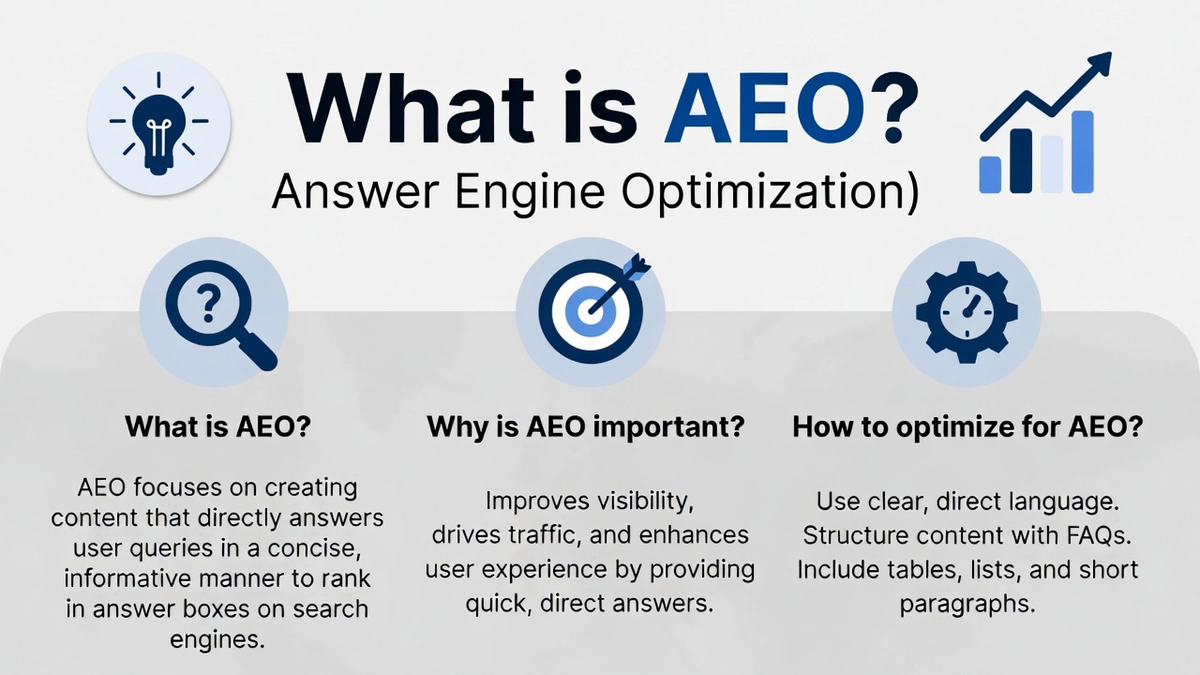
This shift has led to the rise of Answer Engine Optimization (AEO) techniques, where businesses aim to optimize their content to be featured in these AI-driven answers, such as answer boxes, featured snippets, and knowledge panels. AEO focuses on ensuring that search engines can easily pull relevant and high-quality content directly from your website to present to users.
This is different from traditional SEO, which primarily aims to improve rankings within the search results page itself.
Unlike SEO, which revolves around ranking higher in organic results, AEO strategies focus on positioning content in the most visible, AI-driven answer areas of the search engine results page (SERP). AEO techniques require understanding how search engines interpret questions and how to format your content for easy extraction and display.
Why is AEO Important for Businesses Today?
With the rapid growth of voice search and AI-powered answers, businesses must adapt to how users are searching for information. Voice searches, in particular, rely heavily on AI to provide direct answers, making AEO increasingly important.
By optimizing content using AEO strategies, businesses can increase their chances of being featured in answer boxes, snippets, and other high-visibility spots on search engine results pages.
This not only enhances visibility but also drives more targeted traffic to your website, helping you connect with users who are actively seeking the information you provide.
Ready to Rank Higher in Answer Engines? Check Our AEO Service
The Core Elements of AEO
To successfully implement Answer Engine Optimization techniques, businesses need to focus on key components that enhance visibility in AI-driven responses. The core elements of AEO revolve around structuring content so that search engines can easily identify, extract, and present it as a direct answer.
This requires a blend of technical SEO strategies, content optimization, and understanding of search engine algorithms. Let’s explore these essential elements that power AEO and help businesses maximize their digital presence.
Focus on Structured Data: The Backbone of AEO
Structured data plays a pivotal role in AEO services, allowing search engines to understand the context and relevance of the information on your website.
By using structured data, businesses can provide search engines with a well-defined format that makes it easier for them to pull accurate answers from their content. Structured data helps search engines recognize important details like product prices, ratings, and event dates, all of which are crucial for direct-answer placements in search results.
There are several types of structured data to implement, such as Schema.org, JSON-LD, and Microdata, each offering different methods to mark up the content. The most commonly used format today is JSON-LD because it’s easy to implement without altering the HTML structure.
By adding AEO and structured data to your site, you make your content more accessible to AI algorithms, increasing the likelihood of being featured in rich snippets, knowledge graphs, and answer boxes.
Optimizing for Featured Snippets and Answer Boxes
Understanding how featured snippets work is critical to appearing in these highly visible positions on the search results page. Featured snippets are short, direct answers that appear at the top of search results in response to specific queries.
To improve the chances of your content being featured, you need to structure your content in a way that answers common questions clearly and concisely.
To increase the likelihood of appearing in answer boxes, break your content into easily digestible sections, use bullet points, numbered lists, and direct answers to frequently asked questions (FAQs). Focus on delivering value to the user in a format that search engines can easily read and extract.
Crafting AEO content optimization around these formats ensures your content is optimized for search engines looking to provide quick answers.
Voice Search Optimization for AEO
The rise of voice search has transformed the way people interact with search engines, making AEO and voice search even more crucial. Voice search queries tend to be more conversational, often phrased as questions. Optimizing for voice search means adapting your content to match these natural, spoken queries.
To optimize content for voice queries, focus on using clear, natural language that directly answers common questions. Incorporating AEO content optimization techniques such as question-based headings and simple, conversational language will improve the likelihood of your content being selected for voice-driven answers. By tailoring your content to match the way people speak, you’ll ensure better visibility in voice search results.
How to Implement AEO: A Step-by-Step Approach
Implementing AI-driven AEO strategies requires a systematic approach to ensure your content is optimized for visibility in answer boxes, snippets, and other AI-generated responses.
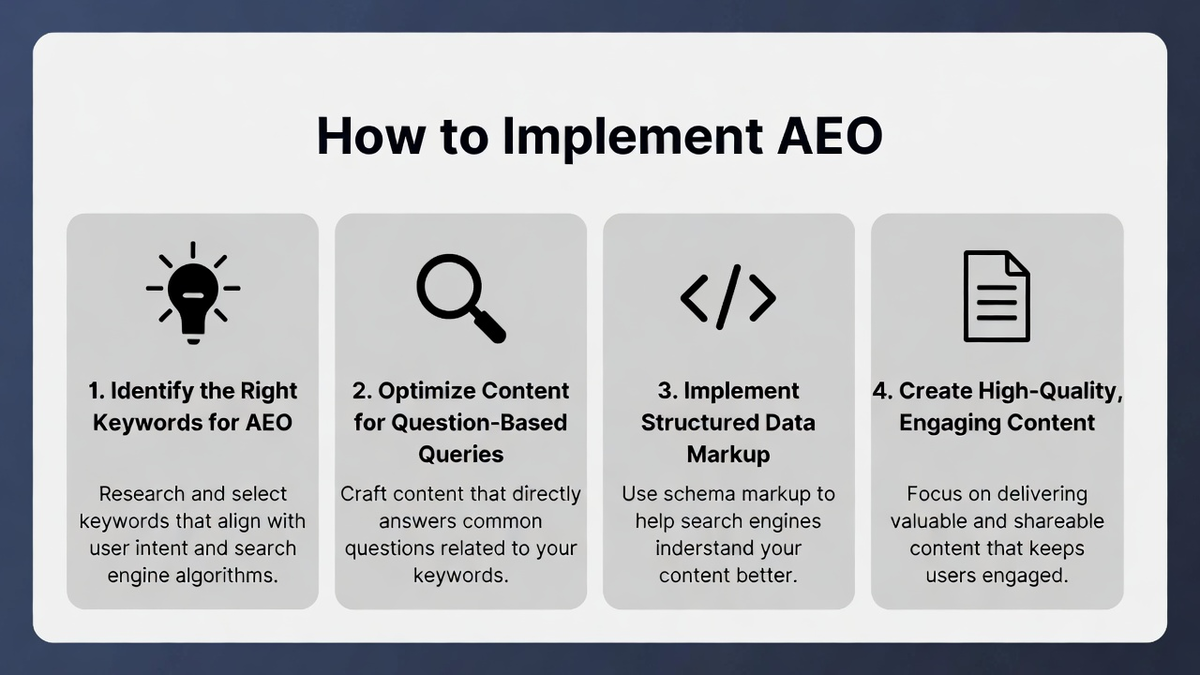
To successfully implement AEO content optimization, businesses must align their content with the specific needs of search engines that prioritize relevant and clear answers.
Here’s an AEO implementation guide to help you implement AEO effectively and improve your online presence.
Step 1: Identify the Right Keywords for AEO
The first step in implementing AEO is identifying the right keywords that will trigger answers in the search engine results pages (SERPs). Unlike traditional SEO, AEO focuses on finding question-based keywords that directly align with what users are asking.
SEO Tools such as Answer The Public, Google’s People Also Ask, and SEMrush are great for uncovering common questions related to your business or industry.
By focusing on what is AEO in digital marketing and similar queries, you can optimize your content to appear in answer boxes and directly address user intent. The key is to look for questions that are highly relevant to your business and target audience.
Step 2: Optimize Content for Question-Based Queries
Once you've identified the right keywords, the next step is to frame your content to directly answer user questions. This means structuring your content in a way that provides clear, concise answers that search engines can easily extract. To optimize your content for AI-driven AEO, use question-based headings, bullet points, and short paragraphs.
Content should be easy to read and focus on answering questions as directly as possible. The importance of clarity, conciseness, and structure cannot be overstated, as search engines prioritize content that provides a straightforward answer to user queries. Aim for simple, informative responses that align with the way users naturally search.
Explore Our Content Marketing Services
Step 3: Implement Structured Data Markup
Next, you need to implement structured data on your website. This step is crucial for AEO content optimization because it provides search engines with the data they need to extract answers from your content and present them in rich snippets.
Use Schema.org to mark up your content with appropriate structured data types such as FAQ schema, How-to schema, and Article schema.
For example, if you have a blog post with a FAQ section, you can implement FAQ schema to make sure each question and answer is clearly marked for search engines to pull directly from your page. This helps increase your chances of appearing in featured snippets or answer boxes.

Step 4: Create High-Quality, Engaging Content
While optimizing for structured data and keywords is essential, content quality still matters. What is AEO in digital marketing if your content doesn’t resonate with users? Quality content drives engagement, and engagement leads to better rankings. To achieve this, make sure your content is informative, accurate, and aligned with user intent.
The best practices for writing AI-driven AEO content include using engaging language, maintaining a conversational tone, and providing real value to the reader. Your content should answer user questions comprehensively and authoritatively, which will help improve your chances of being featured in answer boxes and other high-visibility spots.
2 Tools and Techniques to Enhance Your AEO Strategy
To maximize the effectiveness of your AEO content optimization, using the right tools and techniques is essential. AEO tools and resources can help you analyze, track, and optimize your content for better visibility in answer boxes, snippets, and voice search results. Leveraging these tools allows businesses to stay ahead in the competitive landscape by continuously refining their AEO strategies.
1. Leveraging SEO Tools for AEO Success
Several SEO tools are essential in tracking and optimizing for AEO. Tools like Ahrefs, SEMrush, and Google Search Console and Google Analytics provide insights into how your content is performing in search engine results.
These tools help you identify which keywords trigger direct answers in the search results and track your content’s placement in featured snippets, answer boxes, and knowledge panels. They also provide useful data on how AEO impacts user experience, as users are more likely to interact with content that appears in prominent positions.
By using these tools, you can monitor the effectiveness of your AEO implementation guide and continuously optimize your content to improve visibility and engagement.
2. Analyzing Search Engine Behavior and Answer Engine Patterns
Understanding how search engines are answering queries directly is critical to optimizing your content for AEO. Analyzing search engine behavior and answer engine patterns will help you identify which types of queries are being answered directly by search engines.
Tools like Google’s People Also Ask, SEMrush, and Ahrefs offer data on which questions are being pulled as snippets or answers. By identifying these patterns, you can structure your content to align with these direct-answer opportunities, ensuring your content is optimized for AEO. Knowing the types of queries answered in search engines helps you craft content that meets both user intent and search engine algorithms, improving both AEO and user experience.
4 Common AEO Mistakes to Avoid
When implementing AI-driven AEO strategies, it's crucial to avoid common mistakes that can hinder the effectiveness of your optimization efforts. These mistakes can lead to lower visibility in answer boxes, snippets, and voice search results, ultimately affecting your business’s digital presence. Let’s take a look at some common AEO pitfalls and how to avoid them.
1. Overcomplicating Structured Data
While structured data is essential for AEO, overcomplicating it can have negative consequences. Too much structured data can confuse search engines, making it difficult for them to extract the most relevant information. Overuse of tags or incorrect schema types can lead to your content being overlooked or misinterpreted by search engines.
To avoid this, focus on implementing simple and effective structured data markup that directly corresponds to the content on your page. Stick to commonly used types like FAQ schema, How-To schema, and Article schema, ensuring that the data you mark up aligns with the content's intent.
This will help search engines easily understand and extract your content without unnecessary complexity.
2. Ignoring Content Readability for AEO
A common mistake is focusing too much on optimization and forgetting about user experience in AEO. Search engines prioritize content that is not only optimized but also easily readable and engaging. If your content is too technical or stuffed with keywords, users may find it difficult to understand or engage with.
To balance SEO techniques with readability, ensure that your content is structured clearly and concisely. Use simple language, short paragraphs, and bullet points to break up the text. The content should answer questions directly, providing value to the reader while also optimizing for AEO content optimization.
3. Overlooking Voice Search Optimization
In the age of voice search, neglecting voice-friendly content is a major oversight. Voice search queries tend to be longer and more conversational, so failing to optimize your content for these types of searches can prevent your content from being selected for voice-driven answers.
To address this, focus on natural language and phrasing that mimics how people speak. Incorporate conversational questions and answers into your content to better align with voice search patterns and AEO and voice search.
4. Failing to Update Content Regularly
AEO is not a one-time effort; it requires ongoing attention. One of the biggest mistakes is failing to update content regularly. Search engines evolve, and so do user preferences. If your content isn’t regularly reviewed and updated, it may become outdated, making it less likely to appear in answer boxes.
To avoid this mistake, regularly audit and update your content to keep it relevant and accurate. Update AEO content optimization techniques as trends change and ensure that your content remains aligned with the latest search patterns and user needs.
FAQs
What is AEO in Digital Marketing?
Answer Engine Optimization (AEO) is a strategy to optimize content for visibility in AI-driven answers, such as featured snippets, answer boxes, and knowledge panels. AEO focuses on structuring content so search engines can easily extract and present direct, relevant answers to user queries.
How Does AEO Impact User Experience?
AEO enhances user experience in AEO by providing users with clear, concise answers directly within search results. This allows users to quickly find the information they need without navigating through multiple links, improving satisfaction and engagement, and reducing bounce rates.
Why is Structured Data Important for AEO?
Structured data is critical for AEO because it helps search engines understand your content’s context. Implementing structured data, like FAQ schema or How-To schema, makes it easier for search engines to extract accurate answers, improving the chances of your content being featured in direct-answer spots.
How Can I Optimize for Voice Search with AEO?
Optimizing for voice search with AEO and voice search requires focusing on conversational, natural language. People use full sentences and question-based queries when speaking to voice assistants. Structuring your content to answer these queries directly increases the likelihood of being selected for voice-driven responses.
Conclusion
How to do AEO is becoming a critical aspect of modern digital marketing strategies. With the rise of voice search, AI-powered answers, and featured snippets, optimizing content for Answer Engine Optimization is essential for businesses aiming to stay ahead in search engine results.
AEO enables companies to be visible in high-traffic answer boxes and voice search results, directly meeting user intent. This means greater visibility, more targeted traffic, and improved user engagement.
Centric specializes in advanced AEO strategies that help businesses enhance their online presence and drive long-term success. By leveraging its expertise in digital marketing solutions, it helps businesses optimize their content and stay ahead of the competition.
Start implementing AEO practices today to position your business for sustained growth and success in an AI-driven digital world.