When considering what are the key components of Microsoft Fabric, it’s crucial to understand how this integrated, end-to-end data analytics platform simplifies data management.
Microsoft Fabric consolidates several Microsoft services, including Azure Synapse, Power BI, and Azure Data Factory, into a unified solution for data ingestion, transformation, real-time processing, and reporting.
By leveraging Microsoft Fabric features, businesses can improve data workflows and achieve more efficient data integration and analysis. Microsoft Fabric components are tailored to meet the needs of various roles, from data engineers to business analysts, providing specialized tools for data governance, security, and advanced analytics.
CentricDXB can help organizations fully utilize Microsoft Fabric to optimize their data management and analytics processes. With our expertise, companies can unlock the full potential of Microsoft Fabric, leading to improved decision-making and streamlined operations.
What Is Microsoft Fabric?
Microsoft Fabric is a unified Software-as-a-Service (SaaS) platform designed to streamline and optimize data analytics workflows. It integrates various Microsoft cloud solutions into a single, cohesive environment, enabling businesses to manage, process, and analyze data more effectively.
By combining tools like Azure Synapse, Power BI, and Azure Data Factory, Microsoft Fabric simplifies the process of gathering and processing data, making it easier to generate insights and make informed decisions.
One of the core Microsoft Fabric analytics features is its ability to perform real-time analytics, allowing businesses to analyze data as it’s generated.
Additionally, the platform supports seamless Microsoft Fabric data integration, enabling businesses to combine data from different sources like on-premises systems, cloud platforms, and IoT devices. This unified approach not only saves time but also ensures greater accuracy and consistency in the analysis.
Moreover, Microsoft Fabric data science capabilities empower organizations to leverage machine learning and AI tools to predict trends, automate tasks, and derive actionable insights from complex datasets.
Why Microsoft Fabric Is Important for Businesses?
As businesses face increasing volumes of data, managing and analyzing that data efficiently becomes a crucial challenge. Microsoft Fabric helps organizations streamline their data management processes, making it easier to handle large datasets and extract valuable insights for decision-making.
Significance in Modern Business Environments
In today’s fast-paced business world, data is one of the most valuable assets a company can have. Microsoft Fabric platform plays a crucial role by offering an integrated platform that allows businesses to manage and analyze their data more efficiently.
Its flexibility and scalability make it an ideal choice for organizations of all sizes, enabling them to leverage data for better decision-making.
Simplifying Data Workflows
Microsoft Fabric helps organizations eliminate the complexity of managing multiple systems by unifying the data workflow. From data ingestion to reporting, it simplifies each step, ensuring that data is seamlessly transformed and integrated. This streamlined approach makes it easier for businesses to gain insights and react quickly to changing conditions.
Check Our Microsoft Fabric Solution
9 Key Components of Microsoft Fabric
Microsoft Fabric is designed to offer a unified approach to data analytics and management, with several core components that help organizations optimize their data workflows. These Microsoft Fabric components work together seamlessly, ensuring that businesses can handle, analyze, and derive insights from their data more efficiently.
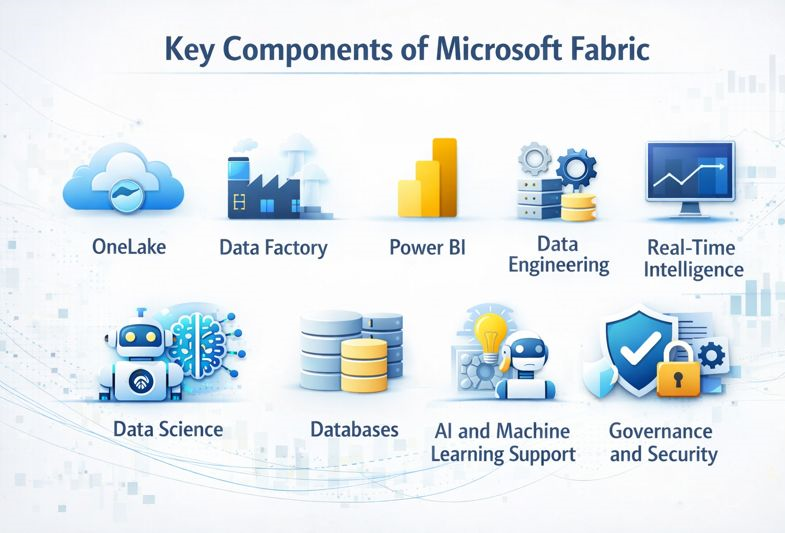
One of the most critical components of Microsoft Fabric is OneLake in Microsoft Fabric, which plays a central role in how data is stored, managed, and accessed across the platform.
1. OneLake: The Unified Data Lake
OneLake in Microsoft Fabric is the foundational storage layer that centralizes all the data within the platform. As a unified data lake, it allows businesses to manage data from multiple sources, including Azure, AWS, and Google Cloud, all within one consistent environment.
OneLake acts as the single source of truth, ensuring that all data is stored in a centralized location for easy access, management, and analysis.
OneLake enables seamless access to data across different workloads without the need for duplication. This reduces the complexity of handling multiple versions of the same data, ensuring that organizations can work with the most up-to-date information without the risk of data inconsistencies.
Moreover, OneLake leverages Delta Lake for efficient storage, providing support for ACID transactions, schema enforcement, and other advanced features that ensure data quality and reliability across the platform. This integration of OneLake in Microsoft Fabric is crucial for organizations looking to manage large volumes of data effectively and efficiently.
2. Data Factory: Data Integration and Transformation
Data Factory plays a key role in Microsoft Fabric data workflows, enabling businesses to seamlessly ingest, transform, and prepare data from various sources. It helps streamline the movement of data by integrating multiple data formats into a unified system, ensuring consistency and accessibility for further analysis.
By automating these processes, businesses can reduce manual data handling and focus on generating actionable insights.
Data Factory supports over 200 built-in connectors, allowing businesses to effortlessly integrate on-premises and cloud-based data sources. This wide range of connectors ensures that data can be pulled from various systems, whether it’s from databases, APIs, or cloud platforms, enabling a unified data flow into the Microsoft Fabric storage model.
Businesses can automate end-to-end data workflows in Data Factory, eliminating the need for manual intervention. By setting up automated pipelines for data ingestion, transformation, and loading, organizations ensure data is always processed and ready for analysis, which improves efficiency and accuracy.
3. Power BI: Data Visualization and Reporting
Power BI Solution is a powerful tool within Microsoft Fabric that enables users to create interactive dashboards and reports. It offers an intuitive interface to visualize complex datasets, turning them into easy-to-understand charts, graphs, and reports.
These visualizations help businesses track performance metrics, gain insights into trends, and make data-driven decisions based on real-time information.
Power BI integrates seamlessly with Microsoft Fabric components like Data Factory and OneLake, ensuring that data used for visualization is consistent and up to date. This integration helps businesses consolidate data from various sources, creating a holistic view of their operations and making it easier to identify key insights from multiple workloads.
With its drag-and-drop interface and pre-built templates, Power BI simplifies the creation of complex visualizations, even for users without technical expertise.
Businesses can create visually appealing and actionable reports that track KPIs, monitor progress, and provide insights into various metrics, making Power BI an indispensable tool in Microsoft Fabric data workflows.
4. Data Engineering: Large-Scale Data Processing
Microsoft Fabric data engineering integrates Apache Spark to handle large-scale data processing. Apache Spark is a powerful framework for big data processing, providing distributed computing capabilities that enable fast and scalable data analysis.
It supports both batch and real-time data processing, ensuring that businesses can analyze vast amounts of data without compromising performance.
Microsoft Fabric data engineering is particularly useful in scenarios such as ETL (Extract, Transform, Load) processes and large-scale analytics. It allows businesses to transform raw data into usable insights by running complex algorithms and data transformations.
Data engineering in Fabric supports large-scale data ingestion, data cleansing, and integration across various systems, making it ideal for managing extensive data pipelines.
5. Real-Time Intelligence: Analyzing Streaming Data
Real-Time Intelligence is a key feature of Microsoft Fabric that enables businesses to analyze data as it is generated. This capability is essential for industries that need immediate insights from data, such as monitoring IoT sensor readings or application logs. It allows businesses to process and analyze streaming data in real time, providing actionable insights without delays.
With Real-Time Intelligence, businesses can monitor and respond to data as it arrives. This feature is crucial for scenarios where timely decision-making is required, such as detecting anomalies in IoT data or monitoring application performance.
Real-Time Intelligence helps organizations take immediate actions based on real-time data insights, improving responsiveness and operational efficiency.
6. Data Science: Building and Operationalizing Machine Learning Models
Microsoft Fabric data science empowers data scientists to build, deploy, and manage machine learning models within the platform. It integrates seamlessly with Azure Machine Learning, providing a comprehensive environment for machine learning workflows.
Data scientists can experiment, train models, and operationalize machine learning models with ease, all within the Microsoft Fabric ecosystem.
One of the key features of Microsoft Fabric data science is its integration with Azure Cloud Machine Learning, which enables seamless collaboration between data scientists and business analysts.
The platform also supports model tracking and versioning, ensuring that models are managed effectively throughout their lifecycle. These capabilities help businesses create accurate predictive models and use them to drive data-driven decisions.
7. Databases: Managing Transactional Data
Microsoft Fabric includes robust database capabilities to manage transactional data effectively. Databases like Azure SQL and Cosmos DB play a pivotal role in supporting transactional workloads within the platform.
These databases provide a reliable and scalable solution for handling day-to-day operations, from customer transactions to real-time updates, ensuring that businesses can rely on consistent data for their critical applications.
Fabric enables seamless integration of external databases like Azure SQL and Cosmos DB into the Microsoft Fabric storage model. Data from these databases can be mirrored into OneLake for unified access, simplifying the management of transactional data.
This integration eliminates the need for redundant data storage and ensures that organizations have a single, consistent view of their data across all workloads.

8. AI and Machine Learning Support
AI plays a crucial role in Microsoft Fabric, with tools like Copilot and SynapseML enhancing intelligent automation data workflows and analytics. Copilot, an AI-powered assistant, helps users automate complex tasks such as generating queries, building pipelines, and analyzing datasets.
SynapseML, an open-source machine learning library, provides advanced capabilities for building and deploying machine learning models directly within the Fabric platform.
AI capabilities in Microsoft Fabric help automate tasks like query generation, data preparation, and model deployment. These features reduce manual effort, enhance productivity, and streamline the process of extracting insights from large datasets.
By using AI to automate repetitive tasks, businesses can focus on strategic decision-making and improve the accuracy of their data analysis.
9. Governance and Security
Microsoft Fabric centralizes governance and compliance data management using tools like Microsoft Purview. Purview enables organizations to discover, classify, and manage their data assets while ensuring that sensitive information is handled in accordance with regulatory requirements.
It provides a unified approach to managing data governance, helping businesses maintain control over data access and security.
Fabric includes advanced security features such as role-based access control (RBAC), data encryption, and auditing to ensure data security. RBAC allows organizations to define permissions for different user roles, ensuring that only authorized personnel can access sensitive data.
Data encryption, both at rest and in transit, protects data from unauthorized access, while auditing features allow businesses to track and monitor data usage to ensure compliance with internal policies and external regulations.
How Microsoft Fabric Enhances Data Analytics?
Microsoft Fabric simplifies and optimizes the entire data analytics process by unifying various workloads into a single platform. It helps businesses manage complex data workflows efficiently, from data ingestion and transformation to advanced analytics and reporting.
This integration provides organizations with the flexibility to scale their data operations and streamline processes, allowing for faster and more accurate decision-making.
Unified Platform for End-to-End Analytics
Microsoft Fabric’s integration of various workloads enables businesses to perform efficient and scalable data processing across multiple stages of the analytics pipeline. Whether it’s ingesting, preparing, or analyzing data, Microsoft Fabric provides the tools to manage each aspect of data analytics.
By integrating services like Data Factory, Power BI, and Synapse Analytics, Fabric offers a holistic solution that connects all stages of data processing, ensuring that organizations can work with a unified set of tools for end-to-end analytics.
Fabric also supports both batch and real-time data analytics, making it versatile enough to handle any analytics need. Batch analytics allow businesses to process large volumes of data at scheduled intervals, while real-time analytics empower organizations to respond to live data streams instantly.
This flexibility ensures that businesses can analyze historical trends as well as make immediate decisions based on current data.
Simplification of Data Management
Microsoft Fabric significantly reduces the complexity of managing multiple systems by consolidating all essential data tools into a single platform. In traditional data workflows, businesses often rely on several disconnected systems to handle different stages of data management, which can lead to inefficiencies and data silos.
Fabric eliminates this challenge by integrating these systems into a unified environment, allowing businesses to manage everything from data ingestion to reporting in one place.
By consolidating tasks like Microsoft Fabric data transformation,
governance, and analytics within one platform, businesses can minimize the overhead of managing separate services.
This not only streamlines the data management process but also improves overall efficiency, ensuring that teams can focus more on analysis and decision-making instead of juggling multiple tools. The result is faster, more accurate insights that can be shared across teams with ease.
Transform Your Business with Data and Analytics!
4 Benefits of Using Microsoft Fabric
Microsoft Fabric offers a comprehensive suite of tools to optimize data management, enabling efficient, scalable, and secure data operations. Its integration of services like Power BI, Data Factory, and Azure Synapse simplifies data workflows, allowing real-time analytics and informed decision-making.
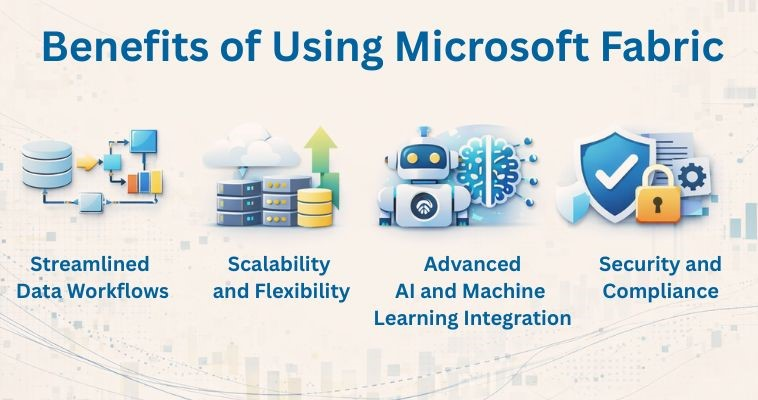
The platform enhances workflow automation, scalability, and governance, ensuring compliance with regulatory standards. Flexible compute and storage scaling help businesses manage growing data demands without sacrificing performance.
1. Streamlined Data Workflows
Microsoft Fabric simplifies the entire data workflow, from data ingestion to visualization. By consolidating various services and tools into one platform, it eliminates the need for businesses to manage multiple systems. Data can be easily ingested from multiple sources, transformed into a unified format, and visualized through tools like Power BI.
This streamlined process improves efficiency, reduces errors, and ensures that all stakeholders have access to the most accurate and current data, enabling faster and better decision-making.
2. Scalability and Flexibility
Microsoft Fabric is designed to scale with the growing needs of a business. The platform supports independent scaling of both compute and storage, meaning that organizations can increase resources as needed without affecting performance.
This flexibility ensures that businesses can handle large datasets and high volumes of traffic, especially as data grows over time. Whether it's processing massive amounts of historical data or managing real-time data streams, Fabric can adapt to meet the demands of any workload.
3. Advanced AI and Machine Learning Integration
One of the key benefits of Microsoft Fabric is its integration of advanced AI and machine learning capabilities. Organizations can leverage AI tools like Copilot and SynapseML to perform predictive analytics, automate data preparation, and generate insights with minimal manual effort.
With these AI features, businesses can analyze complex datasets, predict trends, and automate decision-making processes, leading to more informed strategies and proactive actions.
4. Security and Compliance
Microsoft Fabric provides robust governance and security features, ensuring that businesses can manage their data securely while maintaining compliance with regulatory requirements. The platform offers role-based access control (RBAC), data encryption, and auditing to ensure that sensitive data is protected.
Additionally, its integration with Microsoft Purview helps organizations implement data governance policies, classify sensitive information, and ensure that all data practices meet industry standards. This comprehensive security framework helps businesses mitigate risks and maintain trust in their data management practices.
FAQs
What is Microsoft Fabric used for?
Microsoft Fabric is an integrated data analytics platform designed to streamline data workflows, from ingestion to visualization. It enables real-time and batch data processing, integrates AI tools for predictive analytics, and provides a centralized data management solution for businesses to drive informed decision-making.
How does Microsoft Fabric improve data workflows?
Microsoft Fabric simplifies data workflows by consolidating various services, such as data ingestion, transformation, and visualization, into one platform. It enables seamless integration of data from multiple sources, ensuring efficiency, accuracy, and faster access to insights, thus improving decision-making across organizations.
Can Microsoft Fabric handle both real-time and batch analytics?
Yes, Microsoft Fabric supports both real-time and batch analytics. It allows businesses to process large datasets in batches while also handling real-time data streams, enabling timely insights and the ability to make decisions based on both historical and live data simultaneously.
How secure is Microsoft Fabric for data management?
Microsoft Fabric offers robust security features such as role-based access control (RBAC), data encryption, and integration with Microsoft Purview for governance and compliance. These tools ensure that sensitive data is protected, and businesses can manage their data securely while adhering to industry regulations.
Conclusion
Microsoft Fabric provides a unified platform for data management, integrating key components like AI, real-time intelligence, data engineering, and advanced data visualization capabilities. By consolidating various services, it simplifies data workflows, enhances collaboration, and enables organizations to make faster, data-driven decisions.
What are the key components of Microsoft Fabric? Its powerful features, such as seamless data integration, predictive analytics, and real-time insights, make it an invaluable tool for modern businesses. Microsoft Fabric enables efficient data processing and simplifies complex tasks, ensuring that organizations can optimize their data operations for better outcomes.
Centric can help businesses integrate Microsoft Fabric into their data strategies, providing the expertise needed to unlock the platform's full potential. It works alongside organizations to streamline their data management processes, enhance analytical capabilities, and ultimately drive more informed decision-making.