What is Data Platform Engineering? It is the practice of designing, building, and maintaining the infrastructure that allows organizations to manage and leverage their data effectively.
In today’s fast-paced digital landscape, businesses are inundated with massive volumes of data, making it essential to have a robust data platform that ensures seamless data processing, storage, and analysis. This growing demand for efficient data management systems has made data platform engineering a crucial field in modern businesses.
Centric specializes in helping businesses develop cutting-edge data platforms that streamline data workflows and enhance decision-making. It ensures that data is processed efficiently, securely, and in compliance with industry standards, allowing clients to make data-driven decisions with confidence.
In this guide, you will learn the fundamentals of data platform engineering, the role of data platform engineers, key best practices, and the latest trends shaping this essential field. Whether you’re looking to build a stronger data infrastructure or pursue a career in this area, this article will provide valuable insights to get you started.
Why Data Platform Engineering is Crucial in 2026?
As we move further into the digital age, businesses are facing an unprecedented volume of data from various sources such as IoT devices, customer interactions, and social media.
In 2026, this influx is expected to grow exponentially, presenting both challenges and opportunities. Companies must not only store this data but also process and analyze it efficiently to stay competitive.
To manage these massive data sets, Data Platform Design and Data Platform Architecture have become essential. A well-designed data platform enables businesses to streamline data collection, storage, and processing workflows, ensuring that information is readily accessible and actionable.
Data platforms provide the foundation for businesses to organize vast amounts of data, making it easier to derive insights that drive strategic decisions.
These platforms also support key business goals. With an effective data platform, companies can achieve improved decision-making by ensuring that accurate, up-to-date data is always available. They can also scale operations efficiently, as data platforms can grow with the business.
Furthermore, a robust data platform reduces costs by optimizing data storage and processing, making it more cost-effective to handle the increasing volume of information.
What Do Data Platform Engineers Actually Do?
Data platform engineers play a crucial role in building and maintaining the complex systems that handle vast amounts of data across an organization. Their responsibilities span a wide range of tasks, all of which are designed to ensure that data can be processed, stored, and analyzed effectively.
These engineers are not just technical experts—they also serve as the architects of modern data Management infrastructures, enabling businesses to turn raw data into actionable insights.
Their work is multifaceted, including everything from Data Pipeline Engineering to ensuring that Data Storage Platforms are optimized for speed and scalability. They also need to stay ahead of emerging trends in Data Engineering Platforms to ensure that the company's systems are using the latest technologies and best practices.
By focusing on Data Platform Optimization, data platform engineers ensure that these systems remain efficient and secure as the company grows.
Now let’s explore the specific roles of data platform engineers and the key tasks they perform to ensure the smooth running of data infrastructure.
Designing the Architecture of Data Platforms
When it comes to designing data architecture, data platform engineers are responsible for creating a system that can handle large volumes of data while ensuring reliability, scalability, and security. One of their primary tasks is to select the right tools and technologies that will enable seamless data flow across the organization.
This includes deciding on the Data Platform Architecture and ensuring that it aligns with the company’s long-term goals.
A strong data architecture starts with defining data schemas—this means outlining how data is structured, stored, and related within the system. Engineers must also plan for scalability, ensuring that the platform can handle increasing amounts of data as the business grows.
They also integrate different technologies, such as cloud services, storage solutions, and databases, to create a cohesive infrastructure that supports the entire data lifecycle.
Building and Maintaining ETL Pipelines
A key responsibility of data platform engineers is building and maintaining ETL (Extract, Transform, Load) pipelines. These pipelines are the backbone of any data processing system. Data Pipeline Engineering involves the extraction of data from various sources, transforming it into a usable format, and then loading it into a database or storage system.
These pipelines are critical for ensuring that data is transferred efficiently and accurately across platforms. Data platform engineers must ensure that these pipelines are scalable, reliable, and capable of handling large volumes of data.
By optimizing ETL processes, engineers reduce latency and improve the overall performance of the data platform, ensuring that data is available in real-time for business analysis.
Implementing Data Security and Compliance Measures
With the increasing amount of sensitive data being processed, data security is more important than ever. Data platform engineers are responsible for implementing robust security measures to protect data from breaches and unauthorized access.
This involves setting up encryption methods, defining access control policies, and ensuring that data is handled securely throughout its lifecycle.
Additionally, engineers must ensure compliance with data privacy regulations such as GDPR and CCPA.
This involves implementing appropriate data-handling protocols, conducting audits, and ensuring that data is stored and processed in ways that comply with local and international regulations. As businesses increasingly rely on cloud computing-based systems, maintaining data security and compliance becomes a vital task for data platform engineers.
Optimizing Data Storage and Retrieval
Efficient Data Storage Platforms are at the heart of a data-driven organization. Data platform engineers play a key role in selecting the right storage solutions and strategies for fast data retrieval. This includes evaluating various data storage options such as cloud storage, data lakes, or relational databases, and determining the best choice based on the company's data needs.
Optimizing Data Platform Optimization is crucial to ensure that data can be accessed quickly without compromising security or performance. Engineers use techniques such as indexing, partitioning, and caching to speed up data retrieval and reduce the load on databases.
By focusing on efficient data storage and retrieval strategies, data platform engineers ensure that data is available when needed for analysis, decision-making, and reporting.
Get Started with Data & Analytics Solutions Today
Data Platform Engineering vs. Data Engineering – What’s the Difference?
While data engineering and data platform engineering are interconnected, they have distinct focuses. Data engineering primarily deals with the design and management of data pipelines that facilitate the flow of data across systems.
Data platform engineering, on the other hand, involves building and optimizing the entire data infrastructure, including storage, processing, and security. Understanding the key differences helps clarify the unique responsibilities of each role in supporting data-driven organizations.
Data Engineering: The Focus on Pipelines and Workflows
At its core, data engineering is all about building and managing the infrastructure that facilitates data movement across systems.
Data engineers design and develop data pipelines, which are responsible for transporting data from various sources, transforming it into a usable format, and loading it into storage systems like databases, data lakes, or warehouses. This process is known as ETL (Extract, Transform, Load).
The role of a data engineer is highly technical, requiring deep knowledge of programming languages, database management, and data integration tools. They are responsible for ensuring that data flows efficiently and without interruptions, from its raw form to being ready for analysis.
Data pipeline engineering is the foundation of data engineering, with data engineers needing to address challenges such as data consistency, data quality, and the scalability of pipelines to handle large volumes of data. In summary, data engineering focuses on managing the process and flow of data between systems, ensuring reliability, quality, and efficiency.
Data Platform Engineering: A Holistic Approach
Data platform engineering, on the other hand, is a more holistic approach to managing the entire data ecosystem within an organization. While data engineering focuses primarily on the pipelines that move data, data platform engineering encompasses the broader architecture and infrastructure that enables data storage, processing, analysis, and security.
Data platform engineers are responsible for the Data Platform Architecture, which includes the selection of technologies, cloud services, storage solutions, and security measures that ensure data is accessible, scalable, and secure.
Their role involves not only designing and managing data systems but also ensuring that the various components of the data infrastructure—such as databases, analytics platforms, data warehouses, and integration tools—work seamlessly together.
Data platform engineering also involves optimization tasks like improving data storage solutions, enhancing query performance, and managing access control to ensure compliance with data privacy regulations.
In addition, data platform engineers work closely with data scientists, business analysts, and IT teams to ensure that the infrastructure supports the business's analytical needs and facilitates the extraction of actionable insights.
In short, data platform engineering involves overseeing and integrating all aspects of the data ecosystem, ensuring it runs smoothly, securely, and efficiently across all stages of the data lifecycle.
Platform Engineering vs. Data Platform Engineering – What Sets Them Apart?
Although platform engineering and data platform engineering share some similarities, they are distinct fields within the broader engineering landscape. Platform engineering focuses on creating and managing the underlying infrastructure for software development and deployment, ensuring that applications run smoothly and efficiently across environments.
On the other hand, data platform engineering is a specialized area that focuses on building and optimizing the systems needed for data processing, storage, and analysis.
While both roles involve managing complex infrastructure, data platform engineering has a more specialized focus on handling vast amounts of data and ensuring that it flows seamlessly across systems for business intelligence and decision-making.
Platform Engineering: Enabling Software Development
Platform engineering focuses on designing and maintaining the infrastructure that supports software development and deployment. Platform engineers are responsible for building platforms that enable developers to work efficiently by automating tasks and ensuring reliable delivery of software.
While platform engineers ensure the smooth operation of development workflows, their work is more focused on supporting software applications and operational systems rather than directly managing the flow and storage of data.
Data Platform Engineering: The Specialization
Data platform engineering is a specialized subset of platform engineering that focuses specifically on data processing and analysis infrastructure. While platform engineers handle general application infrastructure, data platform engineers are concerned with the systems that support the entire data lifecycle.
This includes designing and building data pipelines, implementing storage solutions, ensuring data security, and integrating advanced analytics tools. Data platform engineers work with large-scale data systems to ensure that organizations can process, store, and retrieve data efficiently and securely.
They create data platforms that support business intelligence tools, machine learning models, and real-time data processing systems. Unlike general platform engineering, data platform engineering focuses specifically on optimizing the infrastructure needed for data-driven decision-making and ensuring data flows seamlessly across the organization.
How Data Platform Engineering Fits Into a Platform Engineering Organization?
Data platform engineers play a vital role in larger platform engineering organizations by managing the infrastructure that supports the flow, storage, and analysis of data. They ensure that data systems are scalable, secure, and integrated with other parts of the technology stack.
Data platform engineering complements other engineering functions by enabling data-driven decision-making and enhancing the overall business value derived from data.

Collaborating with Data Teams for Enhanced Data-Driven Insights
Data platform engineers collaborate closely with data scientists, analytics engineers, and DataOps teams. They provide the infrastructure that allows these teams to access, analyze, and model data efficiently.
By ensuring that data systems are reliable and optimized, data platform engineers empower data teams to generate insights that drive business strategies and innovation.
Integration with Software Engineering Teams for Smooth Data Flow
Data platform engineers work alongside software engineers to integrate data systems with operational applications. They ensure that data flows seamlessly between the backend systems, databases, and business applications.
This integration supports real-time data access, enhances system performance, and ensures that applications can leverage the data required for their operations, improving overall workflow efficiency.
Supporting Business Intelligence and Analytics Teams
Data platform engineers are essential for supporting business intelligence (BI) and analytics teams by providing the necessary infrastructure. Platforms like Tableau and Power BI rely on the data systems built by data platform engineers to fetch, process, and present data in a user-friendly manner.
This enables stakeholders to make data-driven decisions and derive actionable insights from complex data sets.
How Engineering Intelligence and Developer Experience Can Improve Data Platform Engineering?
Leveraging engineering intelligence is key to enhancing data platform engineering. By using advanced monitoring, analytics, and predictive tools, organizations can identify potential performance bottlenecks and improve system reliability.
This leads to faster data processing, better resource allocation, and proactive issue resolution. Additionally, a focus on developer experience ensures that engineers can work efficiently, leading to smoother data platform management and faster data platform development cycles.
Optimizing Performance with Engineering Intelligence
Engineering intelligence plays a significant role in optimizing performance by utilizing real-time monitoring and predictive analytics. Performance metrics help identify issues before they become critical, enabling proactive fixes.
This ensures that cloud-based data engineering systems remain scalable and responsive, enhancing data platform solutions with better processing capabilities and reduced downtime, ultimately improving the overall data flow efficiency.
Improving Developer Experience Through Better Tools
Improving the developer experience is crucial for building a data platform that is both efficient and user-friendly. Providing developers with optimized internal tools, frameworks, and automation ensures smoother workflows and faster data platform development.
Simplifying complex tasks allows engineers to focus on more critical aspects, reducing time spent on repetitive tasks and enhancing productivity within the development cycle.
Streamlining Workflows for Faster and More Efficient Data Handling
Streamlining workflows through workflow automation and better tool integration accelerates data platform management. By automating repetitive tasks and integrating tools across the data infrastructure, engineers can handle data more efficiently.
This leads to faster data processing, better scalability, and improved collaboration across teams, resulting in more robust data platform solutions that deliver actionable insights faster and with fewer manual interventions.
7 Best Practices for Data Platform Engineering
To build and maintain a successful data platform, engineers must follow a set of best practices that ensure the platform is scalable, secure, and efficient.
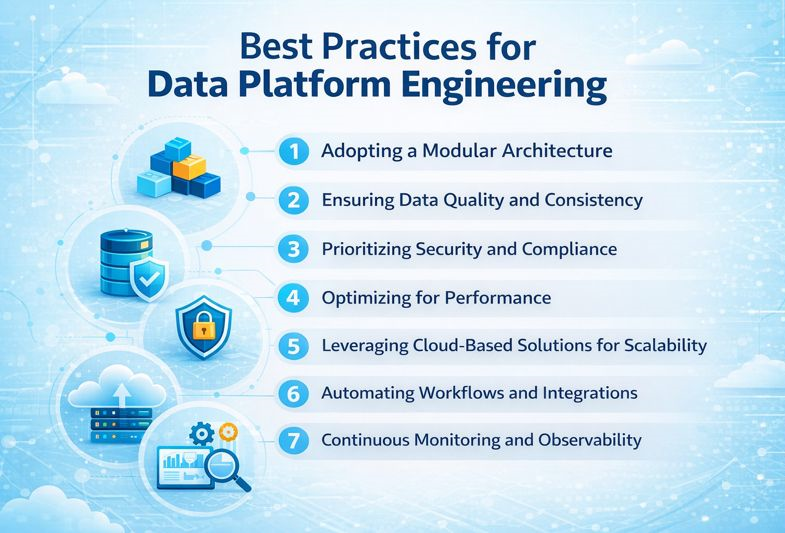
These practices help avoid common pitfalls and ensure that data flows seamlessly across systems while maintaining high performance and compliance with data privacy regulations.
1. Adopting a Modular Architecture
Designing a modular architecture enables flexibility and scalability. By breaking down the platform into loosely coupled components, data platform engineers can independently develop, test, and scale parts of the system without impacting the entire platform. This modular approach also allows for easier updates and maintenance, improving the platform's long-term sustainability.
2. Ensuring Data Quality and Consistency
Data quality is paramount for reliable decision-making. Implement robust data validation, cleansing, and transformation processes to ensure data is accurate and consistent across the platform. Data platform engineers should automate data quality checks and set up monitoring systems to detect anomalies and address issues promptly.
3. Prioritizing Security and Compliance
Security and compliance should be at the forefront of any data platform. Implement strong encryption protocols, access controls, and audit logging mechanisms to protect sensitive data from unauthorized access. Regularly review and update security practices to meet the latest regulatory requirements (e.g., GDPR, CCPA) and ensure that the platform remains secure and compliant.
4. Optimizing for Performance
Data platform engineers must ensure that the platform can handle large volumes of data without performance degradation. Use data platform optimization techniques such as indexing, partitioning, and caching to speed up data retrieval and reduce query response times. Monitoring system performance in real time allows engineers to identify bottlenecks and optimize resource allocation.
5. Leveraging Cloud-Based Solutions for Scalability
Cloud-based data engineering platforms offer significant advantages in scalability and flexibility. By leveraging cloud services like AWS, Google Cloud, or Azure cloud services, engineers can easily scale storage and computing resources based on business needs. Cloud platforms also offer high availability and disaster recovery options, ensuring data is always accessible and protected.
6. Automating Workflows and Integrations
Automation is essential for reducing manual intervention and improving efficiency. Implement automated workflows to handle repetitive tasks such as data ingestion, transformation, and storage management. Additionally, integrate data systems and tools across the platform to streamline data flow and improve collaboration between teams.
7. Continuous Monitoring and Observability
Effective monitoring and observability are crucial for maintaining the health of a data platform. Set up systems to track key metrics, including data pipeline performance, system uptime, and storage utilization. Data platform engineers should implement alerts and log systems to detect and resolve issues before they impact operations.
How Centric is Revolutionizing Data Platform Engineering for Businesses?
Centric is at the forefront of helping businesses transform their Centralized Data Management systems by adopting and implementing highly efficient and scalable data platforms. As organizations face increasing volumes of data, having the right infrastructure in place is crucial for staying competitive and making informed decisions.
It understands that each business has unique data requirements, and we tailor our data platform engineering solutions to meet those specific needs, ensuring that data is processed, stored, and analyzed efficiently.
With extensive expertise in building data platforms for clients across various industries, including oil and gas, logistics, and finance, Centric excels at creating secure, cloud-based data engineering solutions.
It ensures that its clients' platforms are not only scalable to handle growing data but also comply with the highest security standards, allowing them to safeguard sensitive information while enabling seamless data flow.
Centric also incorporates best practices in every step of the data platform development process. From ensuring data quality and security compliance to leveraging cloud-based data solutions, it helps businesses optimize their data environments for both performance and cost-efficiency.
By integrating cutting-edge technologies like machine learning, AI-driven analytics, and real-time data processing, it helps organizations unlock the full potential of their data, providing actionable insights that drive smarter, faster decision-making.
Through its tailored approach to data platform solutions, Centric is not just building infrastructure; it is empowering businesses to harness the power of data and gain a competitive edge in the digital age.
FAQs
What is data platform engineering?
Data platform engineering involves designing, building, and maintaining the infrastructure needed to manage, store, and process vast amounts of data. It ensures seamless data flow, security, and efficient analytics, enabling businesses to make data-driven decisions with confidence and reliability.
Why is data platform engineering important for businesses?
Data platform engineering is crucial because it allows businesses to handle large data volumes effectively. It ensures data accessibility, security, and scalability, providing the foundation for analytics and decision-making. This is essential for businesses to remain competitive and leverage their data for growth.
How do data platform engineers ensure data security?
Data platform engineers implement robust security measures such as encryption, access control, and audit logging to protect sensitive information. They also ensure compliance with data privacy regulations like GDPR and CCPA, securing data at every stage, from storage to processing and retrieval.
What are the key components of a data platform?
Key components of a data platform include data storage systems, data pipelines (ETL), analytics tools, and security measures. A well-designed platform integrates these components, ensuring smooth data flow, efficient storage, and real-time access to valuable insights for decision-making and business operations.
Conclusion
As businesses continue to embrace digital transformation, understanding what is data platform engineering is crucial for success. The role of data platform engineers is evolving, focusing on scalable, secure systems that enable efficient data management, processing, and analysis.
With advancements like AI integration, cloud solutions, and real-time data processing, data platform engineering is reshaping the way businesses handle their data, driving better decision-making and performance.
Centric helps organizations stay ahead by delivering tailored data platform solutions that align with their goals. It ensures that companies build robust and scalable systems capable of meeting the challenges of tomorrow, turning data into a valuable business asset for continued growth.