Data governance is essential for managing and securing organizational data, ensuring it remains accurate and reliable. So, how does data governance impact data quality? Well-defined data governance frameworks set clear rules and processes that guarantee data accuracy, completeness, and consistency.
Without proper governance, data can quickly become unreliable, leading to poor decision-making and missed opportunities.
Data quality ensures that the information used for analysis is up-to-date and fit for purpose. When governance and data quality align, organizations can harness the full potential of their data, making it a trusted asset for decision-making and compliance.
Centric helps organizations implement data governance frameworks that are aligned with their specific business needs. By focusing on people, processes, and technology, it ensures data is both trustworthy and of the highest quality.
In this guide, you’ll discover how data governance impacts data quality, the best practices for integrating the two, and steps you can take to ensure your data remains reliable and actionable.
What is Data Governance and Why Does It Matter?
Data governance refers to the overall management of data availability, usability, integrity, and security within an organization. It defines the policies, procedures, and standards that ensure data is handled consistently and accurately across all departments.
Data governance services is crucial because it provides a structured framework for data management. Without clear governance, data can become unreliable, unstructured, or vulnerable to misuse. It ensures that the right people have access to the right data at the right time while maintaining compliance with regulations.
An essential part of Data Quality Management, data governance focuses on improving the quality of data across the organization. It sets clear guidelines for maintaining accuracy, completeness, consistency, and timeliness of data, which are all vital for effective decision-making.
The importance of data governance cannot be overstated. It helps organizations mitigate risks, such as data breaches or compliance violations, and empowers teams to make data-driven decisions with confidence. Strong governance also ensures that data remains an asset, not a liability, and that it supports strategic business goals.
Why Organizations Need Data Governance?
Data governance is essential for organizations to manage data effectively and reduce risks. It ensures that data is reliable, consistent, and accessible across the business.
With data governance policies in place, organizations can make informed decisions, comply with regulations, and protect sensitive data. Without governance, data may become fragmented, leading to poor analysis and costly mistakes.
Data governance helps organizations maintain compliant data by setting rules to meet legal and regulatory requirements. It also supports business growth by ensuring data is accurate and trustworthy. In short, data governance builds the foundation for data-driven success.
Key Components of Data Governance
Several key components ensure that data governance is implemented effectively across an organization:
-
Data ownership: Defines who is responsible for data management, ensuring accountability and oversight.
-
Accountability: Ensures that teams and individuals are responsible for maintaining data quality and security.
-
Policy enforcement: Ensures that data governance policies are applied consistently across all departments, preventing errors and data breaches.
Data governance tools help streamline these processes by automating tasks, enforcing policies, and tracking data usage. These tools ensure that governance practices are followed, making it easier to maintain clean, reliable data.
Transform Your Business with Data Governance & MDM Services
What is Data Quality and Why Should You Care?
Data quality refers to the accuracy, completeness, consistency, and timeliness of data. It ensures that the data used for decision-making is reliable and fit for its intended purpose. Poor data quality can lead to incorrect insights, missed opportunities, and costly mistakes.
Key aspects of data quality include:
-
Accuracy: Ensures data is correct and free from errors or inconsistencies.
-
Completeness: Ensures all necessary data is present and no critical information is missing.
-
Consistency: Ensures data is uniform across systems and does not conflict.
-
Timeliness: Ensures data is up-to-date and relevant for current decision-making.
-
Relevance: Ensures data is aligned with business needs and objectives.
Improving data quality is essential for maintaining reliable and actionable information. It enables organizations to make informed decisions, optimize operations, and reduce risks.
Data quality assurance practices, such as regular data validation and cleansing, help ensure that data remains trustworthy. These practices ensure data is accurate, complete, and consistent, making it ready for business intelligence and reporting.
The Consequences of Poor Data Quality
Poor data quality can lead to significant negative effects for organizations. When data is inaccurate or incomplete, it can result in incorrect reports, which can mislead decision-makers. This often leads to wrong business strategies, financial losses, and missed opportunities.
Inconsistent or outdated data also wastes resources, as teams spend time correcting errors instead of focusing on strategic tasks. Moreover, poor data quality can damage a company’s reputation, especially when compliance requirements are not met. Ensuring data management and quality is critical to avoid these costly consequences.
How Data Quality Affects Business Insights?
Data quality plays a key role in shaping business insights. High-quality data ensures that decision-makers have accurate, complete, and timely information, leading to better business strategies. When data is reliable, it improves forecasting, optimizes operations, and drives growth.
On the other hand, poor data quality can distort insights, leading to flawed strategies that impact the bottom line. For instance, if data does not meet data quality standards, businesses may make decisions based on faulty assumptions. Reliable data, supported by strong data governance, is essential for turning raw data into actionable insights.
How Data Governance Affects Data Quality?
Data governance plays a crucial role in maintaining data quality across an organization. By defining clear policies, setting standards, and assigning responsibilities, governance ensures that data remains accurate, consistent, and usable.
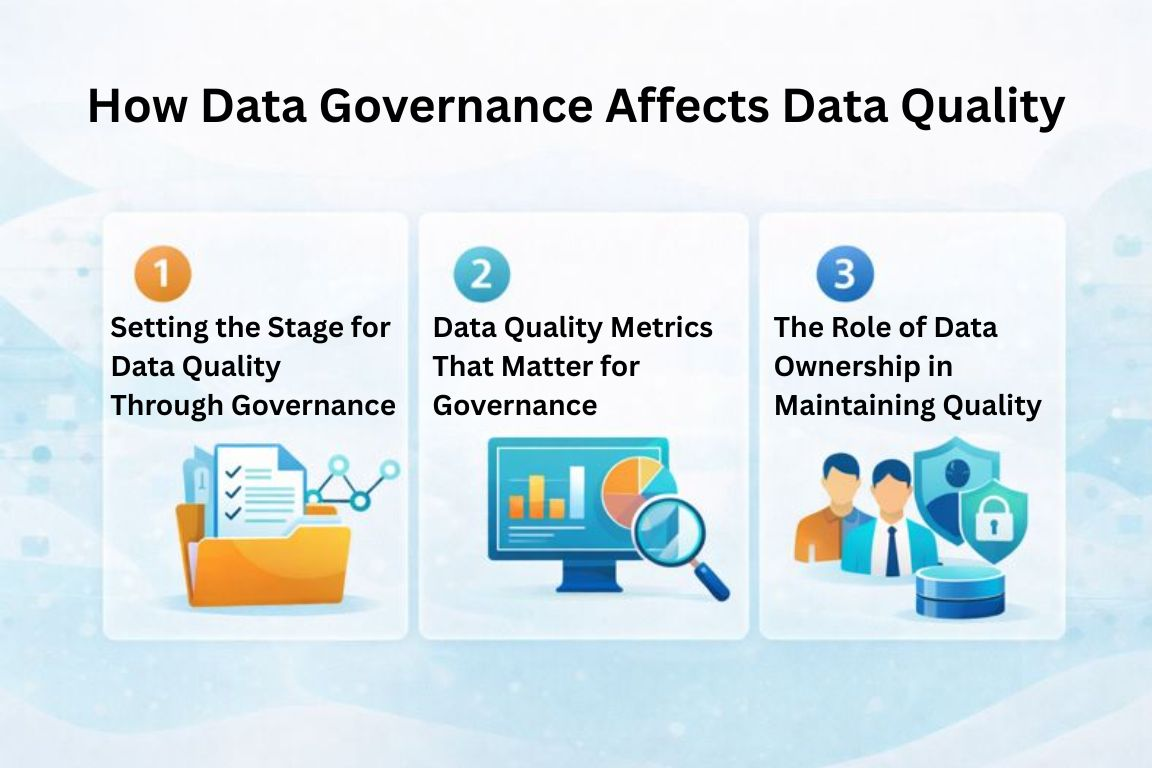
Proper governance provides the structure needed to manage data quality and integrate it into daily operations, making it easier for teams to follow best practices and adhere to data quality standards.
The role of data governance in data quality goes beyond just setting rules; it is about enforcing and monitoring compliance with those rules. This synergy ensures that data remains a valuable asset for decision-making and strategic initiatives.
Setting the Stage for Data Quality Through Governance
Governance policies create a foundation for maintaining high data quality. They define the rules and processes for how data is collected, stored, validated, and accessed. These policies help prevent errors, redundancy, and inconsistencies, ensuring that only reliable and accurate data is used for analysis.
By embedding data quality management into the governance framework, organizations can systematically address potential data quality issues before they become problems. Strong governance practices also foster a culture of data responsibility, making data quality a shared goal across teams.
Data Quality Metrics That Matter for Governance
Measuring data quality is essential to ensure that governance policies are effective. The most important metrics for data quality include:
-
Data Accuracy: Ensures that data correctly reflects the real-world entities it represents. Governance policies ensure validation and checks to avoid errors.
-
Consistency: Measures if data is uniform across all systems and departments. Governance helps ensure standardization to maintain consistency.
-
Timeliness: Refers to whether the data is up-to-date and relevant for current use. Governance ensures that data is refreshed at appropriate intervals.
These metrics, supported by data accuracy and governance, provide measurable insights into how well data governance is maintaining data quality.
The Role of Data Ownership in Maintaining Quality
Data ownership is a fundamental component of data governance. Assigning ownership ensures that specific individuals or teams are accountable for maintaining the quality of data. When data owners are responsible for their respective datasets, they are more likely to ensure the data is accurate, up-to-date, and used properly.
Clear ownership prevents data from becoming siloed or neglected. It also promotes accountability, making it easier to track issues and implement fixes. Effective data ownership supports the overall goal of data quality assurance, ensuring that the right people are taking responsibility for maintaining high-quality, reliable data.
Check Our Data & Analytics Services
The Symbiotic Relationship Between Data Governance and Data Quality
Data governance and data quality are inseparable. Governance policies provide the framework for managing data, while data quality ensures that the data within that framework is reliable and actionable.
This relationship is symbiotic—governance practices help establish the standards that maintain data quality, and high-quality data reinforces the effectiveness of governance efforts.
When governance and quality work together, organizations can ensure that data is both secure and of high value, leading to better decision-making, compliance, and operational efficiency. This mutual reinforcement ensures a continuous improvement process that benefits the entire organization.
Governance Provides the Structure for Quality
Governance policies lay the groundwork for maintaining high-quality data. These policies define clear standards for master data management, including how data should be collected, stored, validated, and accessed. By establishing consistent practices, governance ensures that data is regularly monitored for quality.
For example, governance may set rules for data validation and ensure that data follows strict data quality standards. These structured guidelines help prevent data errors and inconsistencies, ensuring that only accurate and complete data is used in analysis. Through these controls, governance provides a foundation that supports quality data practices.
Quality Reinforces Governance Practices
High-quality data strengthens governance efforts by making them more effective. When data is accurate, consistent, and reliable, governance policies can be applied more efficiently. For instance, data that adheres to quality standards can be more easily validated and processed, reducing the need for frequent corrections.
Moreover, quality data supports the enforcement of governance rules. If data is clean and reliable, governance teams can focus on ensuring compliance, managing security, and enhancing data usability, rather than spending excessive time addressing quality issues.
In this way, data quality directly enhances the effectiveness of governance policies, ensuring they are applied to data that is already well-structured and trusted.
A Feedback Loop of Continuous Improvement
The relationship between governance and data quality creates a cycle of continuous improvement. When governance practices are applied and data quality is regularly assessed, organizations can identify areas where governance needs to be adjusted or improved. Similarly, as data quality improves, it becomes easier to enforce and refine governance policies.
This ongoing feedback loop ensures that both governance and data quality evolve over time, adapting to new business needs and regulatory requirements. Regular monitoring, audits, and quality checks help organizations stay ahead of data issues, making governance efforts more effective and improving overall data quality.
The result is a cycle that continuously enhances the integrity and usability of data across the organization.

3 Best Practices for Integrating Data Governance with Data Quality
Integrating data governance with data quality is essential for ensuring that data is accurate, accessible, and secure across an organization. When data governance policies are effectively combined with data quality initiatives, organizations can reduce errors, improve decision-making, and achieve better compliance. The following best practices will help establish a strong framework for aligning these two essential elements.
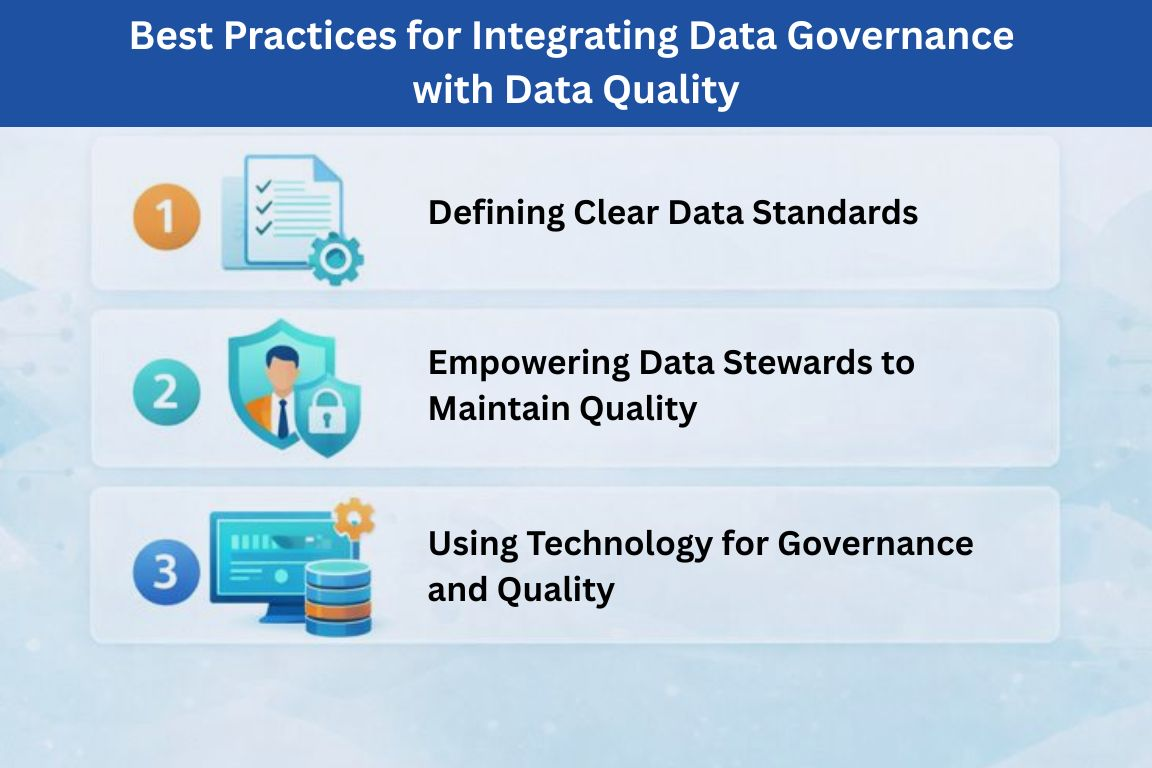
By integrating data governance with data quality, organizations can ensure that data is managed and used effectively throughout its lifecycle. This integration creates a streamlined, efficient process for maintaining high-quality data while adhering to governance policies.
Defining Clear Data Standards
One of the best practices for integrating data governance with data quality is defining clear data standards. These standards should include:
-
Accuracy: Set rules for ensuring that data is free from errors and reflects real-world entities.
-
Completeness: Define the minimum required data attributes to avoid missing or incomplete information.
-
Format consistency: Standardize how data should be formatted (e.g., date formats, naming conventions) to avoid inconsistencies.
Having well-defined data quality standards is critical for ensuring that all data across the organization is treated the same way. Governance policies should enforce these standards, ensuring data is properly validated and structured before being used.
Empowering Data Stewards to Maintain Quality
Data stewards are responsible for overseeing the day-to-day management of data. Their role is crucial in ensuring that both data governance policies and data quality standards are followed. Some of their key responsibilities include:
-
Monitoring data quality metrics and addressing any inconsistencies or issues.
-
Collaborating with business units to ensure data meets their needs and complies with governance standards.
-
Educating teams on best practices for data entry and maintenance to prevent quality issues from arising.
By empowering data stewards with the tools, training, and authority to enforce governance policies, organizations can ensure that high-quality data is maintained and governance rules are consistently applied.
Using Technology for Governance and Quality
Technology plays a vital role in automating and streamlining both data governance and data quality initiatives. These data governance Tools and platforms that enable this integration include:
-
Data governance platforms: These tools help create, enforce, and monitor governance policies, ensuring compliance with data regulations and standards.
-
Data quality management tools: Platforms like Talend, Informatica, or Microsoft Purview help automate data profiling, cleansing, and standardization, improving data accuracy and consistency.
-
Metadata management solutions: Tools like Alation and Collibra enable organizations to manage metadata, ensuring better control and visibility over data assets.
By leveraging these technologies, organizations can significantly improve the benefits of data governance, reduce manual processes, and enhance data quality in real-time.
How to Measure the Impact of Data Governance on Data Quality?
Measuring the impact of data governance on data quality is essential for understanding how effective governance efforts are. By tracking key metrics, organizations can identify areas for improvement and ensure that data remains accurate, reliable, and compliant with governance standards.
It is important to evaluate both the quality of the data and the efficiency of governance policies.
By using the right tools and techniques, organizations can assess the success of their governance efforts and make data-driven decisions about how to improve their data management processes. Here are some key approaches to measuring the impact of data governance on data quality.
Key Performance Indicators for Data Quality
To measure the effectiveness of data governance efforts on data quality, organizations should track specific Key Performance Indicators (KPIs). These KPIs provide insights into how well data quality is maintained and whether governance policies are being followed:
-
Accuracy: The percentage of error-free data. A high level of accuracy indicates strong governance and quality processes.
-
Consistency: Measures how uniform the data is across systems. Governance efforts should ensure that data is standardized across all platforms.
-
Completeness: The proportion of records that contain all required data. Incomplete data often points to gaps in governance practices.
-
Timeliness: How quickly data is updated and made available for analysis. Timely data is crucial for making informed decisions.
-
Compliance Rate: The percentage of data that adheres to established governance policies and regulatory standards.
By monitoring these KPIs, organizations can assess whether their governance policies are driving improvements in data quality.
Tracking and Reporting Governance Metrics
Tracking and reporting are critical steps in measuring data governance's impact on data quality. Dashboards and automated tools can help organizations visualize governance and quality metrics in real-time, making it easier to track progress and identify potential issues.
-
Dashboards: Use dashboards to display real-time KPIs like data accuracy, consistency, and compliance. Dashboards allow teams to quickly identify areas where governance is lacking or where quality needs improvement.
-
Automated reporting tools: Platforms like Tableau, Power BI, and Google Data Studio allow organizations to generate automated reports. These tools help stakeholders stay informed about the state of data quality and governance, making it easier to take corrective action when needed.
With these tools, organizations can efficiently monitor their data quality and governance efforts, ensuring they stay on track.
Continuous Monitoring and Audits
Governance and quality are not one-time efforts; they require continuous monitoring and regular audits to ensure compliance and accuracy over time.
-
Regular audits: Conduct periodic audits to evaluate whether data governance policies are being adhered to and if data quality standards are being met. Audits help identify gaps and opportunities for improvement.
-
Continuous monitoring: Use automated monitoring tools to continuously check the state of data quality. These tools can flag issues in real-time, allowing teams to address problems before they impact business operations.
By implementing both continuous monitoring and regular audits, organizations can maintain high standards of data governance and quality, ensuring data remains reliable and compliant.
Why Data Governance and Quality are a Competitive Advantage?
In today’s data-driven world, data governance and data quality are not just compliance requirements; they are strategic assets that provide organizations with a competitive edge. By ensuring that data is accurate, reliable, and compliant, businesses can unlock insights, streamline operations, and make smarter, faster decisions.
When both data governance and quality are prioritized, organizations can differentiate themselves in the market, innovate more quickly, and operate more efficiently. These practices help businesses leverage their data as a valuable resource rather than a burden, driving success in the long run.
The Future of Business Decisions with High-Quality, Well-Governed Data
High-quality, well-governed data is the backbone of informed decision-making. With data governance ensuring data integrity and data quality ensuring accuracy and completeness, organizations can make decisions that are not only timely but also data-driven and reliable.
As businesses adopt advanced technologies like AI and machine learning, having high-quality, well-governed data becomes even more critical. These technologies rely on accurate and complete data to deliver insights and predictions.
Organizations that invest in data governance and quality can confidently use their data for strategic planning, forecasting, and optimizing operations, ensuring they stay ahead of competitors who may struggle with poor data quality.
Staying Compliant with Industry Regulations
One of the most important roles of data governance is ensuring compliance with industry standards and regulations. With ever-changing data protection laws, such as GDPR, HIPAA, and CCPA, organizations need robust governance policies to stay compliant and avoid legal risks.
Data governance provides a framework for managing sensitive and regulated data, ensuring it is stored, accessed, and used in accordance with legal requirements.
By aligning data governance with data quality, organizations can ensure that their data is not only compliant but also reliable and trustworthy, reducing the risk of fines or reputational damage from non-compliance.
Enhancing Operational Efficiency with Trusted Data
Data governance and quality directly impact operational efficiency. When governance policies are in place and data quality is maintained, businesses can streamline processes, reduce redundancies, and optimize workflows.
For example, reliable data helps eliminate the time spent on correcting errors or addressing data inconsistencies, allowing teams to focus on more strategic tasks. Furthermore, well-governed data can be easily accessed and analyzed, improving collaboration across departments and driving innovation.
By enhancing operational efficiency, data governance and quality allow organizations to allocate resources more effectively, reduce costs, and ultimately improve their bottom line.
FAQs
What is the relationship between data governance and data quality?
Data governance sets the rules, policies, and procedures for managing data, while data quality ensures that the data is accurate, complete, and consistent. Together, they ensure that data is reliable, compliant, and fit for decision-making, improving organizational efficiency and trust.
How does data governance improve decision-making?
Data governance improves decision-making by ensuring data is accurate, consistent, and reliable. With clear policies for data access, quality, and security, decision-makers can confidently rely on data to make informed choices, leading to better outcomes, optimized processes, and minimized risks.
Why is data quality important for business operations?
Data quality is essential for business operations because it ensures that decisions are based on accurate and complete information. High-quality data helps streamline processes, reduce errors, and improve efficiency, allowing businesses to achieve better performance, enhance customer satisfaction, and boost profitability.
How can data governance help with regulatory compliance?
Data governance ensures compliance by establishing policies for data security, privacy, and usage. By enforcing consistent standards and monitoring data management practices, organizations can meet regulatory requirements, reduce legal risks, and avoid penalties, ensuring that data handling complies with industry laws and regulations.
Conclusion
Effective data governance is key to achieving reliable and high-quality data. When considering how does data governance impact data quality? It becomes clear that governance policies are integral in ensuring data remains accurate, timely, and useful for business operations.
Centric expertise lies in helping organizations develop strong data governance frameworks that reinforce data quality at every level. By applying best practices in governance, businesses can maintain data integrity, meet compliance standards, and ultimately leverage data for improved decision-making and operational efficiency.
With data governance in place, organizations can ensure that their data remains a strategic asset.