Qualitative data refers to descriptive information that captures the qualities or characteristics of a phenomenon, often through non-numerical means. If you're wondering what is qualitative data, it’s the type of information that provides insights into emotions, behaviors, perceptions, and experiences, usually gathered through methods like interviews, focus groups, and observations.
Unlike quantitative data, which is structured and measurable, qualitative data allows researchers to explore deeper meanings and understand the "why" behind actions or opinions.
In this guide, you’ll learn about the different types of qualitative data, how it’s collected, its importance, and how it can be effectively analyzed. Whether you're a marketer, researcher, or business strategist, understanding qualitative data is essential to making informed decisions.
What is Qualitative Data?
Qualitative data refers to non-numerical information that describes qualities or characteristics. It’s data that provides in-depth insights into people’s experiences, feelings, and behaviors. In contrast to quantitative data, which deals with numbers and measurable values, qualitative data focuses on understanding the underlying reasons, motivations, and patterns behind human actions.
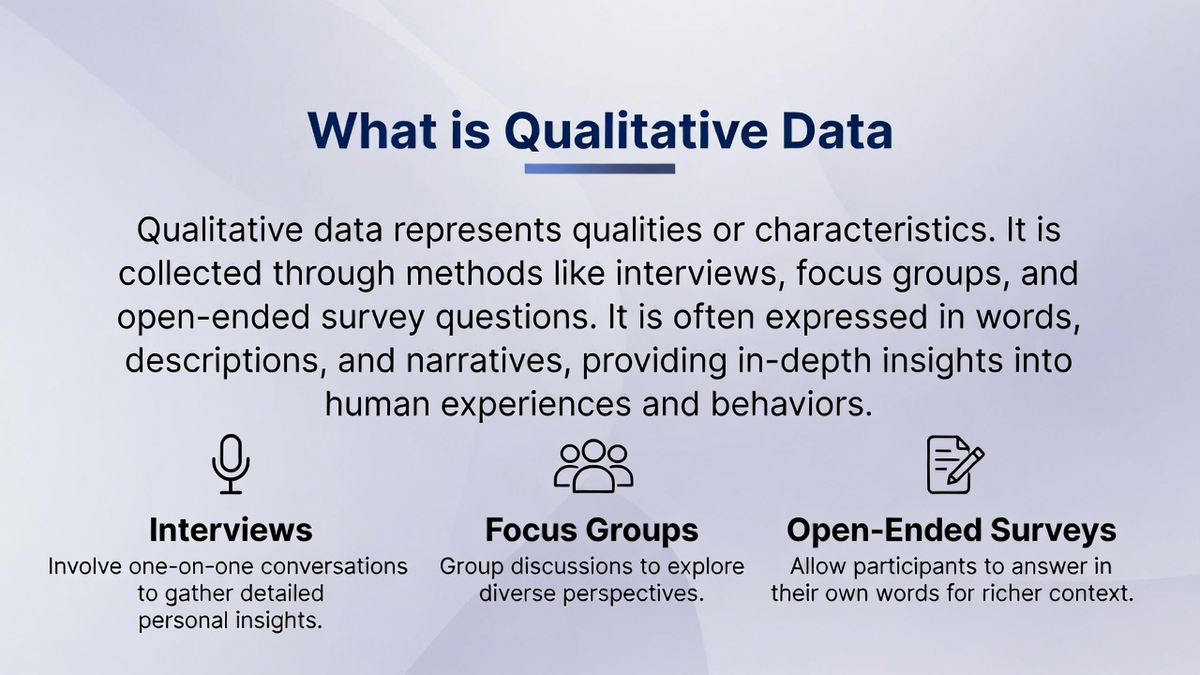
This type of data is primarily used in fields like marketing, psychology, social sciences, and customer research to understand people's perceptions, opinions, and experiences.
Qualitative data plays an essential role in various industries, particularly in market research and consumer behavior analysis. It helps businesses uncover the "why" behind customer decisions, improving products, services, and marketing tactics.
By diving into the richness of human experiences, businesses can make more informed decisions that go beyond numbers. Learning how to analyze qualitative data helps in extracting meaningful insights that guide business growth and customer engagement.
The Basics of Qualitative Data
Qualitative data is descriptive in nature, providing a detailed account of qualities that are observed or felt rather than counted. This data is typically gathered through interviews, focus groups, and open-ended surveys, where participants express their thoughts, feelings, and experiences in their own words.
Unlike quantitative data that focuses on statistical analysis, qualitative data paints a broader picture of a phenomenon, allowing researchers to explore complex subjects from a human perspective.
For example, when conducting customer feedback surveys, a qualitative response might describe how a customer feels about a product's launch services or how a service met their expectations. This type of data is vital in creating a deeper understanding of customer sentiment and helps businesses identify opportunities for improvement.
Qualitative vs Quantitative Data
Qualitative vs quantitative data are both crucial for research but serve different purposes and are used in different contexts.
-
Qualitative data is descriptive and subjective, capturing thoughts, experiences, and emotions. It answers "why" and "how" questions, exploring deeper meanings and offering insights into people's perceptions. For example, open-ended survey responses or focus group discussions about a product’s design are examples of qualitative data.
-
Quantitative data, on the other hand, is numerical and objective. It answers questions like "how many" or "how much," and is used to measure and quantify data. Examples include sales figures, website traffic numbers, or customer satisfaction ratings on a scale of 1-10.
In essence, while qualitative data helps explain why something happens, quantitative data measures how often or to what extent it happens. Together, these types of data provide a comprehensive understanding of a phenomenon. Researchers often combine both to get a well-rounded view of their study subject.
Understanding how to analyze qualitative data allows you to extract nuanced insights from descriptive responses, which can then complement the statistical insights gained from quantitative data, ultimately leading to more informed decisions.
Importance of Qualitative Data in Research
Qualitative data plays a crucial role in research as it helps uncover the underlying motivations, behaviors, and perceptions that influence human actions. Unlike quantitative data, which focuses on numbers and measurable aspects, qualitative data in research provides the richness and depth needed to understand the "why" and "how" behind various phenomena.
By collecting and analyzing qualitative data, researchers can gain valuable insights into consumer behavior, societal trends, and individual perceptions, making it indispensable for both market research and social sciences.
In areas such as psychology, sociology, and consumer behavior, qualitative research methods are used to explore complex topics in a more flexible and open-ended manner. This approach allows for an in-depth understanding of how people think, feel, and act, which is essential for tailoring products, services, and marketing strategies that resonate with the target audience.
The Role of Qualitative Data in Market Research
Businesses increasingly rely on qualitative data examples to understand consumer preferences, pain points, and decision-making processes. Traditional quantitative surveys can tell you how many people prefer a product, but qualitative data dives deeper to reveal why they feel that way.
Through methods like focus groups, in-depth interviews, and open-ended survey questions, businesses can explore the emotions, attitudes, and values that drive purchasing decisions.
For instance, by analyzing customer feedback, a company may identify that a product is perceived as high-quality but too expensive, leading to a shift in pricing or product bundling. Qualitative research methods allow businesses to tailor their strategies based on these insights, ultimately helping to increase customer satisfaction and loyalty.
Uncovering Insights from Qualitative Data
Qualitative data is key in uncovering deeper insights into customer experiences, enabling companies to improve their products or services. For example, by analyzing reviews, social media discussions, or one-on-one interviews, companies can identify areas where their offerings fall short and where they excel.
These insights might not be immediately obvious through quantitative data, such as understanding why customers abandon shopping carts or what specific feature is the most appreciated in a service.
Moreover, qualitative data helps businesses identify emerging trends and unmet needs that would otherwise go unnoticed. By continuously gathering and analyzing qualitative data in research, businesses can stay ahead of the curve, adapting their strategies to meet the ever-changing needs of their customers.
This ability to refine products and services based on genuine customer input fosters long-term relationships and drives sustained growth.
3 Types of Qualitative Data
Types of qualitative data can vary significantly depending on how they are categorized or used in research. Understanding these different types is essential for conducting comprehensive analysis and gathering the right insights.
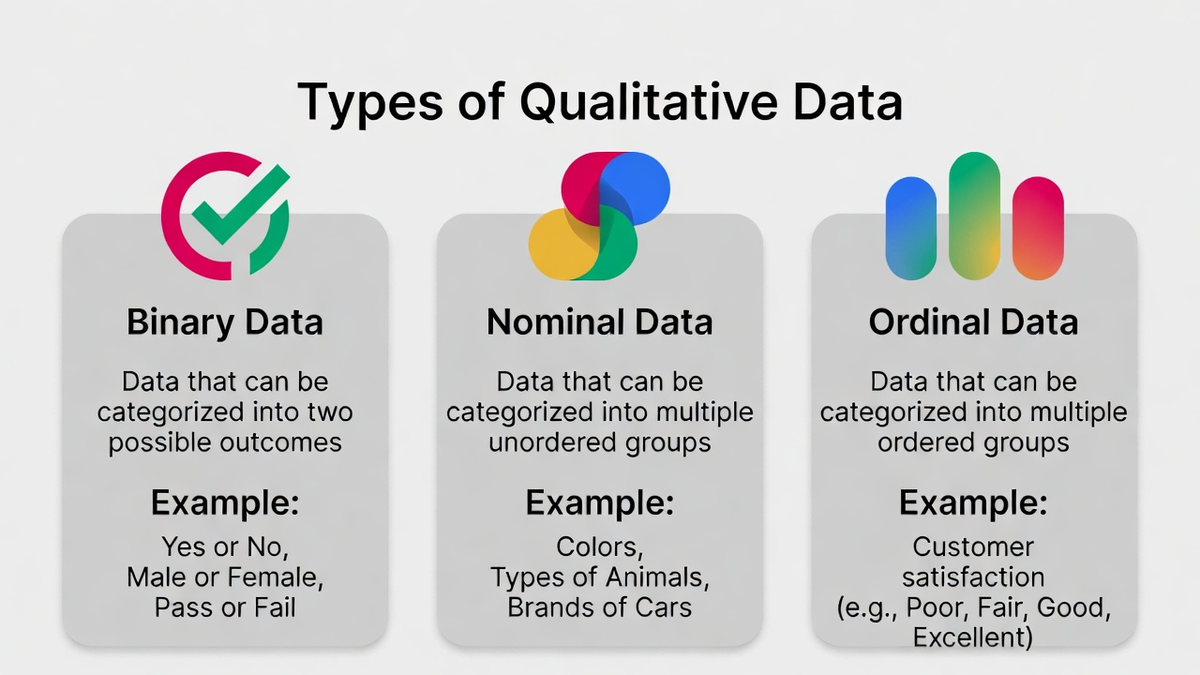
Below are the most common types of qualitative data used in research, each serving a distinct purpose.
1. Binary Data
Binary data is a simple form of qualitative data used to represent two possible categories, often in the form of "yes/no" or "true/false" responses. For example, a survey question asking if a person has used a product before could have binary responses: "Yes" or "No."
This type of data is ideal for straightforward questions where only two options are possible. It helps researchers classify responses quickly and make decisions based on the presence or absence of a trait.
2. Nominal Data
Nominal data consists of categories without any inherent order or numerical value. It includes attributes such as color, gender, or location. For example, categorizing respondents by their preferred color or the region they live in would produce nominal data because these categories are distinct but not ranked.
This type of data is often used to label and classify variables without assuming any hierarchy. Nominal data helps researchers group responses into non-quantitative categories for better segmentation and analysis.
3. Ordinal Data
Ordinal data refers to data that can be ordered or ranked based on categories. Examples include survey satisfaction scales (e.g., "Very Satisfied," "Neutral," "Dissatisfied") where the categories are ordered, but the exact differences between them are not measurable.
This type of data helps in assessing varying degrees of experience or opinion. While the order matters, the intervals between the categories are not necessarily equal, making it ideal for capturing trends in customer feedback and sentiment analysis.
How Qualitative Data is Collected?
Qualitative data collection techniques are vital for gathering insights that can't be quantified numerically but can offer valuable perspectives into people's behaviors, experiences, and motivations.
These methods help researchers capture the depth of human interaction and understanding in natural, real-world settings. Below are some commonly used methods for collecting qualitative data in research and business.
Interviews
Interviews are one of the most widely used methods for gathering qualitative data. These can be either structured, with predefined questions, or unstructured, allowing for a more conversational approach. In-depth, one-on-one interviews provide rich data by giving participants the freedom to elaborate on their thoughts, opinions, and experiences.
Interviews are particularly useful when the goal is to understand personal perspectives, motivations, or emotional responses to a product or service. They can uncover insights that surveys or quantitative methods might miss, providing a more holistic view of the research subject.

Focus Groups
Focus groups involve a small group of participants who discuss a particular topic under the guidance of a moderator. This method allows researchers to observe collective behaviors, perceptions, and group dynamics in real-time.
By encouraging group interaction, focus groups can reveal how participants influence each other’s opinions, leading to deeper insights into collective attitudes, beliefs, and social behaviors. This approach is often used in market research to explore how different groups react to new products, advertisements, or business ideas, making it a powerful tool for understanding consumer behavior.
Observation and Case Studies
Observation is a method where researchers immerse themselves in a natural setting, observing subjects without interference. This technique allows for a more authentic understanding of behaviors, particularly when participants might not fully articulate their actions or feelings.
Similarly, case studies involve an in-depth, detailed examination of a particular instance or event, often over a period of time. Both observation and case studies help in gathering qualitative data by providing contextual insight into complex behaviors or situations.
These techniques are especially useful when studying behaviors that are difficult to replicate in controlled environments, such as workplace dynamics or customer experiences.
Analyzing Qualitative Data
Proper qualitative data analysis is crucial for drawing meaningful conclusions from the raw data collected through various methods. Without thorough analysis, valuable insights may go unnoticed. The process involves organizing, interpreting, and validating data to ensure that it effectively addresses research objectives and provides actionable results.
Thematic Analysis
Thematic analysis involves grouping qualitative data into themes or categories to identify patterns and insights. Researchers systematically review the data, identifying recurring ideas or concepts. This approach allows for a deeper understanding of participants' experiences and behaviors, revealing underlying trends that can inform business strategies and decision-making.
Coding Techniques
Coding techniques are used to assign labels to pieces of qualitative data, categorizing them based on key themes or patterns. This process helps in organizing large volumes of data and making it easier to identify significant insights. Qualitative data analysis becomes more manageable through coding, enabling researchers to analyze complex, unstructured information systematically.
Validating Qualitative Data
Validating qualitative data is essential to ensure the reliability and accuracy of the findings. Researchers cross-check data for consistency and verify that the methods used for analysis align with research objectives. This process minimizes biases and ensures that the conclusions drawn are reflective of true participant experiences and behaviors.
3 Applications of Qualitative Data
Qualitative data plays a vital role in various industries, offering valuable insights that help shape decisions, strategies, and innovations. It allows professionals to explore deeper contexts, understand human behavior, and refine products or services based on detailed, subjective feedback. Below are key areas where qualitative data is commonly applied.
Qualitative Data in Marketing
Qualitative data helps marketers gain a better understanding of consumer behavior by exploring emotions, perceptions, and experiences. Through methods like focus groups and in-depth interviews, marketers can uncover motivations, preferences, and pain points, which improve targeting strategies and product development.
By analyzing consumer sentiment, companies can better tailor messaging, increase brand awareness, and enhance customer engagement.
Qualitative Data in Healthcare Research
In healthcare research, qualitative data is essential for understanding patient experiences, satisfaction, and healthcare outcomes. Interviews, surveys, and case studies provide rich, descriptive data that reveal how patients feel about their treatments, healthcare providers, and overall care.
This data helps healthcare professionals improve patient care, refine treatment strategies, and address issues that quantitative data might overlook.
Qualitative Data in Education
Qualitative data in education helps educators understand student engagement, learning behaviors, and challenges. By using open-ended surveys and classroom observations, teachers can gain insights into how students interact with the material and identify areas where they may need additional support.
This data allows for more personalized teaching strategies, improving overall learning outcomes and addressing students’ unique needs.
3 Challenges in Using Qualitative Data
While qualitative data provides valuable insights, it also comes with challenges that researchers and businesses must navigate. These challenges can affect the efficiency of data collection, the reliability of results, and the scalability of findings. Below are some of the most common challenges faced when working with qualitative data.
Time and Resource Intensive
Qualitative data collection and analysis are more time-consuming compared to quantitative data. Gathering qualitative data often involves conducting interviews, focus groups, and observations, which require significant time and effort.
The analysis process is equally intensive, as researchers must manually transcribe, categorize, and interpret open-ended responses. This makes qualitative research more resource-heavy, often limiting the sample size and scope.
Subjectivity in Interpretation
One of the inherent challenges in qualitative data is the potential for subjectivity in interpretation. Since this data is descriptive and often open to individual perspective, researchers' biases and personal experiences can influence the way they categorize or analyze data.
Ensuring consistency in interpretation requires strict methodological rigor and clear coding schemes to minimize personal bias and enhance the reliability of findings.
Difficulty in Generalizing Results
Generalizing results from qualitative data to a larger population can be challenging. Due to the small sample sizes typically used in qualitative research, findings may not always be applicable to broader groups.
Unlike quantitative research, which uses statistical methods to infer patterns across populations, qualitative research is often more context-specific, limiting the ability to extrapolate findings to a larger audience. This makes it crucial to carefully define the scope of qualitative research and understand its limitations when drawing conclusions.
FAQs
What is the difference between qualitative and quantitative data?
Qualitative data is descriptive and focuses on understanding experiences, perceptions, and emotions, whereas quantitative data is numerical and measures quantities or frequencies. Qualitative data helps answer "why" and "how" questions, while quantitative data answers "how many" or "how much" questions, offering measurable insights.
How is qualitative data collected in research?
Qualitative data is typically collected through methods like interviews, focus groups, and observations. Researchers gather in-depth, open-ended responses to understand people's experiences, feelings, and perceptions. These methods allow for a deeper exploration of topics, offering rich, descriptive insights that quantitative data alone cannot provide.
What are the benefits of using qualitative data in market research?
In market research, qualitative data provides a deeper understanding of customer behavior, motivations, and preferences. By exploring feelings, emotions, and experiences, businesses can uncover valuable insights that help improve products, services, and marketing strategies. This qualitative approach enhances decision-making by focusing on consumer intent and attitudes.
Can qualitative data be generalized to a larger population?
Qualitative data typically involves smaller sample sizes, which limits the ability to generalize findings to a larger population. Unlike quantitative data, which uses statistical methods for broader conclusions, qualitative research provides insights that are more context-specific, making it difficult to apply findings universally without further study.
Conclusion
Understanding what qualitative data is and its role in research is crucial for gaining deep insights into human behavior, emotions, and perceptions. Unlike quantitative data, which provides numerical measurements, qualitative data explores the underlying reasons behind actions and decisions.
It is collected through methods such as interviews, focus groups, and observations, offering valuable context that cannot be captured through numbers alone.
Centric helps businesses harness the power of qualitative data to create more informed strategies.. By combining the depth of qualitative insights it enables businesses to make impactful decisions that drive growth and customer satisfaction. This holistic approach ensures that every strategy is backed by a comprehensive understanding of both the "why" and "how" behind consumer behavior.