Curious about what is meta data SEO and why it matters? Let’s break it down in simple terms. Meta data in SEO refers to the information added within a webpage’s HTML that helps search engines understand what the page is about. This data is not directly visible to users on the page, but it plays a powerful role in how your site appears in search results. It includes elements such as meta titles, meta descriptions, and meta tags, which guide search engines in indexing your content properly.
Metadata is important because it shapes how your website appears on search engine results pages (SERPs). Strong, clear, and well-optimized metadata makes your listings more attractive and more likely to earn clicks. In addition, metadata helps search engines match your content with the right search intent. When done correctly, it improves your chances of ranking for relevant keywords while also delivering a better user experience. In this blog, we will explore everything you need to know about Meta data SEO.
What is Meta Data in SEO?
Metadata is the information that tells search engines what your webpage is about. When Google crawls your site, it reads your metadata to understand context, relevance, and how your page should rank for search queries. SEO emphasize the importance of metadata because it directly impacts how search engines interpret and rank content.
There are two core types of metadata:
- Descriptive metadata explains what the content is, what it contains, and when or where it was created. It helps both users and search engines understand the page.
- Structural metadata shows how a page fits within the broader site structure. It defines relationships between topics and how content connects across your website.
Why Metadata Matters for SEO?
Metadata plays a pivotal role in SEO, offering several key benefits that directly impact a website's performance in search engine results pages (SERPs).
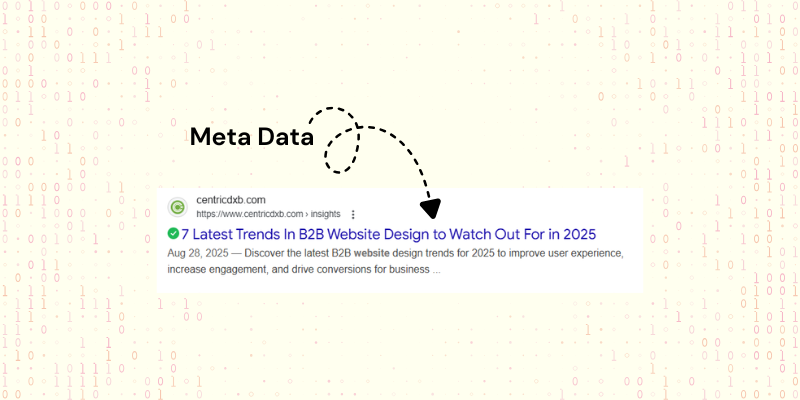
Google explains:
Titles give users an immediate understanding of what a page is about and why it matches their search intent.
Since the title is often the main factor users rely on when deciding which result to click, using clear, accurate, and high-quality titles is essential for higher visibility and stronger click-through rates.
6 Types of SEO Metadata
Metadata encompasses a variety of elements that help search engines and users understand a webpage’s content.
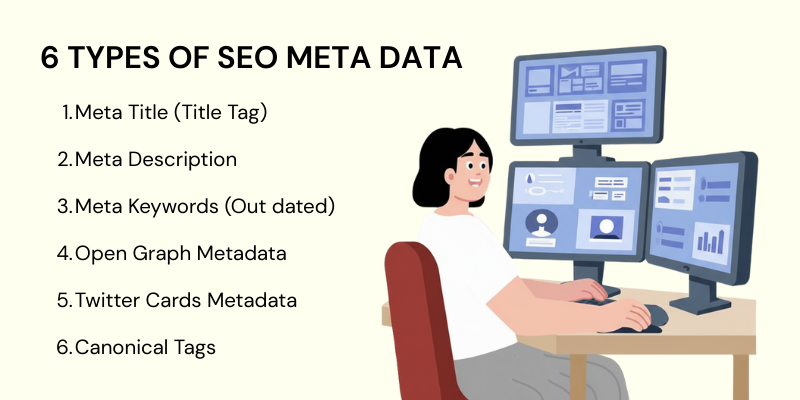
Here’s a breakdown of each type of SEO metadata, which includes vital elements that search engines use to evaluate your page’s relevance and authority. By using Best SEO Tools, you can ensure that each type of metadata is correctly configured to enhance search engine visibility.
1. Meta Title (Title Tag)
The meta title is one of the most important elements of metadata for SEO. It appears as the clickable headline in search engine results and in the browser tab, providing search engines with a clear indication of the page’s content.
A well-optimized title tag not only helps search engines understand the content of the page but also influences whether users will click on the link.
Some key components of the meta title include:
- Directly affects search rankings and click-through rates (CTR).
- Ideal length is between 50-60 characters to avoid truncation in search results.
- Include target keywords near the beginning.
- Keep it concise and descriptive.
- Ensure it accurately reflects the page's content to attract the right audience.
- Avoid keyword stuffing, as it can lead to a poor user experience.
2. Meta Description
The meta description is a brief summary of the page’s content that typically appears below the title in search engine results.
Although it doesn’t directly impact rankings, it plays a crucial role in influencing click-through rates (CTR) by providing users with a snapshot of the page’s content.
Some key components of the meta description include:
- A compelling meta description can convince users to click on your link over others. A well-written description enhances the user experience by clearly indicating whether the content matches their search intent.
- Include primary keywords relevant to the content.
- Keep the length between 150-160 characters to avoid truncation.
- Write engaging, action-oriented copy to encourage clicks.
- Ensure it offers a clear and accurate preview of the page’s content.
3. Meta Keywords (Outdated)
Meta keywords were once an important part of SEO, used to specify relevant keywords for a page. However, they have become obsolete due to abuse and keyword stuffing by spammers.
- Why They Are No Longer Used: Google no longer uses meta keywords as a ranking factor because they were often overused or misused to manipulate rankings.
- Current Use: Some older websites may still have meta keywords, but they no longer contribute to SEO performance or rankings.
4. Open Graph Metadata (OG Tags)
Open Graph (OG) metadata is used to control how content appears when shared on social media platforms, such as Facebook or LinkedIn.
It influences how your link previews appear, impacting user engagement when your content is shared across social platforms.
Some key components of the open graph metadata include:
- OG tags define how the preview of your content will appear, including the title, description, image, and URL.
- A well-optimized OG tag can significantly improve user engagement when your content is shared.
- Use high-quality images for the og:image tag.
- Write compelling titles and descriptions using og:title and og:description to grab attention.
- Ensure the og:url points to the canonical version of the page to avoid duplication.
5. Twitter Cards Metadata
Twitter cards are a feature that enables rich media content to be displayed when shared on Twitter. Twitter cards allow for enhanced visibility and engagement by showcasing images, video, and other rich snippets in tweets.
Some key components of the twitter cards metadata include:
- Use twitter:card to specify the type of card (summary, summary_large_image, player, etc.).
- The twitter:title and twitter:description tags define the text that appears with the tweet.
- Use twitter:image to display an image with the tweet.
- Properly optimizing Twitter cards ensures better visibility and engagement when your content is shared on Twitter or X.
6. Canonical Tags
A canonical tag is used to indicate the preferred version of a page when there are multiple pages with similar content. This tag is essential for handling duplicate content issues that can harm SEO performance
Some key components of the canonical tags include:
- When there are several pages with similar or duplicate content, the canonical tag tells search engines which version of the page should be treated as the primary source.
- Use the canonical tag on pages with similar or duplicate content to direct search engines to the most relevant page.
- Ensure the href attribute in the tag points to the URL you want to be indexed (the canonical version).
How to Write Effective Meta Data?
Writing effective metadata is crucial for improving your page’s SEO performance. Here are some key guidelines to ensure your metadata is both relevant and optimized:
1. Relevance
Ensure your metadata accurately reflects the content of the page. It should clearly describe what users can expect to find, aligning with their search intent.

2. Keyword Placement
Include primary keywords in both the meta title and meta description, but ensure they are naturally incorporated. Keywords should be placed at the beginning of the meta title for maximum impact. Avoid overstuffing keywords as this can negatively affect user experience and SEO performance.
3. Character Limits
It includes
- Meta title: Keep it between 50-60 characters to ensure it’s not cut off in search results.
- Meta description: Limit it to 150-160 characters to make sure the full description is visible in search results.
4. User-Focused Writing
Write metadata that appeals to users, not just search engines. Your meta description should be engaging and action-oriented to encourage clicks. It should offer a clear, concise preview of the page’s content to help users decide if the page meets their needs.
Top 5 Tools to Generate or Audit Metadata
There are several tools available to help generate and audit metadata for SEO, each serving different purposes to improve your website's search engine performance.
Here are some of the best tools you can use to generate or audit metadata for SEO.
- Yoast SEO is a popular WordPress plugin that lets you easily add and manage meta titles, meta descriptions, and other metadata directly in WordPress. It automatically evaluates your metadata and provides guidance to meet SEO best practices, such as optimizing keyword usage, title length, and readability.
- Rank Math is another WordPress plugin similar to Yoast SEO. It helps you define metadata (title/description), manage metadata for pages/posts, and run audits to optimize on-page SEO.
- Screaming Frog SEO Spider crawls your entire website (or up to a certain number of pages for free) and extracts metadata information, such as title tags and meta descriptions. It helps identify issues like missing tags, duplicates, broken links, and indexing problems across your site, making it a powerful tool for detailed SEO audits.
- Ahrefs, a comprehensive SEO suite, provides a deeper analysis of your site, including on-page metadata audits, technical SEO checks (like crawlability and duplicate content), and backlink/competitor analysis. It’s particularly useful for understanding how metadata and content structure impact SEO performance.
- SEMrush offers a full SEO toolkit that includes metadata audits, identifies missing or duplicate metadata, checks on-page SEO factors, and provides actionable recommendations. It’s great for ongoing SEO maintenance, especially for large websites.
These tools help with scanning your website for metadata issues such as missing or duplicate tags, flags for long titles or missing descriptions, and auditing other SEO aspects like broken links, duplicate content, and crawlability.
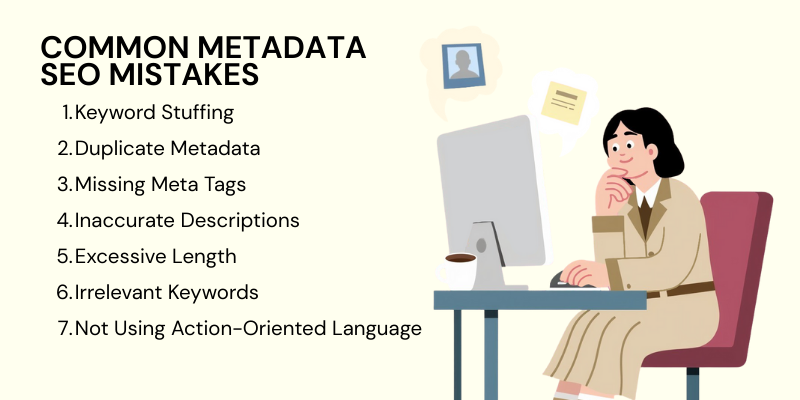
7 Common Metadata SEO Mistakes
Some common SEO metadata mistakes include:
1. Keyword Stuffing
Overloading the meta title or meta description with too many keywords in an unnatural way. This makes the content less readable and can negatively affect user experience and search engine rankings.
2. Duplicate Metadata
Using the same meta title or meta description across multiple pages. Duplicate metadata can confuse search engines and prevent pages from ranking individually. Each page should have unique metadata to avoid this issue.
3. Missing Meta Tags
Failing to include important meta tags, such as meta title, meta description, or meta robots tags, can lead to poor indexing, making it harder for search engines to categorize your content.
4. Inaccurate Descriptions
Writing meta descriptions that don't accurately represent the content of the page. This can mislead users, leading to a higher bounce rate and negatively impacting your SEO performance.
5. Excessive Length
Having meta titles or meta descriptions that are too long, causing them to get cut off in search results. This makes them less effective and can hurt the chances of a user clicking on your link.
6. Irrelevant Keywords
Including keywords in the meta tags that aren’t relevant to the page content. This can confuse both search engines and users, leading to a poor experience and potential penalties from search engines.
7. Not Using Action-Oriented Language
Failing to write engaging and action-oriented meta descriptions that encourage users to click on the link. Without a compelling call to action, users may ignore your page in favor of others.
Explore Our Digital Marketing Services!
Frequently Asked Questions (FAQs)
Why Is Metadata Important For SEO?
Metadata helps search engines understand the context of your content, making it easier to index and rank your pages. Properly optimized metadata can improve your website’s click-through rate (CTR), driving more traffic to your site.
What Is The Ideal Length For A Meta Title?
The ideal length for a meta title is between 50-60 characters to ensure it displays fully in search engine results without getting cut off.
How Long Should A Meta Description Be?
A meta description should be between 150-160 characters to avoid truncation in search results and provide a clear preview of the page content.
What Are Open Graph Tags And Why Are They Important?
Open Graph tags are metadata used to control how content appears when shared on social media platforms, such as Facebook or LinkedIn. These tags help improve social media engagement by customizing the title, description, image, and URL preview.
Should I Use Meta Keywords For SEO?
Meta keywords are no longer a significant ranking factor for Google. They were often abused in the past and are now largely ignored by top search engines. It’s generally best to focus on meta titles and meta descriptions instead
What Is The Difference Between Noindex And Nofollow In The Meta Robots Tag?
Noindex tells search engines not to index a page, while nofollow tells them not to follow the links on that page. These can be used to prevent indexing or passing link equity on certain pages like login or thank-you pages.
Can Metadata Affect My Website’s User Experience?
Yes, well-crafted metadata improves user experience by providing a clear, accurate preview of your content in search results and social media previews. This can lead to higher click-through rates and better engagement.
Conclusion
Now that you've learned what metadata in SEO is, let's wrap up this concept. Metadata plays a crucial role in enhancing your website’s search visibility, user engagement, and overall SEO performance. Properly optimized metadata helps search engines understand your content, ensuring it is indexed and ranked effectively. By creating unique, relevant, and keyword-rich meta titles and meta descriptions, you can improve your click-through rates (CTR) and attract more organic traffic. Metadata not only impacts search engine rankings but also influences how your content appears on social media, making it more likely to be shared and engaged with. A digital marketing agency like Centric can assist in optimizing metadata to boost your SEO efforts and drive greater results for your business.