





Marketing plays a core role in driving business success.
To understand what is marketing in business, it can be defined as every strategic effort a company makes to attract, educate, and convert customers.
Marketing helps businesses understand customer needs, communicate value clearly, and build trust that supports long-term growth.
From brand awareness and market research to advertising and customer engagement, marketing connects products and services with the right audience.
It also guides product positioning, pricing, promotion, and content strategy. Without proper marketing, even strong products struggle to gain attention.
This blog explains the importance of marketing, key strategies, real-world examples, and practical steps to apply marketing effectively in any business.
Understanding the Meaning of Marketing in Business
Marketing in business refers to the process of identifying customer needs, creating value-driven products or services, and communicating that value to the right audience.
It involves research, branding, promotion, pricing, and customer engagement. Marketing helps businesses build trust, attract buyers, and maintain long-term relationships.
It also guides how a company positions itself in the market and stays competitive. Without marketing, even strong products struggle to gain visibility and customer loyalty.
Top 10 Key Components of Marketing
Successful marketing relies on a clear strategy that aligns a product with customer needs and communicates value effectively. These components work together to attract users, build trust, and drive sales while strengthening a brand’s position in the market.

Here are the key components of marketing:
- Market Research: This helps businesses understand customer needs, trends, and competitors. It supports better product, pricing, and promotion decisions.
- Target Audience: It defines the group of people a business wants to reach. Clear targeting makes marketing more focused and effective.
- Product or Service: This is what the business offers to customers to solve a problem. It must match customer needs and expectations.
- Pricing Strategy: Pricing decides how much customers pay for a product or service. It affects profit, demand, and brand value.
- Promotion and Advertising: This includes all activities that spread awareness about a product. It encourages customers to take action and buy.
- Branding: Branding shapes how people see and remember a business. It builds identity, trust, and customer loyalty.
- Distribution (Place): This refers to how products reach customers. It ensures availability at the right location and time.
- Customer Relationship Management: CRM helps manage customer interactions and service. It improves satisfaction and builds long-term loyalty.
- Digital Marketing: This uses online channels like websites and social media. It helps reach a wider audience at a lower cost.
- Sales Support: Sales support provides tools and guidance to close deals. It helps convert leads into paying customers.
The Role of Marketing in Business Growth
Marketing plays a direct role in helping businesses grow by building visibility, attracting customers, and creating trust in the market. It helps companies communicate their value clearly, reach the right audience, and stay competitive.
Through consistent marketing efforts, businesses can increase demand, strengthen their brand, and create long-term customer relationships that support steady growth.
Key ways marketing supports business growth:
- Increases brand awareness
- Attracts new customers
- Builds customer trust and loyalty
- Supports consistent sales growth
- Strengthens market position
According to McKinsey, companies that combine digital tools, analytics, and agile marketing/sales approaches grow up to 5× faster than their peers.
With the right marketing strategy, businesses can grow faster, expand into new markets, and maintain strong customer connections over time.
8 Main Types of Marketing
Businesses use different marketing methods to reach audiences, share their message, and build relationships. Each type plays a unique role in promoting products or services, depending on where customers spend their time and how they prefer to receive information.
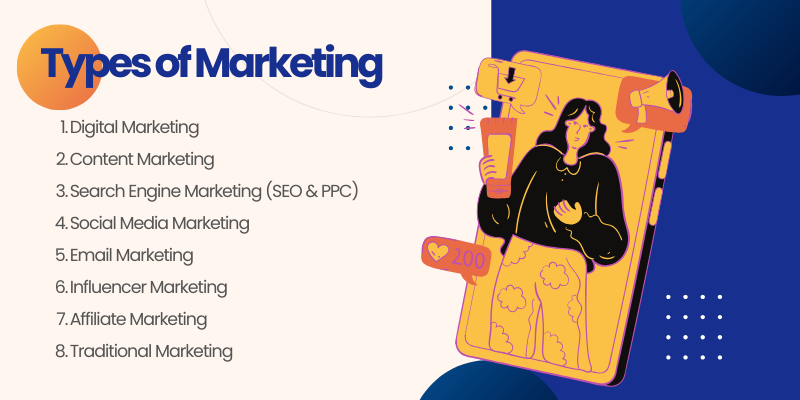
The main marketing types include:
|
Marketing Type |
Explanation |
|
Digital Marketing |
Uses online platforms like websites, apps, and search engines. It helps businesses reach customers through digital channels. |
|
Content Marketing |
Focuses on creating blogs, videos, and guides for users. It builds trust and keeps audiences engaged. |
|
Search Engine Marketing (SEO & PPC) |
Helps businesses appear in search results. SEO brings free traffic, while PPC uses paid ads. |
|
Social Media Marketing |
Promotes products on platforms like Facebook and LinkedIn. It helps build brand awareness and engagement. |
|
Email Marketing |
Sends updates, offers, and news directly to customer inboxes. It supports repeat sales and loyalty. |
|
Influencer Marketing |
Uses public figures to promote products to their followers. It helps brands gain fast visibility and trust. |
|
Affiliate Marketing |
Partners earn commission by promoting your product. It helps increase sales without upfront ad cost. |
|
Traditional Marketing |
Uses TV, radio, print ads, and billboards. It reaches offline audiences and supports brand recognition. |
Explore Our Digital Marketing Services!
The Five Key Stages of the Modern Marketing Process
The marketing process defines how businesses attract, engage, convert, and retain customers in a fast-moving digital world. It ensures that marketing efforts are customer-focused, technology-driven, and aligned with revenue and brand growth goals.
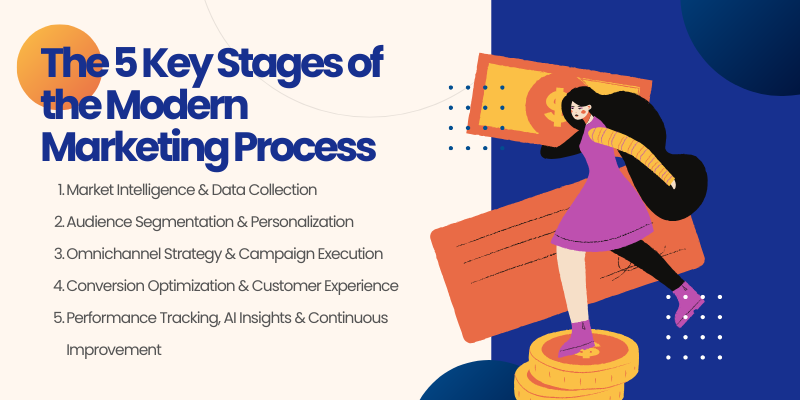
Today’s marketing process is built around five connected stages:
1. Market Intelligence & Data Collection
This stage goes beyond basic market research. It includes:
- Customer behavior tracking across websites, apps, and social platforms
- Competitor monitoring using digital tools
- Search trends, social listening, and real-time analytics
This data helps businesses predict demand, spot gaps in the market, and respond faster to changes.
2. Audience Segmentation & Personalization
Instead of targeting everyone the same way, modern marketing focuses on:
- Creating detailed customer personas
- Segmenting audiences by behavior, intent, location, and interests
- Personalizing content, emails, ads, and website experiences
This makes marketing more relevant and increases conversion rates.

3. Omnichannel Strategy & Campaign Execution
Campaigns now run across multiple connected channels, including:
- Search engines, social media, email, websites, apps, and marketplaces
- Paid ads, influencer marketing, content marketing, and automation
- AI-based targeting and budget optimization
The goal is to deliver a consistent message across all platforms where customers interact.
4. Conversion Optimization & Customer Experience
Marketing today is not only about attracting users, it focuses on:
- Improving landing pages and user journeys
- Reducing friction in sign-ups and purchases
- Using chatbots, CRM systems, and automation to guide users
This stage directly impacts sales growth and customer satisfaction.
5. Performance Tracking, AI Insights & Continuous Improvement
Modern measurement goes beyond basic traffic and leads. It includes:
- Real-time dashboards and predictive analytics
- Attribution modeling to understand what drives sales
- A/B testing, heatmaps, and AI-driven optimization
Insights are used to constantly refine campaigns and improve ROI.
The modern marketing process is no longer linear. It is a continuous loop powered by data, technology, and personalization. Businesses that adapt this approach grow faster, spend smarter, and build stronger customer relationships.
Explore Our Performance Marketing Services!
Real-World Marketing Examples
Understanding how marketing works in real situations makes it easier to apply the concepts effectively and learn what drives Successful Marketing Campaigns in competitive industries.
1. Coca-Cola – “Share a Coke”
In this campaign, Coca-Cola replaced its iconic logo on bottles with popular first names, making the product feel personal and unique to each buyer.
This personalization created emotional connections, increased social sharing and engagement, and helped revive customer interest, boosting brand awareness and sales.
2. Dove – “Real Beauty in the AI Era”
Dove recently launched a campaign to re-affirm its commitment to real-people representation as AI–generated beauty images become more common.
This campaign helped Dove strengthen its authenticity and trust among customers who value realness over “filtered perfection,” reinforcing its brand values in a shifting marketing environment.
3. Spotify – “Wrapped” Campaign
Every year, Spotify’s “Wrapped” gives users a personalized summary of their listening habits, top songs, genres, minutes listened, and encourages them to share it on social media.
Because it’s personal and shareable, “Wrapped” becomes a social-media phenomenon, reinforcing loyalty among existing users and attracting new ones attracted by the buzz.
Frequently Asked Questions (FAQs)
What Is Marketing In Business And Why Is It Important?
Marketing helps businesses attract customers, build trust, and generate sales. It identifies customer needs, communicates value, and creates strong brand awareness that supports long-term success and growth.
What are The Main Types of Marketing?
There are many types, including digital marketing, social media marketing, email marketing, traditional advertising, SEO, content marketing, and influencer marketing. Each supports customer engagement and brand visibility in different ways.
How Does Marketing Help Business Growth?
Marketing increases visibility, builds customer relationships, drives sales, and improves brand loyalty. By reaching the right audience with the right message, businesses can attract more customers and expand faster.
What Is The Difference Between Marketing and Sales?
Marketing focuses on attracting and educating customers, while sales focuses on closing deals. Marketing creates interest and demand; sales converts that demand into revenue. Both work together for business success.
Conclusion
To conclude, understanding what is marketing in business reveals its vital role in driving growth, building brand awareness, and creating meaningful customer relationships. Marketing goes far beyond advertising, it involves researching your audience, positioning your brand, communicating value, and nurturing trust to turn prospects into loyal customers, a process expertly supported by Centric, a digital marketing agency. By defining your goals, knowing your target audience, choosing the right channels, and delivering consistent and valuable content, you can create effective marketing strategies that support long-term success.Whether you're starting a new venture or growing an existing one, thoughtful and strategic marketing helps your business stand out, attract the right customers, and achieve sustainable results.