Curious how to use data analytics in farming?
In modern agriculture, data analytics has become a game‑changer, helping farmers make smarter, evidence‑based decisions that improve efficiency and sustainability.
Data analytics in farming brings together information from soil sensors, weather stations, satellite imagery, and machinery to uncover patterns and insights that would otherwise remain hidden.
It allows farmers to monitor soil health, track crop growth, and sustainable farming practices based on real‑time conditions rather than guesswork.
For example, using predictive models and analytics tools, farmers can forecast yields, detect early signs of pest outbreaks, and optimize irrigation and fertilization schedules, significantly reducing waste and input costs.
In this guide, we will explore how data analytics is reshaping the agricultural landscape, the opportunities it offers, and how it can be leveraged.
What is Data Analytics in Agriculture?
Data analytics is the process of analyzing raw data to identify patterns, trends, and insights that facilitate better decision-making. It involves gathering, cleaning, and contextualizing data, then analyzing it to extract valuable intelligence.
Farmers and agribusinesses are adopting data-driven strategies to enhance productivity and sustainability. Technologies like IoT sensors, drones, and satellite imagery are playing a pivotal role in gathering data and are now becoming integral to everyday farming practices.
Why Data Analytics Matters in Agriculture?
Data analytics isn’t just transforming business and industries; it’s reshaping them.
Across sectors like healthcare, banking and finance, and manufacturing, analytics helps organizations turn raw data into powerful insights that boost efficiency, reduce costs, and accelerate innovation.
This growth isn’t slowing; instead, industries are increasingly dependent on analytics to make informed strategic decisions and maintain a competitive edge.
A recent study shows that integrating technologies like IoT sensors with data analytics supports better decisions for crop yield optimization and sustainable practices by analyzing large volumes of on‑farm data. Farmers can use this insight to adjust irrigation, nutrient application, and pest control more accurately.
Research also suggests that data analytics, especially when paired with technologies like AI and machine learning, opens new possibilities for forecasting pest outbreaks, yield prediction, and adapting to climatic variability, positioning agriculture to meet future demands efficiently.
As a result, agriculture is entering a new frontier where data analytics plays a foundational role in modern farming, often referred to as precision or digital agriculture.
How to Use Data Analytics in Farming?
In today’s world, where farmers are tasked with feeding a growing global population amid climate change, resource scarcity, and rising costs, understanding how to use data analytics in farming has become essential.
Today’s farmers and agribusinesses expect data analytics to help them:
Precision Crop Monitoring and Soil Analysis
Data analytics processes soil and crop data to monitor health, nutrient levels, and variability across fields.
Studies on smart agriculture highlight how IoT sensors combined with analytics help track soil conditions and crop growth in real time, enabling precise field‑specific interventions and improved nutrient management.
Yield Prediction and Forecasting
Analytics models use historical and real‑time data (soil, weather, plant health) to predict future crop yields, helping farmers plan harvests and market strategies.
Predictive analytics research shows how analyzing soil moisture, climate patterns, and crop development can forecast future yields, optimize resource allocation, and reduce waste.
Resource Optimization (Water, Fertilizer, Pesticides)
Data analytics helps optimize irrigation and fertilizer use by determining exactly how much water or nutrients crops need, lowering costs and environmental impact.
Research evidence shows that IoT and analytics studies demonstrate how sensor data combined with analytical models improves water use efficiency and reduces chemical overuse in horticulture and field crops.
Real‑Time Decision Support and Automation
With real‑time sensor data and analytics services, farmers can receive actionable insights for immediate decisions, such as when to irrigate or apply treatments.
Research evidence shows that systematic literature on AI and IoT in agriculture shows that real‑time monitoring systems enable precision irrigation, early disease alerts, and adaptive fertilization strategies.
Early Detection of Pests, Diseases, and Anomalies
Combining analytics with imaging and sensor data enables the detection of crop stress, diseases, or pest outbreaks before visible symptoms appear.
Reviews of smart agriculture methods confirm that data analytics can identify anomalies in crop and soil conditions early, helping farmers act quickly and reduce losses.
Climate & Weather Impact Analysis
Predictive models analyze meteorological data to help farmers forecast weather effects, adapt planting schedules, and mitigate risk from extreme conditions.
Research on IoT and AI deployment services shows the usefulness of high‑resolution, real‑time meteorological data in supporting decisions under changing climate conditions.
Decision Support Systems for Farm Planning
Software tools like DSSAT integrate analytics with crop simulation models to support long‑term farm planning, including climate change adaptation and management practice testing.
Decision support systems facilitate analytical evaluation of strategies, such as irrigation schedules or soil management techniques, helping growers test scenarios before implementation.
Technologies Used in Farming Data Analytics
Data analytics in agriculture relies on a suite of advanced technologies that collect, transmit, and analyze farm data to improve planning, productivity, and sustainability.
These tools enable farmers to transform raw signals, from soil moisture to weather patterns, into actionable insights that enhance decision‑making and resource efficiency.
Farming data analytics leverages IoT sensors, drones, satellite imagery, and advanced software tools to collect, analyze, and optimize farming practices.
Some of the technologies used in farming are as follows:
-
Internet of Things (IoT) Sensors: Devices that collect real-time data from the farm, such as soil moisture, temperature, and crop health, for analysis.
-
Big Data Platforms: Systems designed to store, manage, and process vast amounts of agricultural data for deeper insights and trend analysis.
-
Artificial Intelligence (AI) and Machine Learning (ML): With AI and machine learning Algorithms that analyze data patterns to predict outcomes like crop yields, pest outbreaks, and optimal planting times.
-
Drones and Unmanned Aerial Vehicles (UAVs): Aerial devices equipped with sensors to capture high-resolution imagery for monitoring crop health and field conditions.
-
Satellite Remote Sensing: Using satellites to collect data on large-scale weather patterns, soil moisture, and vegetation to support field-level decision-making.
-
Cloud Computing & Edge Computing: Cloud platforms for storing and analyzing farm data and edge computing for faster, on-site processing with minimal latency.
-
Geographic Information Systems (GIS) & GPS Technology: Tools that map and analyze spatial data like field boundaries, soil types, and crop conditions for targeted farming strategies.
-
Robotics & Autonomous Machinery: Self-operating machines like tractors and harvesters that automate farming tasks while collecting valuable data.
Explore Our Data and Analytics Services
7 Key Benefits of Data Analytics in Farming
Data analytics offers numerous advantages that can revolutionize farming practices
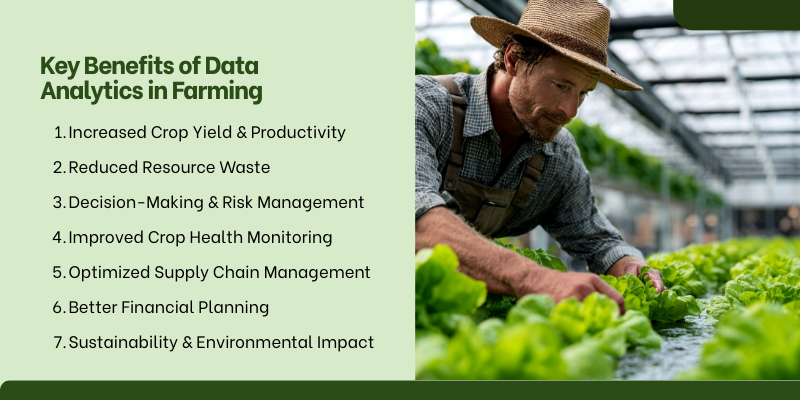
Here are some of the key benefits of data Analytics in farming.
1. Increased Crop Yield and Productivity
Data analytics helps optimize planting schedules, irrigation, and fertilizer use, leading to higher crop yields and improved farm productivity.
2. Reduced Resource Waste (Water, Fertilizers)
By leveraging real-time data, farmers can apply water and fertilizers more efficiently, reducing waste and lowering costs while promoting sustainable farming practices.
3. Enhanced Decision-Making and Risk Management
Predictive analytics provides valuable insights, helping farmers make informed decisions regarding planting, harvesting, and pest management, while also mitigating risks associated with unpredictable weather and pest outbreaks.

4. Improved Crop Health Monitoring
With the use of sensors and satellite imagery, data analytics allows farmers to continuously monitor crop health, detect diseases or pests early, and take immediate action to protect the crops.
5. Optimized Supply Chain Management
Data analytics enables better forecasting of crop yields and demand, helping farmers manage their inventory, improve supply chain efficiency, and reduce losses due to spoilage.
6. Better Financial Planning
By analyzing past farming data and predicting future outcomes, farmers can make more accurate banking and financial plans, set realistic budgets, and manage costs more effectively.
Transform Your Banking & Financial Journey
7. Sustainability and Environmental Impact
Data analytics supports sustainable farming by helping farmers make eco-friendly decisions, such as reducing the use of chemical inputs and minimizing the environmental impact of their practices.
5 Challenges in Implementing Data Analytics in Farming
While data analytics holds immense potential for transforming farming practices, several challenges must be addressed to fully realize its benefits:
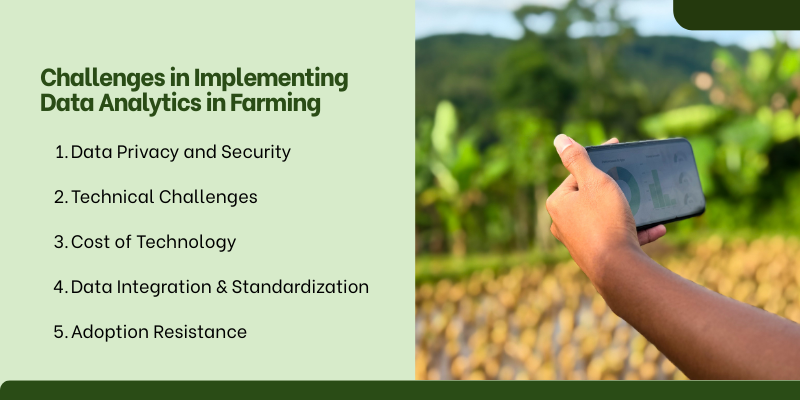
Here are some of the Challenges in Implementing Data Analytics in Farming.
1. Data Privacy and Security
The collection and analysis of vast amounts of farm-related data, including soil conditions, crop performance, and even financial information, raises concerns about data privacy.
Farmers must ensure that their data is secure from breaches or misuse, especially when shared across multiple platforms or with third parties. Developing robust data protection policies and secure storage systems is critical.
2. Technical Challenges
Implementing big data analytics requires advanced technology infrastructure, such as IoT sensors, drones, and cloud-based platforms. For many small and medium-sized farms, accessing or maintaining this technology can be difficult.
Additionally, farmers often lack the technical expertise to manage and interpret the data collected, making it essential to provide adequate training and support for technology adoption.
3. Cost of Technology
The initial investment in data collection tools, analytics platforms, and equipment can be prohibitive, particularly for smaller farms with limited budgets.
While the long-term benefits of data analytics are clear, the upfront costs of technology such as drones, sensors, and software platforms pose a significant barrier to adoption. Farmers may also face ongoing costs for system maintenance and updates.
4. Data Integration and Standardization
A major challenge is the lack of standardized data formats across different tools and platforms used in farming. Integrating data from various sources such as weather data, satellite images, and farm equipment can be complex, requiring specialized software and expertise to ensure compatibility and accuracy.
5. Adoption Resistance
Many farmers are accustomed to traditional farming methods and may be reluctant to adopt new technologies. Overcoming resistance to change, educating farmers about the value of data analytics, and demonstrating its practical benefits are crucial steps in ensuring widespread adoption.
The Role of AI in Farm Data Analytics
Data analytics helps farms monitor current conditions, but Artificial Intelligence services take it a step further by guiding future actions.
While traditional analytics often rely on dashboards, charts, and manual interpretation, AI enhances these processes by automating data retrieval, comparing performance across fields or seasons, detecting hidden patterns, and even generating actionable recommendations.
AI transforms static reports into dynamic, decision-making intelligence, providing farmers with real-time insights to optimize their operations and drive better outcomes.
Future of Data Analytics in Agriculture
Data analytics is set to play a defining role in the future of farming and sustainable agriculture. As technology continues to evolve, farms will increasingly rely on real-time data to make faster, more accurate decisions.
Advanced analytics, combined with AI and machine learning, will enable farmers to predict crop yields with greater precision, respond proactively to climate changes, and manage risks more effectively.
In the future, data analytics will support hyper-precision farming, where inputs like water, fertilizers, and pesticides are applied only where and when needed.
This will significantly reduce resource waste and environmental impact while improving productivity. Climate-resilient farming will also benefit, as analytics will help farmers adapt to changing weather patterns, soil conditions, and water availability.
FAQs
How can AI be used in farming?
AI in farming is used to automate data analysis, predict crop yields, detect pests and diseases, optimize irrigation, and recommend actions based on real-time data. It enhances decision-making by providing dynamic, actionable insights.
How does AI improve farming productivity?
AI improves productivity by automating data analysis, identifying trends and anomalies faster than humans, and providing actionable recommendations. This allows farmers to optimize farming practices, reduce costs, and enhance crop health management.
How does data analytics help in resource optimization?
Data analytics allows farmers to monitor and optimize the use of resources like water, fertilizers, and pesticides. By analyzing soil conditions, weather patterns, and crop performance, farmers can apply resources only where and when they are needed, reducing waste and costs.
Can data analytics predict weather impacts on crops?
Yes, data analytics can forecast weather patterns, enabling farmers to anticipate weather-related challenges such as droughts, storms, or frost. This allows them to make proactive decisions to protect crops and optimize harvest timing.
What challenges do farmers face when implementing data analytics?
Challenges include the high cost of technology, lack of technical expertise, data privacy concerns, and integrating data from multiple sources. Overcoming these challenges requires investment in training, technology, and secure data management systems.
How can AI help with pest and disease management in farming?
AI can analyze patterns in crop health data and environmental factors to predict pest infestations or disease outbreaks. By identifying these issues early, farmers can take timely and targeted actions to mitigate damage, reducing the need for widespread pesticide use.
Conclusion
Now that you understand how to use data analytics in farming, let's wrap up with the key takeaways. As explored, data analytics is revolutionizing the agricultural industry by optimizing farming practices, enhancing productivity, and reducing costs.
Through the use of technologies like IoT sensors, drones, and advanced software platforms, Centric helps farmers collect real-time data to monitor crop health, manage resources efficiently, and make informed decisions.
Data analytics enables farmers to adopt precision farming techniques, predict weather patterns, and mitigate risks such as pest outbreaks and diseases.
This not only increases crop yield but also promotes sustainability by reducing resource waste and minimizing environmental impact. The future of farming lies in data-driven decision-making, where technology helps farmers make smarter, more efficient choices.
By harnessing the power of data analytics, farmers can increase profitability, improve sustainability, and ensure food security for future generations.
As the agricultural landscape evolves, embracing data analytics will be essential for staying competitive and fostering long-term growth in the industry.