How Important is Data Quality in Analytics in 2026 is no longer a theoretical question—it is a practical, business-critical concern. As organizations rely more heavily on AI, real-time dashboards, automation, and predictive models, the margin for error in data has narrowed dramatically.
In 2026, analytics is expected to deliver instant answers, support high-stakes decisions, and guide strategy at speed, often with little room for manual validation or second guessing.
This shift has changed what defines analytics success. It’s no longer about having the most advanced BI tools, the flashiest dashboards, or the latest AI models. Analytics now succeeds or fails based on the reliability of the data flowing through those systems.
When data is inconsistent, duplicated, incomplete, or outdated, even the most sophisticated analytics platforms produce insights that are unstable, misleading, or impossible to trust.
Executives today face constant pressure to act faster, justify decisions with data, and respond in real time to market changes. In that environment, unreliable analytics creates risk, hesitation, and lost confidence.
This is why organizations are increasingly focusing upstream, strengthening data quality as a foundation for analytics. At Centric, we help businesses build analytics environments where data can be trusted, insights remain stable, and decisions are driven by clarity rather than doubt.
What Data Quality Means in Modern Analytics?
In modern analytics environments, data quality is no longer a narrow technical concern—it is a strategic requirement. To define data quality today means looking beyond whether fields are filled or formats are correct. Modern analytics depends on data behaving reliably across multiple systems, over time, and at scale.
As organizations increasingly rely on real-time dashboards, AI-driven insights, and automated decision-making, even small data flaws can cascade into significant analytical errors.
This is where Master Data Management service becomes essential. It evaluates how data performs when aggregated, joined, modeled, and reused across reporting, analytics, and AI workflows.
Data that appears acceptable in isolation may still fail once it is pulled into executive dashboards, forecasting models, or machine learning pipelines. In 2026, analytics success depends on whether data can consistently support these downstream use cases without manual correction or constant reconciliation.
Modern analytics also raises the bar for data quality characteristics. Accuracy alone is no longer sufficient. Consistency across systems, completeness for trend analysis, timeliness for real-time decisions, and uniqueness for correct entity counts all directly impact how analytics behaves.
When these characteristics are weak, analytics outputs may still look polished but quietly lose credibility. This evolution is why data quality is now viewed as a foundational layer of analytics, not a cleanup task performed after reports start breaking.
Not Just “Clean Data” Anymore
Data quality has evolved beyond basic accuracy checks into a requirement for analytics stability, AI reliability, and trusted reporting. Clean-looking data can still fail when used for advanced analytics if it lacks consistency, completeness, or proper structure.
Operational Data vs. Analytics-Ready Data
Operational data is designed to support daily processes, while analytics-ready data is designed to withstand aggregation, historical analysis, and cross-system joins. Data that “works” operationally often breaks under analytical stress, creating distorted metrics and unreliable insights.
Transform Your Business with Data and Analytics!
Why Data Quality Is Important in 2026?
The importance of data quality has grown sharply as analytics becomes faster, more automated, and more deeply embedded in everyday decision-making. In 2026, analytics is no longer a back-office function; it operates in real time, influences customer interactions instantly, and increasingly drives automated actions.
This shift forces organizations to rethink Business Intelligence service and why is it important in an environment where decisions are made at speed and often without human intervention.
Modern analytics places continuous pressure on data to perform under scale, velocity, and complexity. Reliable insights now depend on the characteristics of quality data, including accuracy, consistency, completeness, timeliness, and uniqueness, working together rather than in isolation.
When any of these characteristics break down, analytics outputs become unstable. Metrics drift, trends lose credibility, and different teams arrive at different conclusions from the same data.
In 2026, the factors affecting data quality in analytics are more pronounced than ever. Data now flows from multiple sources, across cloud and on-premise systems, through streaming pipelines and AI models, before reaching dashboards or decision engines. Each handoff introduces risk.
Without strong data quality controls upstream, errors compound silently as data moves faster through analytics systems. This is why organizations that want reliable analytics are prioritizing data quality as a core capability, not a secondary cleanup task.
Analytics Is Faster — Errors Scale Faster
Real-time dashboards, streaming data, and automated decisions amplify mistakes. When flawed data enters fast-moving analytics pipelines, errors propagate instantly and affect decisions at scale.
AI and Predictive Models Raise the Stakes
Poor data quality directly degrades AI outcomes, forecasts, and recommendations. Inconsistent or duplicated data leads to biased models, unstable predictions, and reduced confidence in AI-driven insights.
Executives Expect Instant, Trusted Answers
Decision confidence depends on stable, consistent metrics. Executives need answers they can act on immediately, and that trust only exists when analytics is built on high-quality, reliable data.
The Core Data Quality Dimensions That Impact Analytics
In analytics, not all data quality issues carry the same weight. The characteristics of data quality that matter most are the ones that directly affect aggregation, comparison, and interpretation of data at scale.
In 2026, analytics systems are expected to deliver stable metrics, support AI-driven insights, and enable confident decision-making across the organization. That is only possible when the underlying quality of data holds up under analytical stress.
Among all dimensions, the importance of data accuracy remains foundational. Inaccurate data doesn’t just produce small errors; it changes the story analytics tells. A single incorrect value can distort trends, skew forecasts, and mislead stakeholders, especially when data is rolled up across dashboards and reports.
This is particularly visible in commercial use cases, where the importance of data accuracy in building a lead list becomes critical. Duplicate, outdated, or incorrect lead data inflates pipeline numbers, misrepresents conversion rates, and leads to poor sales and marketing decisions.
Beyond accuracy, analytics depends on multiple dimensions working together. Data must be consistent across systems, complete enough to support historical analysis, timely enough to guide real-time decisions, and unique enough to prevent double counting.
When any of these dimensions break down, analytics does not usually fail outright. Instead, it becomes unstable, producing insights that look valid on the surface but cannot be trusted in practice.
Accuracy
Accuracy is the foundation of reliable analytics because every insight depends on data reflecting real-world conditions. When data is incorrect, trends become distorted and forecasts point in the wrong direction. Even small inaccuracies can compound as data is aggregated across reports and dashboards. Over time, inaccurate data leads decision-makers to act on assumptions rather than facts.
Consistency
Consistency ensures that data means the same thing across systems, teams, and reports. When definitions, formats, or values differ between departments, analytics produces conflicting results. These mismatches force teams to reconcile numbers manually and debate which report is “right.” Without consistency, analytics loses its role as a single source of truth.
Completeness
Completeness determines whether analytics captures the full picture or only fragments of it. Missing fields, partial histories, or gaps in datasets create blind spots in analysis. This makes trend analysis unreliable and weakens comparisons over time. Decisions based on incomplete data are often cautious, delayed, or simply wrong.
Timeliness
Timeliness reflects how current and relevant data is at the moment decisions are made. In real-time analytics environments, outdated data quickly loses value. Delays in data updates can cause teams to react too late or miss opportunities entirely. Timely data keeps analytics aligned with real-world conditions as they change.
Uniqueness
Uniqueness ensures that each real-world entity is represented only once in analytics. Duplicate records inflate KPIs, distort growth metrics, and misrepresent performance. This is especially damaging in customer, revenue, and lead reporting. Without uniqueness, analytics consistently overstates results and erodes stakeholder trust.
How Poor Data Quality Breaks Analytics?
One of the most dangerous aspects of poor data quality is that analytics rarely stops working when problems appear. Dashboards still refresh, reports still render, and charts still look polished. This is why data quality importance is often underestimated.
Analytics tools are designed to consume data, not challenge it, which means flawed inputs can flow through the system without triggering obvious failures.
When the qualities of good data—such as accuracy, consistency, completeness, and uniqueness—are missing, analytics doesn’t collapse; it degrades. Numbers begin to drift, trends become unstable, and stakeholders slowly lose confidence in what they’re seeing. Because these changes happen gradually, teams often adapt with workarounds instead of addressing the root cause.
This is also where what are rules that help ensure the quality of data becomes critical. Without clear validation rules, standard definitions, and governance controls upstream, analytics inherits every inconsistency and duplication present in source systems. Over time, this leads to an environment where teams spend more time explaining numbers than acting on them.
Ultimately, why data accuracy is important becomes evident when trust disappears. Once decision-makers start questioning whether reports are reliable, analytics no longer supports confident action. Instead of accelerating decisions, it introduces hesitation, second-guessing, and delays that quietly undermine the value of data-driven strategies.
Dashboards Still Load — But Trust Is Gone
Analytics rarely “fails loudly” because tools continue to process and visualize flawed data. Dashboards look complete, but the numbers behind them are unstable. As unexplained changes appear over time, trust in analytics steadily erodes. Leaders begin to question insights rather than use them.
Conflicting Numbers Across Reports
The same metric often tells different stories across dashboards and teams. Revenue, customer counts, or performance KPIs vary depending on the data source or report logic used. These inconsistencies force teams to debate numbers instead of decisions. Over time, analytics loses credibility as a shared reference point.
Manual Fixes Become the Norm
When data quality issues persist, analysts shift from analyzing trends to fixing data. Spreadsheets, filters, and custom logic are used to reconcile discrepancies manually. These fixes are fragile, undocumented, and difficult to scale. As a result, analytics becomes slower, more complex, and less reliable.
Start Your Data Engineering & Warehousing Journey!
Business Risks of Ignoring Data Quality
Ignoring data quality in analytics exposes organizations to risks that compound as data volumes, automation, and AI adoption increase. In 2026, data quality means far more than tidy datasets—it determines whether insights are dependable enough to guide strategy at scale.
Without high-quality data, analytics becomes a source of confusion rather than clarity, quietly influencing decisions in the wrong direction.
Many leaders underestimate why is data accuracy important until problems surface across multiple departments at once. Inaccurate or inconsistent data affects forecasting, budgeting, customer insights, and performance measurement simultaneously.
When the characteristics of accurate data—such as consistency, completeness, and uniqueness—are missing, errors are multiplied across dashboards, reports, and automated decisions.
These issues are further amplified by growing data quality challenges for analytics, including multi-source data pipelines, real-time reporting, and AI-driven models. Each added system increases complexity, and without strong data quality foundations, organizations face strategic misalignment, reduced adoption of analytics tools, and increased regulatory exposure.
The cost of ignoring data quality is rarely immediate, but it becomes deeply embedded in business outcomes over time.

Wrong Decisions at Scale
Poor data quality leads to incorrect insights being applied across strategic, financial, and operational decisions. When flawed data feeds enterprise-wide analytics, mistakes are repeated at scale. This can result in misallocated budgets, inaccurate forecasts, and inefficient operations. Over time, these decisions compound into measurable business losses.
Lost Confidence in BI and Analytics Tools
When stakeholders repeatedly encounter conflicting or unstable metrics, trust in BI and analytics tools declines. Teams begin to question dashboards instead of relying on them. Adoption drops as users revert to spreadsheets or intuition. Once trust is lost, even accurate insights struggle to gain acceptance.
Compliance and Reputational Exposure
Inaccurate reporting increases regulatory and reputational risk, especially in highly regulated industries. Errors in financial, operational, or customer data can lead to compliance violations and audits. Public-facing mistakes damage credibility with customers and partners.
Rebuilding trust after such incidents is often far more costly than preventing them through strong data quality practices.
How Data Quality Directly Improves Analytics Outcomes?
When organizations invest in data quality upstream, the impact is immediately visible in analytics performance. The importance of data accuracy becomes clear as metrics stop shifting unexpectedly and reports begin to reflect real business activity instead of data artifacts.
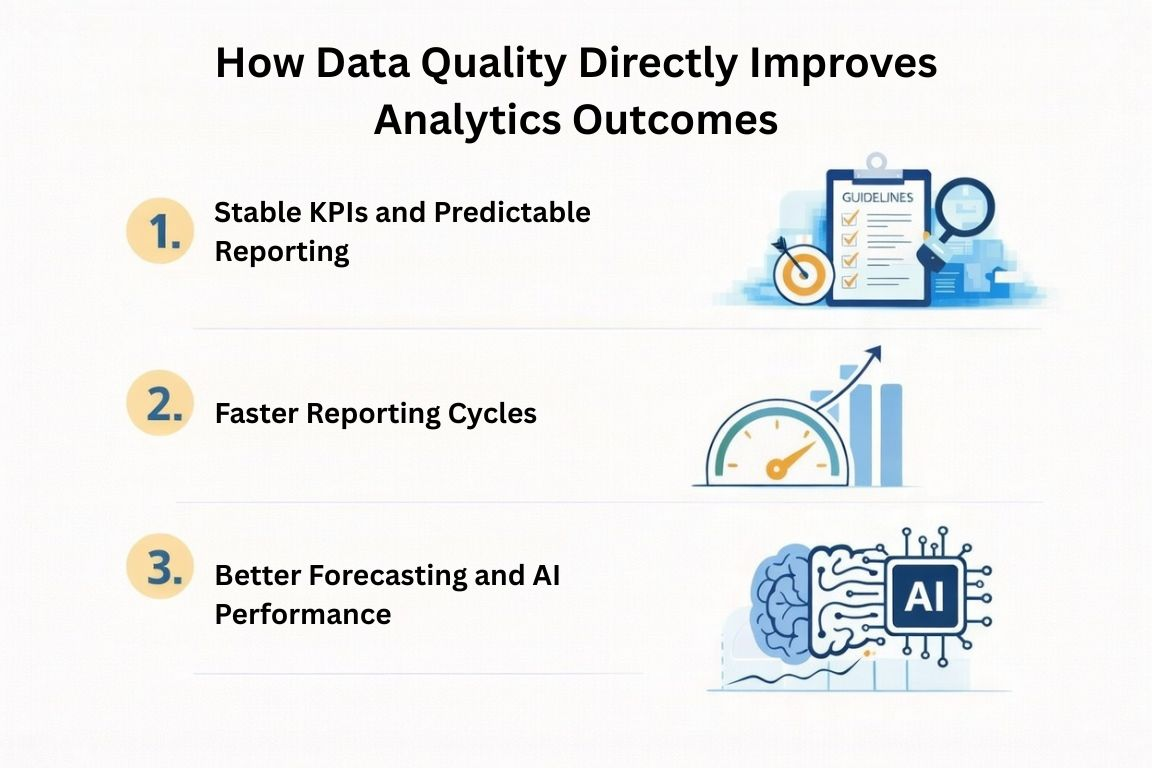
High-quality inputs create analytics environments that are stable, repeatable, and trusted by stakeholders across the organization.
This is where Data Engineering solution comes into play, transforming raw data into valuable insights while ensuring the stability and scalability of analytics processes. Analytics built on strong foundations behaves predictably under pressure, whether it’s month-end reporting, executive reviews, or real-time operational decisions.
The qualities of good data accuracy, consistency, completeness, timeliness, and uniqueness work together to eliminate friction in analytics workflows and reduce the need for constant validation.
As data quality improves, analytics transitions from a fragile, high-maintenance function into a dependable decision engine. Teams spend less time questioning numbers and more time acting on insights. Over time, this shift increases confidence in dashboards, accelerates reporting cycles, and enables advanced analytics and AI initiatives to deliver results as expected.
Stable KPIs and Predictable Reporting
High-quality data leads to consistent KPIs that remain stable over time. Metrics change only when the business changes, not because of data inconsistencies. This stability builds trust among stakeholders and reduces recurring debates about numbers. Predictable reporting allows leaders to focus on decisions rather than explanations.
Faster Reporting Cycles
Clean, reliable data eliminates the need for last-minute adjustments and manual reconciliations. Reports can be generated and shared on schedule without added stress. Analytics teams spend less time fixing issues and more time delivering insights. Faster reporting supports quicker, more confident decision-making.
Better Forecasting and AI Performance
Analytics models and AI systems perform best when trained on accurate, consistent data. Clean data improves forecast accuracy, model stability, and explainability. With reliable inputs, AI-driven recommendations become actionable instead of questionable. This strengthens confidence in predictive analytics across the organization.
How Businesses Should Measure Data Quality for Analytics?
Measuring data quality is essential for ensuring analytics delivers reliable, decision-ready insights. Without clear measurement practices, data issues often remain hidden until they surface in dashboards or reports.
This is why organizations must define what are rules that help ensure the quality of data before analytics begins. These rules act as guardrails, setting expectations for how data should behave as it flows across systems and teams.
This is closely aligned with an effective Data Strategy solution, ensuring that data flows seamlessly across all channels, with full visibility and control over its quality.
Effective data quality measurement focuses on how data performs in real analytical scenarios, not just how it looks at rest. Businesses need visibility into whether data aggregates correctly, joins cleanly across sources, and remains stable over time. This requires moving beyond ad-hoc checks and adopting structured, repeatable measurement methods that align with analytics use cases.
By measuring data quality continuously, organizations can identify risks early and prevent small issues from escalating into widespread reporting problems. Consistent measurement also creates accountability, making it clear when data quality is improving and when corrective action is required.
In 2026, analytics success depends not only on collecting data, but on continuously measuring and enforcing the standards that keep it trustworthy.
2 Key Metrics That Actually Matter
Accuracy, completeness, consistency, timeliness, and uniqueness are the core metrics that determine analytics reliability. These metrics reveal whether data can support aggregation, trend analysis, and decision-making. Monitoring them helps teams pinpoint exactly where data quality breaks down. Together, they provide a practical view of analytics readiness.
1. Data Profiling and Validation
Data profiling and validation identify issues before data reaches dashboards. Profiling highlights patterns, gaps, and inconsistencies across datasets. Validation rules catch formatting errors, missing values, and duplicates early in the pipeline. This proactive approach reduces downstream analytics failures.
2. Continuous Monitoring, Not One-Time Cleanup
One-time data cleanup offers temporary relief but does not sustain analytics quality. Continuous monitoring prevents data quality drift as new data enters systems. Ongoing checks ensure standards are enforced consistently over time. This approach keeps analytics stable, reliable, and trusted.
How to Improve Data Quality for Analytics in 2026?
Improving data quality in 2026 requires a shift from reactive fixes to proactive, system-level practices. As analytics environments grow more complex and automated, data quality must be engineered into workflows rather than corrected after problems appear.
Organizations that make this shift begin to see the benefits of improved data quality across analytics, operations, and decision-making.
High-quality data reduces friction throughout the analytics lifecycle. Reports become easier to produce, insights become more consistent, and teams spend less time reconciling numbers. Improved data quality also strengthens trust in dashboards and AI-driven outputs, enabling faster and more confident decisions. These benefits compound over time as data volumes grow and analytics use cases expand.
In 2026, improving data quality is not about isolated cleanup projects. It’s about embedding quality controls upstream, applying standardization at scale, resolving entities across systems, and enforcing governance in a way that supports speed rather than slowing teams down. When done correctly, data quality becomes an enabler of analytics maturity instead of a constraint.
Build Quality into the Data Pipeline
Addressing issues upstream prevents errors from propagating through analytics systems. Validations, checks, and rules applied early ensure only reliable data reaches dashboards and models. This reduces downstream fixes and improves overall analytics stability. Quality-by-design is far more effective than cleanup after the fact.
Standardize and Validate at Scale
Standard formats, definitions, and business rules ensure data behaves consistently across systems. Validation at scale prevents discrepancies that break aggregations and comparisons. When data is standardized, analytics teams spend less time reconciling definitions. This creates a shared understanding of metrics across the organization.
Resolve Entities and Eliminate Duplicates
Accurate analytics depends on resolving duplicate customers, accounts, and products. Entity resolution ensures each real-world entity is counted once. Eliminating duplicates stabilizes KPIs and improves trend accuracy. This is critical for customer, revenue, and performance analytics.
Apply Governance Without Slowing Teams
Effective governance balances control with agility. Clear ownership, automated enforcement, and well-defined rules maintain data quality without adding friction. When governance supports workflows instead of blocking them, teams adopt it naturally. This ensures data quality improves without sacrificing speed.
Why Partner with Centric for Data Quality and Analytics?
Maintaining high data quality demands more than tools alone—it requires the right mix of expertise, governance, and scalable processes. Centric supports organizations in evaluating, strengthening, and sustaining data quality across complex analytics environments.
By blending data quality management, advanced analytics expertise, and automation, Centric helps businesses convert unreliable data into dependable, decision-ready insights. Our approach prioritizes accuracy, consistency, compliance, and scalability to protect long-term data integrity.
Through Centric’s data analytics services, organizations gain greater clarity, confidence, and control over their data—enabling faster, smarter decisions and supporting sustainable business growth.
FAQs
Why is data quality so important for analytics in 2026?
Data quality is critical in 2026 because analytics, AI, and automation operate at scale and speed. Poor-quality data spreads errors quickly across dashboards, forecasts, and decisions. High-quality data ensures insights are accurate, stable, and trustworthy for executives and teams.
Can modern BI tools fix data quality issues on their own?
No. BI and analytics tools assume incoming data is reliable. They can visualize problems but cannot resolve duplicates, inconsistencies, or missing data. Data quality must be addressed upstream before analytics tools consume the data.
What are the biggest data quality challenges affecting analytics today?
Common challenges include duplicate records, inconsistent definitions across systems, missing data, and outdated information. These issues silently distort KPIs, break joins, and reduce trust in analytics, especially in real-time and AI-driven environments.
How can organizations maintain analytics-ready data long term?
Organizations must embed data quality into pipelines, automate validation, assign clear ownership, and continuously monitor data. Treating data quality as an ongoing operational process ensures analytics remains reliable as systems, volumes, and use cases evolve.
Conclusion
How Important is Data Quality in Analytics in 2026 is no longer a question organizations can afford to debate; it is a requirement for sustainable, data-driven decision-making. As analytics becomes faster, more automated, and increasingly powered by AI, data quality is the foundation that determines whether insights can be trusted or ignored.
Without reliable data, even the most advanced dashboards and models introduce uncertainty rather than clarity.
This is why organizations must focus upstream, strengthening data quality as a core capability rather than treating it as a downstream fix.
Centric helps businesses build analytics environments on reliable, scalable data foundations so leaders can trust their insights, act with confidence, and turn analytics into a true decision engine.