





A golden record is the single, most trusted, most complete version of a master data entity across your entire enterprise. When your organization has one golden record for each customer, product, vendor, and material, every system, every team, and every decision operates from the same truth.
Getting there requires more than technology. Golden record management is a combination of match-and-merge logic, survivorship rules, data quality enforcement, and governance processes that work together to create and maintain authoritative records at scale.
What Makes a Record Golden?
A golden record is not simply the most recent version of data, nor is it a copy from your most trusted source system. It is a composite record assembled from the best attributes across all contributing sources, governed by rules that your organization defines and enforces.
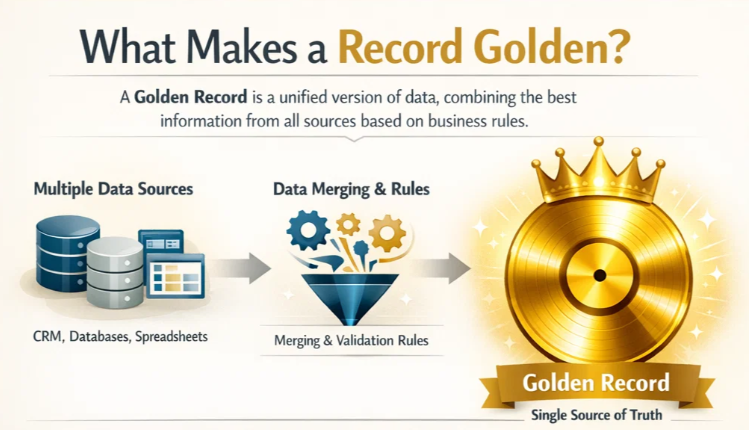
Consider a customer record that exists in Salesforce, SAP, and your e-commerce platform. Salesforce has the most current contact information. SAP has the billing address validated by finance. The e-commerce platform has behavioral data and preferences. The golden record combines the best of each source based on survivorship rules that specify which system is authoritative for each attribute.
The Match-and-Merge Process
Creating golden records begins with identifying which records across your systems represent the same real-world entity. This is the match process, and it is more complex than it sounds.
Deterministic matching uses exact field comparisons (tax ID, email address, DUNS number) to identify matches with high confidence. Probabilistic matching uses fuzzy logic, scoring algorithms, and machine learning to identify likely matches when exact identifiers are unavailable or inconsistent. Most enterprise MDM implementations use a combination of both.
Once matches are identified, the merge process consolidates them into a single golden record. Automated merge handles high-confidence matches. Lower-confidence matches route to human stewards for review, with exception workflows that provide context and suggested resolutions.

Survivorship Rules: Who Wins When Sources Disagree
Survivorship rules define which source system's data prevails for each attribute when sources conflict. These rules are the core logic engine of Golden Record Management and must be designed with business input, not just IT decision-making.
Common survivorship strategies include source-system precedence (e.g., SAP always wins for financial data), most-recent-wins (latest update prevails), most-complete-wins (the record with fewer null values prevails), and trust-score-based (each source has a reliability score per attribute, and the highest-scoring source wins). Most organizations use a hybrid approach, applying different strategies to different attribute groups.
Data Quality: Keeping Golden Records Clean
Quality is not a one-time cleanse. It is a continuous discipline. Effective golden record management requires automated data quality rules that run on every create and update: format validation, referential integrity checks, completeness requirements, and business rule enforcement.
Track data quality metrics at the attribute level: completeness (what percentage of records have all required fields populated), accuracy (what percentage of values match validated reference data), consistency (do related attributes align logically), and timeliness (how current is the data relative to real-world changes).
Common Duplicate Rates Before MDM
Organizations implementing MDM for the first time typically discover duplicate rates of 15-40% in customer data, 10-25% in vendor data, and 5-15% in product data. These duplicates represent real business cost: duplicate customer records mean fragmented views and missed cross-sell opportunities; duplicate vendor records mean duplicate payments and ungoverned supplier risk; duplicate product records mean catalog confusion and fulfillment errors.
Technology for Golden Record Management
Every major MDM platform provides match-and-merge and survivorship capabilities, but the quality of these capabilities varies significantly. Key evaluation criteria include: match algorithm sophistication (does it support probabilistic matching with ML?), survivorship rule flexibility (can you define rules at the attribute level?), steward workflow quality (is the exception review interface intuitive?), and scalability (can it handle millions of records with sub-second match performance?). Organizations like Centric leverage advanced MDM technologies to ensure that these criteria are met, helping clients achieve optimal golden record management."