What Is Generative AI, and why has it suddenly become one of the most discussed technologies across industries? From creating human-like text and realistic images to assisting developers with code and helping marketers scale content, generative AI is changing how work gets done.
Unlike traditional automation tools, it doesn’t just follow rules—it produces new outputs based on patterns learned from data, making it feel closer to human creativity than ever before.
For businesses, this shift is more than a tech trend. Generative AI is reshaping productivity, customer engagement, and digital experiences. Teams can now move faster, test ideas quickly, and personalize interactions at scale without increasing operational overhead.
In this guide, you’ll learn what generative AI really means, how it works behind the scenes, how it differs from traditional AI, and where it’s being used today. We’ll also cover its benefits, limitations, real-world use cases, and what the future holds—so both beginners and experienced professionals can confidently navigate and apply this technology.
What Exactly Is Generative AI?
At its core, generative AI refers to a category of artificial intelligence services that are designed to create new content rather than just analyze or process existing information. This content can include text, images, audio, video, code, and even design concepts.
If you’re looking for a generative AI overview, the simplest way to understand it is this: generative AI learns from vast amounts of data and then uses that learning to produce original outputs that closely resemble human-created work.
For those searching for a what is generative ai simple explanation, think of it as an intelligent system that doesn’t just answer questions or follow commands but generates something new based on patterns it has already learned. Instead of being limited to predefined rules, it adapts to prompts and produces responses that feel contextual, creative, and relevant.
This ability is what sets generative AI apart from earlier AI systems that focused mainly on classification, prediction, or automation.
A Simple Definition Without the Technical Jargon
Generative AI is an AI system that creates new content when you give it an instruction or prompt. You ask, it generates. Whether it’s writing a paragraph, designing an image, or suggesting lines of code, the AI produces results that didn’t exist before, based on what it has learned from existing data.
Transform Your Business with AI Services
What Makes Generative AI Different From Other AI Tools?
Unlike traditional AI tools that are built to follow rules, detect patterns, or make decisions, generative AI is built to create. It doesn’t just identify what already exists; it generates new outputs. This creative capability is why generative AI feels more flexible, conversational, and useful across a wide range of real-world applications.
standing to entirely new inputs. This combination of large-scale learning and real-time generation enables generative AI to produce content quickly while maintaining relevance and coherence across different use cases.
Training Models on Massive Data Sets
Generative AI models are trained on extremely large data sets that include text, images, audio, code, and other digital content. This data helps the model understand how words relate to each other, how images are composed, or how code is structured.
Most models use unsupervised or semi-supervised learning, meaning they learn patterns without needing every example to be labeled. The quality, diversity, and scale of this data play a major role in how accurate and useful the AI’s outputs are.
The Role of Neural Networks and Pattern Learning
Neural networks are the core engines behind generative AI. They are designed to mimic how the human brain processes information by identifying patterns and relationships. Through repeated training, these networks learn probabilities—such as which word is likely to follow another or how visual elements fit together.
This pattern-based learning allows generative AI to create outputs that are coherent, context-aware, and aligned with the user’s intent rather than random or predefined.
From Prompt to Output – What Happens in Seconds
When a user enters a prompt, the generative AI analyzes it to understand context, intent, and structure. The model then predicts the most relevant output based on what it has learned during training. This process happens in fractions of a second, which is why results feel instant.
The system continuously evaluates its own responses and refines future outputs, making each interaction more accurate and useful over time.
How Generative AI Actually Works Behind the Scenes?
Generative AI might feel instant and effortless to use, but behind every response is a layered process built on data, mathematics, and probability. These systems don’t “think” or “understand” in a human sense. Instead, they analyze patterns at scale and use those patterns to predict what comes next.
The goal is not to retrieve stored answers, but to generate new outputs that align with the user’s intent, context, and input.
At a high level, generative AI works by learning structure—how language flows, how images are composed, or how code is written—and then applying that knowledge to new situations. This is why the same system can handle writing, summarization, design support, and problem-solving, all within seconds.
Training Models on Massive Data Sets
Generative AI models are trained on extremely large and diverse data sets that may include text, images, audio, and code. During training, the model is exposed to patterns within this data, such as sentence structure, visual composition, or logical sequences in programming.
Most training uses unsupervised or semi-supervised learning, meaning the system learns without being explicitly told what each data point represents. The broader and higher-quality the data, the better the model becomes at producing accurate and relevant outputs.
The Role of Neural Networks and Pattern Learning
Neural networks are the foundation of generative AI. They process information through layers that identify relationships and probabilities between elements. Instead of memorizing content, these networks learn how pieces of information relate to one another.
Over time, the model becomes better at recognizing context, tone, and structure. This pattern-based learning is what allows generative AI to create content that feels coherent, contextual, and human-like rather than random or mechanical.
From Prompt to Output – What Happens in Seconds
When a user enters a prompt, the model first interprets the input to understand intent and context. It then calculates the most likely output based on what it has learned during training. This prediction process happens in milliseconds, generating text, images, or other content in real time.
Each interaction also contributes to ongoing refinement, helping the system improve accuracy, relevance, and consistency over time.
4 Types of Generative AI You’ll See in Real Life
Generative AI is not limited to a single format or industry. It appears in many forms, each designed to generate a specific type of content based on user input. From writing to web design and web development, and media production, these models are built to support different creative and technical needs.
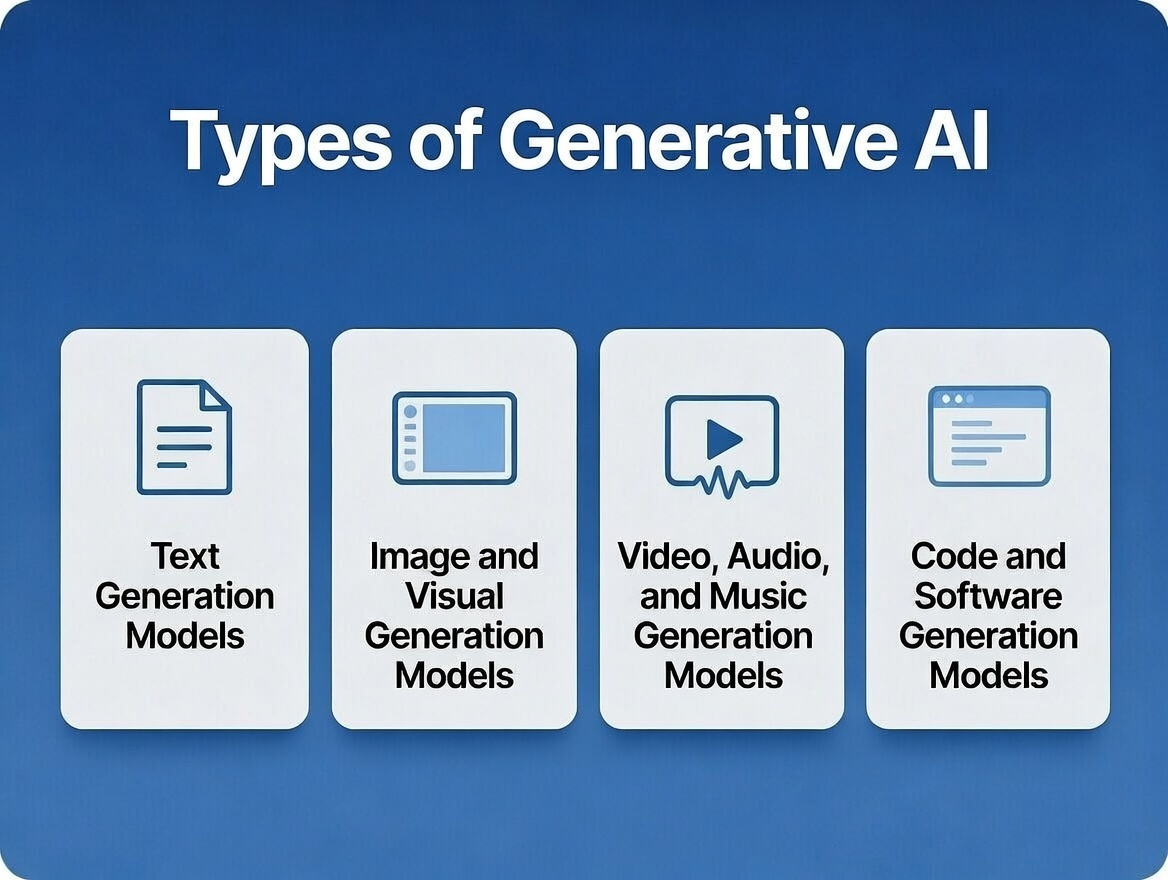
Understanding these types helps clarify where generative AI fits into everyday workflows and how it can be applied in practical scenarios.
1. Text Generation Models
Text generation models are among the most widely used forms of generative AI. They are designed to produce human-like text based on prompts, making them useful for writing articles, emails, reports, summaries, and conversational responses.
These models understand language structure, context, and tone, allowing them to generate coherent and relevant text across various subjects and formats. They are commonly used in content marketing, customer support, research assistance, and internal documentation.
2. Image and Visual Generation Models
Image and visual generation models create original visuals from text descriptions or reference inputs. These models can generate illustrations, product visuals, design concepts, and digital artwork without manual design work.
By learning patterns related to shapes, colors, and composition, they produce visuals that align with creative intent. This makes them useful for marketing, branding services, UI design, and rapid concept exploration.
3. Video, Audio, and Music Generation Models
These models focus on generating or enhancing multimedia content. Video generation tools can create short clips, animations, or edit existing footage. Audio and music generation models can produce voiceovers, sound effects, or original music tracks.
They are increasingly used in advertising, entertainment, training content, and media production, helping teams reduce production time while maintaining creative quality.

4. Code and Software Generation Models
Code and software generation models assist developers by creating code snippets, suggesting improvements, and helping debug applications. They understand programming logic and syntax across multiple languages, making development faster and more efficient.
These models are commonly used for workflow automation, repetitive coding tasks, improving code quality, and supporting software development workflows.s
Why Businesses Are Adopting Generative AI Faster Than Ever?
Generative AI is moving beyond experimentation and becoming a practical tool for everyday business operations. Organizations across industries are adopting it not just to innovate, but to solve real problems related to efficiency, scalability, and customer experience.
As competition increases and digital expectations rise, businesses are turning to generative AI to work smarter, respond faster, and deliver more relevant outcomes without adding complexity to their workflows.
Speed and Productivity Gains
One of the biggest reasons businesses adopt generative AI is the dramatic improvement in speed. Tasks that once took hours—such as drafting content, preparing reports, generating design concepts, or writing code—can now be completed in minutes. This allows teams to focus more on strategy and decision-making rather than repetitive execution, leading to higher overall productivity.
Cost Efficiency at Scale
Generative AI helps organizations reduce costs by automating time-consuming tasks without increasing headcount. Instead of scaling teams to meet growing demands, businesses can use AI to handle repetitive or resource-intensive work. This makes it easier to scale operations efficiently while maintaining consistent output and quality across departments.
Personalization Without Manual Effort
Personalization traditionally requires significant manual effort, especially at scale. Generative AI removes this barrier by creating tailored content, recommendations, and interactions automatically.
Businesses can deliver personalized experiences to customers, users, or internal teams without manually customizing every message, improving engagement while saving time and resources
4 Key Benefits of Generative AI for Teams and Organizations
Generative AI delivers practical benefits that go beyond novelty or experimentation. When applied thoughtfully, it helps teams work more efficiently, collaborate better, and produce higher-quality outcomes.
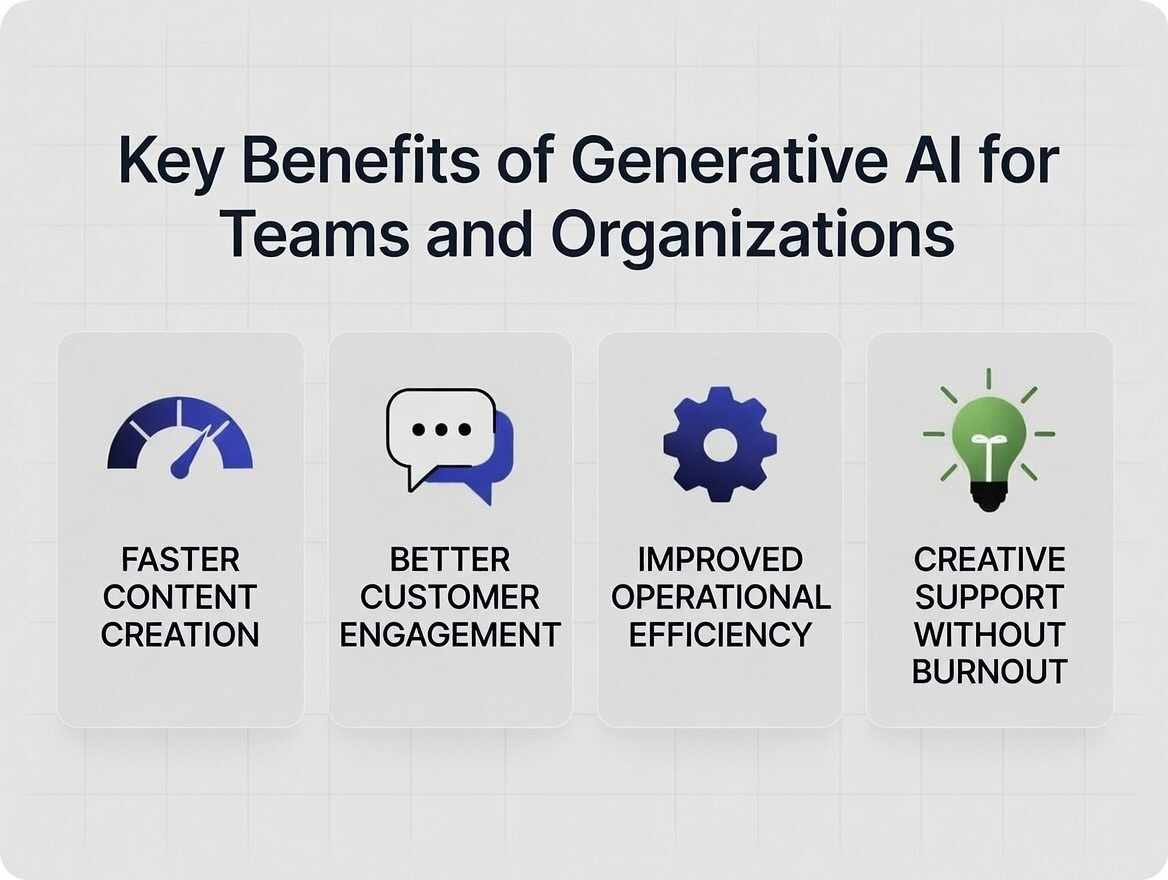
Organizations use generative AI not to replace people, but to support them by removing friction from everyday tasks and enabling more focused, strategic work.
1. Faster Content Creation
Generative AI significantly reduces the time required to produce written, visual, or multimedia content. Teams can generate drafts, ideas, and variations in minutes instead of hours. This speed allows organizations to keep up with content demands without compromising consistency or quality, especially in fast-moving environments.
Explore Our Content Marketing Services
2. Better Customer Engagement
By enabling personalization at scale, generative AI helps businesses communicate more effectively with their audiences. It supports tailored messaging, relevant recommendations, and responsive interactions, making customer experiences feel more meaningful. This leads to improved satisfaction, stronger relationships, and higher engagement over time.
3. Improved Operational Efficiency
Generative AI streamlines internal processes by automating repetitive tasks such as documentation, data summarization, and routine communication. This reduces manual workload, minimizes errors, and helps teams operate more smoothly. As a result, organizations can allocate resources more effectively and focus on higher-impact activities.
4. Creative Support Without Burnout
Creative teams often face pressure to deliver constant output. Generative AI acts as a creative assistant by helping with brainstorming, ideation, and first drafts. This support reduces fatigue, encourages experimentation, and allows professionals to refine and enhance ideas rather than starting from scratch every time.
3 Best Practices for Using Generative AI the Right Way
To get real value from generative AI, organizations need more than just access to tools. Success depends on how thoughtfully the technology is used, monitored, and integrated into daily workflows. When applied with the right practices in place, generative AI technology becomes a reliable support system rather than a risk or distraction.
1. Keeping Humans in the Loop
Human oversight is essential when using generative AI. While AI can generate content quickly, people are needed to review, refine, and validate outputs for accuracy, tone, and relevance. Keeping humans involved ensures quality control, reduces the risk of errors, and helps maintain trust, especially in customer-facing or high-impact use cases.
2. Using AI as an Assistant, Not a Replacement
Generative AI works best as a supportive tool, not a substitute for human expertise. It should assist with drafting, ideation, or automation while final decisions and creative direction remain with people. Treating AI as an assistant allows teams to work more efficiently without losing critical thinking, judgment, or originality.
3. Setting Clear Guidelines and Guardrails
Clear rules and boundaries help prevent misuse and inconsistency. Organizations should define how generative AI can be used, what data it can access, and where human approval is required. Establishing guidelines around tone, accuracy, security, and compliance ensures AI-generated outputs align with business standards and ethical expectations.
FAQs
Is generative AI suitable for beginners with no technical background?
Yes, generative AI is accessible to beginners because most tools use simple, natural-language prompts. You don’t need coding or technical expertise to get started. Over time, users can improve results by learning how to write clearer prompts and review outputs effectively.
How accurate is generative AI when creating content or outputs?
Generative AI can produce highly relevant and well-structured outputs, but accuracy is not guaranteed. Since it generates responses based on learned patterns, human review is essential to verify facts, correct errors, and ensure the content aligns with real-world requirements.
Can generative AI replace human creativity and decision-making?
Generative AI supports creativity but does not replace human judgment or original thinking. It helps with ideation, drafting, and automation, while humans provide context, emotional understanding, and strategic direction. The best results come from collaboration between people and AI systems.
What should businesses consider before adopting generative AI?
Before adopting generative AI, businesses should evaluate data privacy, quality control, and clear usage guidelines. It’s important to define goals, involve human oversight, and start with low-risk use cases to ensure responsible adoption and measurable value.
Conclusion
In a digital environment that continues to evolve at speed, what is Generative AI is no longer just a theoretical discussion—it has become a practical consideration for how businesses operate, compete, and innovate.
From improving how content is created to enabling personalization at scale and supporting smarter decision-making, generative AI is already influencing multiple industries in tangible ways. Its real value lies not in replacing human effort, but in supporting teams to work faster, think broader, and solve problems more efficiently.
As adoption grows, the key to success is using generative AI with clarity, responsibility, and purpose. Organizations that approach it strategically can reduce friction, improve outcomes, and stay adaptable in a changing digital landscape.
With the right guidance, partners like Centric help businesses apply generative AI in ways that align with real goals—turning emerging technology into practical, long-term impact.