Zero-day attacks are rising sharply, and the businesses hit hardest are rarely the ones that ignored security they are the ones that defended against yesterday's threats. A zero-day vulnerability is, by definition, a flaw nobody has patched yet, which means traditional, signature-based defenses are blind to it. Effective zero-day vulnerability protection is therefore less about a single tool and more about layered defense, intelligent detection, and a governance model that keeps your organization resilient when the unexpected lands.
This guide explains what zero-day vulnerabilities are, how zero-day attacks unfold, the core strategies enterprises use to defend against them, and how to fold that protection into a broader security governance framework. Whether you lead IT, security, or risk, you will leave with a practical playbook you can act on.
What Is a Zero-Day Vulnerability?
A zero-day vulnerability is a security flaw in software, hardware, or firmware that is unknown to the vendor responsible for fixing it.
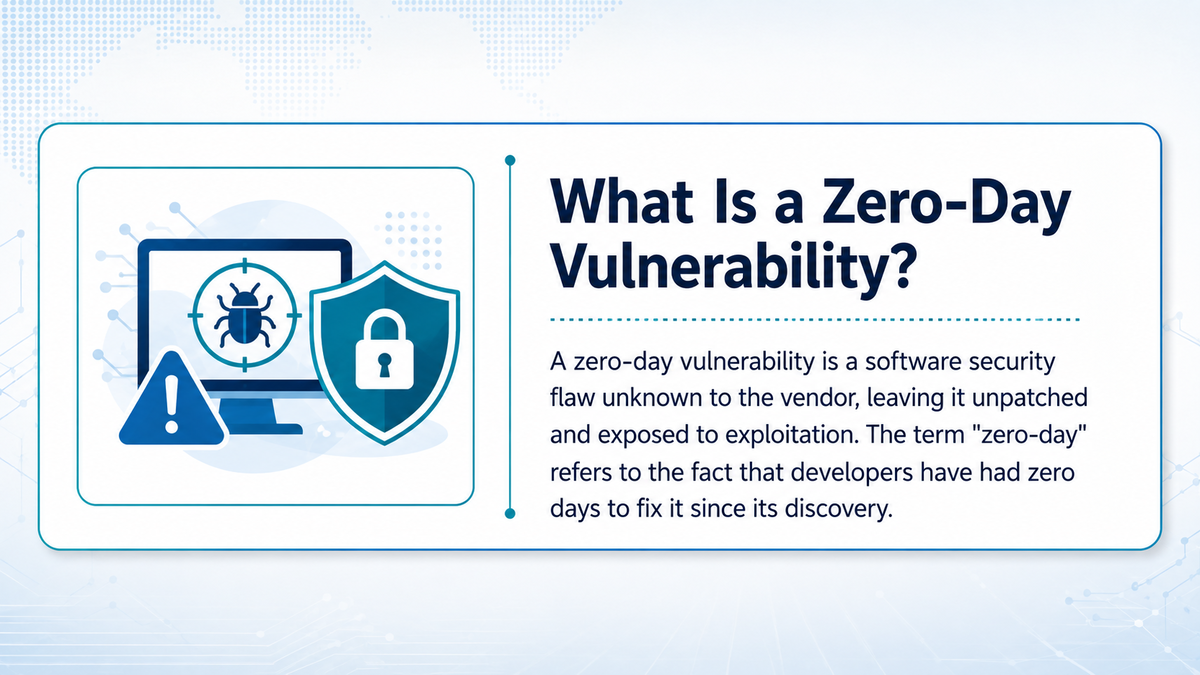
Because the vendor has had zero days to develop and release a patch, attackers who discover the flaw first can exploit it before any defense exists. That window between discovery and a fix is what makes zero-days uniquely dangerous.
Zero-Day Vulnerability vs. Zero-Day Exploit vs. Zero-Day Attack
These three terms are often used interchangeably, but they describe different stages:
|
Term |
What it means |
|---|---|
|
Zero-day vulnerability |
The underlying, unpatched flaw itself. |
|
Zero-day exploit |
The technique or code an attacker builds to take advantage of that flaw. |
|
Zero-day attack |
The actual event in which the exploit is used against a target. |
In short: the vulnerability is the open door, the exploit is the key, and the attack is the break-in.
How Zero-Day Vulnerabilities Are Discovered?
Zero-days surface through several channels some legitimate, some malicious:
-
Security researchers who responsibly disclose flaws to vendors.
-
Bug-bounty programs that reward ethical hackers for reporting issues.
-
Internal testing and code audits by the software maker itself.
-
Threat actors and dark-web markets, where exploits are bought, sold, and weaponized before vendors ever find out.
How a Zero-Day Attack Works (The Lifecycle)
Understanding the lifecycle of a zero-day attack helps you identify where defenses can intervene:
-
Discovery: an attacker or researcher finds a previously unknown flaw.
-
Weaponization: the attacker writes exploit code to take advantage of the flaw.
-
Delivery and exploitation: the exploit is delivered via phishing, a malicious website, or a compromised supply chain, and executed on the target.
-
Window of exposure: the period during which the flaw is actively exploited but no patch exists. This is the critical risk window.
-
Disclosure and patching: the vendor learns of the flaw, develops a fix, and releases it. The vulnerability is no longer a true zero-day, but unpatched systems remain exposed.
Tip: the most valuable defensive investments target the window of exposure detecting and containing exploitation even when no patch is available.
Why Zero-Day Vulnerabilities Are So Dangerous for Enterprises?
Zero-days bypass the assumptions most security programs are built on:
-
No patch exists. You cannot simply update your way out of the risk during the exposure window.
-
Signature-based tools fail. Traditional antivirus and intrusion detection rely on known signatures that a brand-new exploit does not yet have.
-
High business impact. A successful zero-day attack can lead to data breaches, operational downtime, regulatory fines, and lasting reputational damage.
-
Governance exposure. Without clear ownership and response plans, organizations lose precious time deciding who acts and how exactly when speed matters most.
This is why mature organizations treat zero-day readiness not as a purely technical issue, but as part of their overall risk posture something we explore in our data governance framework and broader compliance practices.
Build a Zero-Day Governance Framework with Centric
Famous Zero-Day Vulnerability Examples
Real incidents illustrate why zero-day protection matters:
-
Stuxnet (2010) a worm that used multiple Windows zero-days to target industrial control systems, widely cited as a turning point in cyber-physical attacks.
-
Log4Shell (2021) a critical flaw in the widely used Log4j logging library that exposed countless enterprise applications almost overnight.
-
MOVEit Transfer (2023) a zero-day in a popular file-transfer tool exploited at scale, affecting hundreds of organizations through the software supply chain.
Enterprise platforms are not exempt. We examined one such case in depth in our analysis of a SharePoint security vulnerability (CVE-2023-24955), which shows how a flaw in a trusted collaboration platform can become an enterprise-wide risk and how to respond.
Zero-Day Vulnerability Protection: Core Strategies
No single product stops zero-days. Effective protection relies on defense-in-depth overlapping layers that each reduce risk so that when one fails, others hold.
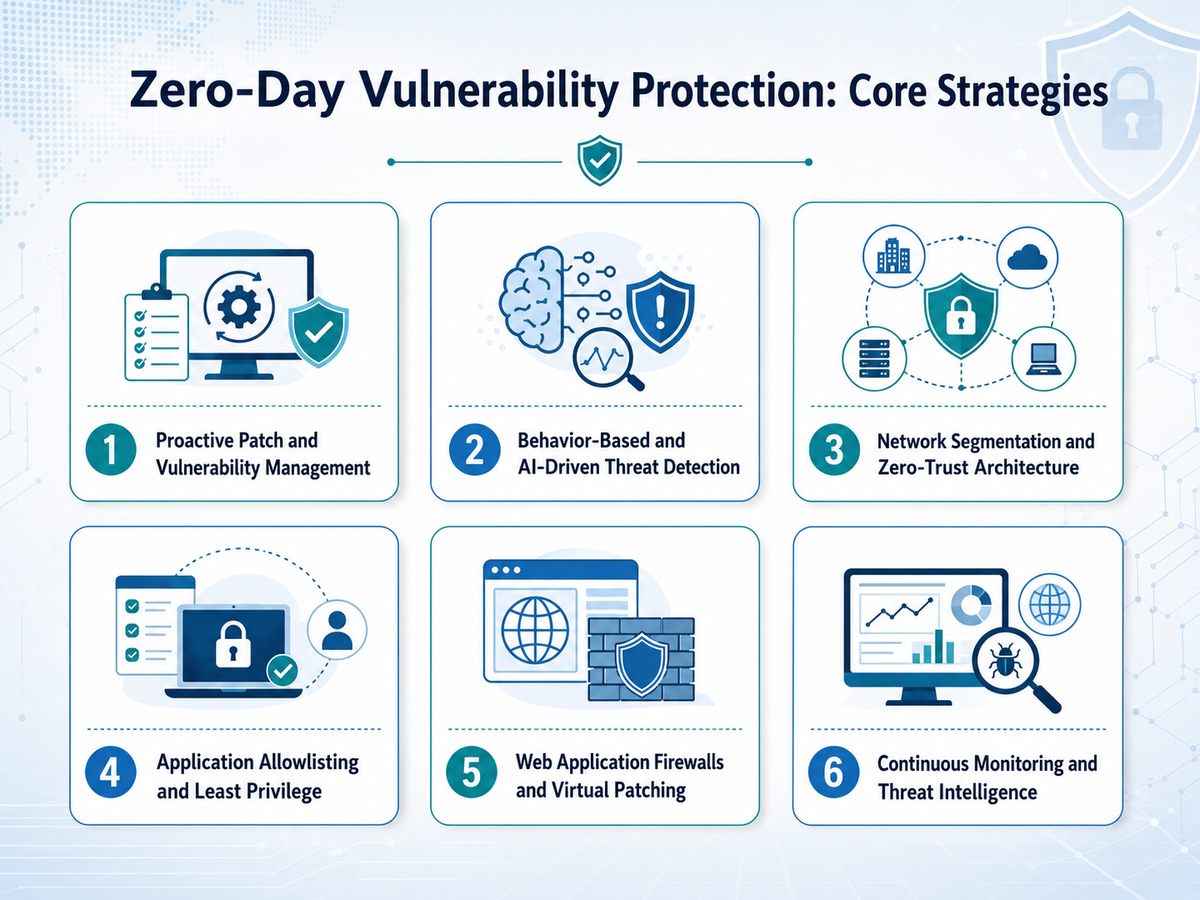
Below are the six strategies that matter most.
1. Proactive Patch and Vulnerability Management
You cannot patch an unknown flaw, but disciplined patch management dramatically shrinks your overall attack surface and closes the door the moment a fix ships. Maintain an accurate asset inventory, prioritize patches by exploitability, and track exposure against sources like the CISA Known Exploited Vulnerabilities catalog.
2. Behavior-Based and AI-Driven Threat Detection
Because zero-days have no signature, detection must focus on behavior rather than known patterns. Endpoint Detection and Response (EDR/XDR) and AI-based anomaly detection flag unusual activity unexpected process spawning, lateral movement, or data exfiltration even when the underlying exploit is brand new. This is where modern intelligent automation and AI workflows meaningfully raise the bar for defenders.

3. Network Segmentation and Zero-Trust Architecture
Segmenting networks and adopting a zero-trust model never trust, always verify limits how far an attacker can move after an initial compromise. Even if a zero-day breaches one system, segmentation contains the blast radius and protects critical assets.
4. Application Allowlisting and Least Privilege
Allowlisting permits only approved applications to run, blocking unknown exploit payloads by default. Pair this with least-privilege access so that compromised accounts and processes have minimal reach.
5. Web Application Firewalls and Virtual Patching
Web Application Firewalls (WAFs) and virtual patching apply protective rules at the network or application edge, shielding vulnerable systems before an official patch is available. This is one of the most direct ways to defend during the window of exposure.
6. Continuous Monitoring and Threat Intelligence
Around-the-clock monitoring, combined with current threat intelligence, helps you spot emerging zero-day campaigns early and respond before they escalate. Telemetry from across your environment becomes the early-warning system that signature tools cannot provide.
Build a Resilient Security Strategy
How to Remediate a Zero-Day Vulnerability?
When a zero-day is detected, a calm, repeatable incident-response playbook saves critical time:
-
Detect and confirm validate the activity and identify affected systems.
-
Contain isolate impacted assets to stop lateral movement.
-
Mitigate apply virtual patches, WAF rules, or configuration changes to reduce exposure.
-
Patch deploy the vendor's official fix as soon as it is released, prioritizing internet-facing and high-value systems.
-
Review conduct a post-incident review to capture lessons learned and strengthen controls.
Governance and Risk: Building Zero-Day Resilience at the Enterprise Level
Tools alone do not create resilience governance does. The organizations that weather zero-day events best are those that have decided, in advance, who is accountable, how decisions are made, and how risk is tracked.
-
Embed zero-day readiness into your security governance framework, with documented response plans and clear escalation paths.
-
Maintain a risk register and assign clear ownership (for example, using a RACI model) so action is never delayed by ambiguity.
If you are formalizing this layer, our guidance on how to implement data governance and our data governance and master data management services provide a practical starting point.
How Centric Helps?
Centric helps enterprises move from reactive patching to proactive resilience combining AI-driven detection, zero-trust architecture, and strong governance into a single, coherent program. From intelligent automation and AI workflows that surface threats faster, to governance frameworks that keep your organization audit-ready, we help you close the window of exposure with confidence.
Frequently Asked Questions
What is a zero-day security vulnerability?
It is a software flaw unknown to the vendor, with no patch available leaving “zero days” for defenders to fix it before attackers can exploit it.
How do you protect against zero-day vulnerabilities?
Use layered defense: behavior-based detection (EDR/XDR), zero-trust segmentation, application allowlisting, virtual patching and WAFs, continuous monitoring, and a tested incident-response plan.
What is a famous example of a zero-day vulnerability?
Well-known examples include Stuxnet, Log4Shell (Log4j), and the MOVEit Transfer exploit, along with enterprise platform flaws such as the SharePoint CVE-2023-24955.
How do you remediate a zero-day vulnerability?
Detect and contain the affected systems, apply mitigations or virtual patches, deploy the vendor patch once released, and then run a post-incident review.
How are zero-day vulnerabilities discovered?
Through security researchers, bug-bounty programs, and internal testing and, on the malicious side, by threat actors and dark-web exploit markets.
Can antivirus stop zero-day attacks?
Traditional signature-based antivirus often cannot, because no signature exists yet for a brand-new exploit. Behavior-based and AI-driven detection is far more effective.
Conclusion
Zero-day vulnerability protection is not a product you buy once it is a posture you build and maintain. By layering proactive patching, behavior-based detection, zero-trust segmentation, and virtual patching on top of a clear governance framework, enterprises can defend effectively even against threats no one has seen before.
The goal is not to predict every zero-day, but to ensure that when one appears, your people, processes, and technology are ready to contain it. At Centric, we help enterprises build exactly that kind of resilience combining AI-driven detection, zero-trust architecture, and governance frameworks into a coherent program that keeps you protected today and prepared for what comes next.