In today’s data-driven world, clean and accurate data is the foundation for effective decision-making and business success. However, what makes manually cleaning data challenging is more complex than it seems. From human errors to time-consuming processes, manual data cleaning presents several hurdles that can significantly impact data quality.
As datasets grow larger and more intricate, the task becomes increasingly difficult, requiring meticulous attention to detail and consistency. Additionally, with the increasing reliance on diverse data sources, inconsistencies in formats and missing values further complicate the cleaning process.
The absence of a standardized approach can lead to subjective decisions, which may introduce further inaccuracies. All of these challenges can result in delayed timelines, increased costs, and unreliable data that can ultimately affect business outcomes.
At Centric, we understand the critical role that data plays in driving business strategy, which is why we focus on helping organizations ensure data accuracy through innovative solutions.
In this guide, you'll learn about the key challenges of manually cleaning data, such as inconsistency, inefficiency, and human error. We’ll explore how automated tools and best practices can overcome these obstacles. By the end, you'll understand how the right tools can transform your data management for better quality and decision-making.
What is Data Cleaning?
Data cleaning is the process of identifying and rectifying inaccuracies, inconsistencies, and errors in raw data to ensure that it is suitable for analysis and decision-making.
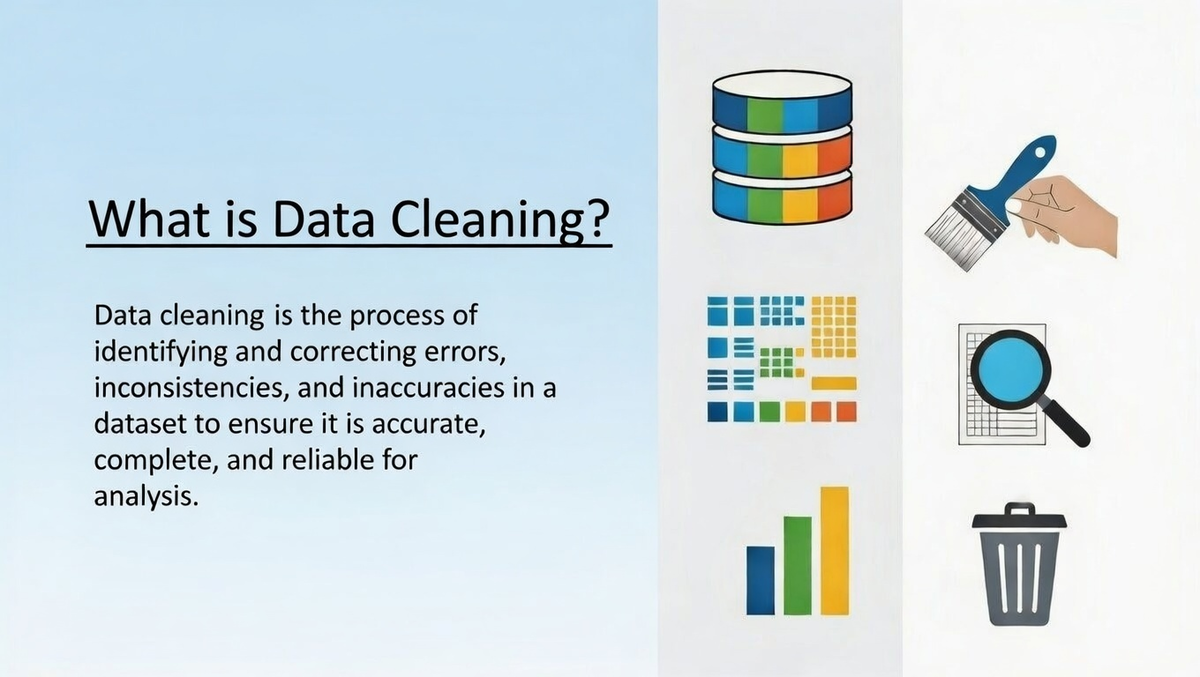
It includes tasks such as correcting errors, removing duplicates, and standardizing formats to ensure the dataset is as reliable as possible.
Correcting inaccuracies and inconsistencies in raw data
Raw data is often messy and can contain errors, inconsistencies, or typos. These issues need to be addressed to avoid misleading conclusions. This is particularly important for ensuring data accuracy issues are resolved, which can otherwise distort any business intelligence services or AI model predictions.
Ensuring datasets are accurate and reliable for analysis
The ultimate goal of data cleaning is to ensure datasets are accurate and reliable for further analysis. Clean data sets the foundation for successful data-driven business projects, ensuring that any insights gained are based on trustworthy information.
Transform Your Data With Our Data & Analytics Services
4 Types of Data Issues That Require Cleaning
There are several types of common data issues that must be addressed during the data cleaning process. These issues can arise from manual data entry, errors in data capture, or inconsistencies across different data sources.
1. Duplicate records
Duplicates occur when the same record is entered multiple times, leading to redundant or skewed analysis. This can be particularly problematic in customer databases, where repeated records can affect customer segmentation and reporting.
2. Missing values
Missing data can arise for a variety of reasons, such as incomplete manual data entry or system failures. These gaps need to be handled either by imputing values, removing incomplete records, or applying business rules for filling in missing data.
3. Formatting errors
Inconsistent data formats—such as varying date formats or currency symbols—can cause confusion and errors during analysis. Standardizing data formats ensures that datasets are uniform and can be easily processed without error.
4. Outliers and inconsistencies
Outliers are data points that differ significantly from others and could indicate errors or unique situations. Data cleaning involves assessing whether outliers should be removed, corrected, or kept based on their relevance and business impact. Similarly, inconsistencies in naming conventions or categorizations need to be standardized to ensure the dataset is coherent.
By addressing these issues, businesses can avoid data accuracy issues and ensure the data is primed for accurate analysis, decision-making, and automation.
The Importance of Clean Data for Business Decisions
Clean data is not just a nice-to-have; it's essential for businesses striving to make informed, strategic decisions in a competitive landscape. In this section, we’ll delve into why clean data is crucial, how it directly impacts decision-making, and its influence on driving successful business outcomes through AI and data and analytics services.
How Clean Data Fuels Business Success?
Clean data is the cornerstone of accurate insights that businesses rely on for making key decisions. Without it, any analysis or prediction could lead to faulty conclusions and misaligned strategies.
Ensures accurate insights for decision-making
Clean data allows businesses to trust the information driving their strategies, ensuring that decisions are based on reliable, up-to-date facts rather than flawed data, which could lead to costly mistakes.
Enhances the reliability of data models and AI
For AI models and predictive analytics services to function optimally, they need clean data to train on. Without it, machine learning algorithms could become biased, leading to unreliable outputs that could affect customer experiences, forecasting, and operational efficiency.
Supports regulatory compliance and reporting
Clean data is vital for businesses that need to meet industry standards and legal requirements. It ensures that businesses can generate accurate reports, avoid regulatory penalties, and maintain transparency in their operations, particularly in industries like healthcare and finance.
Why Manual Data Cleaning is So Challenging?
Manual data cleaning presents several significant challenges that can hinder the efficiency of the process and compromise the quality of the data. From time-consuming tasks to the increased risk of human error, it’s evident that manual cleaning becomes increasingly inefficient as datasets grow larger.
In this section, we’ll explore these challenges in greater detail and highlight why relying on manual data cleaning is not a sustainable solution for modern businesses.
Time-Consuming and Resource Intensive
Manual data cleaning requires human intervention for each record, making the process slow and inefficient, particularly for large datasets. As the volume of data increases, the time needed to clean it grows exponentially, putting a strain on valuable resources.
Tasks such as checking for duplicates, filling missing values, and ensuring consistency become overwhelming and unmanageable as datasets expand. The time it takes to clean large amounts of data manually creates significant delays, especially when decision-making is time-sensitive.
When it comes to cleaning big data manually, the task becomes almost impossible. The sheer volume of records makes it impractical to rely on manual methods, and businesses face scalability issues as data volume continues to rise.
What may seem like a manageable task for a smaller dataset becomes a roadblock for large organizations that require efficient, scalable solutions.
High Risk of Human Error
Manual processes are inherently prone to mistakes, which can seriously affect the quality and accuracy of the data. Human errors such as typos, incorrect data entry, or accidental deletions are common when cleaning data manually.
Even small mistakes can lead to major repercussions, particularly in complex datasets where the margin for error is minimal. These errors can introduce inconsistencies and distortions, resulting in unreliable data and skewed analysis that can severely impact business decisions.
Simple errors like incorrect data entries or missed values can compromise the integrity of the dataset. This can lead to insights based on flawed data, making business recommendations unreliable and potentially costly for the company. When data cleaning errors accumulate, they create long-term challenges that make it difficult to trust the data used for decision-making.
Subjectivity and Inconsistency in Approach
Without standardized guidelines, manual data cleaning is often subject to personal interpretation, leading to inconsistencies in how different team members approach the cleaning process.
For example, one analyst may choose to remove duplicate entries, while another may opt to consolidate them, creating discrepancies across the dataset. Similarly, decisions about handling missing data can vary depending on individual judgment, resulting in inconsistent approaches and outcomes.
The lack of clear guidelines means that data cleaning can be interpreted differently by each person involved, introducing subjectivity into the process.
These variations make it difficult to maintain consistency across teams, which can lead to datasets that are not uniformly cleaned or validated. As a result, inconsistencies in the cleaned data can cause confusion during analysis and reporting, further impacting the decision-making process.
Limited Scalability
One of the biggest drawbacks of manual data cleaning is its inability to scale effectively as datasets grow in size and complexity. The more data there is to clean, the more time and labor is required.
This rapidly becomes unsustainable as the volume of data continues to increase. Scaling manual processes to handle large datasets is nearly impossible, especially for businesses that need to clean vast amounts of data regularly.
As the data scale increases, the cost of cleaning grows proportionally, making it difficult for organizations to keep up with demand. The resources required to manually clean growing datasets become a significant drain on time and budget, limiting the company’s ability to respond quickly to new data insights.
In such cases, the manual cleaning process becomes a bottleneck, delaying key decisions and slowing down business operations.
Challenges in Addressing Complex Data Issues
Manual data cleaning becomes increasingly difficult when dealing with complex data issues. These problems can arise when dealing with large or multi-source datasets that contain inconsistencies across platforms or missing values.
Identifying these issues manually is often a daunting task, requiring deep expertise and attention to detail. For example, discrepancies in how data is recorded across different sources or the presence of missing data patterns may not be immediately obvious without specialized tools.
Even experienced data analysts can struggle to clean complex datasets effectively, as detecting subtle data issues requires a high level of expertise. Without proper data validation methods, errors are likely to slip through the cracks, leading to data quality problems.
As the complexity of the data grows, so does the difficulty of cleaning it manually, making it increasingly clear that automated solutions are necessary to address these challenges effectively.
-
Discrepancies across multiple data sources: Data often comes from various systems with different formats, structures, or naming conventions, making it difficult to reconcile manually.
-
Hidden missing data patterns: Identifying missing values in complex datasets, especially when they follow patterns across rows or columns, requires advanced techniques and tools.
-
Handling outliers and anomalies: Detecting outliers that may be genuine but rare, or the result of input errors, can be tricky without specialized tools designed to spot these anomalies.

The Role of Automation in Overcoming Manual Data Cleaning Challenges
Automated tools provide essential solutions to many of the difficulties associated with manual data cleaning. By automating data cleaning processes, businesses can overcome the data management obstacles that slow down decision-making and resource allocation.
These tools help streamline tasks that were traditionally time-consuming, improve data consistency, and handle much larger datasets than manual methods ever could. Let's explore how automation addresses these challenges and the important role it plays in effective data cleaning.
3 Benefits of Automated Data Cleaning Tools
Automated data cleaning tools are designed to address the limitations of manual cleaning, offering significant advantages to organizations looking to enhance their data management processes.
1. Speed and efficiency
Automated tools can clean data much faster than manual processes, which allows businesses to save valuable time. This efficiency is especially noticeable when cleaning large datasets, where manual intervention would be too slow to keep up with the volume of data. By automating the repetitive aspects of reducing data cleaning errors, businesses can accelerate their workflows automation and focus on higher-value tasks.
2. Accuracy
One of the most significant advantages of automating data cleaning is its ability to reduce human error. Automated systems follow predefined rules and algorithms to clean data, ensuring that the process is consistent and accurate across all records.
This eliminates inconsistencies caused by human mistakes, improving the overall reliability of the dataset and reducing the chance of data inconsistencies slipping through the cracks.
3. Scalability
As businesses grow and their data volume increases, automating data cleaning becomes essential. Automation allows companies to handle datasets of any size without needing additional resources, ensuring that data cleaning processes remain manageable and efficient. Automation removes the data management obstacles associated with scaling up data cleaning efforts manually, providing a solution that works well for both small and large datasets.
Why Automation Still Needs Human Oversight?
While automation offers clear benefits for reducing the time and effort involved in cleaning data, human expertise is still necessary for managing more complex data issues.
-
While automation can handle repetitive tasks, human judgment is essential for complex data cleaning decisions. Automated tools excel at tasks like removing duplicates, filling missing values, and identifying simple inconsistencies, but they still struggle with more complex problems that require interpretation and context.
Human intervention is necessary to decide whether an outlier is an error or an important data point, or how to resolve inconsistencies in multi-source datasets.
-
The synergy between automation and human expertise can ensure high-quality data cleaning. Automation can handle the bulk of the repetitive work, but human oversight is crucial for reducing data cleaning errors and making nuanced decisions that require domain knowledge.
Combining the strengths of both can ensure that datasets are not only clean but also accurately represent the underlying reality, improving the overall quality and usefulness of the data.
4 Best Practices for Effective Data Cleaning
Implementing data cleaning best practices can make the process more efficient and reduce risks, ensuring data quality is maintained.
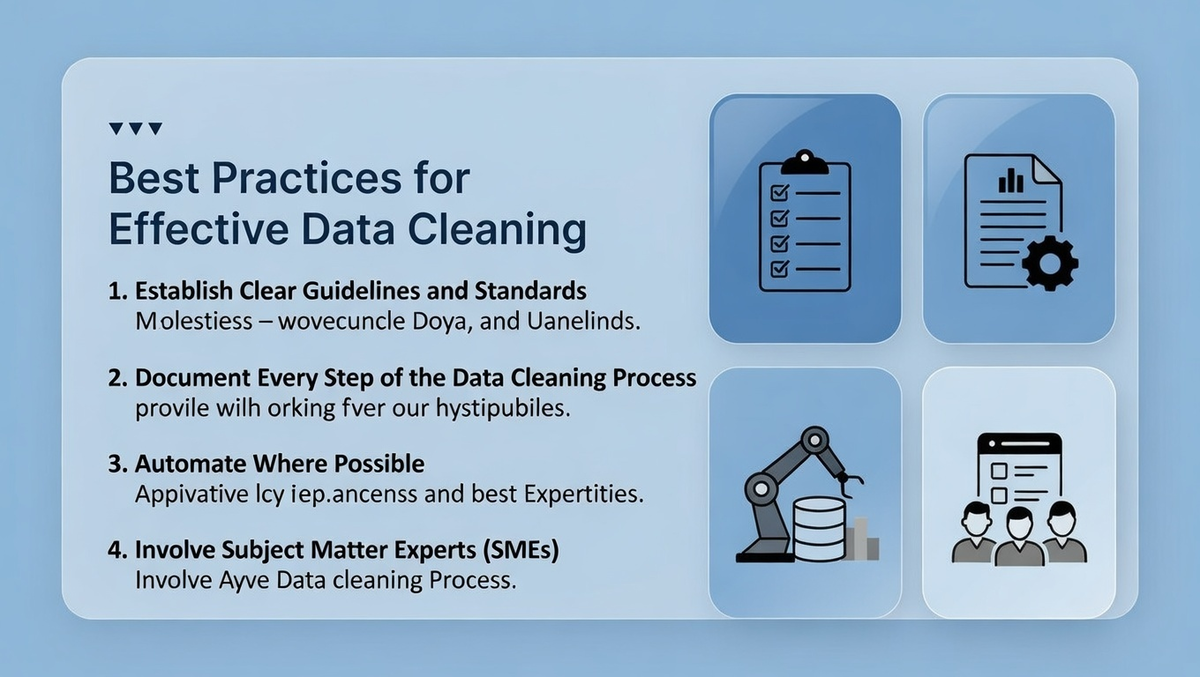
By following these practices, businesses can avoid inconsistencies, minimize errors, and keep their datasets reliable and usable for decision-making. Below are essential practices to adopt for effective data cleaning.
1. Establish Clear Guidelines and Standards
Defining rules for identifying and correcting data errors is vital to maintaining consistency throughout the cleaning process. It ensures that every team member follows the same approach for handling issues like missing values or duplicates. Additionally, maintaining consistent naming conventions and data formats makes the dataset uniform, eliminating confusion and errors during analysis.
2. Document Every Step of the Data Cleaning Process
It’s essential to document each step of the data cleaning process. By keeping track of decisions made during cleaning, businesses can ensure that future updates or audits follow the same approach. Documentation also makes the process reproducible, allowing others to revisit the work, understand the changes, and maintain transparency across the team.
3. Automate Where Possible
Automation can significantly improve the efficiency of the data cleaning process. Using automated tools to remove duplicates, fill missing values, and standardize data formats reduces the time spent on repetitive tasks. This not only speeds up the cleaning process but also minimizes human errors, ensuring data quality and consistency across large datasets.
4. Involve Subject Matter Experts (SMEs)
For complex datasets, involving subject matter experts (SMEs) is crucial. Their domain knowledge helps to accurately address specific data issues that automated tools may miss.
Whether it’s understanding the correct handling of industry-specific data or interpreting unusual patterns, SMEs provide the context needed to ensure accurate data cleaning decisions and reliable outcomes.
What Happens if Data is Not Cleaned?
Neglecting data cleaning can lead to significant issues for businesses, impacting their ability to make informed decisions, allocate resources efficiently, and maintain compliance. Poor-quality data results in costly errors and missed opportunities. In this section, we’ll explore the potential consequences of failing to clean data and the risks involved.
Impact on Data-Driven Decision Making
Inaccurate or incomplete data leads to flawed analysis, which in turn results in poor decision-making. Business strategies based on unclean data can misguide leadership, leading to ineffective actions, misplaced investments, or wasted resources. These decisions, when driven by unreliable data, can negatively affect revenue, growth, and long-term strategies.
Increased Costs and Resources Spent on Fixing Mistakes
When data is not cleaned initially, businesses often have to invest more time and money later on to fix errors. Mistakes made during the early stages of data collection or analysis can create cascading issues as the data is used for further operations. This additional corrective effort can strain resources and delay critical projects, ultimately driving up costs.
Compliance Risks
Industries such as healthcare, banking, and finance are highly regulated and require accurate data for compliance with legal standards. Failing to clean data properly can lead to incorrect reporting, non-compliance, and potential fines. Inaccurate data can also damage a business’s reputation, leading to legal consequences and a loss of trust from stakeholders and customers.
FAQs
Why is manual data cleaning so challenging?
Manual data cleaning is time-consuming, error-prone, and inconsistent, especially when handling large datasets. It requires human intervention for each record, which increases the risk of mistakes and makes it difficult to scale. Without automation, it’s hard to manage growing data effectively and efficiently.
How does automation improve data cleaning?
Automated tools streamline repetitive data cleaning tasks like removing duplicates, filling missing values, and standardizing formats. They reduce human error, save time, and ensure scalability. By automating data cleaning, businesses can handle large datasets more efficiently, leading to better data accuracy and decision-making.
What are the common data cleaning issues businesses face?
Businesses often encounter duplicate records, missing values, inconsistent formatting, and outliers. These issues can lead to incorrect analysis and flawed decision-making. Manual cleaning struggles with large datasets, requiring significant time and resources to address, making automated tools essential for efficient solutions.
How does clean data impact business decision-making?
Clean data ensures accurate insights for decision-making, boosting business efficiency and strategic planning. It improves the reliability of analytics, leading to informed choices that drive growth. Without clean data, businesses risk making decisions based on flawed information, which can harm revenue and resource allocation.
Conclusion
What makes manually cleaning data challenging? The complexity of handling large datasets, coupled with the risks of human error and inconsistencies, makes manual data cleaning a time-consuming and inefficient process.
Clean, reliable data is essential for accurate decision-making, strategic planning, and maintaining a competitive edge. By implementing the right tools and practices, businesses can transform data cleaning from a burden into an opportunity for growth.
Centric is dedicated to helping businesses navigate these challenges through a blend of automated solutions and expert guidance. By prioritizing data integrity, Centric ensures organizations can trust their data, empowering them to make well-informed decisions and achieve their goals with confidence.