




Have you ever wondered what is rank tracking?
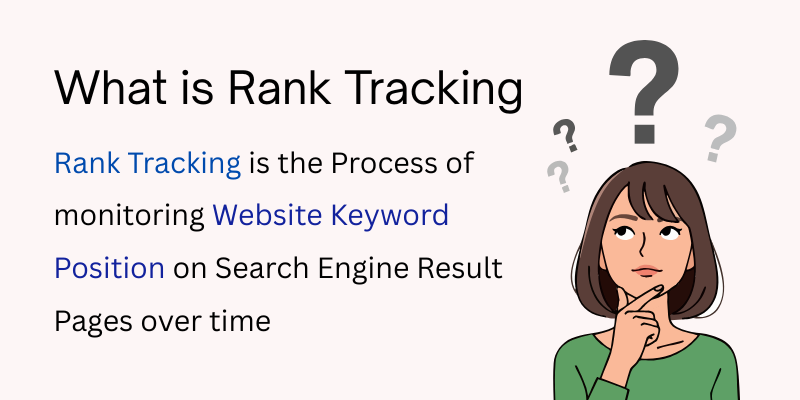
Rank tracking is the process of monitoring your website’s keyword positions on search engine results pages (SERPs) over time.
By keeping an eye on where your site ranks for specific keywords, you can gauge the effectiveness of your SEO efforts and identify areas for improvement.
This process is essential for businesses aiming to improve their visibility and stay competitive. It shows whether your rankings are improving or slipping, helping you assess the impact of your SEO strategies.
Regular rank tracking also allows you to monitor competitors, ensuring you stay ahead in your industry.
In this blog, we will explore the essential aspects of rank tracking, a crucial element of any SEO strategy. It offers valuable insights into keyword performance and website visibility, helping drive growth and maintain a competitive edge.
What is Rank Tracking?
Rank tracking is the process of monitoring your website’s keyword positions on search engine results pages (SERPs) over time. By tracking where your site ranks for specific keywords, you can evaluate the effectiveness of your SEO efforts and assess your visibility in search results. This helps you understand how your site’s visibility fluctuates in response to search engine algorithm updates, user behavior changes, and content improvements.
Regular rank tracking provides insights into which keywords are driving traffic and conversions, helping you identify areas of success and those needing optimization. It also allows you to spot underperforming keywords that could benefit from more targeted content or additional SEO strategies.
It’s essential for adapting strategies, improving content, and boosting organic traffic, while keeping your website competitive in the ever-changing search landscape. Consistent rank tracking also ensures you’re aligned with your competitors’ performance and helps you adjust your approach to outperform them in the SERPs.
Start Tracking Your SERP Positions
Why Rank Tracking is Essential for SEO?
Rank tracking is crucial for optimizing your SEO strategy. By using rank tracking SEO tools you can measure keyword rankings and adjust your efforts accordingly to ensure your content is reaching its target audience and driving traffic to your site.
Here’s why:
-
Measures SEO Performance: Regularly tracking keyword rankings helps assess the effectiveness of your SEO efforts, allowing you to adjust strategies and improve content or on-page optimization if needed.
-
Identifies New Keyword Opportunities: Monitoring ranking changes helps uncover high-potential keywords and stay ahead of search trends, improving visibility and driving targeted traffic.
-
Understands Competitor Performance: Rank tracking lets you track competitors’ rankings, helping you identify gaps and adjust your strategies to outperform them in the market.
How Rank Tracking Works?
Rank tracking monitors keyword performance and SEO progress through two main methods:
-
Manual Rank Checking: This involves manually searching for keywords on search engines to see where your website ranks. While simple, it’s time-consuming and less accurate, as results can vary based on location, device, and search history.
-
Automated Rank Track: This method uses tools or scripts to automatically monitor keyword positions in SERPs, providing consistent and accurate data. It’s faster and more efficient, ideal for tracking large sets of keywords regularly. best seo tools like SEMrush, Ahrefs, and Moz offer automated tracking features to save time and ensure precision.
5 Key Metrics to Track in Rank Tracking
When it comes to rank tracking, it's crucial to monitor key metrics that provide insights into the effectiveness of your SEO strategy.

These metrics help you assess your website's performance in search engine results and guide your optimization efforts.
Here are the most important metrics to track:
1. Keyword Position
The position of each keyword on search engines is one of the most important metrics in rank tracking. Higher keyword rankings often correlate with better visibility, driving more organic traffic to your website.
Monitoring keyword positions helps you determine whether your SEO strategies are paying off, and which keywords need more focus. A keyword that ranks higher on the search results page is more likely to attract clicks, which directly impacts your website's traffic and conversion rates.
2. Search Volume
Search volume measures how often a particular keyword is searched for within a given timeframe. Keywords with higher search volumes are typically more competitive, but they also have the potential to bring more traffic if you rank well for them.
Monitoring search volume helps you prioritize keywords that have a balance between competition and search demand, allowing you to optimize content that will yield the most significant traffic benefits.
3. Click-Through Rate (CTR)
CTR measures the percentage of clicks your website receives relative to the number of times it appears in search engine results. For example, if your website ranks #1 for a keyword and is clicked 100 times out of 1,000 impressions, the CTR is 10%.
A high CTR indicates that your title tags, meta descriptions, and content are effectively attracting users. Tracking CTR helps you understand how well your listings resonate with users and whether adjustments to on-page elements like titles or descriptions are needed to boost engagement.
4. Keyword Movement
Tracking the movement of keywords over time, whether they move up or down, provides valuable insight into the effectiveness of your SEO efforts. If your keywords are rising in rank, it indicates that your optimization strategies are working.
On the other hand, if keywords are dropping in rank, it could be a sign that adjustments are needed, whether through improved content, better link-building, or other SEO tactics.
Monitoring keyword movement allows you to react promptly and refine your strategies to stay competitive.
5. SERP Features
Search Engine Results Pages (SERPs) often display various features beyond just organic listings, such as rich snippets, knowledge panels, and featured snippets.
These features can significantly impact your website's visibility and traffic. For example, appearing in a featured snippet (position zero) can drastically increase click-through rates.
Tracking how your website appears in these SERP features helps you identify opportunities to optimize your content further, targeting the elements that drive additional visibility and engagement.
Try Our Free SERP Checker Tool
How to Track Rankings Effectively?
Tracking rankings effectively goes beyond simply watching the numbers move up and down. It’s about gathering meaningful, consistent data that drives smart, data-backed SEO decisions.
Start by using a rank tracking system to keep your process automated, ensuring you get accurate, reliable insights across different devices and locations.

Here’s a step-by-step guide to help you track rankings the right way:
1. Identify the Right Keywords
The first step is to select the most relevant keywords for your business. These should include:
-
Primary keywords: Core terms directly tied to your product, service, or niche.
-
Secondary keywords: Related terms or variations your audience might use.
-
Long-tail keywords: More specific queries that often indicate a strong intent to purchase or take action.
Choosing the right keywords should align with your goals, whether it’s increasing brand awareness, driving conversions, or establishing authority in a specific area.

2. Group and Prioritize Keywords
Organize your keywords into clusters based on topics, user intent, or the customer journey stages (e.g., awareness, consideration, decision). This approach makes it easier to evaluate performance across different types of content.
For example, you can assess how blog posts perform compared to product pages. Prioritize high-intent keywords with manageable competition, taking into account your website's domain authority.
3. Set Up a Reliable Rank Tracking Tool
Manual rank checking can be inconsistent, as results vary by location, device, and personal search history. Instead, use a dedicated rank track tool like Nightwatch to automate the process and get accurate, localized data across all major search engines.
With Nightwatch, you can:
Track keyword rankings by location and device (desktop or mobile).
-
Monitor competitor rankings alongside your own.
-
Identify SERP feature opportunities (such as featured snippets or local packs).
-
Integrate with Google Search Console and Google Analytics for unified insights.
Nightwatch’s capabilities eliminate guesswork and ensure you focus on what drives performance.
4. Monitor Trends Over Time
Ranking data fluctuates daily, so it’s important to focus on long-term trends. Track your rankings weekly or biweekly and compare performance month-over-month or quarter-over-quarter. Look for patterns like seasonal drops or gradual improvements to gain insight into your SEO momentum.
5. Analyze Competitor Movements
SEO doesn’t happen in a vacuum. Use competitor tracking features in Nightwatch to see which competitors are rising in your niche. If a competitor surpasses you for a key term, analyze their strategy. Perhaps they’ve optimized for search intent or refreshed an old piece of content.
6. Apply Insights and Refine Your Strategy
Rank tracking should lead to actionable insights. Use the data to identify which keywords or pages need optimization. This could involve adding internal links, expanding content, or improving on-page SEO.
Monitor the effects of these changes over time to see how they impact rankings. The goal is to continuously refine your strategy based on the insights you gather from rank tracking, ensuring ongoing SEO growth.
3 Common Mistakes in Rank Tracking
Tracking keyword rankings is a critical part of any SEO strategy, but it's easy to make mistakes that can skew results and lead to ineffective decision-making.
Here are some common mistakes to watch out for and how to avoid them for better results.
1. Over-Reliance on One Device
One common mistake in tracking rankings is focusing on a single device type, usually desktop. Rankings can vary significantly between desktop and mobile devices due to differences in search algorithms and mobile-first indexing.
Mobile search results often show different rankings and SERP features compared to desktop. For accurate data, it's essential to track rankings on both desktop and mobile devices to get a complete view of your website’s performance.
This helps ensure you're not missing important fluctuations that could affect your overall SEO strategy.
2. Ignoring Local SEO
Many businesses make the mistake of ignoring local SEO factors when tracking rankings. If you’re targeting local customers or have a location-based business, rankings can differ significantly depending on the geographic location of the searcher.
Local SEO factors like Google My Business listings, local keywords, and proximity to the searcher can influence rankings.
To get accurate insights, make sure to track local rankings and tailor your SEO strategy to target location-specific queries. Ignoring local SEO can result in missed opportunities for businesses that rely on regional visibility.
Grow Your Business with Local SEO
3. Not Using Accurate Tracking Locations
Another common error is not using the right location settings when tracking rankings. SERP rankings can vary based on the user’s location, and failing to account for this can lead to inaccurate data.
For global websites or businesses targeting multiple regions, it's important to use geo-targeting or VPNs to simulate search results from different locations.
This ensures that you're monitoring accurate rankings and getting a true representation of how your site performs in various regions, which is especially important for businesses with a global or localized customer base.
Frequently Asked Questions
How does rank tracking help improve my website's SEO strategy?
Rank tracking helps by providing data on keyword performance, allowing you to identify successful strategies, adjust underperforming areas, and optimize content to improve rankings over time.
What are the benefits of rank tracking software?
Rank tracking software automates keyword monitoring, provides accurate and consistent data, saves time, and offers insights into competitor performance, helping to refine SEO strategies effectively.
How to improve search engine ranking visibility using rank tracking insights?
Use rank tracking insights to focus on high-value keywords, refine underperforming ones, and optimize content or SEO strategies based on trends and competitor performance.
What is rank tracking in SEO?
Rank tracking in SEO is the process of monitoring your website’s position for specific keywords on search engine results pages (SERPs). It helps businesses understand how their SEO efforts are performing, identify trends, and make data-driven decisions to improve visibility and traffic.
Conclusion
Now that you understand what is rank tracking, let’s wrap up and conclude.
It’s the process of monitoring your website’s keyword positions in search engine results over time. Consistent rank tracking is crucial for refining your SEO strategies, as it provides valuable insights into how your website performs and how to optimize your content effectively.
By regularly tracking your rankings with platforms such as Centric, you can stay ahead of competitors and adjust your strategies to keep up with evolving search engine algorithms.
This ongoing monitoring ensures that your SEO efforts are on track, helping you adapt to changes in search trends and continue driving organic traffic.
Whether you're tracking keyword performance or analyzing competitor movements, rank tracking provides the data needed to make informed decisions and maintain a competitive edge in the market.