What is data annotation, and why is it so crucial for AI and machine learning (ML)? Simply put, data annotation is the process of labeling raw data to make it understandable and usable for machine learning algorithms.
It plays a pivotal role in training AI models by allowing them to learn from real-world examples, such as images, text, and audio. The accuracy and quality of the annotations directly impact the performance and reliability of the AI system.
Centric helps organizations prepare for AI and ML initiatives by providing high-quality data annotation services. Our team supports businesses in building AI-ready data pipelines and implementing computer vision solutions, ensuring seamless machine learning model development.
In this guide, you will learn about the various types of data annotation, the challenges and benefits it brings to AI projects, and best practices for effective annotation. By the end of this post, you’ll gain a clear understanding of how this process enhances machine learning outcomes and shapes the future of AI.
What is Data Annotation and Why is it Important in AI and Machine Learning?
Data annotation is critical for developing accurate AI and ML models because it provides the foundation upon which these models learn. Without high-quality labeled data, machine learning algorithms would struggle to recognize patterns and make meaningful predictions.
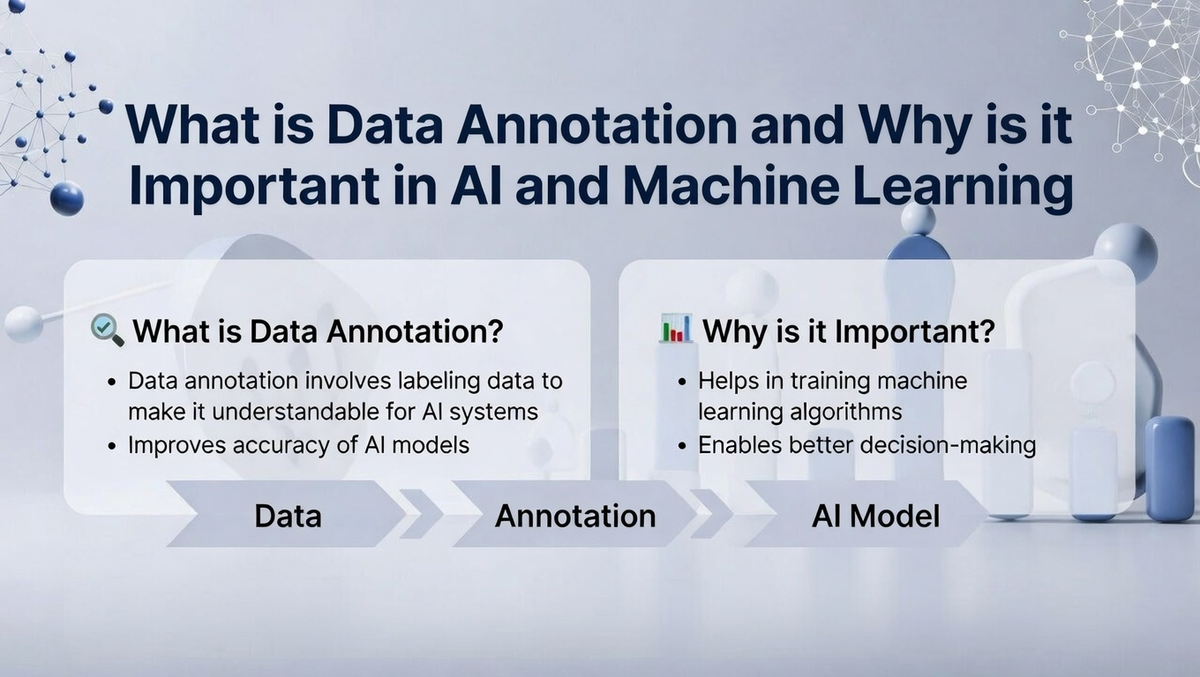
Machine learning datasets must be properly labeled and organized to allow AI systems to understand and interpret raw data effectively. This process enables AI to process unstructured data such as text, images, and audio, allowing it to perform tasks like speech recognition, object detection, and sentiment analysis.
Data tagging for machine learning is an essential component in this process. It involves categorizing and labeling data points, helping AI models distinguish between different variables and understand their context. Data labeling is the backbone of AI and ML, as it provides the necessary context for algorithms to draw insights and make decisions based on patterns.
Without accurate and consistent data annotation, AI systems would fail to interpret the real-world data they're designed to analyze, making data annotation indispensable for successful AI and ML development.
4 Types of Data Annotation in Machine Learning
Data annotation is a multi-faceted process that involves labeling different types of data, and its application varies across industries depending on the specific needs. The most common annotation types include text, image, video, and audio annotation.
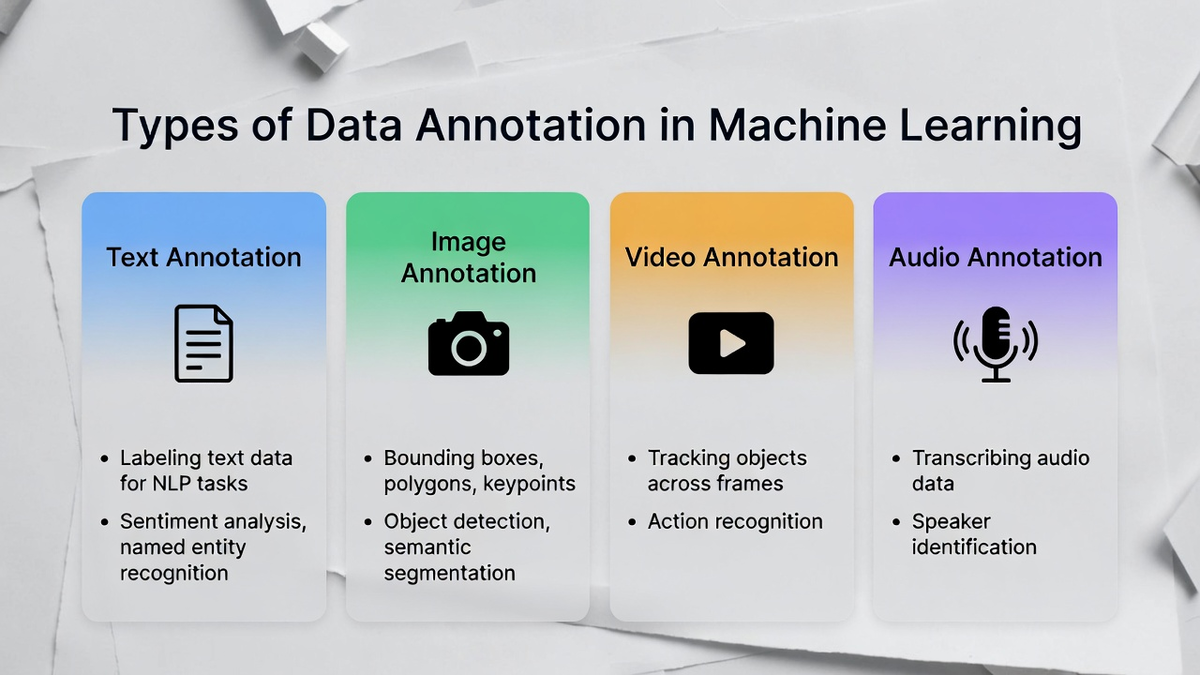
These methods are fundamental in training machine learning models to interpret and understand different forms of unstructured data. Below, we explore each of these data annotation techniques and how they are used in various industries.
1. Text Annotation
Text annotation plays a vital role in Natural Language Processing (NLP), helping AI models understand human language. This type of annotation involves tagging words, sentences, or entire paragraphs with meaningful labels to help machine learning models understand context, sentiment, intent, and more.
Tasks like sentiment analysis, intent detection, and keyword tagging rely heavily on text annotation. For instance, sentiment analysis tags text as positive, negative, or neutral, helping AI assess customer feedback. Intent detection helps chatbots understand the user's goal, while keyword tagging allows AI models to identify key concepts in a document.
Industries such as customer service, e-commerce, and healthcare use text annotation to enhance their AI-driven tools and improve user interactions.
Boost your sales with the E-commerce marketing Service
2. Image Annotation
Image annotation enables AI systems to recognize and interpret images, a critical aspect of computer vision. There are several techniques within image annotation, including classification, object detection, and segmentation.
-
Classification assigns labels to images, such as identifying whether an image contains a dog or a cat.
-
Object detection goes a step further, identifying and locating specific objects within an image.
-
Segmentation divides an image into distinct sections, allowing AI to focus on individual objects.
Applications of image annotation are vast, especially in autonomous driving, where AI models need to recognize road signs, pedestrians, and vehicles. In medical imaging, it helps detect abnormalities in X-rays or MRIs, improving diagnostic accuracy. Industries like healthcare, automotive, and security are leveraging image annotation to develop smarter AI systems.
Accelerate your Automotive Industry with Automotive Marketing Agency
3. Video Annotation
Video annotation involves tagging and labeling frames within a video to help AI systems understand motion, actions, and context over time. Unlike static image annotation, video annotation requires AI to interpret sequences of events, making it a more complex and resource-intensive process.
Applications of video annotation include security (e.g., identifying suspicious activities or tracking movements in surveillance footage), entertainment (e.g., tagging specific scenes in movies or sports), and autonomous vehicles (e.g., detecting pedestrian movement or traffic signals in live video feeds).
Despite its challenges, video annotation is crucial for systems that need to analyze dynamic and real-time data.
4. Audio Annotation
Audio annotation involves labeling specific sounds or speech in an audio file, enabling AI systems to understand and classify audio signals. It plays a significant role in speech recognition, where AI models transcribe spoken words into text, and in emotion detection, where the system analyzes voice tone and pitch to identify a speaker's emotional state.
For example, in customer service chatbots, audio annotation helps AI understand spoken queries and respond appropriately. In mental health applications, it can assist in detecting emotional changes or distress in a person’s voice.
This annotation type is particularly useful in sectors like healthcare, customer service, and entertainment, where AI models need to interpret and respond to audio inputs.
Grow your Audience with Targeted Entertainment Marketing
How Data Annotation Enhances AI Performance?
Data annotation plays a crucial role in enhancing the performance of AI and machine learning (ML) models. The quality of annotated data directly impacts how well AI systems can understand, learn, and make decisions based on the input data.
When machine learning algorithms are trained on well-annotated datasets, they can identify patterns with greater accuracy and make more informed predictions. In contrast, poor data annotation can lead to inaccurate results and suboptimal model performance.
High-quality annotated data provides AI technology with the context and structure they need to interpret complex data types, such as images, text, audio, and video. For instance, data annotation for computer vision allows AI models to learn to identify and classify objects, detect anomalies, and even recognize facial expressions with greater precision.
Similarly, deep learning annotation enables the creation of large, labeled datasets required for training deep neural networks, which rely on vast amounts of annotated data to learn hierarchical features.
The benefits of using high-quality annotated data are significant:
-
Increased Accuracy: Annotated data helps AI models achieve higher accuracy by providing clear labels for the system to learn from. Whether it's image classification or sentiment analysis, well-labeled data improves the model's ability to recognize patterns and deliver more reliable results.
-
Reduced Biases: High-quality data annotation is essential for minimizing bias in AI models. Annotators can ensure that the data is diverse, representative, and free from skewed labels, leading to more fair and unbiased outcomes. This is particularly important in sensitive areas such as healthcare or finance, where biases can lead to harmful decisions.
Incorporating data annotation for computer vision and deep learning annotation into your AI development process ensures that models can understand complex data and perform optimally across a wide range of applications. By investing in quality annotation, businesses can unlock the full potential of their AI systems, enabling more accurate, efficient, and ethical solutions.
3 Challenges in Data Annotation
While data annotation is essential for developing high-performance AI and machine learning models, it comes with its own set of challenges. These challenges can hinder the efficiency and effectiveness of AI development if not managed properly. The main hurdles include data quality, consistency, and scalability.
Additionally, data annotation is a resource-intensive process that requires effective project management to ensure smooth execution.
1. Overcoming Data Quality Issues
Maintaining accurate and clean data sets is one of the primary challenges in data annotation. Poor data quality can lead to erroneous AI model predictions and reduce the overall reliability of the system. Here are some tips to maintain high-quality annotated data:
-
Regular Data Audits: Conduct frequent audits of the annotated data to identify and correct errors or inconsistencies before they affect model training.
-
Automated Data Annotation: Incorporating automated data annotation tools can help speed up the process, but they must be carefully supervised to ensure accuracy. These tools can handle large volumes of data but need to be supplemented with manual oversight for fine-tuning.
-
Manual Data Annotation: While manual data annotation may be slower, it often leads to higher-quality annotations, especially in complex cases that require human judgment.
Consistency in labeling is crucial to avoid discrepancies that could confuse AI models. Clear guidelines and training for annotators can help ensure uniformity across the dataset. This leads to more reliable models capable of accurately interpreting input data.
2. Scalability and Resource Management
One of the biggest challenges in data annotation is managing large volumes of data efficiently. As AI models require massive amounts of labeled data to train effectively, scaling the annotation process becomes increasingly difficult. To handle this, consider the following:
-
Leveraging Automated Data Annotation: While manual data annotation is more accurate, using automated tools for repetitive or straightforward tasks can significantly reduce time and effort, allowing human annotators to focus on more complex tasks.
-
Data Categorization for AI: Organizing and categorizing data into manageable chunks is essential when dealing with large datasets. Data categorization for AI helps break down the annotation task into smaller, more digestible parts, making it easier to scale efforts.
-
Resource Management: Ensure you have a well-trained, scalable team of annotators or consider outsourcing parts of the process to third-party providers. Additionally, integrating AI-driven annotation tools with human oversight can help manage the data annotation process efficiently without sacrificing quality.
3. Reducing Bias in Annotated Data
One of the ethical concerns in data annotation is ensuring that the data is free from biases, which can inadvertently be introduced by annotators. This is particularly important for ensuring that AI models do not perpetuate or amplify harmful stereotypes. Here’s how to address this:
-
Diverse Annotator Teams: It is vital to involve annotators from diverse cultural, linguistic, and demographic backgrounds to ensure that the dataset is comprehensive and representative. This diversity helps minimize biases in the data, which in turn leads to more fair and ethical AI systems.
-
Regular Bias Audits: Conduct regular reviews and audits of the annotated data to check for and correct any biases. This should include reviewing the types of data being categorized, the labels being applied, and how these align with real-world scenarios.
-
Ethical Data Annotation Practices: Training annotators on the importance of unbiased data annotation and making sure they understand the ethical implications of their work is crucial. Implementing best practices and guidelines will help reduce unintended bias in the data.
Incorporating these steps helps build a more ethical AI framework, ensuring that the models trained on these datasets are both accurate and socially responsible.

The Role of Annotators in the Data Annotation Process
Data annotation relies heavily on human involvement to ensure that AI models are trained with accurate and high-quality data. While automated tools can help speed up the process, human annotators provide the nuanced understanding and contextual judgment that machines currently cannot replicate.
Annotators play a critical role in labeling raw data—whether it's text, images, audio, or video—to make it comprehensible for machine learning algorithms.
Human annotators are responsible for reviewing large datasets, identifying key features, and applying appropriate labels or tags to the data. They ensure that data is correctly categorized, which enables AI systems to learn the right patterns and make accurate predictions.
The accuracy of an AI model’s output is directly linked to the quality of the annotations it has been trained on, making annotators an essential part of the AI development process.
To be effective, annotators must possess specific skills and expertise, including:
-
Attention to Detail: Annotators must be able to accurately label data, even when it’s complex or requires interpreting subtle distinctions.
-
Domain Knowledge: Specialized data, such as medical images or legal documents, requires annotators who understand the context and terminology used in these fields.
-
Consistency: Ensuring that data labeling is uniform across large datasets to prevent discrepancies in AI model outputs.
-
Critical Thinking: Annotators need to be able to interpret ambiguous data, make educated decisions on how to label it, and recognize patterns within the data.
Types of Annotators: In-house vs Outsourced vs AI-Assisted
There are various approaches to staffing data annotation projects. Each model—whether in-house, outsourced, or AI-assisted—comes with its own set of advantages and challenges.
In-house Teams:
-
Pros: Complete control over the annotation process, better communication and alignment with project goals, and stronger data security as sensitive information stays within the company.
-
Cons: High costs due to the need for specialized staff, training, and management. Scalability can also be an issue for larger projects, and the time investment is significant.
Outsourced Teams:
-
Pros: Cost-effective and scalable, as outsourcing allows businesses to tap into a global pool of annotators. It’s easier to quickly scale efforts without needing to hire and train internal teams.
-
Cons: Less control over the process, potential quality issues, and concerns regarding the handling of sensitive data, especially when using offshore teams. Communication barriers can also arise, particularly when dealing with complex or domain-specific data.
AI-Assisted Annotation:
-
Pros: Marketing Automation tools can speed up the annotation process by suggesting labels, making the task more efficient. AI-driven annotation tools can handle simple tasks, allowing human annotators to focus on more complex or nuanced data points.
-
Cons: AI tools require upfront investment and constant fine-tuning to ensure quality. There’s also the risk of perpetuating errors if the AI system itself is not well-trained, leading to potentially inaccurate annotations.
Ensuring Data Security and Privacy in Annotation
Data security and privacy are critical considerations when performing data annotation, especially when the data involved is sensitive or personally identifiable. Given that AI and machine learning models are often trained on large datasets containing confidential information, it’s essential to have robust security protocols in place to protect both the data and the annotators involved.
Best practices for handling sensitive data during annotation include:
-
Data Anonymization: Before annotating, ensure that personally identifiable information (PII) is anonymized or removed to protect privacy.
-
Access Control: Restrict access to sensitive data based on the annotator’s role. Only those who need to see the data for annotation purposes should have access to it.
-
Compliance with Regulations: Ensure that the data annotation process adheres to data protection regulations, such as GDPR, HIPAA, or other regional data privacy laws, especially when dealing with healthcare, financial, or legal data.
-
Confidentiality Agreements: Annotators, whether in-house or outsourced, should sign confidentiality agreements to protect the integrity of the data and ensure that sensitive information is not disclosed improperly.
-
Training Annotators on Privacy: Provide ongoing training to annotators on the importance of data security and privacy, ensuring they understand the ethical implications and risks involved.
By following these practices, companies can mitigate the risks associated with sensitive data while maintaining the accuracy and quality of annotated datasets. Ensuring data security is vital for fostering trust with customers and clients, especially in industries that handle highly sensitive information.
Applications of Data Annotation Across Different Industries
Data annotation plays a crucial role in transforming raw data into actionable insights across various industries. By enabling AI and machine learning systems to learn from labeled data, businesses can unlock the full potential of their AI models. Here are a few examples of how data annotation is applied across different sectors:
Healthcare
In healthcare, data annotation is used to label medical images, such as X-rays, MRIs, and CT scans, to help AI models detect diseases and abnormalities. Annotated data allows AI to identify conditions like tumors, fractures, and lesions with remarkable accuracy, assisting doctors in diagnosing and creating personalized treatment plans for patients.
Automotive
For autonomous vehicles, data annotation is essential for training AI to recognize and understand various objects on the road, including pedestrians, vehicles, traffic signs, and obstacles. By annotating images and videos captured by cameras and sensors, AI systems can learn to navigate streets safely, making self-driving cars a reality for the future.
Retail
In the retail sector, data annotation helps AI models analyze customer behavior by labeling interactions such as purchasing patterns, product preferences, and feedback. With annotated data, AI can predict consumer trends, optimize inventory management, and personalize shopping experiences, ultimately improving customer satisfaction and increasing sales.
Finance
In banking and finance, data annotation is used to label transactions for fraud detection. By annotating historical data with labels such as "fraudulent" or "genuine," AI models learn to identify unusual patterns and behaviors, enabling them to flag suspicious transactions in real-time and reduce the risk of financial fraud across banking and payment systems.
Explore Our Financial Marketing Agency in the USA
3 Best Practices for Data Annotation
To achieve high-quality AI models, organizations must follow best practices when managing their data annotation projects. By implementing a structured approach, businesses can ensure the data is accurate, consistent, and relevant for training machine learning algorithms. Below are some best practices to help streamline the process and maintain data integrity.
1. Setting Clear Annotation Guidelines
Setting standardized guidelines is essential for maintaining consistency in data annotation. Clear instructions ensure that annotators understand the specific labeling requirements, which helps prevent errors and inconsistencies.
Well-defined guidelines are especially important when handling complex or domain-specific data, as they provide a framework that aligns with the organization's goals, leading to more accurate and uniform annotations across large datasets.
2. Leveraging AI for Efficient Annotation
AI tools can significantly enhance the data annotation process by assisting human annotators and speeding up routine tasks. AI-powered platforms can pre-label simple or repetitive data points, which human annotators can then refine.
This collaboration between AI and humans not only reduces the time spent on manual annotation but also increases overall efficiency, allowing annotators to focus on more intricate tasks that require human judgment and expertise.
3. Quality Control and Regular Audits
Maintaining the quality and accuracy of annotated data is crucial for the success of AI models. Regular audits and quality checks help identify errors, inconsistencies, or potential biases in the annotations.
By implementing feedback loops, organizations can continuously monitor the progress of the annotation process, make necessary adjustments, and ensure the data meets the required standards. This iterative approach ensures that the dataset remains accurate and reliable throughout the project.
FAQs
What is data annotation in machine learning?
Data annotation is the process of labeling raw data (such as text, images, or audio) to make it understandable for machine learning models. It helps AI systems recognize patterns and make accurate predictions. High-quality data annotation is essential for training effective machine learning models.
Why is data annotation important for AI development?
Data annotation is crucial for AI development because it provides labeled data needed for training machine learning models. By accurately tagging data, it enables AI systems to learn patterns, classify information, and make predictions, directly impacting the model’s accuracy and real-world performance.
What are the different types of data annotation techniques?
There are several data annotation techniques including text annotation, image annotation, video annotation, and audio annotation. Each technique is tailored to different forms of data, enabling AI models to analyze, classify, and interpret information for tasks like sentiment analysis, object detection, and speech recognition.
How does AI-powered annotation enhance efficiency?
AI-powered annotation tools enhance efficiency by automating repetitive tasks like labeling simple data points. This allows human annotators to focus on more complex annotations, speeding up the process. By combining AI and human effort, businesses can improve data accuracy and scale annotation efforts quickly.
Conclusion
Data annotation plays a pivotal role in AI and machine learning, enabling models to learn from labeled data and make accurate predictions. What is data annotation? It is the process of tagging raw data to make it understandable for AI systems. High-quality annotations ensure that AI models can identify patterns and perform tasks with precision.
Centric assists organizations in adopting AI-driven solutions by providing expert data annotation services. Our team helps businesses create AI-ready data pipelines, ensuring that the data used to train AI models is clean, diverse, and accurate. Trust Centric to support your AI journey and ensure your models deliver impactful, reliable results.