


The marketing funnel stages are awareness, interest, consideration, conversion, and retention and advocacy. They are usually grouped into top of funnel (TOFU), middle of funnel (MOFU) and bottom of funnel (BOFU). Each stage has its own buyer question, content, channels and metrics, so you can see where prospects drop off and fix that step.
Key Takeaways
- Most teams use five stages grouped into TOFU, MOFU and BOFU; 3, 4, 5 and 7-stage models describe the same journey at different levels of detail.
- Map one buyer question, one content type and two or three metrics to every stage.
- B2B funnels are buying-group funnels: Forrester found an average of 13 people involved in a buying decision.
- Buyers do most of the work alone; Gartner says they spend only 17% of buying time meeting potential suppliers.
- AI answers are reducing clicks at the top of the funnel, so measure visibility and citations, not only traffic.
B2B buyers rarely move in a straight line from an ad to a sale. Gartner reports that buyers spend only 17% of their buying time meeting potential suppliers, and Forrester found that an average of 13 people take part in a buying decision. Your marketing funnel has to serve that self-directed, multi-person research before sales ever gets a call.
The guide below explains each marketing funnel stage, what buyers need at each one, which content and channels fit, which metrics to track with simple formulas, how B2B and AI search change the picture, and how to audit your own funnel to find the leaks.
What Is a Marketing Funnel?
A marketing funnel is a model of the steps people take from first hearing about your company to becoming a customer and recommending you. It narrows at each step because fewer people move forward. Teams use it to plan content and campaigns for each step, measure drop-off, and decide where to invest next.
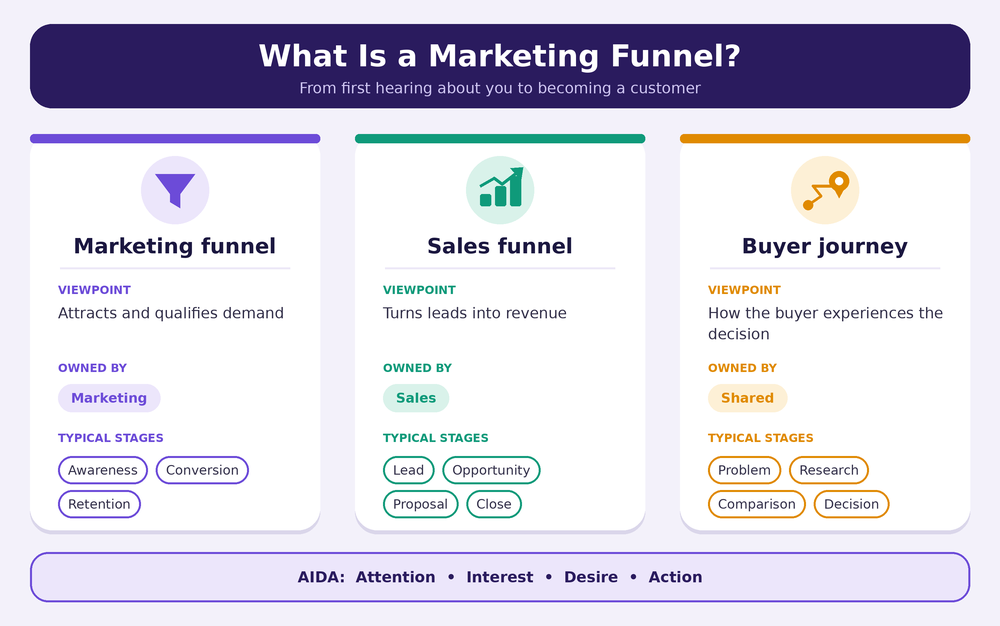
The idea traces back to the AIDA model (attention or awareness, interest, desire, action). Three related terms are often mixed up, so it helps to separate them before you plan anything.
Scale Your Business With Digital Marketing
|
Term |
Viewpoint |
Owned by |
Typical stages |
|---|---|---|---|
|
Marketing funnel |
How the company attracts and qualifies demand |
Marketing |
Awareness to conversion and retention |
|
Sales funnel |
How sales turns qualified leads into revenue |
Sales |
Lead, opportunity, proposal, close |
|
Buyer journey |
How the buyer experiences the decision |
Shared |
Problem, research, comparison, decision |
For the sales side, see our guide to the B2B sales funnel. For the buyer's view, read the buyer journey in digital marketing.
Marketing Funnel by the Numbers (2026)
The figures below show why funnel planning has changed: buyers research alone, decisions involve many people, and AI answers are reducing clicks at the top of the funnel. Each statistic comes from Gartner, Forrester, Pew Research Center, Seer Interactive or Ahrefs, with a note on what it means for your funnel.
|
Statistic |
What it means for your funnel |
Source |
|---|---|---|
|
B2B buyers spend only 17% of buying time meeting potential suppliers |
Most of the funnel runs through your content, not your sales team |
|
|
When comparing several suppliers, time with any one sales rep may be only 5% or 6% |
Your website and content must make the case without a rep |
|
|
Gartner lists six B2B buying jobs: problem identification, solution exploration, requirements building, supplier selection, validation, consensus creation |
Map MOFU and BOFU content to these jobs |
|
|
On average, 13 people are involved in a B2B buying decision (survey of 16,000+ buyers) |
Create content for each role in the buying group |
|
|
Users clicked a traditional search result in 8% of visits with an AI summary vs 15% without |
Top-of-funnel traffic is harder to earn |
|
|
Organic CTR on informational queries with AI Overviews fell from 1.76% to 0.61% (June 2024 to September 2025) |
Awareness content needs visibility metrics beyond clicks |
|
|
AI Overviews correlate with a 58% lower CTR for the top-ranking page |
Being cited in the answer matters as much as ranking |
The Marketing Funnel Stages
The marketing funnel stages are awareness, interest, consideration, conversion, and retention and advocacy. Awareness sits at the top of the funnel, interest and consideration in the middle, and conversion at the bottom, with retention and advocacy after the sale. Some models use three, four or seven stages, but they describe the same journey.
|
Funnel zone |
5-stage model |
7-stage model |
Buyer question |
|---|---|---|---|
|
TOFU (top) |
Awareness |
Awareness |
"What is this problem, and who can help?" |
|
MOFU (middle) |
Interest |
Interest |
"Is this worth looking into?" |
|
MOFU (middle) |
Consideration |
Consideration, intent |
"Which approach and which vendors fit us?" |
|
BOFU (bottom) |
Conversion |
Evaluation, purchase |
"Why this vendor, and is it safe to choose them?" |
|
Post-sale |
Retention and advocacy |
Retention and advocacy |
"Did we get value, and would we recommend them?" |
1. Awareness (TOFU)
Buyers notice a problem or opportunity and start learning. Your goal is to be found and remembered, not to sell. Educational articles, short videos, social posts and search visibility work best. Measure reach, impressions, new users and branded search growth.
2. Interest (MOFU)
Buyers want to understand their options. Guides, webinars, newsletters and comparison content help them learn and give you permission to follow up. Measure engaged sessions, return visits, email sign-ups and content downloads.
3. Consideration (MOFU)
Buyers compare approaches and build a shortlist. Case studies, product or service pages, pricing explanations, ROI calculators and expert consultations matter most. Measure marketing qualified leads (MQLs), demo or consultation requests and visits to high-intent pages.
4. Conversion (BOFU)
Buyers decide and need confidence. Proposals, references, security and compliance details, implementation plans and clear next steps reduce risk. Measure sales qualified leads (SQLs), opportunities, win rate and customer acquisition cost (CAC).
5. Retention and advocacy (post-sale)
Customers judge whether they got value. Onboarding, customer education, success reviews and community content drive renewals, expansion and referrals. Measure retention, net revenue retention, net promoter score and referrals.
Content and Channels for Each Funnel Stage
Every stage needs content that answers the buyer's question at that moment and a channel that reaches them there. Mismatches are the most common funnel problem: sales pitches at the top, or thin blog posts at the bottom. Use the table below as a starting map, then adjust it to your buyers and sales cycle.
|
Stage |
Content that works |
Main channels |
Call to action |
|---|---|---|---|
|
Awareness |
How-to and explainer articles, short video, industry trends |
Organic search, AI search, social, paid social |
Read more, subscribe |
|
Interest |
Guides, webinars, newsletters, checklists |
Email, LinkedIn, retargeting |
Download, register |
|
Consideration |
Case studies, comparisons, service pages, calculators |
Search, retargeting, ABM, email nurture |
Request a consultation or audit |
|
Conversion |
Proposals, references, security and compliance documents, pricing |
Sales, landing pages, direct email |
Book a call, start a project |
|
Retention and advocacy |
Onboarding, training, success reviews, community |
Email, customer portal, events |
Renew, refer, review |
Our guides go deeper on each part of the map: B2B content strategy from awareness to conversion, the B2B email funnel, LinkedIn ad types for B2B lead generation and sales funnel examples.
Marketing Funnel Metrics by Stage
Track two or three metrics per stage and one conversion rate between stages. Stage metrics show volume and quality, while stage-to-stage conversion rates show where prospects leak. Use your own historical data as the benchmark, because conversion rates vary widely by industry, deal size and sales cycle length.
|
Stage |
Metric |
How to calculate |
|---|---|---|
|
Awareness |
Reach and new users |
Unique people or users reached in the period |
|
Awareness |
Branded search growth |
Branded search impressions this period vs last period |
|
Interest |
Engagement rate |
Engaged sessions divided by total sessions |
|
Consideration |
Visitor-to-lead rate |
New leads divided by unique visitors |
|
Consideration |
Cost per lead (CPL) |
Marketing spend divided by new leads |
|
Conversion |
MQL-to-SQL rate |
SQLs divided by MQLs |
|
Conversion |
Win rate |
Deals won divided by opportunities closed |
|
Conversion |
Customer acquisition cost (CAC) |
Sales and marketing cost divided by new customers |
|
Retention |
Customer lifetime value (CLV) |
Average annual revenue per customer times gross margin times average customer lifespan in years |
|
Retention |
Net revenue retention |
Starting revenue plus expansion minus churn and contraction, divided by starting revenue |
For landing pages and campaign reporting, see landing page metrics to track and how Centric measures SEO success.
Get a High-Converting Landing Page
How the B2B Marketing Funnel Is Different?
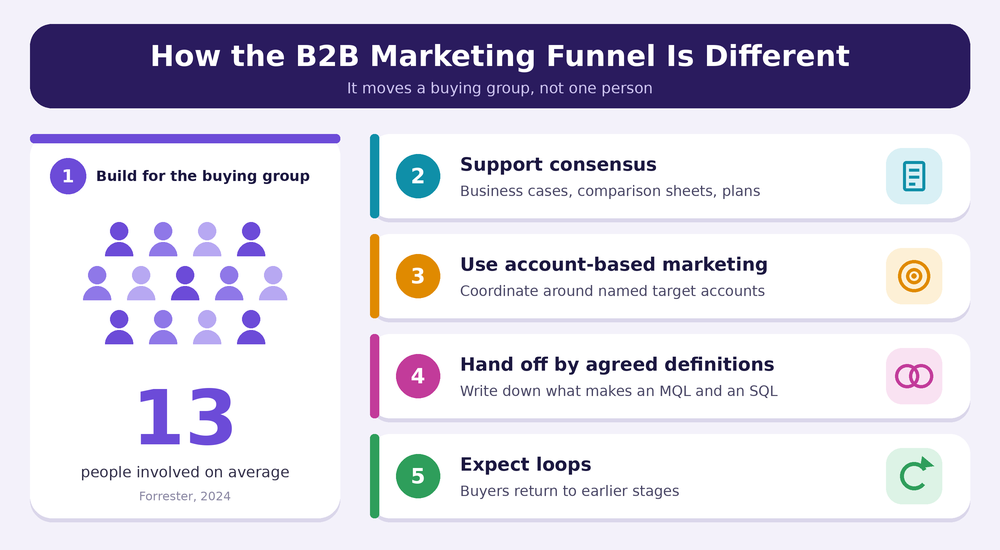
A B2B marketing funnel moves a buying group, not one person, through the stages. Gartner describes six buying jobs, from problem identification to consensus creation, and buyers move back and forth between them. Your content has to serve several roles at once and help your champion win internal agreement.
-
Build for the buying group: Forrester's 2024 study found an average of 13 people involved; give finance, IT, operations and leadership the evidence each needs.
-
Support consensus creation: Business cases, comparison sheets and implementation plans help a champion sell internally.
-
Use account-based marketing for target accounts: Coordinate ads, content and sales outreach around named accounts at the consideration stage.
-
Hand off by agreed definitions: Marketing and sales should agree in writing what makes an MQL and an SQL.
-
Expect loops: Buyers return to earlier stages when new people join or requirements change.
Read our guides to B2B demand generation strategy, B2B lead generation and the lead generation funnel for the next level of detail.
Grow Your Business With B2B Marketing
Proof: Big Tex Storage, bottom-of-funnel search
Centric moved Big Tex Storage's paid search from defending branded keywords to winning non-branded, high-intent searches, cutting branded spend from 75% to under 15% and protecting branded demand with SEO. From July 2024 to July 2025, phone leads rose 111%, online bookings rose 91% and paid search customers doubled, with a 7.5% increase in ad budget. Read the Big Tex Storage PPC case study.

How AI Search Is Changing the Top of the Funnel?
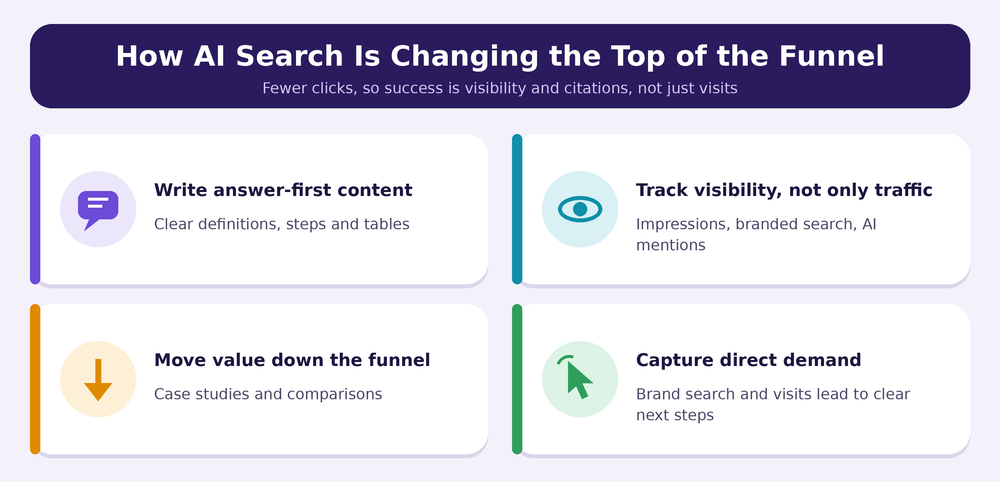
AI answers in Google and chat assistants now handle many awareness-stage questions directly, so fewer people click through. Pew found users clicked a traditional result in 8% of visits with an AI summary, compared with 15% without. Awareness content still matters, but success is now measured by visibility and citations as well as visits.
-
Write answer-first content: Clear definitions, steps and tables are easier for AI systems to cite.
-
Track visibility, not only traffic: Monitor impressions, branded search and mentions in AI answers.
-
Move value down the funnel: Put more effort into consideration content, such as case studies and comparisons, that AI summaries cannot replace.
-
Capture direct demand: Make brand search and direct visits lead to clear next steps.
Our guides on how to show up in AI Overviews and Centric SEO services cover this shift in detail.
How to Build and Audit Your Marketing Funnel?
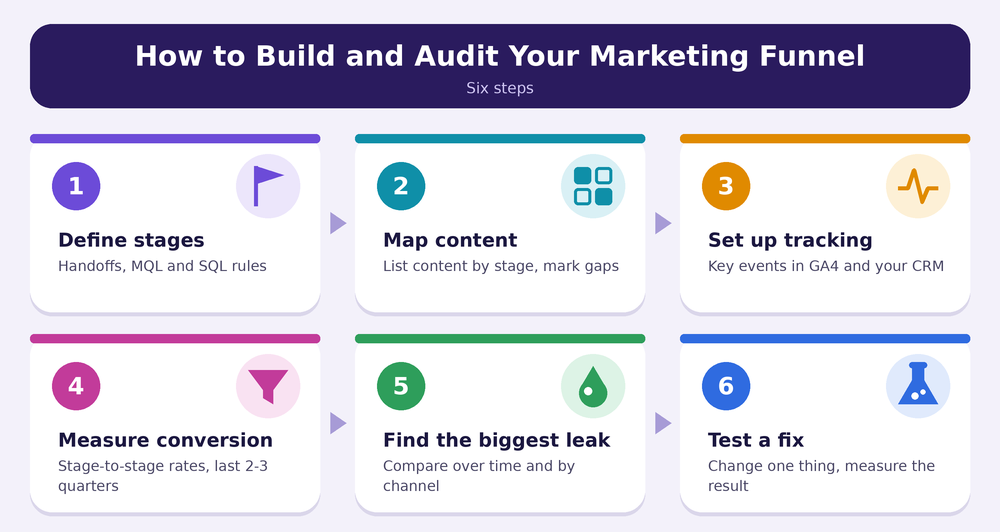
Build or audit your funnel in six steps: define stages and handoff rules, map content to each stage, set up tracking, measure stage-to-stage conversion, find the biggest leak, and test a fix. Fix one leak at a time, starting where the drop-off is largest and the fix is cheapest.
-
Define stages and handoffs: Write down what moves a prospect from one stage to the next, including MQL and SQL rules.
-
Map content to stages: List existing content by stage and mark gaps, using the content table above.
-
Set up tracking: Track key events in GA4 and stages in your CRM. Google describes GA4 funnel exploration as a way to "visualize the steps your users take to complete a task."
-
Measure conversion between stages: Calculate each stage-to-stage rate for the last two or three quarters.
-
Find the biggest leak: Compare rates over time and by channel to find where prospects drop off most.
-
Test a fix: Change one thing, such as a landing page, offer or nurture email, and measure the result.
For tools and testing, see our marketing automation tools roundup, A/B testing for landing pages and our conversion funnel optimization guide.
Common Funnel Mistakes
Most funnels fail for a handful of reasons: they stop at the sale, push sales messages too early, measure only traffic, ignore the buying group, or never agree on handoffs. The table lists each mistake, why it hurts and what to do instead, so you can check your own funnel against it.
|
Mistake |
Why it hurts |
What to do instead |
|---|---|---|
|
Selling at the awareness stage |
Buyers are still learning and leave |
Teach first; offer a next step, not a pitch |
|
Thin content at the bottom |
Buyers cannot justify the decision internally |
Publish case studies, comparisons and implementation detail |
|
Measuring only traffic |
AI answers reduce clicks even when visibility grows |
Track visibility, leads and stage conversion |
|
Writing for one persona |
Other buying group members block the deal |
Create content for each role |
|
No agreed MQL and SQL rules |
Leads stall between marketing and sales |
Agree definitions and service levels in writing |
|
Stopping at the sale |
Retention and referrals are lost |
Plan onboarding, success and advocacy content |
Marketing Funnel Checklist
Use this checklist when you build a new funnel or review an existing one each quarter. It covers stage definitions, content coverage, channels, tracking, handoffs and post-sale stages, so every part of the funnel has an owner, a metric and a next step for the buyer.
-
Stages and handoff rules written down.
-
MQL and SQL definitions agreed with sales.
-
At least one strong content asset for every stage.
-
Content for each role in the buying group.
-
Clear call to action on every page and email.
-
Key events tracked in GA4 and stages tracked in the CRM.
-
Stage-to-stage conversion rates reported monthly.
-
Visibility and AI citations tracked alongside traffic.
-
One funnel test running at a time.
-
Onboarding, retention and referral content in place.
Frequently Asked Questions
What are the marketing funnel stages?
The marketing funnel stages are awareness, interest, consideration, conversion, and retention and advocacy. Awareness is the top of the funnel, interest and consideration are the middle, and conversion is the bottom. Retention and advocacy follow the sale and turn customers into repeat buyers and referrers.
What are TOFU, MOFU and BOFU?
TOFU, MOFU and BOFU stand for top, middle and bottom of the funnel. TOFU covers awareness, where buyers learn about a problem. MOFU covers interest and consideration, where they compare options. BOFU covers conversion, where they choose a vendor. Each zone needs different content, channels and metrics.
What are the 5 stages of the marketing funnel?
A common five-stage model is awareness, interest, consideration, conversion, and retention and advocacy. Other versions use four stages (awareness, consideration, conversion, loyalty) or seven stages that split consideration and conversion into intent, evaluation and purchase. Choose one model and use it consistently across marketing and sales.
What is the difference between a marketing funnel and a sales funnel?
A marketing funnel describes how a company attracts and qualifies demand, from awareness to a qualified lead and beyond. A sales funnel describes how sales turns qualified leads into revenue through opportunities, proposals and closing. In B2B the two connect at the MQL to SQL handoff.
Which metrics should I track at each funnel stage?
Track reach and branded search at awareness, engagement and sign-ups at interest, leads and cost per lead at consideration, MQL-to-SQL rate, win rate and acquisition cost at conversion, and retention and lifetime value after the sale. Also track the conversion rate between each pair of stages.
How is a B2B marketing funnel different from B2C?
A B2B funnel serves a buying group rather than one buyer. Forrester found an average of 13 people involved in a B2B buying decision, and Gartner says buyers spend only 17% of buying time with suppliers. B2B content must support research, internal consensus and risk checks across several roles.
Is the marketing funnel still relevant with AI search?
Yes, but the top of the funnel is changing. AI answers resolve many early questions without a click, so awareness content should be easy to cite and measured by visibility as well as traffic. Middle and bottom-of-funnel content, such as case studies and comparisons, becomes more important.
Final Thoughts
Marketing funnel stages give your team a shared map: what buyers need at each step, what to publish, where to promote it and how to measure progress. Define the stages, map content and metrics to each, plan for buying groups and AI search, and fix the biggest leak first, one test at a time. Centric create a journey that converts efficiently and strengthens brand loyalty. The real power of mastering marketing funnel stages lies in building meaningful connections that drive both immediate results and sustainable growth.
Centric supports each funnel stage through SEO and content marketing for awareness and consideration, performance marketing and landing pages for conversion, and email and account-based marketing for retention. Its teams also work on the measurement side, tracking conversion rates, cost per acquisition and channel performance so funnel decisions rest on data