



Oil and gas lead generation is the process of attracting, qualifying and converting buyers such as operators, EPC contractors and procurement teams into sales opportunities. The strategies that work best combine a defined target account list, technical content and SEO, LinkedIn and compliant email outreach, trade shows, and a nurture process built for long, multi-stakeholder sales cycles.
Key Takeaways
-
67% of B2B buyers prefer a rep-free buying experience (Gartner, 2026), so oil and gas suppliers must be found and trusted before the first sales call.
-
Buyers make first contact with sellers 61% of the way through their journey, and the first vendor contacted wins 77% of the time (6sense, 2025).
-
An average of 13 people are involved in a B2B buying decision (Forrester, 2024), so lead generation must reach engineers, procurement and executives, not one contact.
-
Trade shows still matter: OTC 2026 in Houston drew nearly 25,000 attendees and nearly 1,000 exhibiting companies (OTC, 2026).
-
Email outreach in the US must follow CAN-SPAM, which makes no exception for B2B email and allows penalties of up to $53,088 per violating email (FTC).
-
Measure pipeline and sales-accepted leads by segment, not form fills alone.
In this guide
-
What is oil and gas lead generation?
-
Oil and gas lead generation by the numbers (2026)
-
Who buys in oil and gas?
-
9 lead generation strategies for oil and gas companies
-
Which lead generation channels work best for oil and gas?
-
A 90-day oil and gas lead generation plan
-
How do you measure oil and gas lead generation?
-
Common mistakes to avoid
-
Oil and gas lead generation checklist
-
Frequently asked questions
US crude oil production averaged a record 13.6 million barrels per day in 2025, according to the U.S. Energy Information Administration (2026). High activity does not make selling easier. Gartner found that 67% of B2B buyers now prefer a rep-free buying experience (Gartner, 20, so suppliers that rely only on relationships and cold calls miss buyers who research on their own.
The guide below is written for oilfield service companies, equipment manufacturers, EPC contractors and technology providers that sell to operators. It explains who buys, nine strategies that generate qualified leads, a channel comparison, a 90-day plan, the metrics to track, and the compliance rules that apply to outreach in the US.
What Is Oil and Gas Lead Generation?
Oil and gas lead generation is the work of finding companies and people who are likely to buy your products or services, earning their attention, and turning that interest into qualified sales conversations. In this sector, a lead is usually an account with several stakeholders, a defined project or need, and a procurement process.
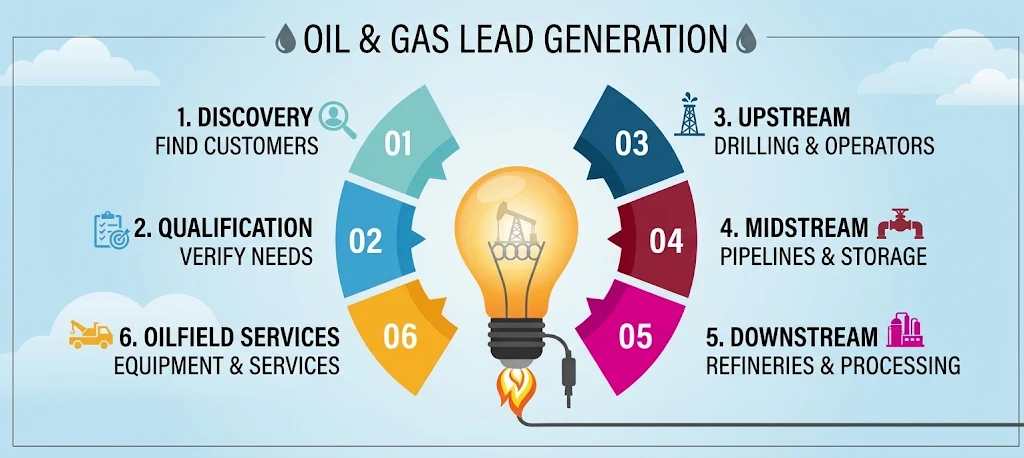
Most oil and gas suppliers sell into one or more of the industry's segments, and each segment buys differently:
|
Segment |
Typical buyers |
What they often buy |
|---|---|---|
|
Upstream |
Operators, drilling and completions teams, HSE |
Drilling, completions, well services, equipment, inspection, data and software |
|
Midstream |
Pipeline, storage and processing operators |
Integrity management, compression, monitoring, maintenance, engineering |
|
Downstream |
Refiners, petrochemical plants, distributors |
Turnaround services, process equipment, automation, safety, logistics |
|
Oilfield services and supply chain |
Service companies, EPC contractors, distributors |
Components, subcontracted services, rentals, software, marketing |
For a primer on the middle segment, see our guide to midstream oil and gas. For the general model behind lead generation, read what B2B lead generation is.
Oil and Gas Lead Generation by the Numbers (2026)
The figures below show how B2B buyers research and decide, how large the buying group is, what trade shows still deliver, and which rules govern outreach. Buyer data comes from Gartner, 6sense and Forrester, industry data from the EIA and OTC, and compliance rules from the FTC and Google.
|
Statistic |
What it means |
Source |
|---|---|---|
|
US crude oil production averaged a record 13.6 million b/d in 2025 |
The US market remains large and active for suppliers |
|
|
67% of B2B buyers prefer a rep-free buying experience (646 buyers surveyed) |
Your website and content must answer questions before sales does |
|
|
45% of B2B buyers used generative AI during a recent purchase |
Clear, factual pages help AI tools describe your offer correctly |
|
|
69% of B2B buyers prefer to validate AI-generated insights with sales reps |
Sales still matters once buyers have shortlisted vendors |
|
|
Buyers first contact sellers 61% of the way through the buying journey |
Most research happens before a lead form is filled in |
|
|
The first vendor buyers contact wins 77% of the time |
Being on the shortlist early decides most deals |
|
|
13 people are involved in a buying decision on average; 89% of purchases involve two or more departments |
Target buying groups, not single contacts |
|
|
Nearly 25,000 attendees and nearly 1,000 exhibitors at OTC Houston 2026 |
Major events concentrate buyers in one place |
|
|
Up to $53,088 in penalties per email that violates CAN-SPAM |
B2B outreach needs opt-out, address and honest headers |
Who Buys in Oil and Gas?
Oil and gas purchases are made by buying groups, not individuals. Engineers judge technical fit, HSE teams judge risk, procurement manages vendor approval and price, and executives approve budgets. Effective lead generation gives each role the evidence it needs, in the format it prefers, at the stage it is in.
|
Role |
What they care about |
Content that works |
|---|---|---|
|
Engineers and technical managers |
Performance, specifications, compatibility, field proof |
Technical data sheets, case studies, application notes, webinars |
|
Operations and field leaders |
Uptime, response time, ease of deployment |
Short videos, deployment timelines, service coverage maps |
|
HSE and compliance |
Safety record, certifications, standards |
Certification lists, safety documentation, compliance pages |
|
Procurement and supply chain |
Vendor approval, pricing structure, terms, references |
Capability statements, pre-qualification documents, references |
|
Executives |
Cost, risk, return and strategic fit |
Business cases, ROI explanations, executive summaries |
9 Lead Generation Strategies for Oil and Gas Companies
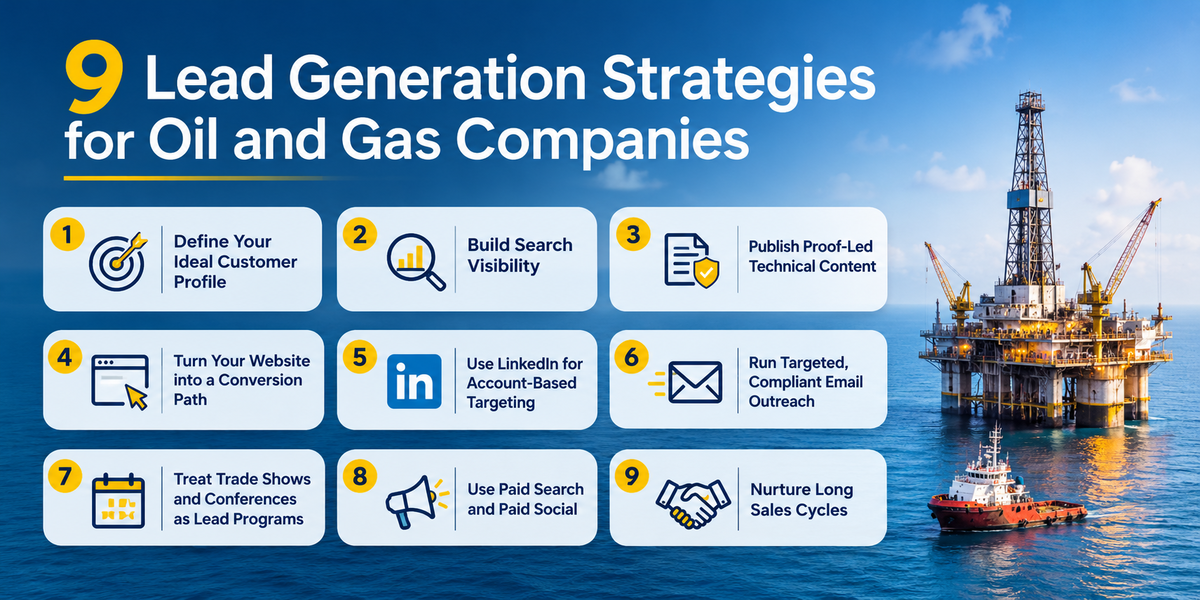
The nine strategies below cover the full path from choosing target accounts to closing deals. Start with strategies 1 and 4, which make every other channel more effective, then add the channels that match where your buyers research, meet suppliers and make decisions in your segment and region.
Strategy 1: Define your ideal customer profile and target accounts
List the segments, company types, regions, asset types and project triggers that match your best past deals. Then build a named account list and map the buying group at each account.
-
Score accounts on fit (segment, size, region) and timing (new projects, permits, expansions, leadership changes).
-
Map at least three roles per account: technical, procurement and executive.
-
Keep the list in your CRM so marketing and sales work from the same accounts.
Strategy 2: Build search visibility for technical, high-intent queries
Engineers and buyers search for specific problems, products and standards. Pages that answer those searches clearly bring in leads who already have a need.
-
Create one page per service, product line and application, using the terms buyers use.
-
Answer the main question in the first lines of each page so search engines and AI tools can quote it.
-
Add location pages for the basins and regions you serve.
Our guide to SEO strategies for oil and gas companies covers keyword research, technical SEO and AI search in detail.
Strategy 3: Publish proof-led technical content
Oil and gas buyers trust evidence over claims. Case studies with measurable results, application notes and technical comparisons do more than general blog posts.
-
Write case studies with the problem, the asset or site type, what you did and the measured result.
-
Turn sales questions into articles, FAQs and short videos.
-
Gate only high-value assets such as detailed guides or calculators; keep case studies and specifications open.
Strategy 4: Turn your website into a conversion path
A website that explains services but offers no clear next step loses leads. Every service page needs one primary call to action, proof near that call to action, and a short form.
-
Use specific CTA labels such as "Request a site assessment" instead of "Submit".
-
Keep forms short: name, work email, company and the need.
-
Place a relevant case study or certification next to each form.
Centric Promethean Energy case study shows the effect of this approach for an upstream company: after the websites were merged and the user journey was rebuilt, the case study reports a 38% improvement in conversion rates and a 300% increase in traffic.
Strategy 5: Use LinkedIn for account-based targeting
LinkedIn lets you reach people by company, job title, function and seniority, which suits buying groups at named accounts. Pair company page content with employee posts and targeted ads.
-
Run ads to your target account list, split by role (technical vs procurement vs executive).
-
Share case studies and field results from team members, not only the company page.
-
Follow up content engagement with relevant, personal outreach.
See our guide to LinkedIn ad types for B2B lead generation, or Centric account-based marketing services.
Strategy 6: Run targeted, compliant email outreach
Email works when it is relevant to one account and one problem, and when it follows the rules. In the US, CAN-SPAM "makes no exception for business-to-business email" (FTC).
-
Include a valid physical postal address and a clear way to opt out, and honor opt-outs within 10 business days, as the FTC requires.
-
Use honest subject lines and sender details.
-
Authenticate your domain. Google requires bulk senders of more than 5,000 messages a day to Gmail to set up SPF, DKIM and DMARC, offer one-click unsubscribe and keep spam rates below 0.3% (Google).
-
Reference a specific trigger, such as a new project, a facility expansion or an event, in the first line.
Centric B2B email marketing services cover list strategy, sequences and deliverability.

Strategy 7: Treat trade shows and conferences as lead programs
Events such as OTC in Houston bring operators, contractors and suppliers together in one place. OTC 2026 reported nearly 25,000 attendees and professionals from more than 100 countries (OTC, 2026). The leads come from the work done before and after the show.
-
Before: pick target accounts attending, book meetings in advance, and promote your booth or talk.
-
During: log every conversation in your CRM with the need, role and next step.
-
After: follow up within days with the content or proposal you promised.
Strategy 8: Use paid search and paid social for high-intent demand
Paid search captures people already searching for a service. Bid on specific service and product terms, send clicks to matching landing pages, and exclude job seekers and irrelevant searches.
-
Group campaigns by service and region.
-
Build one landing page per campaign with one call to action.
-
Retarget visitors who viewed service pages or downloaded content.
Centric performance marketing services manage paid search and paid social for B2B companies.
Strategy 9: Nurture long sales cycles and align sales with marketing
Capital projects move slowly, so many good leads are not ready to buy today. A nurture process keeps you on the shortlist until a project is approved.
-
Agree a shared definition of a marketing-qualified and sales-accepted lead.
-
Send role-based content sequences over weeks and months, not days.
-
Score leads on fit and engagement, and route hot leads to sales quickly.
-
Review lost and stalled deals each quarter to improve targeting and content.
Read more about structuring this process in our lead generation funnel guide.
Which Lead Generation Channels Work Best for Oil and Gas?
The best channels depend on your segment and sales cycle, but most oil and gas suppliers combine search, content, LinkedIn, email and events. The table compares each channel by what it does best, how quickly it usually produces results, and the metric that shows whether it is working.
|
Channel |
Best for |
Speed |
Key metric |
|---|---|---|---|
|
SEO and AI search |
Buyers researching problems and suppliers |
Slower to build; compounds over time |
Organic leads and rankings for service terms |
|
Technical content and case studies |
Building trust across the buying group |
Medium |
Content-assisted opportunities |
|
LinkedIn (organic and ads) |
Reaching named accounts and specific roles |
Medium |
Engagement and meetings at target accounts |
|
Targeted email outreach |
Starting conversations tied to a trigger |
Fast |
Positive reply rate and meetings booked |
|
Trade shows and conferences |
Face-to-face meetings with many buyers |
Fast around event dates |
Meetings held and opportunities created |
|
Paid search |
Capturing active demand for a service |
Fast |
Cost per qualified lead |
|
Nurture and CRM |
Converting leads over long cycles |
Ongoing |
Lead-to-opportunity conversion rate |
A 90-Day Oil and Gas Lead Generation Plan
A 90-day plan turns the strategies into a sequence a small team can follow. The first month builds the foundation, the second launches channels, and the third measures results and doubles down on what produces sales-accepted leads in your segment.
|
Phase |
Focus |
Outputs |
|---|---|---|
|
Days 1 to 30 |
Foundation |
ICP and target account list, buying group map, CRM fields, conversion fixes on top service pages, tracking set up |
|
Days 31 to 60 |
Launch |
Two case studies, LinkedIn campaign to target accounts, first email sequence, event meeting plan, paid search on top services |
|
Days 61 to 90 |
Measure and scale |
Channel report by segment, lead scoring rules, nurture sequence, next quarter content plan |
How Do You Measure Oil and Gas Lead Generation?
Measure oil and gas lead generation by pipeline, not volume. Track how many qualified leads each channel produces, how many become sales-accepted opportunities, and how much pipeline and revenue they create. Review the numbers by segment and region every month, and adjust targeting and content based on what converts.
|
Metric |
What it shows |
|---|---|
|
Engaged target accounts |
Whether you are reaching the right companies |
|
Marketing-qualified leads by channel |
Which channels bring in leads that fit |
|
Sales-accepted leads |
Whether sales agrees the leads are worth pursuing |
|
Meetings booked |
How well outreach and events start conversations |
|
Lead-to-opportunity rate |
How well nurture and qualification work |
|
Pipeline value and win rate by source |
Which channels produce revenue |
Lead generation tools help with data, outreach and tracking; our roundup of lead generation tools compares common options.
Common Mistakes to Avoid
Most weak oil and gas lead generation programs share the same problems: broad targeting, generic messaging, no follow-up after events, and outreach that ignores email rules. The table lists the most common mistakes, why each one hurts, and what to do instead, so you can check your own program.
|
Mistake |
Why it hurts |
What to do instead |
|---|---|---|
|
Targeting "the oil and gas industry" as one market |
Upstream, midstream and downstream buyers have different needs |
Build messages and lists by segment and role |
|
Reaching one contact per account |
An average of 13 people are involved in B2B buying decisions |
Map and reach the whole buying group |
|
Generic emails sent at volume |
Low replies, spam complaints and CAN-SPAM risk |
Send fewer, trigger-based emails with opt-out and address |
|
No follow-up after trade shows |
Booth conversations go cold |
Log every contact and follow up within days |
|
Gating every asset |
Buyers who prefer rep-free research leave |
Keep proof open; gate only high-value tools |
|
Measuring leads, not pipeline |
Channels that look busy may produce no revenue |
Track sales-accepted leads, pipeline and win rate |
Oil and Gas Lead Generation Checklist
Use this checklist to review your lead generation program before the next quarter or event season. Each item reflects a step in the strategies above, from targeting and website conversion to outreach compliance, event follow-up and measurement, so gaps are easy to spot and assign to an owner.
-
Define the ICP by segment, region and project trigger.
-
Build a named target account list in the CRM.
-
Map technical, procurement and executive contacts per account.
-
Give every service page one clear CTA, a short form and nearby proof.
-
Publish at least one measurable case study per core service.
-
Authenticate email (SPF, DKIM, DMARC) and include opt-out and postal address.
-
Plan pre-show meetings and post-show follow-up for each event.
-
Agree MQL and SAL definitions with sales.
-
Track pipeline and win rate by channel and segment.
Frequently Asked Questions
What is lead generation in the oil and gas industry?
Lead generation in oil and gas is the process of attracting and qualifying companies and people who may buy your products or services, such as operators, EPC contractors and procurement teams. It combines targeting, content, search, LinkedIn, email, events and nurturing to turn interest into qualified sales conversations.
How do oil and gas companies get new clients?
Oil and gas suppliers win new clients by targeting the right accounts, showing proof of results, and reaching the full buying group. The most common channels are referrals and existing relationships, trade shows, technical content and SEO, LinkedIn, targeted email outreach and paid search for high-intent service terms.
What is the best lead generation channel for oilfield services?
No single channel is best for every oilfield services company. Many combine search visibility for service and location terms, LinkedIn targeting of operators in their basins, trade shows, and targeted email tied to project triggers. Track pipeline by channel for one or two quarters, then invest in what converts.
Should oil and gas companies buy email lists?
Purchased lists often contain outdated or irrelevant contacts, which lowers replies and raises spam complaints. Any commercial email in the US must still follow CAN-SPAM, including opt-out and postal address rules. A smaller, researched list of named accounts and verified contacts usually performs better and carries less risk.
How long does oil and gas lead generation take to show results?
Outreach, events and paid search can create meetings within weeks, while SEO and content take longer to build. Because oil and gas sales cycles are long and involve many stakeholders, judge programs on qualified opportunities and pipeline over several quarters rather than on lead volume in the first month.
Is LinkedIn effective for oil and gas lead generation?
LinkedIn suits oil and gas lead generation because it lets you reach people by company, job title, function and seniority. That fits account-based targeting of operators and contractors. Results improve when company content, employee posts, targeted ads and personal follow-up work together around the same target accounts.
How do you qualify oil and gas leads?
Qualify oil and gas leads on fit and timing. Check whether the company matches your segment, region and asset types, whether there is an active project or need, who the decision-makers are, and whether budget and procurement steps are known. Agree these criteria with sales so qualified leads are accepted and followed up.
Final Thoughts
Oil and gas lead generation works when it matches how buyers now behave: they research on their own, decide in groups and shortlist early. Define your target accounts, make your website convert, publish proof, reach buying groups through search, LinkedIn, email and events, and measure pipeline by segment. Small, consistent programs beat broad campaigns. Centric provides B2B marketing services for oil, gas and renewables companies, including SEO, account-based marketing, LinkedIn and email programs, and website conversion work. Its Promethean Energy project, where the user journey was rebuilt after merging several websites, reflects the website and buying-journey focus described above. This industry experience is why Centric builds lead generation around buying groups and pipeline measurement rather than lead volume alone.