





What is local SEO, and why is it crucial for small and medium businesses?
Local SEO (Search Engine Optimization) is a strategy that helps businesses optimize their online presence to appear in local search results.
By focusing on location-specific keywords and optimizing various aspects of your website and online presence, local SEO ensures your business ranks higher for local searches.
For small and medium businesses, local SEO is essential because it increases visibility to customers in your area who are actively searching for products or services like yours.
Without proper local SEO, even the best products or services may remain unnoticed by potential customers in your region.
In this blog, we’ll guide you on how to improve local SEO for your small or medium business. You’ll learn actionable tips to enhance your local search visibility, improve your Google Business Profile, and attract more local customers.
What is Local SEO and Why Does It Matter?
Local SEO (Search Engine Optimization) is a digital marketing strategy that helps businesses optimize their online presence to attract customers in their geographic area.0
Unlike general SEO, which focuses on broad search rankings, local SEO is specifically designed to improve a business’s visibility in local search results.
This includes optimizing for location-based queries, such as “restaurants near me” or “plumbers in [city name].”
The role of local SEO is crucial for driving nearby customers to your business. When people search for products or services in their area, they want relevant and timely results.
By optimizing your website, Google Business Profile, and local listings, local SEO ensures that your business appears in front of these potential customers at the right time.
This is especially important for small and medium businesses that depend on local foot traffic or service areas.
The impact of local SEO on revenue and visibility is significant. When a business appears in local search results, it’s more likely to gain the trust of local customers and drive them to make a purchase or visit.
Optimizing for local SEO not only boosts visibility but also improves conversions, leading to higher sales and an increase in overall revenue. It’s a powerful tool for businesses looking to grow and succeed in their local market.
Explore How To Do Local SEO?
6 Steps to Improve Local SEO Performance
Improving your local SEO performance is essential for attracting nearby customers and boosting your business visibility in local search results.
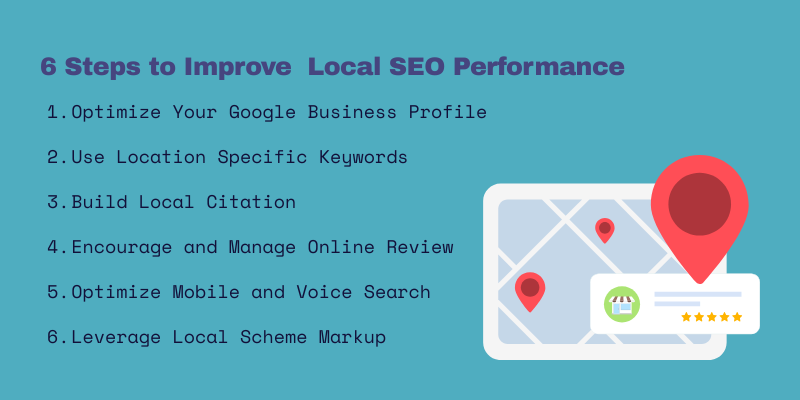
Here are 6 steps to enhance your local SEO performance:
-
Optimize Your Google Business Profile
-
Use Location-Specific Keywords
-
Build Local Citations and Get Listed on Local Directories
-
Encourage and Manage Online Reviews
-
Optimize mobile and voice search
-
Leverage Local Scheme Markup
By following these steps, you can improve your search engine rankings, attract more local customers, and drive increased revenue.
1. Optimize Your Google Business Profile
Your Google Business Profile is a critical component of your local SEO strategy. It helps you show up in local search results and enhances your online presence.
Optimizing your profile ensures that potential customers can easily find and contact you.
Here are some key steps to fully optimize your Google Business Profile:
-
Claim and Verify Your Profile
The first step is to claim and verify your Google Business Profile. This process confirms that you are the legitimate owner of your business, enabling you to control your information and make updates. Verification is typically done through a postcard sent to your business address with a code or by phone or email, depending on your business type.
-
Add Accurate NAP (Name, Address, Phone) Information
Ensure that your NAP (Name, Address, Phone) information is consistent and accurate across your Google Business Profile. This information must match exactly what is on your website and other online listings. Consistency in NAP helps search engines trust your business data, which can improve local search rankings and visibility.
-
Upload High-Quality Images and Regular Posts
Visuals are essential for engaging customers. Upload high-quality images of your business, products, services, or any relevant content. Regularly post updates, offers, or news on your Google Business Profile to keep your customers informed and engaged. Active profiles with regular posts are more likely to show up in local search results, helping drive more traffic to your business
2. Use Local Keywords Strategically
Using local keywords strategically is crucial for improving visibility in location-based searches. Local keywords help search engines understand your business location and services, attracting customers nearby.
Here's how to use them effectively:
-
Conduct Local Keyword Research: Use best SEO tools like Google Keyword Planner, Ahrefs, or Ubersuggest to find location-specific keywords, combining your product/service with your location (e.g., “best Oil Gas and Renewables in USA”).
-
Add Keywords to Meta Titles, Descriptions, and Content: Integrate local keywords into meta titles, meta descriptions, and website content to help search engines associate your site with specific locations, boosting click-through rates.
-
Create Location-Specific Landing Pages: For businesses in multiple regions, create landing pages with localized keywords and content (e.g., “Car Repair in Dammam”), improving local search rankings and customer reach.
Explore Our Local SEO Services!
3. Build Local Citations and Backlinks
Building local citations and backlinks is essential for improving your local SEO and increasing your business’s visibility in local search results.
Citations help search engines verify your business details, while link building from reputable local sources enhance your site’s authority.
Here’s how to effectively build local citations and backlinks:
-
Get Listed on Local Directories
Being listed on local directories is a key step in building citations for your business. Directories like Yelp, Yellow Pages, and local chamber of commerce websites provide valuable backlinks and help search engines understand your business’s location and relevance.
Ensure that your business details, including your NAP (Name, Address, Phone number), are consistent across all directories. This consistency boosts your local SEO and helps establish trust with both search engines and potential customers.
-
Collaborate With Local Influencers or Blogs
Another effective way to build backlinks is by collaborating with local influencers or bloggers. Reach out to local influencers in your niche or area and offer them something of value in exchange for a mention or link to your website.
Additionally, guest blogging or getting featured on local blogs that are relevant to your industry can help you acquire high-quality backlinks. These backlinks not only improve your local search rankings but also increase your business’s credibility and visibility within the local community.
Explore How to Find Backlinks? & How To Get Backlinks?
4. Encourage and Manage Online Reviews
Online reviews are a powerful tool for improving local SEO and building trust with potential customers. Positive reviews not only enhance your reputation but also contribute to higher rankings in local search results.
Here are some key strategies for effectively encouraging and managing your online reviews:
-
Ask Satisfied Customers for Reviews
After a positive interaction or purchase, encourage satisfied customers to leave reviews on platforms like Google, Yelp, or Facebook.
Request reviews via email, social media, or directly in person, and make it easy by providing links or clear instructions on where and how they can leave a review. More reviews help improve your local search visibility and reputation.
-
Respond Professionally to All Reviews
Whether positive or negative, always respond to reviews professionally. Show appreciation for positive feedback to build customer loyalty. For negative reviews, stay calm, address the customer's concerns, and offer solutions if possible.
A timely, respectful response can turn a dissatisfied customer into a loyal one and demonstrate your commitment to customer satisfaction.

5. Optimize for Mobile and Voice Search
As mobile and voice search become increasingly popular, optimizing your website for these platforms is crucial for improving user experience and local SEO performance.
Here’s how you can optimize for both:
-
Ensure Mobile-Friendly Website Design
With more people using smartphones to search for local businesses, having a mobile-friendly website is essential for local SEO. Google prioritizes mobile-first indexing, meaning your website’s mobile version is considered the primary version for ranking purposes.
Ensure your website is responsive, meaning it adjusts to different screen sizes and offers a seamless experience across devices.
Focus on fast loading times, easy navigation, and clear calls to action. A mobile-optimized website not only improves your rankings but also enhances user experience, which can lead to higher conversion rates and customer satisfaction.
-
Use Conversational Keywords for Voice Search
Voice search is gaining traction as more people use voice assistants like Siri, Google Assistant, and Alexa to perform local searches. To optimize for voice search, use conversational keywords that mimic natural speech patterns.
For example, instead of targeting keywords like "best pizza near me," focus on phrases like "where can I find the best pizza near me?" This shift in Keyword research strategy can help you rank for voice search queries, which are often longer and more question-based. By optimizing for voice search, you can capture customers using these platforms to find local businesses.
6. Leverage Local Schema Markup
Structured data, or schema markup, helps search engines better understand your business and its location, ultimately improving your local SEO performance.
It provides search engines with additional information, such as your address, business hours, phone number, and the services you offer.
This data is presented in a standardized format that search engines can easily process and interpret, making your business more visible in local search results.
These snippets can include details such as your business location, customer ratings, and hours of operation, which enhance your visibility and appeal to potential local customers.
Here are the key benefits of using local schema markup:
-
Improves Local Rankings: Helps your business rank better in local search results by providing search engines with clear location-based information.
-
Increases Visibility: Appears in local search features like Google’s local pack, knowledge panels, and featured snippets.
-
Enhances User Experience: Displays your business’s essential details (location, contact info, hours) directly in search results, improving the likelihood of user engagement.
-
Boosts Click-Through Rates (CTR): More visible, informative search results lead to higher CTRs, driving more relevant traffic to your site.
By implementing local schema markup on your website, you make it easier for search engines like Google to display key business information directly in search results, often in the form of rich snippets.
7 Best Ways To Track and Measure Local SEO Performance
Tracking and measuring local SEO performance is crucial for understanding how well your business ranks in local searches and identifying areas for improvement.
Local SEO tools help monitor visibility, keyword rankings, and online reputation, ensuring your business stays competitive in local search results.
1. Set Up and Optimize Google My Business (GMB)
Claim your GMB listing and ensure all business details (name, address, phone number, hours, and categories) are accurate.
2. Monitor Local Keyword Rankings
Use tools like SEMrush, Ahrefs, or BrightLocal to track where your website ranks for local keywords (e.g., “best coffee shop near me”).
3. Track Website Traffic with Google Analytics
Go to Acquisition → Source/Medium to analyze visits from “google / organic.” Filter by location to see where your visitors come from.
4. Analyze Google Search Console Data:
Identify which search queries bring local users to your website. Review impressions, clicks, and click-through rates for local keywords.
5. Monitor Reviews and Ratings:
Keep an eye on customer feedback on GMB, Yelp, and Facebook. Respond to reviews promptly, as engagement affects local ranking and reputation.
6. Track Local Backlinks and Citations:
Tools like Moz Local and Whitespark can help track citations (mentions of your business name and address). Ensure NAP (Name, Address, Phone number) consistency across all directories.
7. Measure Conversions
Set up goals in Google Analytics (calls, form submissions, bookings) to measure how local visitors convert into customers.
By regularly tracking these metrics, you can see which strategies improve your visibility in local searches and refine your SEO efforts to drive more local leads.
Explore Best SEO Tools for Keyword Ranking Reports & Best SEO Reporting Software
Conclusion
Understanding how to improve local SEO is a powerful strategy that can significantly boost your business's visibility and attract nearby customers. By optimizing your Google Business Profile, using location-specific keywords, building local citations, encouraging customer reviews, ensuring mobile optimization, and leveraging structured data, you can enhance your local search rankings.
To keep improving your local SEO, it’s essential to track and measure performance regularly. Using tools like Google Search Console and Google Analytics helps you understand your website's traffic and keyword performance, while monitoring local rankings and customer actions ensures you're meeting your business goals. Remember, how to improve local SEO is an ongoing process. Consistent optimization and monitoring are key to staying ahead of the competition and ensuring that your business continues to appear in front of the right local audience.
Keep refining your seo strategy with Centric & stay updated with SEO trends, and watch your business grow in local search results.