





Ever looked at your organic traffic and wondered, “Where is this actually heading?” You’re not alone. SEO results take time, and guessing future performance can feel stressful, especially when budgets, content plans, and expectations depend on it. That’s exactly where forecasting SEO traffic comes in.
SEO traffic forecasting is the process of estimating how much organic traffic your website is likely to receive in the future. It uses signals like historical performance, keyword rankings, search demand, and trend patterns to give you a realistic picture of what’s ahead. Instead of reacting after traffic drops or spikes, you get the chance to plan in advance.
In digital marketing, clarity matters. When you know which keywords are likely to grow, which pages can bring consistent visits, and where traffic may slow down, decision-making becomes easier. You can plan content with purpose, set achievable goals, and align SEO efforts with business priorities.
Over time, this leads to better rankings, stronger click-through rates, and improved ROI from organic search.
In this blog, we’ll break down how SEO traffic forecasting works, the key metrics you should track, common challenges marketers face, and the tools and strategies that can help you create more reliable forecasts, without overcomplicating the process.
What is SEO Traffic Forecasting?
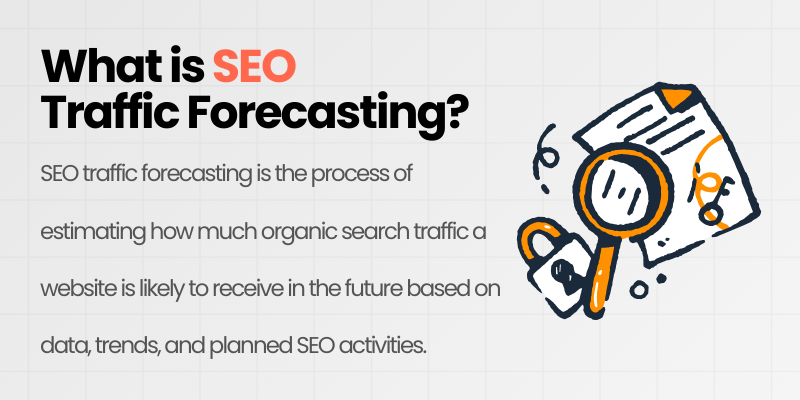
SEO traffic forecasting is the process of estimating how much organic search traffic a website is likely to receive in the future based on data, trends, and planned SEO activities.
It uses historical patterns and statistical insights to estimate how changes in your SEO efforts might impact future search visibility, traffic, and related metrics. To improve accuracy, Google keyword ranking plays a critical role in understanding where your website stands and predicting how SEO efforts can impact rankings and traffic.
SEO forecasting isn’t about exact predictions; rather, it gives you a data-informed direction for future traffic and ranking trends based on patterns you’re already seeing.
Why Forecasting SEO Matters More Than Ever?
A strong SEO forecast does more than estimate future traffic, it builds confidence and trust. When you can clearly show, for example, that a proposed SEO initiative could drive a 20% increase in organic traffic, the conversation changes. You’re no longer talking in possibilities. You’re setting clear expectations supported by data. For the best insights, using the best SEO reporting software helps track these changes and project future growth with confidence.
That level of clarity makes a real difference. It helps secure leadership buy-in, unlocks budgets, and brings marketing, content, and growth teams onto the same page with shared, measurable goals.
But the value of forecasting goes beyond credibility. Today, it’s a necessity.
Search is changing rapidly. With search generative experiences (SGE) and AI-powered answers taking up more space in the SERPs, organic visibility is under pressure. Early research suggests these AI-driven results can reduce organic click-through rates by 15–35%, even for well-ranking pages.
In this environment, SEO forecasting becomes a strategic advantage. By modeling different scenarios, such as lower CTRs, shifting search demand, or changing keyword intent, you can adjust targets and strategies before the impact is felt. Instead of reacting after performance drops, you’re planning ahead.
This marks an important shift. Forecasting SEO is no longer just about predicting traffic numbers. It’s about preparing for outcomes, leads, conversions, and revenue, in a search landscape where clicks alone don’t tell the full story.
When done properly, an SEO forecast becomes a roadmap. And your role evolves from simply executing SEO tasks to advising the business on where growth is heading and how to respond with confidence.
First-Party vs. Third-Party Data in SEO Forecasting
SEO forecasting relies on two key data sources: first-party data and third-party data. Both play an important role in creating accurate and reliable forecasts.
First-party data focuses on your own website’s performance. This includes metrics such as organic clicks, impressions, CTR, conversion rates, average order value, and seasonal trends.
To enhance your SEO forecasting process, pairing this with the Best SEO Tools can allow you to gain deeper insights into traffic patterns, competitor activities, and other key SEO factors.
These insights typically come from tools like Google Search Console, Google Analytics, CRM systems, and your existing SEO platforms. This data shows how your site is currently performing and how users interact with it.
Third-party data provides visibility into the competitive landscape. It includes information about competitors’ keyword rankings, search volumes, estimated organic traffic, top-performing pages, and backlinks profiles.
SEO tools allow you to analyze this data by simply entering a competitor’s domain, giving you context beyond your own site.
For the most accurate SEO forecasts, experts recommend combining both first-party and third-party data.
Together, they offer a complete picture, your current performance plus market and competitor insights, helping you build more realistic and actionable SEO projections.
How to Forecast SEO Traffic? Step-by-Step
Forecasting SEO traffic involves using a combination of methods, tools, and data analysis techniques to predict website performance.
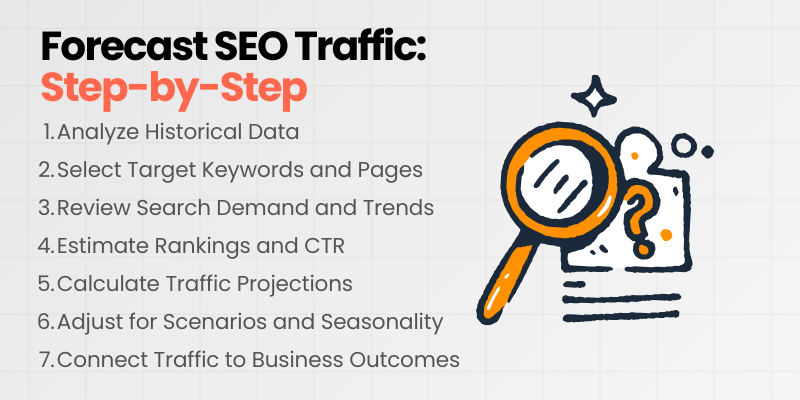
Here’s a step-by-step process to forecast SEO traffic:
1. Analyze Historical Data
This is your foundation. Look at past organic search performance, including clicks, impressions, sessions, and conversion metrics, using tools like Google Search Console and Google Analytics.
Historical patterns help uncover trends and seasonal behavior that you can use to estimate future performance. The more data you have (ideally 12–24 months), the more reliable your forecast becomes.
By examining past performance, you can identify growth rates, recurring slow periods, and baseline performance levels. This historical baseline is essential because it informs reasonable expectations rather than guesses about future traffic.
2. Select Target Keywords and Pages
You can’t forecast traffic for every possible keyword, so prioritize. Identify the keywords and landing pages that are most relevant to your strategy (e.g., high-value commercial terms or pages already ranking within striking distance of Page 1).
These are the ones where meaningful traffic gains are most realistic. With this list, you can then work out traffic potential by estimating how much search demand exists for these terms and how clicks might change if rankings improve.
3. Review Search Demand and Trends
Search volume and trends give context to the keywords you’re forecasting.
Use data sources that show how often people search for specific terms, and how interest shifts over time, including tools like Google Trends for broader pattern analysis.
Understanding demand helps distinguish between keywords with stable year-round interest versus those with strong seasonality (e.g., “best umbrellas” likely spikes before rainy seasons). This step ensures your forecast reflects real market behavior rather than static assumptions.
4. Estimate Rankings and CTR (Click-Through Rate)
Once you know what users are searching for, you need to estimate where your pages will rank for these keywords in the future, and then apply realistic click-through rates (CTR) for each ranking position.
CTR is the percentage of searchers who click a result after seeing it. Higher ranking positions usually get more clicks, but those rates vary by keyword and search intent. Using average CTR benchmarks by position helps convert rank expectations into estimated clicks.
This step bridges the gap between potential visibility (rank) and actual visits (traffic).
5. Calculate Traffic Projections
Now you bring it all together. For each target keyword or page:
- Multiply the estimated monthly search volume
- By the assumed CTR based on your target position
This gives you a traffic estimate for that keyword. Summing all of your keyword estimates gives you the total forecasted organic traffic.
This numerical projection lets you answer real questions such as: “If we move this page to position 3 for these three terms, how much traffic can we expect?”
6. Adjust for Scenarios and Seasonality
Forecasting isn’t about a single number, it’s about preparing for multiple outcomes. Build several scenarios:
- Conservative: slower ranking improvement or lower CTR
- Realistic: most likely based on current trends
- Optimistic: faster improvements if SEO efforts succeed
Also adjust for seasonal patterns: some niches have predictable peaks or dips in demand. This helps create more nuanced projections for planning and budgeting.
7. Connect Traffic to Business Outcomes
Traffic alone isn’t the end goal. Map your forecasted traffic to business results like leads, sales, or revenue. For this, use your site’s current conversion rates or value per converted visit.
For example:
- If your site converts at 3% and your average sale is $100, then 1,000 forecasted visits could translate into $3,000 in sales.
This step helps stakeholders see the business value of SEO improvements, not just raw numbers.
8. Review and Refine Regularly
SEO and search behavior are constantly shifting. Update your forecast regularly (monthly or quarterly) using fresh data, improved rankings, and changes in search trends. Refinement keeps your plan aligned with real performance and market shifts.
4 Key Metrics for Forecasting Organic Traffic
Accurate SEO forecasting depends on understanding and correctly interpreting a few core metrics. Each one plays a different role in predicting future performance and translating SEO activity into business impact.

1. Traffic
Traffic refers to the number of users who visit your website through organic search results. This is the most visible outcome of SEO efforts and often the starting point for any forecast.
When forecasting traffic, you analyze historical organic sessions or clicks to identify growth trends, seasonality, and volatility. Traffic projections are typically built by combining keyword search volume, expected rankings, and estimated CTR.
While traffic alone doesn’t guarantee business success, it indicates demand and visibility and serves as the base metric from which other outcomes are calculated.

2. Revenue
Revenue measures the income generated from organic search traffic, making it one of the most important metrics for stakeholders.
To forecast revenue, traffic projections are combined with conversion rate and average order value (or lead value). This allows you to estimate how increases or decreases in organic traffic may impact sales or pipeline value.
Revenue forecasting shifts SEO discussions from rankings and clicks to real business outcomes, helping leadership understand the financial return of SEO investments.
3. Visibility
Visibility reflects how often your website appears in search results across a defined set of keywords. It is usually expressed as a percentage or index that represents your share of available search impressions.
In forecasting, visibility helps assess how competitive your site is within its market. Improvements in visibility often signal future traffic growth, even before clicks increase.
Tracking visibility trends allows you to identify whether your SEO efforts are expanding your presence across more keywords or stronger positions, which is a leading indicator of traffic changes.
4. Positions
Positions refer to your average rankings in search engines results for targeted keywords.
Rankings are a core input for traffic forecasting because they directly influence CTR. Small movements, such as improving from position 8 to position 4, can result in significant traffic gains.
By forecasting potential ranking improvements based on planned SEO activities, you can estimate how traffic and revenue may change over time.
How These Metrics Work Together?
- Positions influence CTR
- CTR drives Traffic
- Traffic, combined with conversion data, generates Revenue
- Visibility provides early signals of growth or decline across the keyword set
Together, these metrics create a complete framework for forecasting organic performance, connecting search visibility to real, measurable business results.
How to Keep Your Forecast Accurate?
An SEO forecast delivers the most value when it evolves alongside your strategy. Regular reviews help you stay aligned with real performance, catch changes early, and make smarter adjustments over time. Using SEO Reporting tools can make this process easier by providing updated metrics and trends for accurate comparisons.
Here’s how to keep your forecast accurate and actionable:
1. Review Your Forecast Monthly
Set a monthly check-in to compare forecasted vs. actual traffic.
- Pull actual organic clicks from Google Search Console.
- Add them to your forecast dashboard in a separate column.
- Measure the gap between projected and actual performance.
Alongside the numbers, note any influencing factors, such as a major content launch, delayed publishing, algorithm updates, or an unexpected traffic spike. This context helps explain why performance differs, not just that it does.
2. Analyze What’s Driving the Difference
Once you spot a variance, dig into the cause.
- Are certain pages or keywords outperforming expectations?
- Did publishing slow down or competition increase?
- Was there a seasonal shift or SERP change?
This step helps you determine whether you’re on track or need to adjust course.
3. Adjust Assumptions as Conditions Change
Forecasts are built on assumptions, and those assumptions must evolve as your strategy and the market change.
- Update growth rates or scenario modifiers (for example, adjust an aggressive +30% outlook to a more realistic +20%).
- Recalculate baselines if traffic consistently trends higher or lower than expected.
- Rerun keyword opportunity analysis if SERPs, demand, or seasonality shifts.
4. Keep the Forecast Dynamic
Avoid treating your forecast as a static document. Each review should improve its accuracy.
By regularly validating results, refining assumptions, and responding to real-world changes, your forecast stays relevant, and continues to guide smarter SEO decisions over time.
Explore Our Digital Marketing Services!
7 Main Challenges in SEO Traffic Forecasting
SEO traffic forecasting can be a powerful tool for digital marketing, but it comes with its own set of challenges. Understanding these challenges is crucial for making more accurate predictions and adapting strategies effectively.
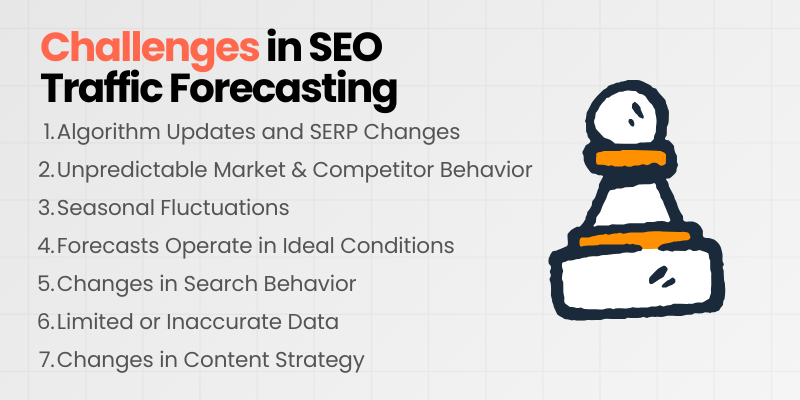
Here are some common obstacles:
1. Algorithm Updates and SERP Changes
Google updates can change rankings overnight. At the same time, evolving SERP layouts, such as more ads, local packs, featured snippets, or AI-generated overviews, can reduce CTR even when rankings stay the same.
2. Unpredictable Market and Competitor Behavior
Forecasts often assume steady growth, but competitors may suddenly invest heavily in SEO services, launch new content, or build links aggressively. External events, industry shifts, or global changes can also cause traffic to rise or fall unexpectedly.
3. Seasonal Fluctuations
SEO traffic can be heavily influenced by seasonal factors, such as holidays, industry-specific events, or changing consumer behaviors.
These fluctuations can make forecasting difficult, as the same website may experience different traffic patterns throughout the year.
4. Forecasts Operate in Ideal Conditions
Every model is built on assumptions. Real-world performance rarely follows a straight line, which is why forecasts should always be treated as estimates not guarantees.
5. Changes in Search Behavior
User behavior and search intent are constantly evolving. As search engines become more sophisticated, the way people search for information changes.
Voice search, mobile-first indexing, and the rise of featured snippets can all impact traffic in unpredictable ways, making accurate forecasting difficult.
6. Limited or Inaccurate Data
Accurate SEO forecasting relies heavily on the availability of reliable and up-to-date data. Incomplete or inaccurate data can lead to misleading forecasts.
Additionally, data discrepancies between different tools and platforms can create confusion and make it difficult to form a cohesive traffic forecast.
7. Changes in Content Strategy
When businesses adjust their content strategy, it can have a direct impact on SEO traffic. New content types, changes in targeting keywords, or shifts in user engagement tactics can all influence the accuracy of traffic predictions.
Frequently Asked Questions
What is forecasting SEO traffic and why is it important?
Forecasting SEO traffic refers to the process of estimating how much organic search traffic your website is likely to get in the future based on historical data, keyword trends, and SEO performance metrics. It’s important because it helps you set realistic goals, plan your content strategy, and allocate resources wisely as you grow your SEO presence.
How does forecasting SEO traffic help with planning my SEO strategy?
When you forecast SEO traffic, you can see potential growth patterns and understand how changes to your content, keywords, or rankings might impact future visits. This makes it easier to prioritise actions, manage expectations with stakeholders, and make data‑backed decisions rather than guessing what might happen.
What data do I need for forecasting SEO traffic?
To forecast your SEO traffic, you typically need historical organic traffic data, keyword rankings, search volumes, and performance metrics from tools like Google Search Console and Google Analytics. Some methods may also use competitor insights and trend patterns to refine the prediction.
What are the 7 steps of forecasting?
The 7 steps of forecasting involve a structured approach to predicting future trends, such as sales, traffic, or market growth. Here’s a breakdown of the key steps:
- Define the Objective: Clearly outline what you're forecasting (e.g., sales, demand, traffic).
- Collect Historical Data: Gather past data to identify patterns and trends.
- Select the Forecasting Model: Choose a suitable model based on your data and forecasting goals.
- Identify Variables: Determine key variables that affect the forecast (e.g., seasonality, market conditions).
- Prepare the Data: Cleanse and organize the data for analysis, ensuring it's accurate and relevant.
- Generate the Forecast: Use statistical or machine learning models to calculate predictions.
- Monitor and Adjust: Continuously track performance and adjust the forecast based on new data and insights.
Conclusion
SEO traffic forecasting is an essential practice for businesses aiming to optimize their digital marketing strategies. By accurately predicting future organic traffic, companies can make informed decisions, allocate resources effectively, and stay ahead of the competition. The key metrics such as organic search volume, keyword rankings, and CTR are vital for building a solid traffic forecast. For Centric, a digital marketing agency known for its client-focused approach, leveraging these metrics is essential to deliver results. With the right tools and best practices, businesses can anticipate fluctuations in traffic, address challenges like algorithm changes, and adjust their strategies accordingly. Implementing SEO traffic forecasting will not only help in optimizing SEO efforts but also enable businesses to plan content, marketing campaigns, and budget more effectively. Incorporating SEO traffic forecasting into your digital strategy will provide the insights needed to improve rankings, enhance visibility, and drive more targeted traffic. By using the right combination of tools and data analysis, you can confidently predict future growth and take proactive steps to achieve long-term success.