





Have you ever wondered, what is marketing automation? Let’s dive into this concept and explore its significance.
Marketing automation refers to the use of software platforms and technologies to automate repetitive marketing tasks and processes.
This includes tasks such as email campaigns, social media posts, lead generation, and customer segmentation.
By automating these activities, businesses can save time, enhance personalization, and focus on strategic tasks that drive growth.
In today’s competitive landscape, marketing automation has become essential for businesses aiming to scale their marketing efforts without increasing resources.
It helps companies engage customers at the right moment with the right message, delivering a highly personalized experience without manual intervention.
This allows businesses to nurture leads through the sales funnel, improve customer retention, and boost conversions, all while reducing the risk of human error.
In this blog, we’ll explore how marketing automation works, its benefits, and why it’s an invaluable tool for businesses aiming to grow efficiently.
Learn how automation can transform your marketing efforts and lead to better customer relationships and higher conversions.’
What Is Marketing Automation?
Marketing automation is the use of specialized software and technologies to automate repetitive marketing tasks, allowing businesses to manage and streamline their marketing processes more efficiently.
It enables companies to nurture leads, personalize customer journeys, and improve overall campaign effectiveness without the need for manual intervention in every step.
With marketing automation, tasks such as sending emails, managing social media posts, generating leads, segmenting customer data, and tracking user behavior are automated.
This helps marketers focus on more strategic activities while ensuring that timely, personalized content reaches the right audience at the right time.
For example, automated email campaigns can be set up to nurture leads through a series of pre-defined messages, based on user interactions with the brand.
Social media posts can be scheduled and automatically published, ensuring consistent brand presence across platforms.
Additionally, automated tools can segment audiences based on behavior and preferences, delivering personalized experiences that increase engagement and conversions.
Ultimately, marketing automation empowers businesses to scale their marketing efforts, reduce manual workload, optimize resource allocation, and achieve better results by delivering more relevant content to customers in a timely and efficient manner.
Explore Our Digital Transformation Services!
How Marketing Automation Works?
Marketing automation works by leveraging automated workflows, triggers, segmentation, and behavioral tracking to deliver personalized messages throughout the customer journey.
These elements ensure that businesses can engage customers at the right time with the right content marketing, improving efficiency and driving better results.
Automated workflows allow businesses to create sequences that guide customers through their journey, such as sending a welcome email when they subscribe or a reminder when they abandon a cart.
Triggers, like a user clicking on a specific link or visiting a product page, prompt these automated actions to ensure timely communication.
Segmentation is another crucial component, as it divides an audience into smaller groups based on shared behaviors, demographics, or interests.
This helps marketers send highly relevant content to each segment, improving engagement. Additionally, behavioral tracking monitors customer actions, such as clicks, page views, or email interactions, allowing marketers to trigger specific actions based on real-time behavior.
Key components of marketing automation include:
-
Email automation: Sends personalized, timely emails to leads and customers based on their behavior.
-
Lead scoring: Assigns a score to leads based on engagement, helping prioritize high-value leads.
-
Customer segmentation: Groups customers based on shared characteristics for more targeted marketing.
-
Multi-channel workflows: Delivers consistent messaging across various channels like email, social media, and SMS.
-
Analytics and reporting: Provides insights into campaign performance, helping optimize future marketing efforts.
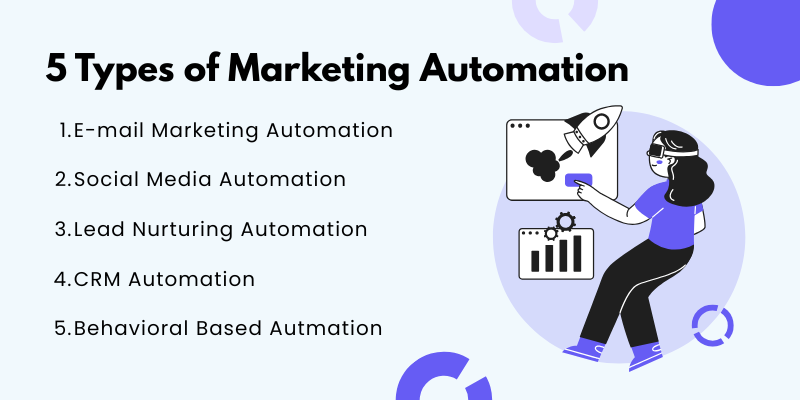
5 Types of Marketing Automation
Marketing automation comes in various forms, each designed to help businesses achieve different goals by streamlining processes, increasing efficiency, and enhancing customer engagement.
Here's a breakdown of the most common types of marketing automation and how they benefit businesses:
1. Email Marketing Automation:
This type of automation focuses on automating email marketing or campaigns. It includes tasks like sending welcome emails to new subscribers, newsletters to keep customers informed, abandoned cart reminders to bring back potential buyers, and re-engagement emails to win back inactive customers.
By automating these processes, businesses can maintain consistent communication with their audience without manual intervention.
Explore Our Email Marketing Services!
2. Social Media Automation
Social media automation allows businesses to schedule and automate posts across various platforms like Facebook, Twitter, LinkedIn, and Instagram.
This ensures consistent engagement, even outside of business hours. It helps marketers manage multiple accounts, track performance, and maintain a regular posting schedule, all while saving time.
3. Lead Nurturing Automation
This automation type helps businesses nurture leads through the sales funnel with relevant content, offers, and reminders. Based on customer behavior and engagement, the automation ensures that leads receive timely follow-ups, educational materials, or special offers, increasing the chances of conversion.
4. Customer Relationship Management (CRM) Automation
CRM automation focuses on automating tasks related to customer relationship management, such as follow-ups, personalized outreach, and tracking interactions with both prospects and existing clients. This helps businesses build stronger connections, improve customer retention, and provide a personalized experience at scale.
Explore Our CRM Integration Services!
5. Behavior-Based Automation
Behavior-based automation triggers marketing actions based on user behavior, such as website visits, downloads, or clicks.
By monitoring these actions, businesses can tailor content and offers that are most relevant to the individual, delivering a more personalized experience and improving the likelihood of conversions.
4 Major Benefits of Marketing Automation
Marketing automation brings several benefits that can transform the way businesses engage with their audience.
Key Benefits of Marketing Automation include
1. Efficiency & Time Savings
Automation drastically reduces the time spent on repetitive marketing tasks, allowing businesses to focus on higher-value activities like strategy development and creative work.
With automated workflows handling email sequences, social media posts, and lead follow-ups, marketers can operate more efficiently and reach a broader audience without increasing effort.
2. Improved Lead Nurturing
Marketing automation allows businesses to nurture leads through the sales funnel with relevant content at the right time.
Automation tools can track lead behavior and engagement, sending personalized messages based on where the lead is in the customer journey. This ensures that leads are consistently engaged, leading to higher chances of conversion.
3. Higher Sales Conversions
By automating tasks such as lead scoring and email follow-ups, businesses can more effectively prioritize high-value leads and reach out to them at optimal times.
This level of personalization and timely outreach significantly improves the chances of turning prospects into customers, ultimately boosting sales conversions.
4. Consistent Customer Experience
Marketing automation ensures that customers receive a consistent and seamless experience across multiple channels. Whether it’s email, social ads, or website interactions, automation tools help deliver the same personalized message across all touchpoints.
This consistency builds trust with customers and helps create a unified brand experience, leading to stronger customer relationships and increased loyalty.

Popular Marketing Automation Tools
Here’s a brief overview of some of the leading marketing automation platforms that businesses commonly use:
-
HubSpot: An all‑in‑one marketing, sales, and service platform that offers CRM‑integrated automation, workflow automation, email automation, and journey orchestration
-
ActiveCampaign: A platform strong in email marketing automation, segmentation, and integrations. Well‑suited for businesses looking to automate campaigns with deeper personalization.
-
Mailchimp: A user‑friendly tool focused originally on email, now offering marketing automation features such as segmentation, behavior‑based messaging, and templates.
-
Klaviyo: Built with e‑commerce in mind; it enables automated email, SMS, and cross‑channel campaigns using data from online stores and behavior triggers.
-
Marketo (aka Adobe Marketo Engage): An enterprise‑grade marketing automation platform that supports multi‑channel campaigns, lead scoring, nurturing, and advanced analytics
-
Salesforce Marketing Cloud: A comprehensive marketing automation suite integrated with the Salesforce ecosystem. It supports email, mobile, social, website personalization and real‑time journey mapping.
Explore Our Workflow Automation Services!
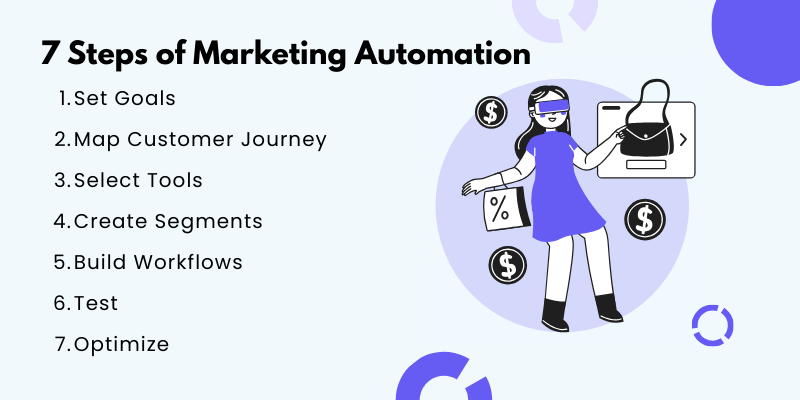
7 Steps of Implementing Marketing Automation in Your Business
Here’s a step-by-step guide to help you get started:
1. Set Goals
Begin by identifying the specific goals you want to achieve with marketing automation. These could include increasing lead generation, improving conversion rates, enhancing customer retention, or scaling personalized marketing efforts. Setting clear, measurable goals will guide your strategy and help track progress.
2. Map Customer Journeys
Understanding the paths that your customers take from initial awareness to final purchase (and beyond) is crucial. Map out these journeys to identify key touchpoints, pain points, and opportunities to engage customers at the right time. This ensures that your automation strategy is aligned with the customer experience.
3. Select Tools
Choose the right marketing automation tools based on your goals, budget, and business size. Popular tools like HubSpot, Mailchimp, ActiveCampaign, or Salesforce Marketing Cloud offer a range of features, so select one that meets your business needs, whether it's email automation, CRM integration, or multi-channel marketing.
4. Create Segments
Segment your audience based on demographics, behavior, or engagement levels. This allows you to send tailored content and messages that are more relevant to each segment. For example, you might have separate segments for new leads, active customers, and long-term users. Segmentation helps improve targeting and engagement.
5. Build Workflows
Design automated workflows that guide leads and customers through the journey, such as sending a welcome email, nurturing leads with relevant content, or triggering a follow-up after a cart abandonment. Workflows are the heart of marketing automation, ensuring consistent engagement at every step.
6. Test
Before fully rolling out your automation strategy, test your workflows and emails to ensure they function as expected. Test things like email deliverability, timing, and trigger accuracy. A/B testing can also be helpful for determining which messages or approaches work best.
7. Optimize
After launching your automation strategy, continuously monitor its performance. Use analytics to track key metrics such as open rates, conversion rates, and customer engagement. Based on this data, optimize your workflows, segments, and content to improve results over time.
5 Common Mistakes to Avoid in Marketing Automation
While marketing automation offers numerous benefits, there are common pitfalls that businesses should be aware of to ensure success.
Here are some mistakes you must avoid in marketing automation:
1. Over-Automation
While automation can save time, over-relying on it can make your marketing feel impersonal and robotic.
It’s important to strike a balance between automation and human interaction. Customers appreciate personalized touches and real-time engagement, so use automation to enhance, not replace, personal connections.
2. Poor Segmentation
One of the most critical aspects of marketing automation is segmentation. Failing to properly segment your audience can lead to irrelevant messaging, which diminishes the effectiveness of your campaigns.
Make sure you segment based on key factors like demographics, behavior, and engagement to ensure your messages are tailored and impactful.
3. Generic Messaging
Sending out generic messages that don’t resonate with your audience is a major mistake. Marketing automation allows for personalized communication, so take full advantage of it.
Use customer data and insights to create messages that speak directly to your audience's needs, preferences, and pain points.
4. Lack of Testing
Skipping the testing phase before launching your automated campaigns can lead to errors and missed opportunities. Test everything from email subject lines and workflows to triggers and call-to-action buttons.
A/B testing is especially valuable for determining which elements perform best and optimizing your campaigns for better results.
5 Ignoring Analytics
Not analyzing the performance of your automation campaigns is a missed opportunity for growth. Analytics provide valuable insights into how well your campaigns are performing, which channels are most effective, and where adjustments need to be made.
Regularly review key metrics such as open rates, conversion rates, and customer engagement to continuously optimize your strategy.
How AI is Revolutionizing Marketing Automation?
AI is transforming marketing automation by making it smarter, more personalized, and efficient.
Here's how:
-
Personalization at Scale: AI analyzes customer data to deliver tailored content and messages, improving engagement and conversions across automated channels.
-
Predictive Analytics: AI forecasts customer behavior, helping marketers optimize campaigns and target high-value prospects with greater accuracy.
-
Intelligent Lead Scoring: AI analyzes broader data to score leads more accurately, improving lead qualification and conversion rates.
-
Automated Content Creation: AI generates content like emails and social media posts, saving time while ensuring consistency and relevance.
-
Chatbots and Virtual Assistants: AI-powered bots engage customers in real-time, providing support, recommendations, and completing transactions.
-
Smart Segmentation: AI segments audiences based on behavior, allowing for dynamic and highly targeted marketing campaigns.
-
Behavioral Triggering: AI triggers personalized messages based on real-time customer actions, such as website visits or cart abandonment.
-
Enhanced Analytics: AI analyzes marketing data, providing actionable insights and optimizing campaign performance in real-time.
Frequently Asked Questions
How does marketing automation improve customer engagement?
Marketing automation delivers personalized content to the right audience at the right time, building stronger customer relationships and boosting engagement.
Is marketing automation only for large businesses?
No, marketing automation can be beneficial for businesses of all sizes by saving time, improving consistency, and increasing sales conversions.
Can marketing automation replace human marketers?
No, marketing automation complements human marketers. It automates repetitive tasks, allowing marketers to focus on strategy and creative initiatives.
How do I measure the success of my marketing automation?
Measure success through key metrics like open rates, conversion rates, lead scoring, ROI, and customer lifetime value.
What marketing automation tools should I use?
Popular tools include HubSpot, Marketo, ActiveCampaign, Mailchimp, and Salesforce. Choose based on your business size, needs, and budget.
Conclusion
Now that you understand what marketing automation is, let's summarize the key points. It’s a powerful tool that transforms how businesses engage with customers, making marketing efforts more personalized, efficient, and scalable. By automating repetitive tasks, businesses can deliver timely, relevant content, improving customer relationships and boosting conversions. Centric leverages marketing automation to streamline processes, enhance customer experiences, and enable businesses to scale their marketing strategies without additional manual effort. Ultimately, it drives growth, helps businesses stay competitive, and ensures more effective, data-driven marketing strategies.