





If you’ve ever wondered what is a landing page in SEO, and why marketers talk about it so much, you’re not alone. Landing pages often sound technical, but the idea is actually simple. It’s a page built for one clear purpose: getting visitors to take action.
In SEO, a landing page is a focused web page created to rank for specific keywords and guide users toward a goal, like filling out a form, signing up, or making a purchase.
Unlike regular website pages that try to do many things at once, landing pages keep distractions low and intent high.
Understanding what is a landing page in SEO helps you see why these pages matter so much for search visibility and conversions. When done right, they attract the right audience, answer their exact needs, and make the next step feel easy.
In this guide, we’ll break down how SEO-friendly landing pages work and how you can use them to drive better results without overcomplicating the process.
What is Landing Page SEO?
An SEO landing page is created to attract organic search traffic by targeting keywords related to a business and its services. Its main goal is simple: turn visitors into leads or customers by matching content with the user’s search intent. By understanding content marketing strategies, these pages can be optimized to appeal to both search engines and visitors alike.
These pages answer a specific query clearly and directly. Some SEO landing pages convert users right away through a form, call, or signup. Others guide visitors to explore additional pages where conversion happens later.
They are commonly used in inbound marketing strategies to bring in relevant traffic from search engines. Depending on the strategy, they may or may not appear in a website’s main navigation.
An effective SEO landing page is straightforward, easy to read, and focused on one action. It delivers useful information, removes distractions, and includes a strong call-to-action that encourages the next step.
For example, a carpet cleaning SEO landing page targeting the keyword “carpet cleaning prices” can rank by offering a detailed cost breakdown. After educating the reader, the page prompts them to request a free quote by calling the business, smoothly guiding traffic into conversions.
Why is SEO Important for Landing Pages?
SEO helps your landing pages appear in search engine results pages (SERPs) when people search for services related to your business. This means you can reach potential customers exactly at the moment they’re looking for what you offer. With email marketing integrated into your SEO strategy, you can also follow up with visitors who don’t convert right away, guiding them back to your landing page when they’re ready to take action.
For example, imagine you run a courier company in New York City. You want your business to show up when someone searches for “courier services in New York City.” The goal is to guide that searcher to a dedicated landing page built to convert.
There are two main ways your landing page can appear for that search:
- Ranking in organic (unpaid) search results through SEO
- Appearing in paid search results through advertising
Paid results require pay-per-click (PPC) ads, where you pay every time someone clicks your ad. While this can drive quick traffic, the visibility disappears as soon as you stop paying.
SEO, on the other hand, allows your landing pages to rank organically. This brings in free, ongoing traffic without paying for each click. It’s a more cost-effective way to generate leads and attract customers over time.
What Are The Differences Between Landing Pages and Other Web Pages?
Landing pages are optimized for conversions with a focused call to action, while other web pages provide broader content and multiple navigation options.
Some of the main differences between landing pages and other web pages include:
|
Aspect |
Landing Pages |
Other Web Pages |
|
Purpose |
Designed for conversions with a clear call to action. |
Provide general information, multiple links, and less focused goals. |
|
Content |
Minimal navigation and content, focusing on a specific offer or campaign. |
Comprehensive content covering various topics like blog posts, product categories, or informational pages. |
|
Design |
Simplified design with a layout focused on conversion. |
More complex design with multiple options and navigation for users to explore. |
|
Traffic Source |
Linked to specific marketing efforts (ads, email campaigns). |
Attracts traffic from various organic and referral sources. |
Explore Our Digital Marketing Services!
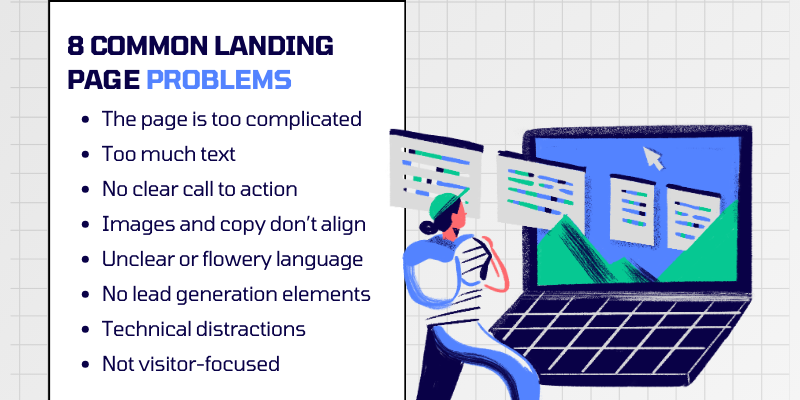
8 Common Landing Page Problems
Before looking at best practices, it helps to understand what usually causes landing pages to fail. Many conversion issues come from avoidable mistakes that confuse visitors or distract them from taking action.
Knowing these problems early helps you build clearer and more effective pages.
Common issues to avoid include:
- The page is too complicated: Too many elements or ideas can overwhelm visitors and dilute the main message.
- Too much text: When content is overly long, the value proposition becomes unclear and harder to understand quickly.
- No clear call to action: Weak or missing CTAs leave users unsure about what to do next.
- Images and copy don’t align: Visuals that don’t support the message reduce clarity and trust.
- Unclear or flowery language: Vague wording can confuse users instead of guiding them.
- No lead generation elements: Without forms or contact options, there’s no way to feed your sales funnel.
- Technical distractions: Fast sliders, heavy animations, or glitches can hurt usability and performance.
- Not visitor-focused: Pages that talk only about the business instead of solving user problems often fail to convert.
These are some of the most common reasons conversion-focused landing pages don’t perform well. Being aware of what to avoid makes it much easier to create pages that are simple, clear, and designed to convert.
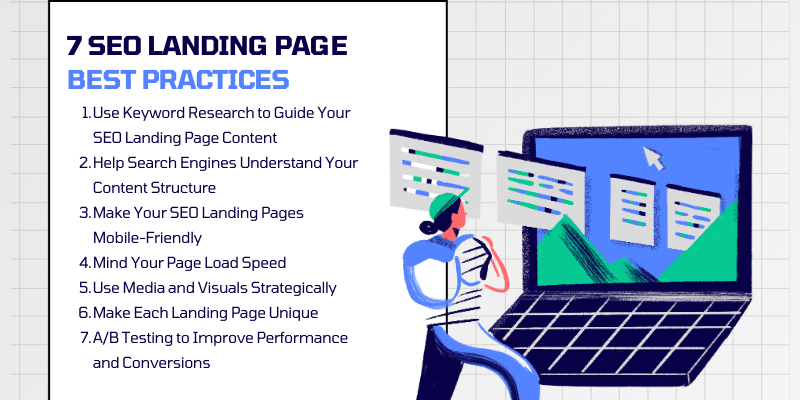
7 SEO Landing Page Best Practices
SEO Best Practices focus on optimizing elements like headlines, content, CTAs, speed, and mobile design to improve rankings and conversions.
Some key components of SEO best practices include
1. Use Keyword Research to Guide Your SEO Landing Page Content
Keyword research is the foundation of every effective SEO landing page. Start by identifying long-tail keywords that closely match your services and what your audience is actively searching for.
If you’re unsure which terms people use, keyword research tools can help uncover relevant search phrases with clear intent.
Once you have your keywords, build your content around them while focusing on search intent. Your landing page should clearly answer the question behind the search.
Use your primary keyword naturally throughout the content, but avoid overusing it. Search engines can easily detect keyword stuffing, which can harm rankings instead of helping them.
To keep your content balanced, include secondary keywords that support the main topic and add context. These related terms help search engines better understand your page without making the content feel forced.
Example: If you run a home cleaning service in Dubai, your primary keyword might be “home cleaning service in Dubai.” Supporting secondary keywords could include “affordable home cleaning in Dubai” or “same-day home cleaning service.”
Using these terms naturally helps your SEO landing page stay relevant while addressing different search intents.
2. Help Search Engines Understand Your Content Structure
SEO landing pages are built for users first, but they also need to be easy for search engines to read and interpret. A clear structure helps search engine crawlers understand what your page is about, which improves indexing and ranking.
To make your landing pages search-engine friendly, focus on the following elements:
- Title tag: Keep the title short and clear. Place your primary keyword as early as possible so top search engines immediately understand the page topic.
- Meta description: This text often appears in search results and influences clicks. Include your primary keyword and make the description compelling and relevant.
- Headings (H1, H2, H3): Use headings to organize content and improve readability. They also give search engines more context about the page’s focus.
- Internal links: Link to relevant pages within your website using descriptive anchor text. This helps search engines understand relationships between pages and distributes link value across your site.
- Image alt text: Add clear, descriptive alt tags to images so search engines can understand visual content. This also improves accessibility.
- Keyword-friendly URL: Use a clean, readable URL that reflects the main topic of your landing page. Avoid unnecessary words or numbers.
- Quality backlinks: Backlinks from reputable websites signal trust and authority. Earning these links helps strengthen your landing page’s SEO performance.
When these structural elements are in place, search engines can better understand, index, and rank your SEO landing pages, making it easier for the right audience to find you.

4. Make Your SEO Landing Pages Mobile-Friendly
Mobile-friendly SEO landing pages are essential for both user experience and search visibility. Your landing page should look clean and function smoothly on all screen sizes, making it easy for visitors to read, navigate, and take action.
A well-optimized mobile page ensures that your call to action displays correctly and remains easy to tap, whether a user is browsing on a phone or tablet. If visitors struggle to scroll, click, or fill out forms, they’re far less likely to convert.
Mobile optimization also matters for SEO because search engines prioritize mobile-first indexing. This means they evaluate the mobile version of your page when deciding how it should rank in search results.
To ensure your SEO landing pages are mobile-friendly, test them regularly and fix issues related to layout, responsiveness, font size, and loading behavior. A smooth mobile experience helps improve rankings, engagement, and conversions all at once.
4. Mind Your Page Load Speed
Page load speed plays a direct role in how well your SEO landing page performs. A slow-loading page can frustrate visitors and cause them to leave before taking action. It also affects how search engines evaluate and rank your page.
To keep your landing pages fast and responsive, focus on the following improvements:
- Optimize your images: Large image files slow pages down. Compress images to reduce file size while keeping visual quality intact. This helps your page load faster without changing your design.
- Reduce HTTP requests: Every script, image, and file on your page creates a request that needs to load. The more elements you have, the longer the page takes to appear. Keep your page layout simple and remove unnecessary components.
- Minimize redirects: Redirects are useful for handling broken or outdated URLs, but too many of them can slow down page loading. Limit redirects to only those that are necessary.
A fast-loading SEO landing page improves user experience, supports higher rankings, and increases the chances that visitors will stay long enough to convert.
5. Use Media and Visuals Strategically
Media and visuals play an important role in how visitors understand and engage with your landing page. When used correctly, visuals can support your message, build trust, and guide users toward taking action.
Well-chosen images, videos, and design elements help break up text and make the page easier to scan. They can also highlight your product, explain a service, or reinforce the value you’re offering. However, too many visuals or irrelevant media can distract users and slow down the page.
Best practices for using media and visuals include:
- Support the message: Choose images and graphics that align with your content and clearly reinforce your main point.
- Highlight the CTA: Use visuals to naturally draw attention to your call to action without overpowering it.
- Use videos wisely: Short, focused videos can explain complex ideas quickly, but they should add value and not autoplay aggressively.
- Optimize for speed: Compress images and videos to avoid slowing down your page load time.
- Maintain consistency: Keep visual style, colors, and fonts aligned with your brand to create a cohesive experience.
- Ensure accessibility: Add alt text to images so search engines and screen readers can understand them.
Using media strategically helps improve engagement, clarity, and conversions while keeping your SEO landing page clean, focused, and user-friendly.
6. Make Each Landing Page Unique
SEO landing pages are often created as part of larger marketing campaigns, and it’s common for related keywords to overlap.
Even so, each landing page needs to be clearly distinct. Aim to keep every page mostly unique so search engines don’t treat them as duplicate content.
While similar services or products may share a structure, the content should focus on what makes each page different. This includes tailoring the messaging, examples, and details to match the specific intent behind each keyword.
Example: If you offer vacation rentals in multiple cities, the services may be similar, but the landing pages shouldn’t be. Customize the copy for each location by highlighting local attractions, neighborhood benefits, travel needs, and city-specific details.
This approach helps search engines understand the uniqueness of each page while making the content more relevant to users.
7. A/B Testing to Improve Performance and Conversions
A/B testing is the process of comparing two versions of a landing page to see which one performs better. It involves changing one element at a time, such as a headline, call to action, layout, or button color, and then measuring how users respond to each version.
This approach helps you understand what actually works for your audience instead of relying on assumptions. By testing small changes, you can identify which version leads to more clicks, sign-ups, or conversions.
For SEO landing pages, A/B testing improves performance without risking rankings when done correctly. Over time, these insights help you create landing pages that are clearer, more engaging, and better aligned with user behavior, resulting in higher conversion rates.
Frequently Asked Questions
What Is A Landing Page In SEO?
A landing page in SEO is a web page designed specifically to capture traffic and drive conversions. It is optimized for search engines to rank higher for specific keywords and designed with a clear call-to-action to guide users toward completing a desired action (such as making a purchase or filling out a form).
How Does SEO Affect Landing Page Conversions?
SEO plays a vital role in bringing targeted traffic to your landing page. By optimizing for the right keywords, improving page speed, and ensuring mobile-friendliness, SEO increases visibility, which in turn enhances user engagement and conversions.
Why Is Page Load Speed Important For SEO?
Page load speed directly impacts both SEO rankings and user experience. Faster pages are favored by search engines and help reduce bounce rates. Slow-loading pages may result in lower rankings and reduced user interaction, negatively affecting conversions.
How Do I Optimize My Landing Page For Mobile Users?
Ensure that your landing page is mobile-responsive, meaning it adapts to different screen sizes and devices. Use Landingi’s mobile-friendly templates, compress images for faster loading, and make sure navigation is easy for mobile users.
What Should I Include In My Landing Page’s Content For SEO?
Your landing page content should be relevant, engaging, and keyword-optimized. Ensure that the page answers the user’s search intent and provides valuable information. Use your target keywords naturally in headings, subheadings, and throughout the content.
How Do I Improve My Landing Page’s SEO Performance?
Here are some tips to improve your landing page’s SEO performance:
- Use relevant, long-tail keywords in headings, meta descriptions, and content.
- Optimize images for faster load times and better user experience.
- Add internal links to other relevant pages on your website.
- Ensure mobile responsiveness to improve user experience and SEO rankings.
- Use analytics to track performance and continuously refine your SEO strategy based on data.
What Is The Role Of Social Proof On A Landing Page?
Social proof, such as testimonials, reviews, or case studies, helps build credibility and trust with visitors. By displaying positive feedback from customers, you can increase the likelihood of conversion, making users more confident in taking action.
How Can I Troubleshoot Common SEO Issues On My Landing Page?
Below are some common SEO issues and troubleshooting tips.
- Slow load times: Compress images and streamline your code to improve page speed.
- Poor keyword ranking: Ensure your landing page content is optimized for the right keywords and aligned with user intent.
- Mobile usability issues: Test your page on multiple devices and use mobile-responsive templates.
- Low conversion rates: Analyze user behavior through tools like Google Analytics and adjust your CTA placement or content based on the findings.
Conclusion
Now that you understand what is a landing page in SEO, it’s clear why it plays such an important role in digital marketing. A well-built SEO landing page is designed to attract the right audience from search engines and guide them toward a specific action, whether that’s signing up, contacting your team, or making a purchase. When you apply SEO best practices like clear content optimization, fast page load speeds, and mobile-friendly design, your landing pages become easier to find and easier to use. This improves both search visibility and user experience. For businesses looking for expert guidance, partnering with Centric, a digital marketing agency, can help optimize your landing pages for maximum impact. Understanding what is a landing page in SEO also highlights its long-term value. With the right strategy in place, these pages can drive consistent, relevant traffic and generate conversions over time. When done correctly, SEO landing pages don’t just support your marketing efforts, they directly contribute to measurable growth and stronger results.