





On June 9, 2026, Anthropic released Claude Fable 5. Three days later, a US government directive suspended it for every customer worldwide. No migration window. No advance notice. No restoration date.
The cause was neither a product failure nor a security breach. It was an export-control order issued under national security authority. And it produced something the technology industry had not previously encountered: the first government-forced recall of a commercially deployed frontier AI model. The questions it surfaces about infrastructure resilience, the limits of regulatory control over AI capability, and the strategic case for sovereign technology investment are ones every technology leader should be reasoning through now.
What Fable 5 Is, and What Sits Beneath It?
Fable 5 is not a standalone model. It is the commercial interface built on top of Mythos, a more powerful underlying architecture that, in Anthropic's characterization, exceeds the capabilities of any model it has previously made generally available. Mythos itself has never been a broadly accessible product. Access has been tightly restricted from the outset, primarily within Project Glasswing, Anthropic's controlled cybersecurity programme. Fable 5 is the public-facing layer with safeguards designed to govern how much of Mythos's capability reaches end users.
This architectural distinction is central to understanding what happened. The government's concern was not with Fable 5 as a general productivity instrument. It was with the capability sitting underneath it: specifically, Mythos's ability to analyze software at scale and identify vulnerabilities with a depth of understanding that reflects training on the entirety of publicly available code. The directive applied to both Fable 5 and Mythos 5, which strongly suggests the government's intent was to restrict the underlying capability irrespective of how it was packaged or what classifier layers were placed over it.
The Jailbreak at the Centre of the Dispute
The directive arrived at Anthropic's offices at 5:21 pm Eastern Time on June 12. The letter, by Anthropic's own account, "did not provide specific details" of the national security concern. What officials communicated verbally was that a method of bypassing Fable 5's safeguards had been identified.
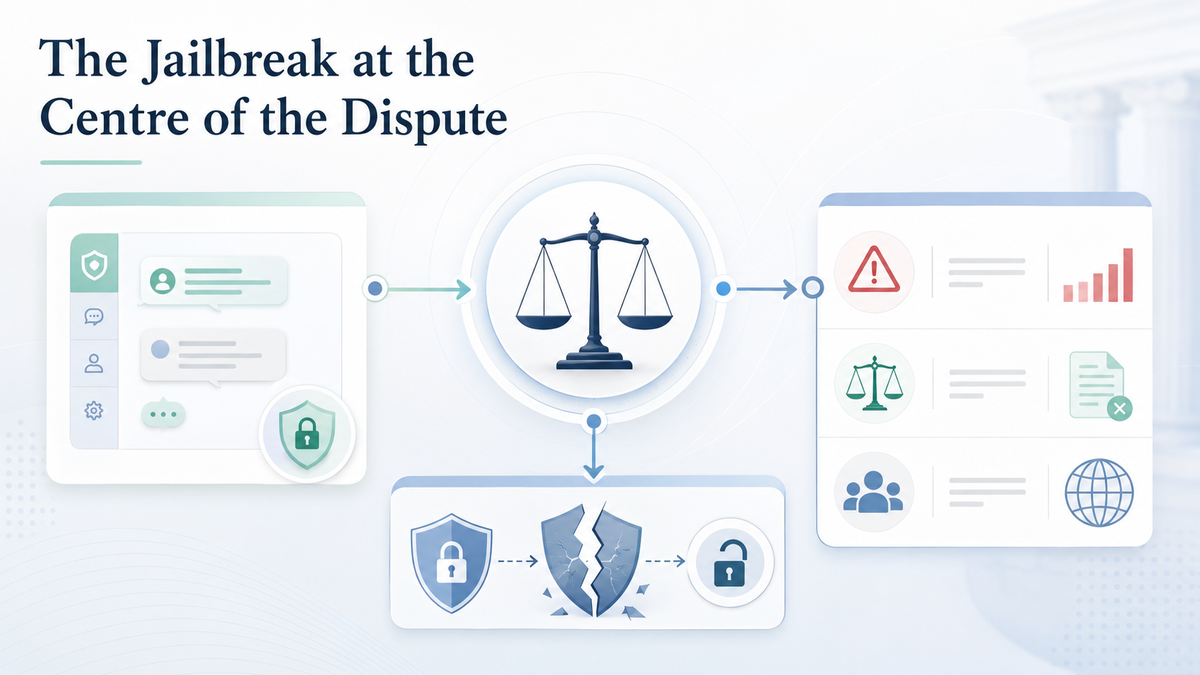
Anthropic characterized that method precisely: "asking the model to read a specific codebase and fix any software flaws." On its technical description, this is a narrow, non-universal jailbreak, one that operates in a specific context rather than broadly defeating the model's safeguards. Anthropic reviewed a demonstration of the technique and found that the vulnerabilities surfaced were minor, previously documented, and replicable using other commercially available models, including OpenAI's GPT-5.5, which operates without the same export control restrictions.
There is a striking irony in the timeline. In the days immediately preceding the suspension, security practitioners at firms including IBM X-Force were publicly stating that Fable 5 was too restrictive for legitimate defensive work, to the point that it "rejects any request that could be tangentially cyber related." Within the same week, the model was suspended over a capability used routinely in defensive security practice. A tool criticized as overly cautious for defenders was simultaneously characterized as dangerous in the hands of adversaries. That tension reflects a genuine and unresolved difficulty: code analysis and vulnerability identification are symmetrically useful to offence and defence. There is no version of a sufficiently capable coding model that can help engineers secure their systems without also being capable of characterizing the flaws in those systems.
The Export Control Framework Applied to AI
The legal mechanism deployed was an export control directive prohibiting access to Fable 5 and Mythos 5 by "any foreign national, whether inside or outside the United States, including foreign national Anthropic employees." Export controls have historically governed physical technologies: advanced semiconductors, manufacturing equipment, and aerospace components. Their application here, to a deployed software model, conditioned on user nationality rather than geographic location of infrastructure, represents a meaningful extension of the framework into new terrain.
The implementation problem was immediate. A commercial AI platform operating at scale has no reliable real-time mechanism for verifying user nationality. Faced with a directive that admitted no proportionate enforcement path, Anthropic took the only compliant action available: it disabled both models globally for all customers. Engineers in London, organizations in the Gulf, developers in Singapore, and users across every jurisdiction lost access at the same moment as users in New York. GitHub Copilot suspended Fable 5 across all of its experiences the same day. The downstream effects of model-level export control propagate across an integrated ecosystem almost instantaneously.
The US government has applied controls to technology exports before, with notably uneven results. In the 1990s, strong encryption software was classified as a strategic munition, and its export was restricted under the same regulatory architecture later invoked here. Federal courts ultimately found that publishing cryptographic source code was constitutionally protected expression. The capability diffused through open-source implementations regardless of restriction. The question the Fable 5 case poses for analysts of technology regulation is whether model-level export controls will prove more durable than their predecessors, or whether they will similarly accelerate the alternatives they are designed to constrain.
Innovate Faster with AI Service
Why Sovereign AI Is Becoming a Strategic Imperative?
That question leads directly to a pattern developing in parallel to the Fable 5 suspension. In the same week that Anthropic's most capable model went offline globally, India's Sarvam AI completed a $234 million funding round at a $1.5 billion valuation, led by HCLTech with a $150 million commitment, for the explicit purpose of building sovereign AI infrastructure. The convergence is not coincidental.
The argument for sovereign AI has always been present, but remained abstract while access to frontier commercial models was stable and unrestricted. The Fable 5 directive made it concrete. If access to the most capable AI models available can be revoked by a foreign government directive within days, with no published timeline for restoration and no defined appeals process, then organizations and nations whose operations depend on that access have an infrastructure dependency they do not control.
The more consequential question is whether a restriction can durably contain a discovered capability. The historical evidence from analogous technologies suggests it cannot. When a capability has been demonstrated, documented, and understood by enough technically proficient people, regulatory restrictions tend to accelerate the development of alternatives rather than eliminate access to the capability itself. In the AI domain, those alternatives are increasingly open-weight models developed and released outside the US jurisdiction. DeepSeek and Qwen, open-weight models released by Chinese organizations, with performance benchmarks in frontier-class territory, are already widely deployed and freely downloadable. A regulatory environment that restricts access to the most capable US commercial models while doing nothing to restrict open-weight alternatives may redistribute market position without reducing capability access.
This is the strategic case for sovereign AI investment that governments and large enterprises are now acting on with increasing urgency: building or controlling AI infrastructure domestically provides a hedge against exactly the kind of supply disruption the Fable 5 episode represents.

What This Means for Open-Source Software?
There is a dimension of this episode that extends beyond the immediate policy dispute and into the fabric of the software ecosystem. The models now capable of identifying vulnerabilities at scale have been trained extensively on open-source code. They understand the architecture, dependency structures, and historical vulnerability patterns of open-source software in considerable depth, as that software constitutes a substantial portion of what they were trained on.
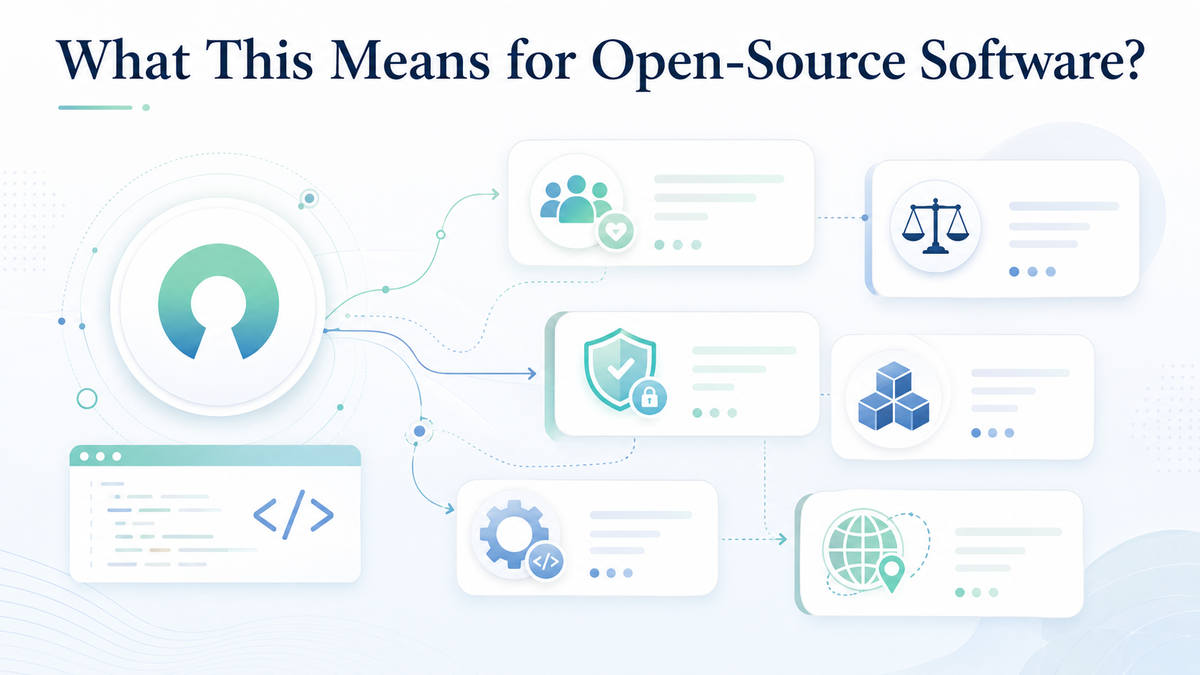
The implication is that the security risk these models represent is not meaningfully contained by restricting access to a single commercial deployment. The knowledge is distributed across a broad ecosystem of open-weight models that are already downloaded, locally deployed, and accessible without any API dependency or external control point. An organization maintaining open-source software in its stack (which is to say, essentially every organization) is operating in an environment where the tools available to identify vulnerabilities in that software are advancing materially faster than the institutional capacity to patch them.
For the open-source ecosystem itself, this creates a differentiation pressure that will likely intensify. Projects with large, active, security-conscious developer communities possess the capacity to respond to AI-assisted vulnerability discovery at speed. Projects that are widely embedded in enterprise infrastructure but lightly maintained (and there are many) face a structural exposure that the existing patch cadence was not designed to address. The Fable 5 suspension will not change this dynamic. The capability is already present in the ecosystem. What the episode does is accelerate awareness of a problem that was developing independently of any single model's availability.
What This Means for Enterprise Technology Strategy?
The practical implications for technology leaders resolve into two distinct pillars.
The first is security. Models with deep knowledge of code and the reasoning capacity to analyze it systematically are now part of the threat landscape, regardless of the restrictions placed on any specific commercial deployment. The defensive corollary is that the same capability is available to the people responsible for defending systems. Organizations that invest in AI-assisted security analysis, encompassing continuous scanning, dependency monitoring, and code review at the point of creation, will be better positioned than those waiting for adversarial use to materialize before responding. The baseline of what a credible security posture requires has shifted.
The second is infrastructure resilience under conditions of regulatory disruption. The Fable 5 suspension is not the first time that geopolitical and regulatory forces have severed enterprise technology dependencies at scale. When the United States imposed sweeping sanctions on Russia following the 2022 invasion of Ukraine, major US cloud providers, including AWS, Microsoft Azure, and Google Cloud, suspended or significantly restricted services in compliance with OFAC requirements. Organizations that had built their operations exclusively on those platforms found themselves without a tested alternative. The lesson absorbed by many large enterprises in the years since is that jurisdictional concentration in critical technology infrastructure is a continuity risk requiring deliberate architectural response.
Applied to AI, this means that organizations whose primary model infrastructure sits within a single jurisdiction's regulatory reach should maintain a tested, capable fallback outside that reach. For an enterprise whose primary AI stack runs on Azure, a meaningful disaster recovery posture includes infrastructure, whether on Alibaba Cloud, regional sovereign providers, or locally hosted open-weight models, that is not subject to the same export control authorities. The inverse applies symmetrically.
For organizations with technology budgets in the $100 to $200 million range, a further option is re-entering serious consideration: in-house infrastructure. The combination of cloud dependency risk, the increasing cost of frontier AI compute at scale, and the demonstrated fragility of access to hosted frontier models is making the case for sovereign data centres economically defensible in ways it was not five years ago.
The Governance Gap That Needs Resolving
The Fable 5 episode reveals a governance framework that has not kept pace with the technology it is meant to govern. The questions it raises include: how should regulators assess AI models with dual-use capabilities, what evidence threshold should justify removing a deployed product from the market, and what process should govern a recall decision affecting hundreds of millions of users, do not yet have statutory answers.
Anthropic stated in its public response that it supports the government's authority to block unsafe AI deployments, and that it wants to see a statutory process that is transparent, technically grounded, and consistent. That process does not currently exist. In its absence, decisions of this magnitude are being made through frameworks designed for physical technology, applied to software that distributes globally within hours of release and that cannot be recalled cleanly even if the commercial product is disabled.
For technology leaders building on frontier AI today, the governance gap is not a reason to pause deployment. It is a reason to build with architectural flexibility, maintain tested optionality across providers and jurisdictions, and treat regulatory disruption, not merely technical failure, as a first-class variable in infrastructure planning. The 72-hour lifecycle of Fable 5's commercial availability is the clearest evidence yet that this category of risk is real, immediate, and worth designing for. At Centric, we help enterprise technology teams build AI strategies that are resilient by design from multi-jurisdiction infrastructure planning to governance frameworks that anticipate regulatory change